Back home, a good comeback story usually involves a high school football team. Out here, it involves a fish smaller than your thumb that lives in exactly one cavern on Earth.
On Oct. 10, the National Park Service counted 137 endangered Devils Hole pupfish. That is nearly double the 77 fish observed in spring 2026 and more than double the 69 recorded in fall 2025.
The fish lives exclusively in Devils Hole, a deep, water-filled cavern within Death Valley National Park. The site is a detached unit of the park, set inside Ash Meadows National Wildlife Refuge, about 90 miles northwest of Las Vegas.
137 Fish in One Cavern, and Scientists Counted Every One
Scuba divers and surface counters from the National Park Service and the U.S. Fish and Wildlife Service did the count. Biologists from the two agencies have monitored the population using these methods since 1972.
They found the fish in the cavern depths and along the shallow limestone shelf where they feed and spawn. The water there holds a constant temperature of 92 degrees, according to the Park Service.
Superintendent Mike Reynolds said, "It's exciting to see Devils Hole pupfish numbers increase so significantly over the past year."
The rebound needed help. Scientists released 72 captive-raised pupfish into Devils Hole between March 2025 and February 2026, and conservation teams provided supplemental feeding while algae recovered.
Because the species lives only 10 to 14 months on average, biologists believe most of the 137 fish hatched and grew in Devils Hole itself. That is the detail that makes this more than a stocked pond story.
The fish is still vulnerable. Two earthquakes in 2025 disrupted the habitat, and an Oct. 9, 2026 earthquake in Panama, nearly 3,000 miles away, sent waves through the cavern and initially left signs of stress in the fish.
Fall Is the Season This Place Was Made For
The pupfish is one of 26 species of endemic plants and animals at Ash Meadows, found nowhere else. The Park Service counts three other endangered fish and seven threatened plants in that group.
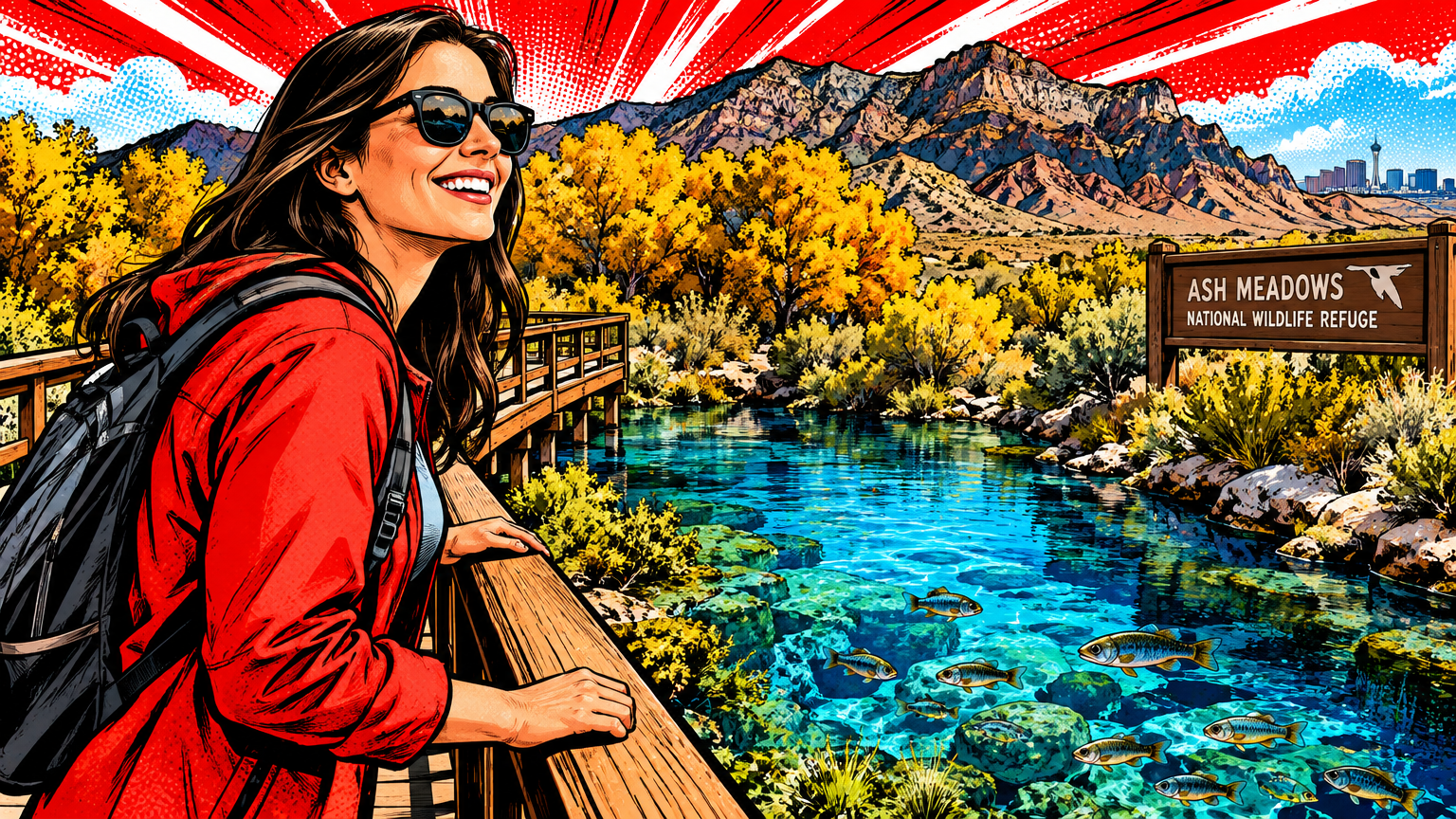
The Fish and Wildlife Service calls fall and spring the best seasons to visit. In fall, the ash trees turn gold and orange, birds flock to the refuge on their annual migration, and lizards scurry along the boardwalks.
Start at the visitor center at 8757 Spring Meadows Rd, Amargosa Valley, NV 89020. Admission is free, the refuge is day use only, and the visitor center is open 9 a.m. to 4 p.m. every day.


How to Do the Day Trip Right
From the visitor center parking lot, the Fish and Wildlife Service lays out the loop for you. Crystal Spring Boardwalk sits right behind the visitor center.
Devils Hole is 3.6 miles east from the lot. Point of Rocks is 4.1 miles, and Longstreet Spring and Cabin is 3.4 miles the other way.
- Go in the morning, when wildlife is active and the boardwalks are quiet.
- Fuel up before you leave. The nearest gas station is at Longstreet Casino, about 6 miles from the visitor center on Highway 373, and Pahrump is 30 miles southeast for food and supplies.
- Respect the dirt roads. All refuge roads are dirt but maintained for regular vehicles and motorcycles; after rain they can turn slick and muddy, so call ahead for conditions.
Downtown Las Vegas is 106 miles away, and the Furnace Creek visitor center in Death Valley is 44 miles beyond the refuge. That means you can see a fish that exists nowhere else, walk over blue springs in gold fall color, and still be home for dinner.
Most day trips give you a photo. This one gives you a number to root for: 137, and climbing.