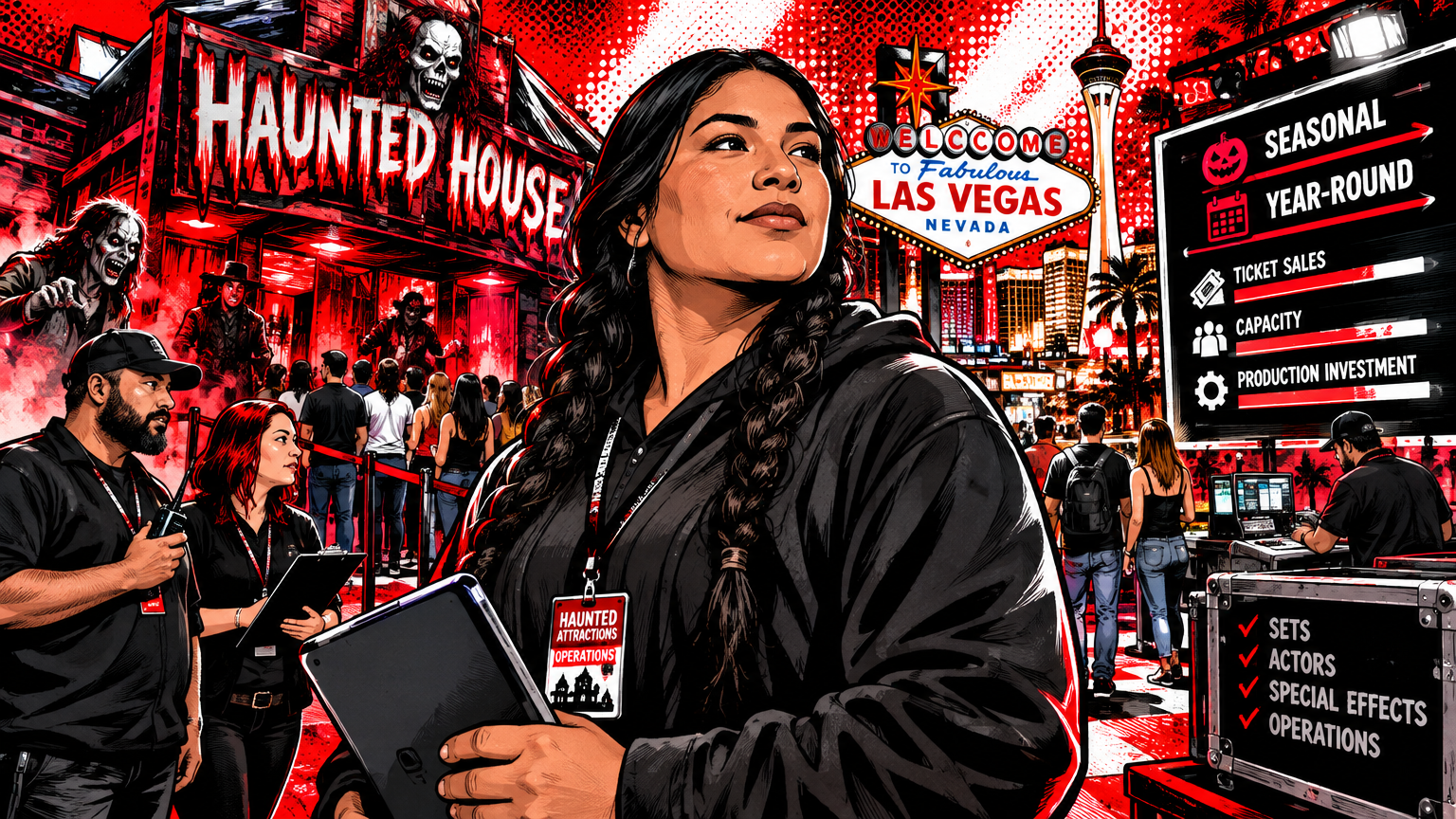
Fear is the product. Cash flow is the business. A Las Vegas haunted attraction has to turn its production, site and payroll into paid admissions, and the math changes sharply depending on whether the doors open for a few weeks or all year.
Consider a simple planning example: 15,000 admissions at an average realized ticket price of $45 produce $675,000 in gross ticket revenue. That is arithmetic, not a reported result for any Las Vegas operator. It is not profit, either. Taxes, ticketing fees, discounts, labor, insurance, rent, construction, marketing and other expenses still sit between gross sales and the bottom line.
The local market illustrates why one formula does not fit every haunt. Universal Horror Unleashed is a year-round horror attraction at AREA15. Seasonal offerings include Fear Zone at Circus Circus and Halloween Maze. Those businesses compete for entertainment spending, but they do not share the same calendar, site arrangement or operating model.
Two calendars, two different plays
Seasonal attractions have a hard deadline
A seasonal haunt has a short window to sell tickets. Its build, creative development, promotion and hiring need to be in motion before opening night. Once the season ends, unsold capacity is gone. The operator cannot simply carry an empty October Saturday into November and sell it later.
That creates a concentrated risk profile. A delayed opening, weak advance sales or operational interruption can remove valuable selling nights from a limited run. Fixed commitments do not necessarily fall just because attendance does. The operator has to protect the runway before the first guest arrives, then make every scheduled night work.
A year-round attraction has a different advantage: more operating dates over which to spread its investment. Universal Horror Unleashed is positioned as an ongoing venue rather than a Halloween-only run. That creates more opportunities to earn revenue, but it also means a continuing operation instead of a single short season. More dates do not guarantee stronger returns. They expand the window in which the business has to attract guests and deliver a reason to come back.
Las Vegas offers a market, not a guaranteed crowd
Las Vegas is built around paid experiences. That is an opportunity, not a forecast. A haunt still has to earn a place in a visitor's itinerary and compete for local spending. The audience, location, concept and date all shape demand. A high-profile address can improve visibility, but visibility alone does not fill a queue.
Location also determines the deal around the attraction. Access, parking, wayfinding, queue space and the relationship with the host venue affect how smoothly guests arrive and enter. The site can provide a valuable platform, but any operating arrangement has costs and conditions. Those terms are specific to the operator and are not public merely because the attraction's ticket page is.
Revenue depends on more than the posted ticket
Ticket price multiplied by admissions is the cleanest way to understand gross ticket revenue. It is also an incomplete way to judge a business. The number that matters is realized revenue per guest after discounts and other adjustments, followed by what remains after the cost of serving that guest.
Pricing can segment demand. General admission, faster entry or upgraded experiences can offer customers different ways to buy. But a premium product has to deliver a real benefit, and a discount has to generate enough added attendance to justify the lower price. A full calendar is not the same thing as a profitable calendar.
Additional spending can improve the total sale when it fits the experience. Food and drink, merchandise, photographs or bundled venue access can create more revenue per visit. The right mix depends on what the attraction actually offers and how its venue handles those sales. An operator should not count an add-on as guaranteed income until customers buy it and the economics of that sale are clear.
The same discipline applies to group bookings and private events. They may bring customers on particular dates, but their value depends on price, staffing and the service required. The strategic question is not whether a group fills the room. It is whether that booking contributes more than the capacity and resources it consumes.

Capacity is the operating lever
A haunt sells an experience, but it also runs a flow system. Guests have to move from ticket scan to queue to attraction without turning the night into a bottleneck. The number of groups moving through, the time each spends inside and the spacing between groups shape both revenue capacity and show quality.
Push throughput too low and the operator leaves sellable capacity unused. Push it too hard and the experience can feel rushed, crowded or inconsistent. That can weaken the product and the guest's willingness to recommend it. Managers need to match admission timing, staffing and the design of the route to the attraction's actual operating capacity.
This is where the headline attendance target can mislead. A projection is useful only when it is tied to nights open, admissions available per night, expected demand and the cost of operating at each level. Operators should watch advance sales, arrival patterns and nightly throughput, then adjust promotion and staffing within the limits of the venue and the show.
Production and labor determine the margin
The build is not just decoration. Sets, lighting, sound, effects and queue areas are part of the product, and much of that work has to be ready before revenue starts. Some elements may be reused or refreshed in later seasons; others may need replacement or redesign. Reuse can improve the economics, but only if the experience remains compelling to customers.
Labor is equally central. Performers matter, but so do admissions staff, supervisors, maintenance and people responsible for guest flow and safety. A show with strong scenes and weak execution still creates a poor visit. A reliable operation requires enough people for the schedule, clear roles and training that supports consistent performance.
There is no defensible public cost breakdown for the local operators discussed here. Rent, production budgets, payroll, attendance and net income are business-specific. The useful analysis is the structure of the problem: the operator must match its cost base to realistic demand, not build an optimistic forecast and hope the crowd arrives.
Site requirements also depend on the property and jurisdiction. A temporary event on City of Las Vegas property, for example, is not automatically governed the same way as an attraction operating inside a private venue. The city's Special Events Handbook describes permitting and safety processes for events under the city's jurisdiction. Operators need to confirm which rules apply to their specific site and activity.
The investment case comes down to execution
A seasonal attraction has to recover a concentrated investment quickly. A year-round venue has more dates, but it must sustain demand beyond the Halloween rush. Both models need credible attendance assumptions, disciplined staffing, controlled production spending and a guest experience strong enough to support the price.
The business is not won by building the biggest maze or advertising the loudest. It is won by aligning capacity with demand, protecting the guest experience and knowing what each admission contributes after costs. Las Vegas will keep rewarding entertainment that earns its position in a crowded market. In the haunted-house business, the real power move is not just making the crowd scream. It is making the numbers hold.