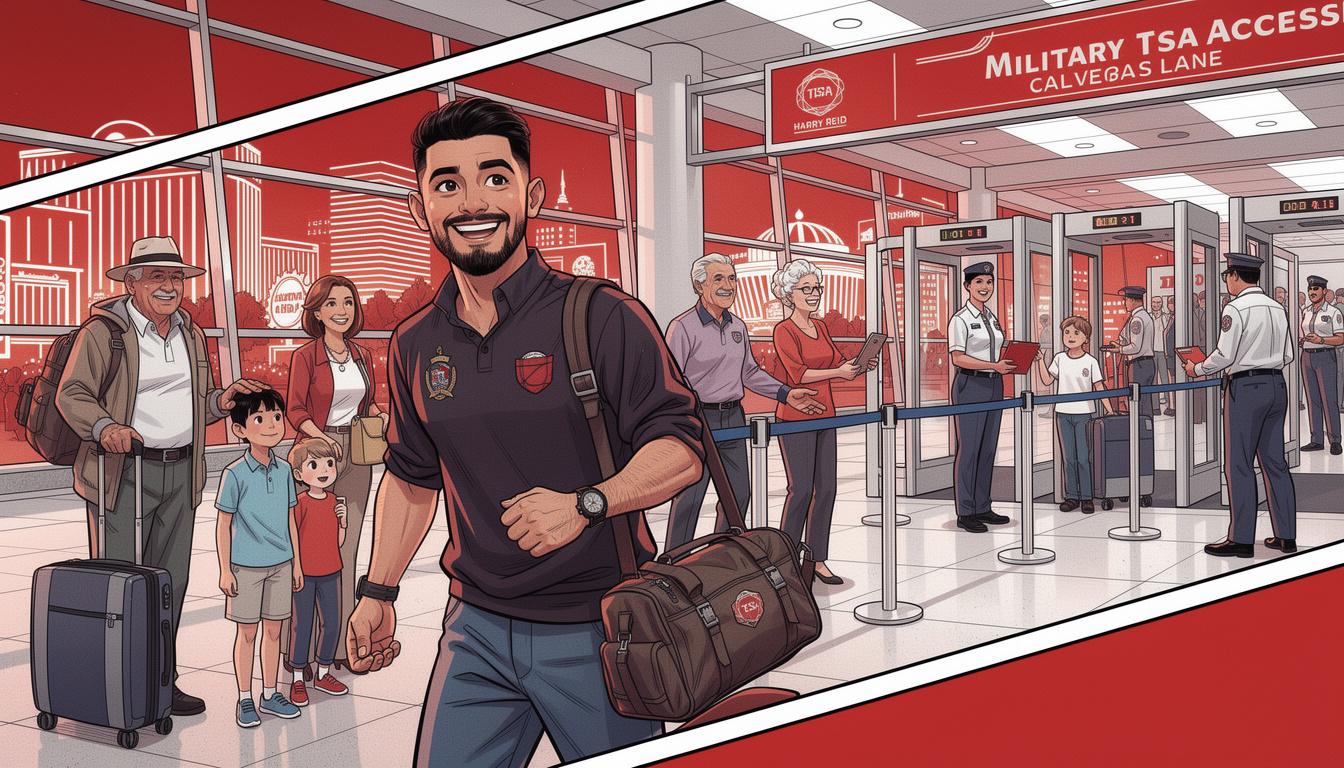
The real 2026 move at Harry Reid International Airport
Harry Reid International Airport has secured a practical operating upgrade in 2026. Eligible service members, veterans, and their families can now receive dedicated military-lane access or front-of-the-line service at the TSA checkpoint.
That is the confirmed play. It is narrower than a terminal expansion, but it lands where airport operations live or die: the security queue.
The Transportation Security Administration lists Harry Reid International Airport among more than 30 U.S. airports offering dedicated military lanes or front-of-the-line service. Travelers do not have to be in uniform. They must present qualifying military or veteran documentation to receive the benefit.
The distinction matters. TSA does not say that Las Vegas is building a separate checkpoint, adding a fixed number of screening lanes, or installing new screening equipment for this program. It also does not identify a construction budget, passenger-capacity increase, or guaranteed reduction in wait times at LAS.
This is an access and queue-management program. That still carries value at one of the country’s busiest origin-and-destination airports.
Why the airport business benefits
Follow the traffic. Harry Reid International handled nearly 55 million passengers in 2025, the third-highest annual total in airport history, according to the airport’s official passenger report. It also maintained nonstop connections to more than 170 markets.
At that scale, a checkpoint is not just a security function. It is a pressure valve for the entire terminal operation. A cleaner queue can improve predictability for travelers, reduce friction near checkpoint entrances, and give eligible passengers more confidence in their path to the gate.
There is also a commercial angle, but it needs to stay grounded. Faster checkpoint access can give a traveler more time beyond security, where airport restaurants, stores, and lounges compete for spending. TSA and airport officials have not published a revenue forecast tied to the military program, however. There is no verified basis for assigning it a specific sales increase or claiming it will materially change airport revenue.
The stronger business case is service. LAS competes as the front door to a destination built on speed, hospitality, and repeat visits. A targeted benefit for the military community strengthens that position without requiring a publicly announced multibillion-dollar construction program.
Who can use the military access
TSA says the special access is available to service members, veterans, and their families. At airports with a dedicated military lane, eligible travelers can show a valid military or veteran ID to enter. Where the airport provides front-of-the-line service instead, travelers should present the documentation to the lane monitor.
Veterans need proof of veteran status plus identification that meets TSA requirements. Some documents satisfy both requirements, while others must be paired with another acceptable ID.
- Documents that can establish veteran status and serve as acceptable identification: A Veteran Health Identification Card, a Department of Defense Uniformed Services ID card, or a state-issued driver’s license or identification card showing veteran status.
- Documents that establish veteran status only: A Veteran ID Card, a Department of Veterans Affairs proof-of-service letter, or a state or county veteran ID card. TSA says these must be presented with another acceptable form of identification.
The operational format can vary by checkpoint and airport conditions. Eligible travelers should look for posted military-lane signs or ask the TSA lane monitor before joining the standard queue.
Military travelers also have TSA PreCheck options
The military-lane benefit should not be confused with TSA PreCheck. They are connected pieces of the same travel strategy, but they are not identical products.
Military personnel and civilian Department of Defense employees can receive TSA PreCheck benefits by entering their Department of Defense identification number as the Known Traveler Number on the airline reservation. TSA says eligible personnel do not need to complete the standard enrollment process for that benefit.
Children 12 and younger can accompany an eligible service member or Department of Defense employee through a TSA PreCheck lane. Travelers ages 13 through 17 generally must be on the same airline reservation as an eligible parent or guardian to receive the expedited-screening indicator.
TSA has also expanded military-family benefits beyond the checkpoint. Its military TSA PreCheck program includes discounted enrollment or renewal for eligible military spouses and no-cost enrollment or renewal for eligible Gold Star families. Qualifying severely disabled veterans can also receive no-cost TSA PreCheck under the VETS Safe Travel Act.
What travelers should expect at LAS
Harry Reid International Airport has five TSA checkpoints, three in Terminal 1 and two in Terminal 3. The airport’s official security guide publishes checkpoint locations and operating hours, but those hours can change with operating needs.
The smart move is simple. Arrive with the right identification, confirm that the Known Traveler Number is attached to the reservation when using TSA PreCheck, and ask the lane monitor where military access is being provided. Do not assume the benefit eliminates screening or guarantees a fixed wait time.
TSA continues to recommend arriving two hours before a domestic flight and three hours before an international departure. Priority access is leverage, not permission to arrive late.
Travelers who need additional help can contact TSA Cares at least 72 hours before departure. That program provides screening assistance to travelers with disabilities, medical conditions, and other special circumstances, including wounded warriors and veterans who require support.
A targeted win, not a construction megadeal
The military access program should be measured for what it is. It is not a newly announced terminal, a three-lane construction project, or a documented 8 percent capacity increase. No public cost, staffing increase, or revenue target has been attached to the Las Vegas rollout.
It is a focused customer-service upgrade backed by a national TSA initiative. That makes strategic sense in Southern Nevada, where the military community has a major presence and LAS moves tens of millions of passengers every year.
The airport wins when it removes friction without adding unnecessary complexity. Eligible military travelers gain a more direct route into the screening process. Other passengers may benefit when priority traffic is managed more deliberately, although TSA has not quantified that effect at LAS.
That is the 2026 boost. Small footprint. Clear audience. Immediate utility. Las Vegas does not need every airport move to carry a billion-dollar price tag. Sometimes the strongest position comes from controlling the line, respecting the customer, and keeping the entire machine moving.