The Arts District’s small-business case in 2026 is not just about a distinctive storefront or a spot near downtown. It is also about who pays for neighborhood improvements, who sets the priorities and whether the area can attract investment without pricing out the businesses and artists that built its identity.
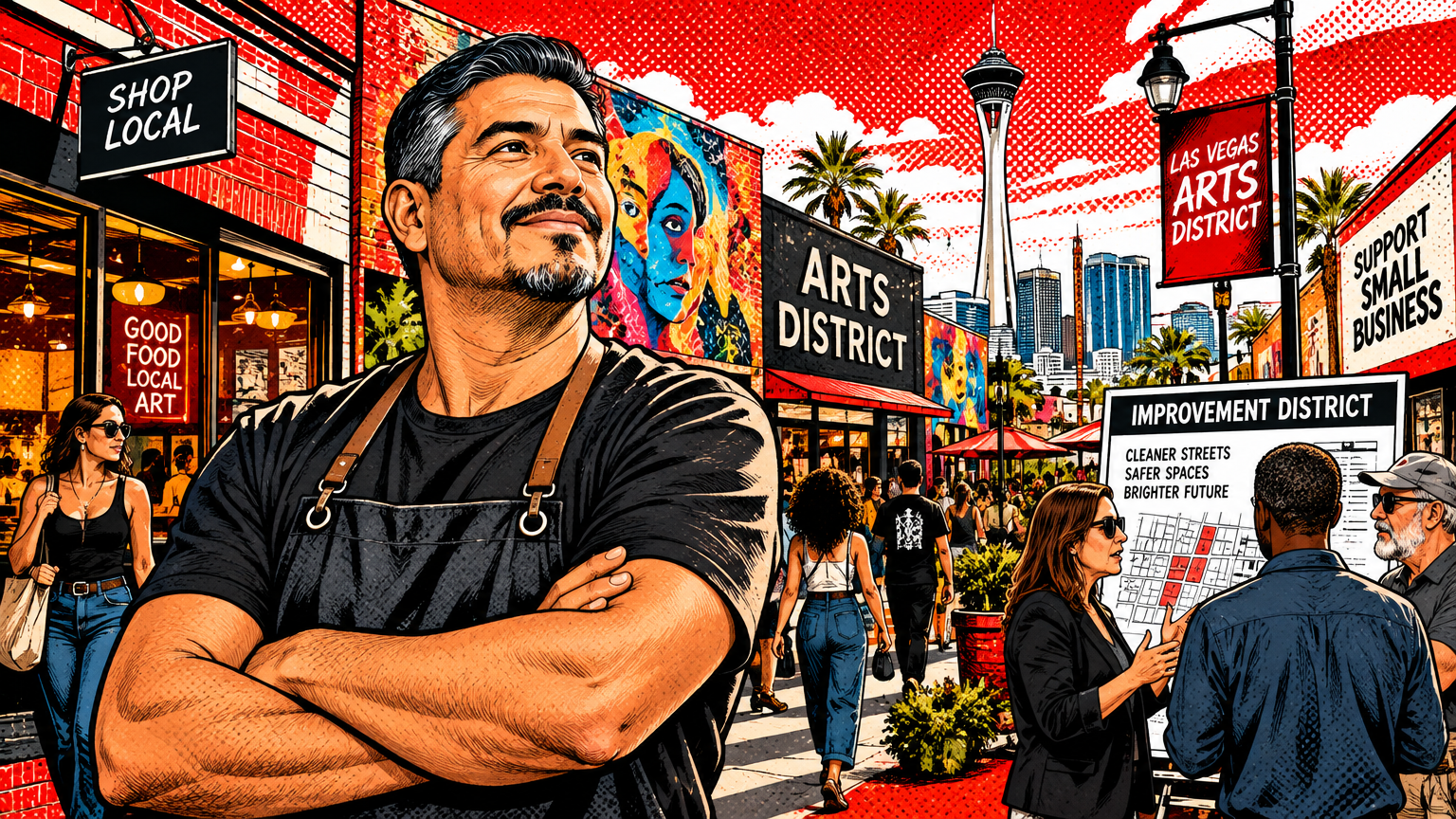
That debate has sharpened around a proposed Business Improvement District, or BID, that could raise about $1.9 million in its first year for services including safety, cleaning, public-space improvements and marketing. The proposal is not approved. As of Oct. 15, property owners representing 20% of the proposed district’s assessed value had signed on, according to Las Vegas Weekly’s reporting. Supporters need signatures representing at least 50% before the proposal can proceed to a City Council hearing.
The distinction matters for business owners weighing an address in the neighborhood. The Arts District has a clear identity and a concentration of independent retail, galleries, restaurants and other destinations. But no verified count establishes that more small businesses are opening there in 2026. The more immediate story is a neighborhood in transition, with investment proposals and operating pressures putting its business model under scrutiny.
A distinct downtown business position
Identity is an asset, not a sales forecast
The city describes the 18b Arts District as a downtown area with eclectic boutiques, galleries and reimagined spaces. That mix gives independent operators a setting distinct from resort retail and large-format shopping. A recognizable neighborhood can help a new business stand out. It does not guarantee a steady line of customers or make the numbers work.
For a small operator, the business case still comes down to fundamentals: occupancy costs, fit-out expenses, staffing, visibility and repeat sales. A space with character may require more work before opening. A busy event can introduce customers, but it cannot substitute for dependable weekday revenue. The address can provide leverage. The concept and its execution have to convert that leverage into sales.
The city’s retail and small-business information presents downtown as a collection of distinct commercial districts and points businesses to local planning resources. That is useful context, not proof that a particular storefront is available, affordable or suited to a particular business. Lease terms and property conditions vary, so operators need to evaluate the full cost of occupancy rather than relying on a neighborhood-wide price assumption.
Events add another layer of visibility. The city describes First Friday as a monthly downtown event showcasing local artists, performances and nearby galleries. That activity can bring people into the area. For a business, the commercial value depends on whether visitors discover the storefront, make a purchase and return outside the event window.
The proposed improvement district is the key business question
What the proposal would fund
The BID proposal would cover a defined area stretching from Bonneville Avenue to Wyoming Avenue, and from the railroad tracks east to Las Vegas Boulevard. Under the plan, property owners would pay assessments to support services beyond the city’s standard provision. Proposed work includes safety patrols or ambassadors, cleaning and maintenance, lighting, wayfinding, public-space improvements and marketing.
The proposed first-year budget is about $1.9 million, with roughly $1.67 million expected from property assessments, according to the proposal summarized by the Las Vegas Sun. Commercial, apartment, nonprofit and government properties would be assessed at 6.5 mills on assessed value, while residential properties would pay 3.25 mills, according to the plan’s public materials. The association 18b says assessments can be passed through to tenants under some leases. For small businesses operating on narrow margins, that possibility belongs in the cost calculation.
The proposal is led by neighborhood stakeholders, not operated day to day by the city. If it reaches the required petition threshold, the City Council would hold a public hearing and decide whether to establish it. The city says a BID is managed by an independent stakeholder board, while its own Arts District plan describes the city’s role as supporting a public-private partnership.
The timeline remains uncertain. With support at 20% of the assessed value as of Oct. 15, the petition effort had not reached the 50% threshold reported by Las Vegas Weekly. A hearing and council decision would come later in the process. Until the proposal clears those steps, the assessment and service plan remain proposed, not settled policy.
Support and opposition reflect different priorities
Supporters argue that shared funding can address security and sanitation concerns, improve public spaces and market the district as a destination. A coordinated effort could help individual businesses benefit from cleaner streets, clearer wayfinding and stronger neighborhood promotion.
There is also a serious concern on the other side of the ledger. The 18b Las Vegas Arts District Neighborhood Association has opposed the proposal as written, arguing that it lacks adequate protections for artists, small businesses and residents. The group says property assessments could be passed along to tenants and that higher investment could contribute to rising costs and displacement. Its position is not the same as opposition to cleaner streets or safer public spaces. It is a dispute over governance, affordability and who gets a seat at the table.
That tension is central to the district’s business outlook. Improvements can make an area more attractive to customers and property investors. If the resulting costs weaken independent operators or displace long-standing businesses, the district risks eroding the very character that gives it commercial distinction.


What business owners should watch next
For now, owners considering a move should separate what exists from what is only proposed. The district has an established mix of small businesses and cultural activity. First Friday is a recurring draw. The BID, its assessment structure and its future services depend on a petition and formal city review. None of those proposed improvements should be treated as guaranteed when building a lease forecast.
Operators should price the actual space, confirm lease pass-throughs and investigate construction, access, parking and build-out requirements at the property level. They should also model revenue across ordinary business days, not just major event nights. A strong concept needs repeat customers and margins that can absorb the realities of an urban location.
The Arts District has a business identity that many commercial areas cannot manufacture. The next test is whether investment can reinforce that identity while keeping independent businesses in the deal. In Las Vegas, the strongest neighborhood play is not simply attracting capital. It is making sure local operators still have a viable position after the capital arrives.