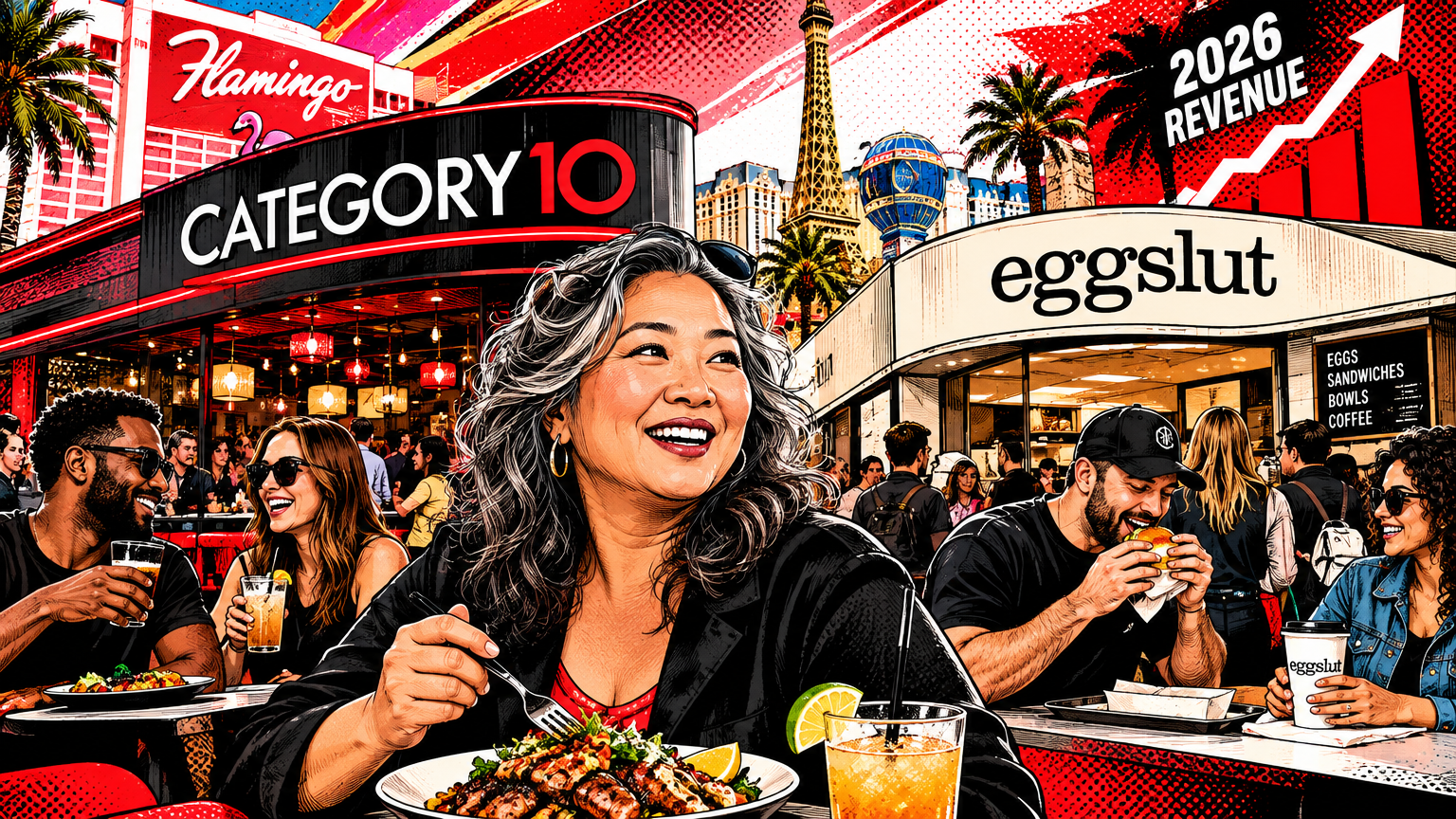
Las Vegas restaurants are competing for customer spending in a year when visitor volume has been under pressure. The latest high-profile addition is Category 10, Luke Combs' three-story restaurant and entertainment venue at Flamingo Las Vegas, which opened Oct. 15. Its 34,000 square feet, seven interior bars and two stages put food and beverage inside a larger entertainment proposition. Eggslut, already operating at The Cosmopolitan, takes a tighter approach: a focused, egg-centered menu serving guests earlier in the day.
Those concepts show different ways to pursue sales, not a citywide revenue forecast. Neither company has publicly reported Las Vegas revenue for its venue, and their openings do not establish that the restaurant sector as a whole is booming. For operators and property owners, the business test is whether customers spend enough, often enough, to cover the costs of space, labor, food and service.
Category 10 opens with a bigger entertainment footprint
Dining is one part of the proposition
Category 10 opened at Flamingo on Oct. 15, according to the announcement from Caesars Entertainment. The venue spans three floors and 34,000 square feet, with 800 seats, seven interior bars, two stages and a rooftop area. Its menu includes Southern-inspired dishes, while the venue also promotes live music, line dancing and private events.
The format creates more ways to make a sale during a visit. A customer may come for dinner, drinks, live music or an event, and the venue can serve different occasions under one roof. But a larger footprint is not a revenue guarantee. It also means the operation must staff and maintain multiple spaces and deliver a steady flow of food, drinks and entertainment. The public figures available describe the venue's size and features, not its costs, sales or profitability.
Category 10 is owned and operated by Opry Entertainment Group, a subsidiary of Ryman Hospitality Properties, according to the company announcement. For Flamingo, the venue adds a branded attraction within the resort. For the operator, the Strip location offers visibility and access to resort guests, while performance depends on converting that access into transactions.
Eggslut targets a different customer occasion
A recognizable menu, an earlier service window
Eggslut operates at The Cosmopolitan of Las Vegas, where the resort lists its hours as 7 a.m. to 2 p.m. Monday through Thursday and 7 a.m. to 3 p.m. Friday through Sunday. The chef-driven concept, founded in 2011, centers its menu on eggs and offers items including the Fairfax Sandwich and The Slut.
That is a different position from an evening-oriented entertainment venue. Eggslut serves breakfast and lunch hours, with a compact, clearly defined menu that can appeal to guests seeking a meal without planning a full night out. Its location inside a major Strip resort puts it in front of visitors already on property. The official listing confirms the restaurant's location and hours, but does not disclose customer counts or sales.
The comparison is useful because it shows how dining concepts compete for different time slots and reasons to visit. It does not prove one model is more profitable. A broader entertainment offer may create additional spending opportunities, while a focused menu can make the customer proposition easy to understand. In both cases, demand has to translate into efficient service and sales after operating expenses.


What the visitor numbers say, and what they do not
The local demand picture is not a simple boom story. The Las Vegas Convention and Visitors Authority reported 38.5 million visitors in 2025, down 7.5% from 2024. Convention attendance reached about 6 million, nearly matching the prior year, while annual hotel occupancy averaged 80.3%, down 3.3 percentage points. Those figures describe destination-wide travel and hotel performance, not restaurant sales or the results of an individual venue.
The LVCVA's January 2026 release described a strong convention and events calendar ahead, including an estimate that the Las Vegas Convention Center would host about 1.2 million tradeshow attendees in 2026, compared with 1 million in 2025. That provides a potential source of visitor demand, but it is not a restaurant revenue forecast. Convention attendees are only one part of the customer mix, and the release does not say how much they will spend at particular restaurants.
For restaurant operators, the underlying revenue levers remain practical: the number of customers served, the average amount spent per visit, operating capacity and the costs required to deliver the experience. More hours, a larger venue or a recognizable brand can help attract attention. None replaces execution. A full room is a useful signal, but without sales and cost disclosures it cannot tell investors or customers whether the business is profitable.
The 2026 revenue test
Category 10 and Eggslut offer two distinct plays on Strip dining. Category 10 combines food and drinks with music, dancing and event space. Eggslut serves a more narrowly defined breakfast-and-lunch occasion. Both give their resort settings another dining option, but the available public information does not establish their 2026 revenues or contribution to the wider restaurant economy.
That distinction matters when headlines turn new openings into claims of a sector-wide surge. Las Vegas has a large visitor economy and a substantial convention calendar, but the latest official visitation figures also show a year-over-year decline in 2025. Openings, customer traffic and business performance are related, not interchangeable measures.
The signal for 2026 is competition for the guest's time and spending, not a published revenue total. Category 10's opening adds a sizeable entertainment-led venue to the Strip, while Eggslut holds a clear position in the resort's morning and midday dining mix. The operators that turn those positions into repeat, well-managed sales will earn the leverage. Vegas dining's next chapter will be decided at the register, not by the opening-night buzz.