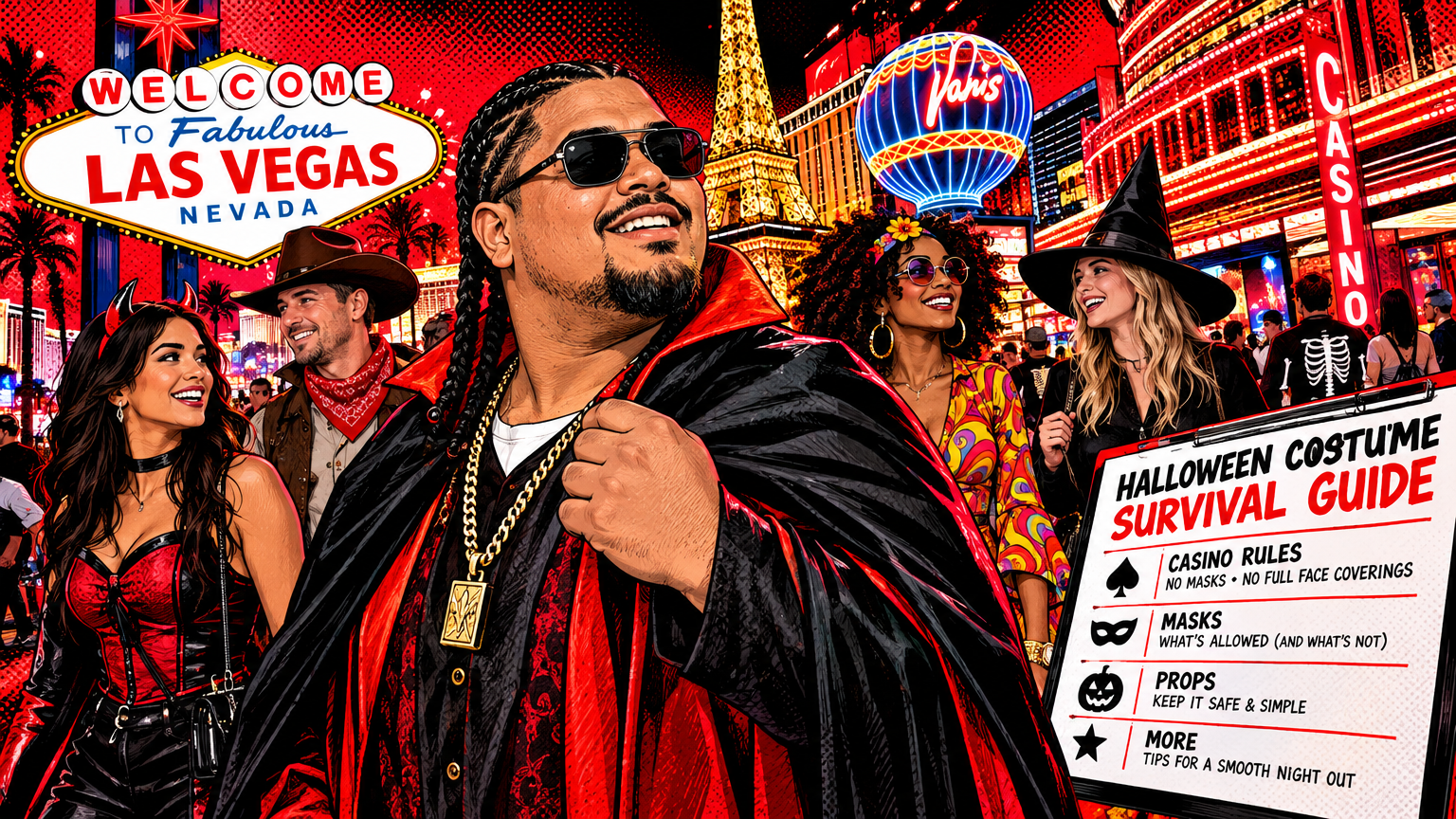
Las Vegas Halloween plans can go from dinner to a casino, a show or a packed dance floor in one night. Your costume has to work beyond the first photo. The smart play is to check the rules for every stop, keep your face easy to identify, leave weapon-shaped props at home and wear something you can move in. That is how you stay in the night instead of getting stuck at the door.
There is no single costume rulebook for every casino, nightclub, restaurant and ticketed event. Policies can differ by venue and occasion. For one official example, The STRAT’s Halloween costume guidelines say costumes must be appropriate, prohibit fake weapons and full-face masks, and restrict extreme makeup or face paint covering the entire face. Treat that as one property’s policy, not a guarantee of what another door will allow.
Step 1: Check the rules for every stop
Before you lock in the costume, make a quick list of the places you plan to visit. Look up the specific club, show, restaurant or event, not just the resort name. A property can have different rules for its casino floor, a nightclub and a special event, and a ticketed party may publish its own entry instructions.
Check the venue’s official website or event page for costume, face-covering, prop, bag and dress requirements. If the rule is unclear, contact the venue before heading out. Policies can change, so check again close to Halloween, especially if you are going to a special event. A quick question now beats a long line followed by a costume adjustment in the restroom.
Your pre-night checklist
- Confirm the policy for each venue and event on your itinerary.
- Look for restrictions on masks, face paint, props, bags and costume coverage.
- Save your ticket and event details on your phone.
- Plan a version of the look that still works if one accessory has to come off.
Do not assume a costume that gets a cheer on the Strip will be accepted at every entrance. When the rules are specific, follow them. When they are not, keep the outfit easy to inspect and the conversation with staff easy, too.
Step 2: Keep your face and ID easy to check
A full-face mask can be the centerpiece of a look, but it can also create an entry problem. Some venues restrict masks or face coverings, and staff may ask you to remove an item so they can identify you. The STRAT’s published Halloween rules, for example, prohibit full-face masks and full-face extreme makeup. Other properties may set different requirements, so check before you go.
If you want the character without the hassle, build around makeup that leaves your face recognizable, a hat or a removable headpiece. Bring valid photo identification and keep it somewhere you can reach without dismantling the costume. If your plans include a 21-plus venue, make ID access part of the design, not an afterthought.
Comfort counts here, too. Heavy face coverings and elaborate makeup can become a long-night problem under bright lights and in crowded rooms. Test the look before Halloween and make sure you can remove or adjust pieces quickly if asked.
Step 3: Leave weapon-shaped props at home
Fake guns, replica firearms, swords, knives and similar props are a bad bet for a night moving between venues. A prop that looks harmless in a costume photo may still be prohibited by the venue or treated as a security concern. The STRAT’s official guidelines specifically say fake weapons are not allowed there. Do not count on a plastic version, a clever explanation or a prop tucked in a bag to get you through.
Swap the prop for a detail that reads clearly without resembling a weapon, such as a graphic, a distinctive color or a piece of clothing that carries the character. If you are considering any unusual accessory, ask the event or venue first. If you cannot confirm that it is allowed, leave it behind.
Keep accessories simple
Choose pieces that are easy to inspect, remove and carry. Oversized accessories can snag on people, block your view or slow you down in a crowded space. Follow staff instructions at the entrance and do not argue over an item the venue has told you cannot come in. The goal is to get to the fun, not turn the door into your headline act.
Step 4: Dress for the walk, not just the photo
Vegas nights often involve more walking than the map suggests. Moving between a casino, a show and a club can mean long corridors, escalators, casino floors and stretches outside. A costume that looks great standing still may become a project if it drags, limits your vision or makes stairs awkward.
Wear shoes you can manage for hours. If the costume calls for dress shoes or heels, consider bringing a more comfortable pair for the walk between stops. Do a practice run at home: sit down, climb a few stairs, reach for your phone and check whether anything slips, catches or blocks your view. Make sure you can move through a crowd without bumping people with wings, trains or bulky add-ons.
Plan for the temperature and the time you will spend indoors and outside. A heavy costume can feel hot after hours in a crowded room, while a lightweight look may not be comfortable outdoors later. Choose layers you can manage without carrying a bulky extra piece all night.
Step 5: Make transportation and regrouping part of the plan
Pick a clear meeting point with your group in case you get separated. Costumes can make people harder to recognize, and crowded rooms make phone calls difficult. Share the plan, keep your phone charged and agree on a backup place to meet.
Think about how you will get between stops before the night gets loud. Make sure your costume lets you get in and out of a car without damaging it or obstructing the driver’s view. Do not assume an outfit that is easy to wear inside one resort will be comfortable for a longer walk to the next one.
Travel light. A small bag is easier to keep track of, and the venue may have its own bag policy. Keep your phone, payment method and ID secure, and leave valuables or costume pieces you cannot afford to lose at home.
Step 6: Build in a plan B
The best Vegas costume can take a pivot. Make the mask, cape or dramatic accessory easy to remove, and choose a base outfit that still reads as a costume if you have to lose one piece. That gives you options if a venue’s rules call for a change, the outfit gets uncomfortable or your plans shift.
Before you head out, run one last check: venue rules reviewed, face easy to show, no weapon-shaped props, comfortable shoes, phone charged and transportation sorted. Keep the look bold but wearable. Then you can focus on what matters: the people, the music, the photos and the possibility that the next stop becomes the best one of the night.