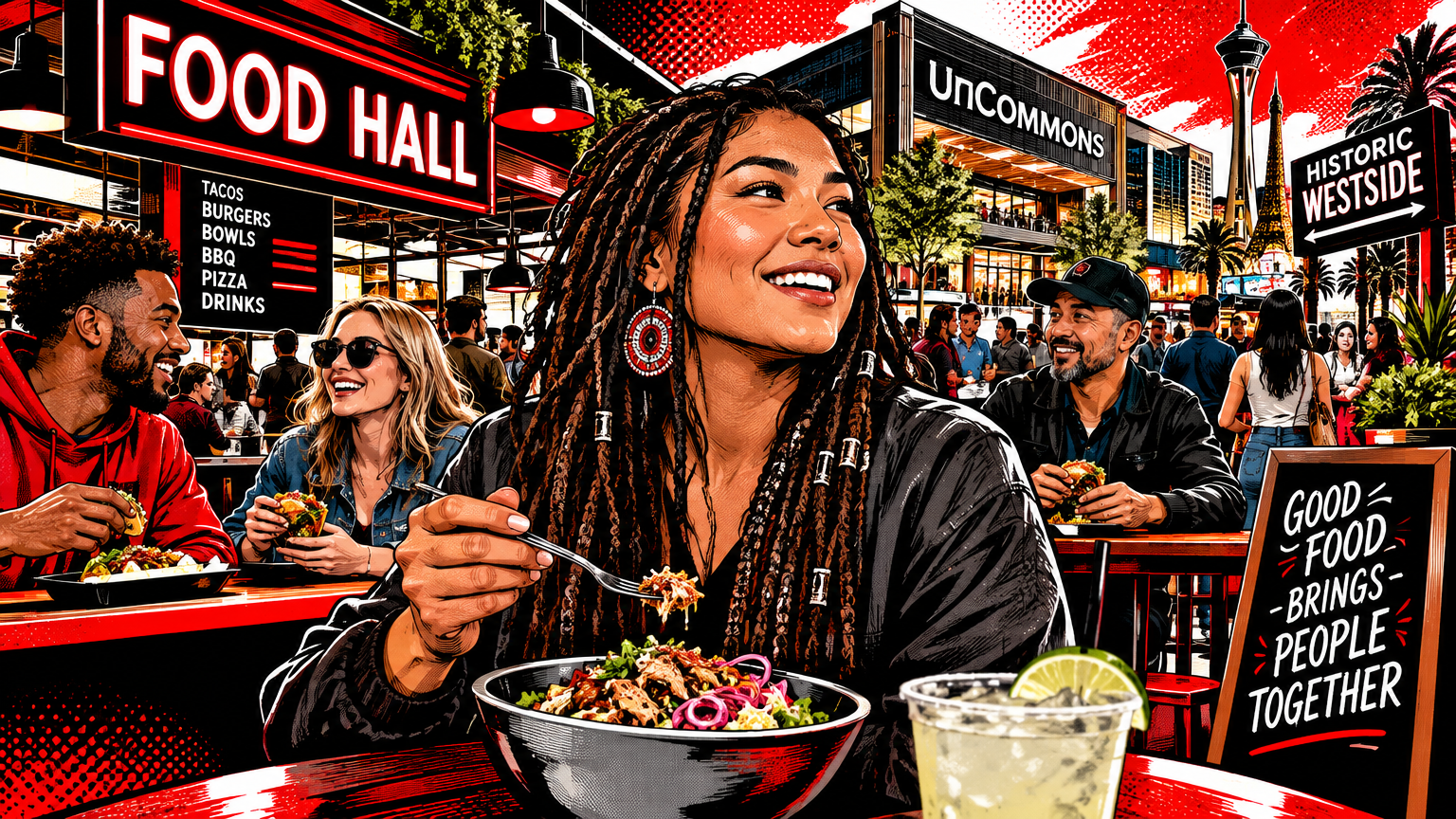
Las Vegas has two distinct food-hall plays on the 2026 board, and both are built around location as much as the menu. STIX ASIA is planned for an 18,000-square-foot space at UnCommons in the southwest valley, while the city’s published 2026 development plan includes The Good Word Market Hall on the Historic Westside. One targets a destination dining experience built around Asian cuisines. The other is designed to give emerging local food businesses a place to test concepts.
The common wager is straightforward: put several food choices in one shared setting, then give that setting a reason to draw customers. But the projects are not interchangeable, and neither has published a customer-count forecast or sales target. The useful signal is in what each operator is building, where it is going and which audience it is designed to serve.
That distinction matters in a market where a food hall’s address can do as much work as its menu. A resort location can capture guests already on property. A mixed-use development can make dining part of a longer visit. A neighborhood hall can give local entrepreneurs a lower-profile platform than a standalone restaurant. The format creates options. It does not guarantee the traffic or the sales.
Two 2026 projects, two different plays
STIX ASIA brings a large format to UnCommons
UnCommons lists STIX ASIA as coming in 2026 at an 18,000-square-foot venue in southwest Las Vegas. Its project description calls for 12 dining stalls featuring food from across Asia. The development’s plan emphasizes an immersive street-market experience, giving the hall a clear identity rather than presenting it as a generic collection of counters.
Reporting by CoStar described construction underway in June 2026 and an opening targeted for the fall. CoStar also reported plans for indoor and outdoor lounges and seating for about 400. Those details make this a substantial tenant and visitor draw for UnCommons, but an opening target is not the same as an operating date. UnCommons’ own listing still gives the broader timeline as 2026.
The commercial logic is a focused offer at meaningful scale. A dozen stalls can provide range within one cuisine-led destination. The concept still has to convert interest into visits, and visits into sales across its vendors. Its position at UnCommons places dining within a larger mixed-use campus, rather than making the food hall a standalone attraction on the Strip.
The Good Word is built around local business incubation
On the Historic Westside, the City of Las Vegas has described The Good Word Market Hall as a planned food and entertainment space operated by the city. The city’s 2026 plan describes incubation kitchens for up to three food businesses, rotating concepts, a full bar and live music programming. The intent is to provide a platform for local food entrepreneurs while creating a gathering place near the shareDOWNTOWN Westside development.
This is a different kind of real-estate bet. The Good Word’s published plan puts small-business opportunity and neighborhood activity at the center. It is not simply a resort amenity scaled down for a local audience. The city says the hall is intended to complement nearby housing and retail, with space for emerging operators to test ideas and build customer bases.
The distinction between a stated plan and a completed project matters. The city’s page describes the hall as part of its 2026 program, but does not provide a confirmed opening day. Its business-incubator purpose is clear; the eventual tenant mix and operating performance will determine how much local traffic the concept can retain.
What existing halls show about the format
Las Vegas already has established examples across different property types. Block 16 Urban Food Hall sits inside The Cosmopolitan and brings several counter-service concepts together in a Strip resort. Famous Foods Street Eats is part of Resorts World Las Vegas’ dining collection. At ARIA, Proper Eats Food Hall offers multiple named food concepts, including Wexler’s Deli, Egghead and Temaki Bar. Off the Strip, Eat Your Heart Out at Durango Casino & Resort spans 25,000 square feet and combines local favorites with concepts new to the market, according to the resort.
These venues show the range of the playbook, not proof that every hall performs the same way. The resort halls have an existing property, guest base and dining portfolio around them. STIX ASIA and The Good Word are being developed for different settings and different purposes. Their competition is not only other food halls. It is every nearby restaurant, quick-service option and reason a customer might spend time elsewhere.
For operators, shared space offers a way to present more than one menu under a single roof. That can help a group with competing preferences find a common place to eat. It also puts execution under pressure. Guests need to understand the choices, place orders efficiently and find seating. Vendors need a clear identity, dependable service and a customer base that extends beyond opening-week curiosity.

Traffic is the opportunity, not the result
Las Vegas has a broad calendar of conventions and events, and the Las Vegas Convention and Visitors Authority publishes tourism indicators covering the wider market. Those regional measures do not predict how many people will walk into a particular food hall. A busy city is an opportunity set, not a guarantee of tenant revenue.
That is why the 2026 projects should be judged by their own operating fundamentals: location, visibility, vendor mix, hours, service speed and whether the experience gives customers a reason to return. For STIX ASIA, that means delivering on its Asian street-market positioning at UnCommons. For The Good Word, it means making the incubator model work for local food businesses and the surrounding neighborhood.
The market signal is not that Las Vegas has discovered one winning dining formula. It is that developers and the city are using the food-hall format to solve different problems, from creating a destination at a mixed-use campus to opening a route for small operators. In Vegas, the real leverage comes when the location, the offer and the customer all line up. Foot traffic opens the door. The business model has to close the deal.