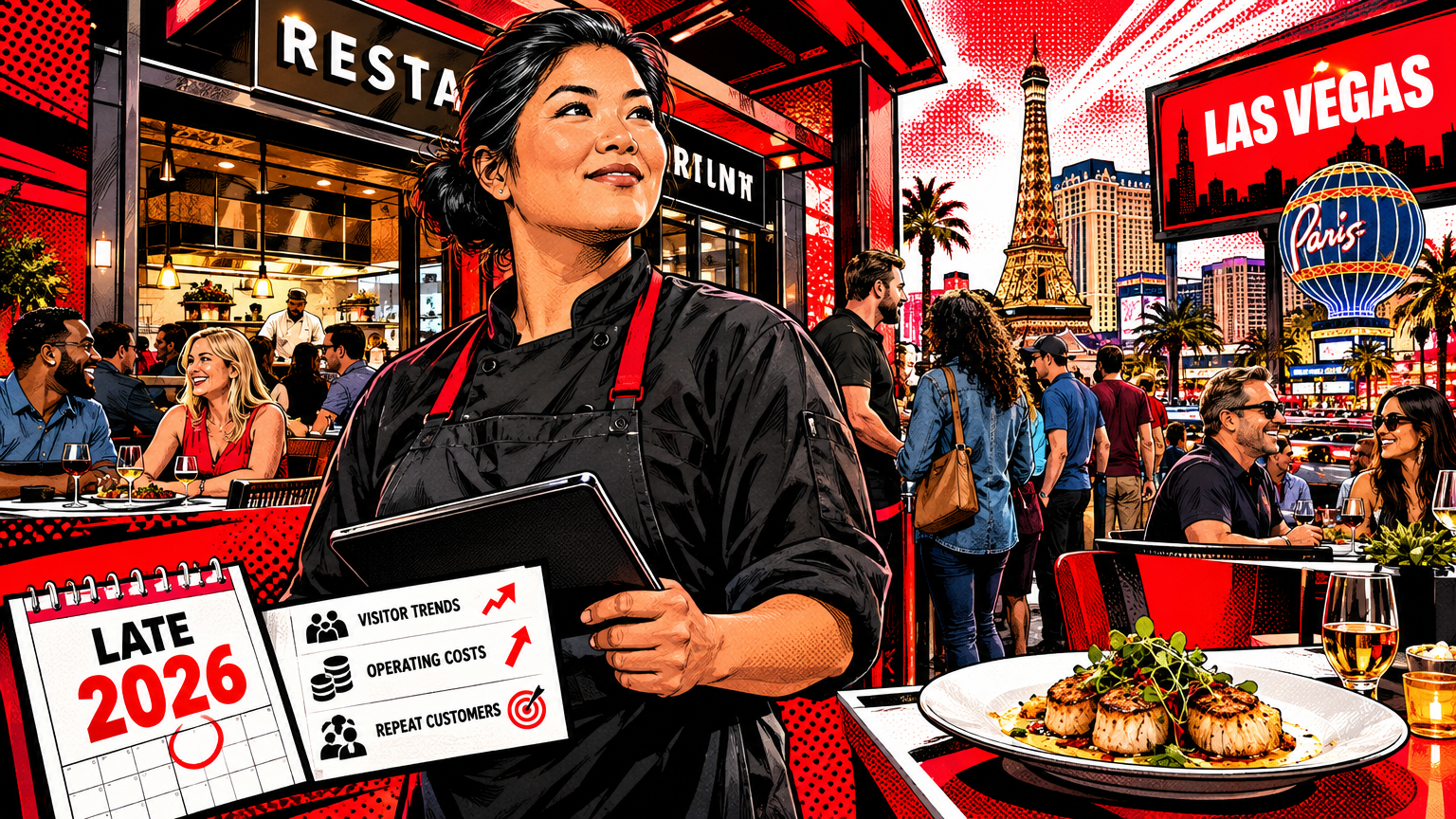
Las Vegas is still adding restaurants in late 2026. The sharper question is what those openings have to overcome: visitor traffic that weakened last year, customers watching their budgets and an industry-wide cost squeeze that leaves less room for a weak business plan.
The local opening pipeline is active. An October update from Eater Vegas’s new-restaurant roundup highlighted additions ranging from Finney’s Crafthouse in Downtown Summerlin to Yu by Sijie at Tivoli Village, Hello Kitty Cafe at the Forum Shops and Mama Tess. Those openings span different customers, real estate and price points. They are evidence of continuing investment, not proof that every concept is winning or that openings are accelerating.
The market signal is more complicated than a ribbon-cutting. The Las Vegas Convention and Visitors Authority reported 38.5 million visitors in 2025, down 7.5% from 2024. Meanwhile, the National Restaurant Association’s 2026 industry report describes persistent cost pressures and cautious household spending nationwide. Put those facts together and the stakes are clear: new restaurants need more than a strong opening weekend. They need a durable reason to earn the next visit.
The opening calendar is active, but it is not the whole story
Las Vegas has built its dining identity on a wide range of bets. A Strip restaurant can sell access, spectacle and a meal that becomes part of a visitor’s trip. A neighborhood restaurant needs to make regular visits feel worthwhile. A food hall or cafe has another equation, built around convenience, location and repeat traffic. There is no single winning format, and a list of new names does not reveal whether any one operator has secured a profitable runway.
The recent mix makes that point. Downtown Summerlin and Tivoli Village serve different centers of activity from the Forum Shops, where a branded cafe can benefit from heavy visitor exposure. Mama Tess adds another local dining option. Each address comes with a different audience and competitive set. The commercial play is not simply to open in Las Vegas. It is to match the concept to the customers who can actually reach it and come back.
Nor should a busy opening calendar be mistaken for a verified count of late-year openings. Eater’s October roundup is a snapshot of restaurants it identified as new or newly relevant to diners. It does not establish the full market pipeline, investment levels, or the financial performance of the businesses it covers. Those details matter to landlords and operators, but they cannot be inferred from an opening announcement.
Why the business case carries more weight
A restaurant spends money before it serves its first guest. Build-out, equipment, hiring, inventory and marketing all compete for capital. Once the doors open, rent, payroll, food, insurance, energy and payment fees keep pressure on the operating model. The National Restaurant Association’s 2026 report says more than nine in 10 operators cite costs such as food, labor, insurance, energy and swipe fees as significant challenges. It also reported that 42% of operators said their restaurant was not profitable in the previous year.
Those figures describe the national industry, not Las Vegas alone. They are still useful context for evaluating local openings. A new dining room enters a business where sales growth does not automatically translate into healthy margins. The same report projects $1.55 trillion in U.S. restaurant and foodservice sales for 2026, with real, inflation-adjusted growth of 1.3%. That is a growth forecast, not a guarantee of stronger profits for individual operators.
Location has to earn its place in the deal
Visitor-facing locations can offer visibility and access to customers who want a memorable meal during a short stay. But they also compete for a limited number of dining occasions. A traveler has only so many breakfasts, dinners and late-night stops to allocate. The restaurant has to make its value obvious, whether that means a strong menu, a distinctive experience or a convenient fit with the trip.
Off the Strip, the leverage shifts. A concept may depend more heavily on local customers and repeat business. That does not make the operating challenge smaller. It makes consistency, access and a clear customer proposition more important. For a landlord, the right tenant can strengthen a center’s appeal. For an operator, the right site is the one whose traffic and costs align with the business, not merely the one with the loudest address.


Visitor demand and local spending are different levers
The LVCVA’s 2025 report adds pressure to the visitor side of the equation. Along with the annual decline, December visitation was down 9.2% year over year. Convention activity offered a counterweight: Las Vegas hosted 6 million convention attendees in 2025, nearly matching 2024. The same release reported annual hotel occupancy of 80.3%, down 3.3 percentage points, and an average daily room rate of $183.52, down 5%.
Those measures do not tell us how much restaurant revenue changed. They do show that the visitor economy was mixed, with fewer visitors overall and convention business holding comparatively steady. Restaurants that depend on tourists face a different exposure from those built around neighborhood regulars. Some businesses may serve both audiences, but that is a positioning choice, not a free bonus. A concept that tries to appeal to everyone can lose the clarity that makes someone choose it.
For residents, value is about more than the lowest price. It can mean dependable service, a meal worth the cost and a place that fits a routine. For visitors, it may mean a restaurant that feels specific to Las Vegas or gives the trip a memorable moment. Operators have to decide which customer anchors the model, then make the offer work for that person.
The measure is what happens after opening night
A launch creates attention. It does not settle the business case. The real test is whether the restaurant can convert that attention into repeat demand while managing expenses, maintaining service and delivering a clear proposition. A recognizable brand can help fill the first room. It cannot replace execution once the novelty wears off.
That is what makes the late-2026 opening picture feel different. New concepts are arriving across the valley, but the evidence does not support a sweeping claim that Las Vegas openings are booming or that operators have all adopted one new strategy. What the verified picture does support is a more demanding backdrop: visitor volume fell in 2025, national restaurant operators report significant cost pressure, and new businesses still have to earn their position in a crowded market.
For developers and property owners, a restaurant is part of a larger real estate strategy, but the name on the sign is only the start. For operators, every square foot has to work. The next advantage belongs to businesses that know their customer, fit their location and deliver enough value to bring that customer back. Las Vegas will keep opening its doors. The deals with staying power will be the ones built for the business after the buzz.