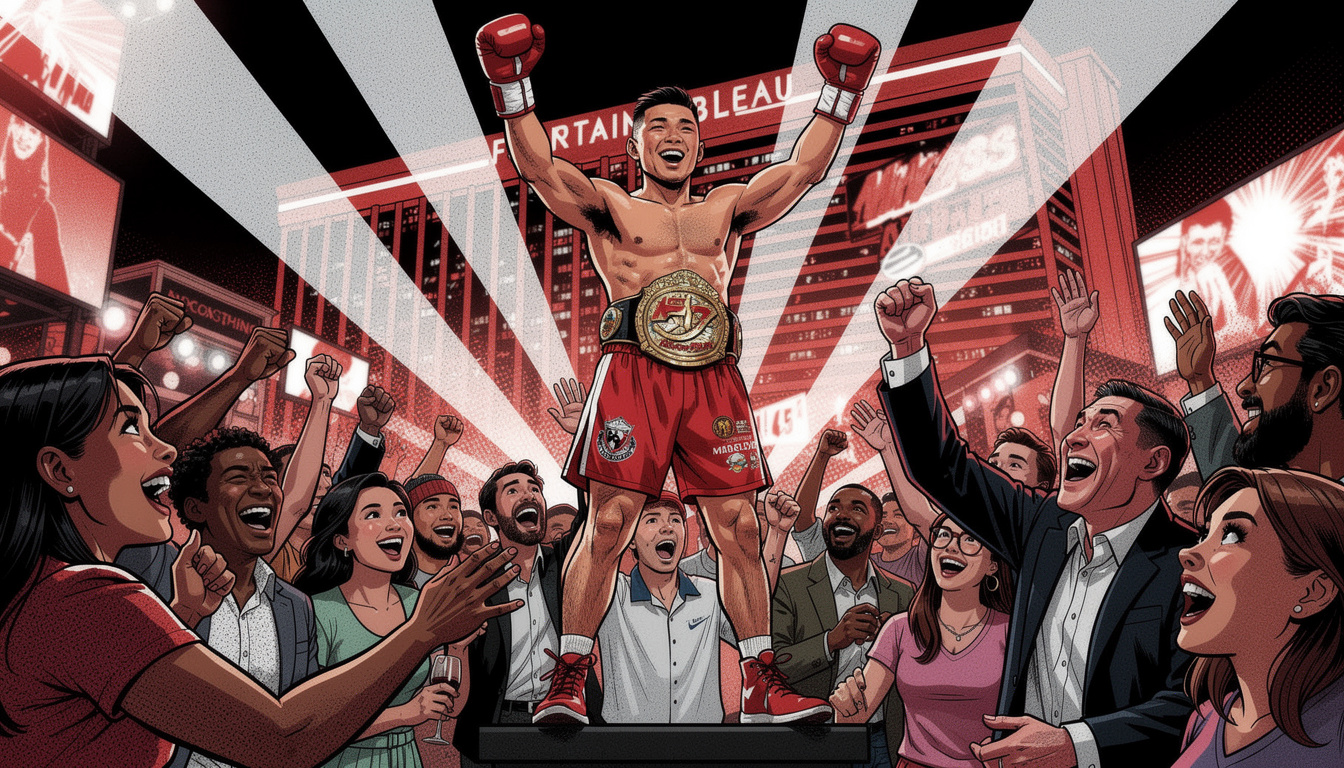
A Championship Night at Fontainebleau
Las Vegas did not have to wait long in 2026 for a championship fight with some real bite. On Jan. 24, Raymond Muratalla defended the IBF lightweight title against Andy Cruz inside BleauLive Theater at Fontainebleau Las Vegas, adding another Strip resort to the city’s long list of serious boxing hosts.
The fight delivered, too. Muratalla retained his championship by majority decision after 12 competitive rounds, with the judges scoring it 114-114, 116-112 and 118-110. That final card was much wider than the other two, but the official result stood: Muratalla left Las Vegas unbeaten and still carrying the IBF belt.
That is a sturdier story than simply announcing another fight card. Fontainebleau put a legitimate world championship at the top of the bill, and the main event gave the room the kind of tense, high-level action that fight fans remember. In a city where boxing history hangs around like cigarette smoke used to, earning a place on the calendar takes more than setting up a ring and turning on the lights.
I grew up in the Midwest, where a big Saturday night might involve high school basketball, chili in a slow cooker and somebody arguing about the thermostat. In Las Vegas, an undefeated world champion can defend his belt inside a luxury resort while the rest of the Strip carries on like this is perfectly normal. After a few years here, it still is not normal to me. That is part of the fun.
What Happened in Muratalla vs. Cruz?
The champion survived a difficult test
The official Matchroom Boxing card presented Muratalla against Cruz for the IBF world lightweight title. Cruz entered with only six professional fights, but that number did not tell the whole story. The Cuban challenger brought an elite amateur background, including an Olympic gold medal from the Tokyo Games, and was widely viewed as a dangerous assignment for the champion.
Cruz boxed effectively at range with his jab and right hand. Muratalla answered with steady pressure, combination punching and persistent work to the body. Neither fighter ran away with the contest. Muratalla’s ability to keep advancing and work at close range helped him secure the decision, particularly on the two scorecards that favored him.
According to the reported results and scorecards, Muratalla improved to 24-0 with 17 knockouts, while Cruz suffered his first professional defeat. Muratalla then called for the biggest available fights in the division, which is exactly what a champion is supposed to do after surviving a challenger with Cruz’s pedigree.
The victory mattered because it strengthened Muratalla’s standing in a crowded lightweight division. It also gave Fontainebleau a main event with consequences beyond one night. The championship remained with Muratalla, Cruz learned what 12 rounds at the top professional level feel like, and Las Vegas got a competitive title fight instead of a ceremonial showcase.
The supporting card brought more than one storyline
The main card gave fans several recognizable names before Muratalla and Cruz entered the ring. Khalil Coe defeated Jesse Hart by majority decision in a light heavyweight bout. Former junior middleweight champion Israil Madrimov earned a unanimous decision over Luis David Salazar, and welterweight prospect Omari Jones defeated Jerome Baxter by unanimous decision.
Zaquin Moses also won a unanimous decision over Leandro Damian Medina in a super featherweight contest. Taken together, the results made the event a full boxing card rather than a one-fight attraction. That matters in a theater-sized room, where the audience is close enough to notice when the early bouts are merely filling time.
Why BleauLive Theater Fit the Fight
Fontainebleau did not try to make this look like a stadium spectacle. BleauLive Theater was the venue, and its scale helped give the card a different personality from a giant arena show.
Fontainebleau describes BleauLive Theater as a three-level, 90,000-square-foot venue that can accommodate as many as 3,800 guests, depending on the event configuration. That is substantial enough for a televised championship card but compact enough to keep the ring from feeling like a postage stamp in the middle of an aircraft hangar.
There is a sweet spot for boxing venues. Too small, and a world title fight can feel overlooked. Too large, and empty sections drain the energy right out of the room. A flexible theater gives promoters another option between an intimate casino ballroom and one of the city’s major arenas.
It also gives Fontainebleau something valuable: proof that BleauLive can handle more than concerts and stage productions. Championship boxing brings its own demands, including weigh-in activities, broadcast positions, dressing rooms, security, media operations and a ring-centered seating plan. Successfully staging the Muratalla-Cruz card showed that the theater belongs in future conversations about appropriately sized Las Vegas fights.
That does not mean every blockbuster belongs there. The largest pay-per-view events will continue to chase arena capacity and the gate revenue that comes with it. BleauLive offers a different lane, one suited to strong world title cards that benefit from a closer, louder setting.
What the Fight Meant for Las Vegas Boxing
Las Vegas boxing is bigger than any single promoter, casino or arena. Its strength comes from having multiple stages available, from smaller development cards to championship events capable of taking over an entire weekend. Fontainebleau’s January card expanded that range.
The event also placed more sports attention on the north end of the Strip. Fontainebleau sits near the Las Vegas Convention Center, in a stretch of Las Vegas Boulevard that spent years waiting for major resort development to catch up with its potential. A world title fight does not transform a neighborhood by itself, but it gives visitors another reason to make that part of the Strip their destination rather than somewhere they pass in a rideshare.
There is no need to oversell it. Muratalla-Cruz was not the biggest fight in Las Vegas history, and nobody needs to compare every championship bout with the nights that made Caesars Palace, the MGM Grand and other famous venues part of boxing folklore. The January card accomplished something more practical. It established Fontainebleau as a credible host for meaningful professional boxing.
That is good news for fans. More viable venues create more opportunities for promoters to match the right card with the right room. They also keep the city’s boxing identity from depending on one building or one business relationship.
A promising start, not a finished legacy
One successful championship night does not automatically make a venue a boxing institution. That kind of reputation is built through repeat events, memorable matchups and smooth experiences for fans and fighters. Muratalla’s victory gave Fontainebleau a solid first chapter in that process, not the entire book.
Still, this was no empty publicity exercise. An undefeated champion faced a gifted mandatory challenger, the fight went the full 12 rounds, and the outcome affected the top of the lightweight division. Las Vegas got substance along with the spotlights.
For Fontainebleau, that January night showed what BleauLive Theater can become when the right card comes together. For the city, it was another reminder that boxing here does not survive on nostalgia alone. New fighters keep arriving, new rooms keep opening and the bell keeps ringing. Back home, we would call that a pretty good Saturday night.