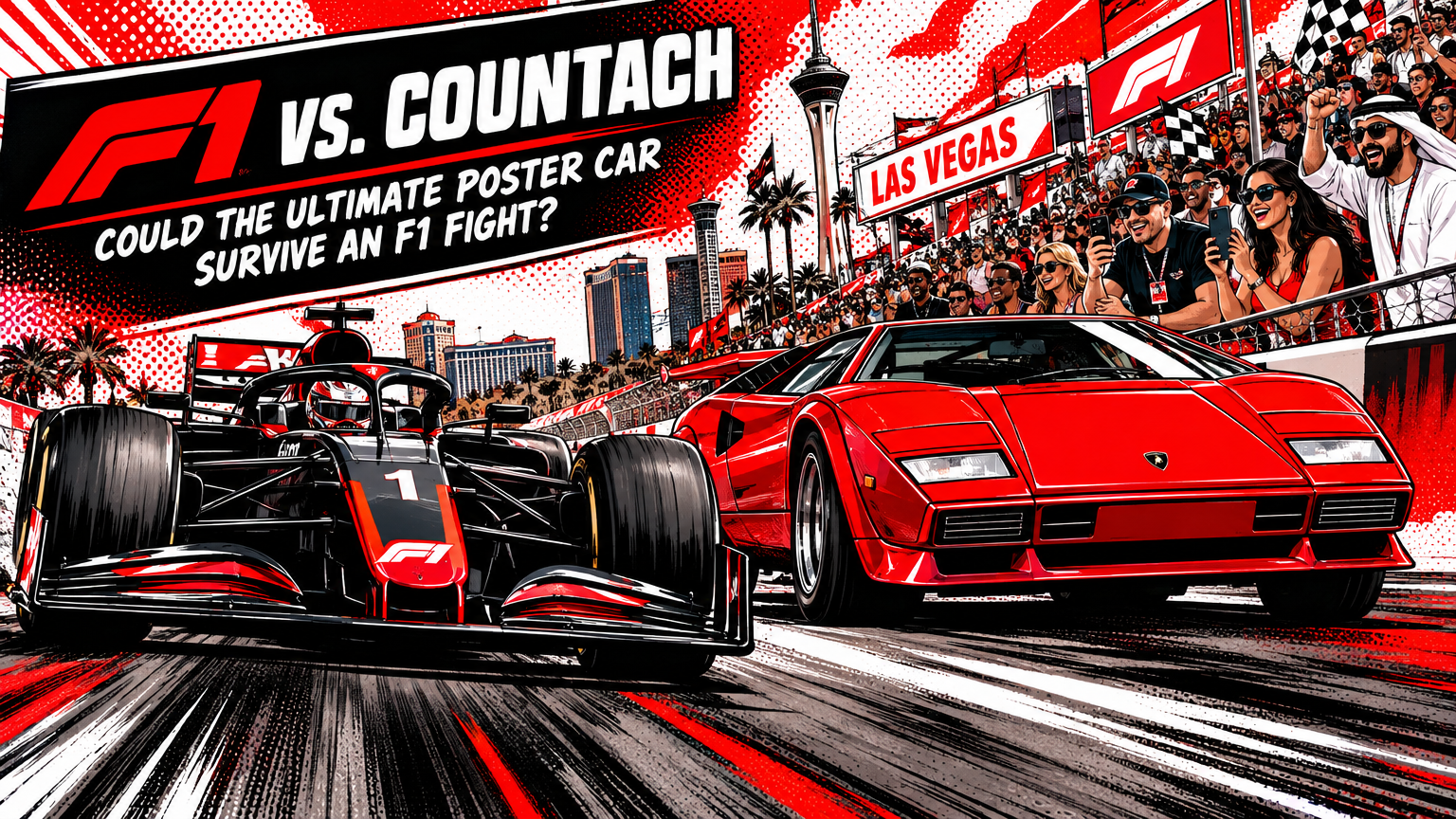
There are cars that are fast. There are cars that look fast. Then there is the Lamborghini Countach, which looks like somebody gave a twelve-year-old a ruler, a box of crayons, and permission to design the craziest car on Earth.
For decades, that was enough.
The Countach became one of the defining supercars of its era. Scissor doors. A screaming V12. A body that looked completely unreasonable. Add the giant rear wing and suddenly every normal car in the parking lot looked like it had given up on life.
But Las Vegas has Formula 1 coming back to town.
So it's time to ask the extremely important question nobody actually needed answered.
What happens if the Lamborghini Countach picks a fight with a Formula 1 car?
Bad things, Lamborghini fans. Very bad things.
First, Which Countach Are We Talking About?
The original Countach wasn't one single car with one set of performance numbers. Lamborghini kept developing it throughout its long production run.
So we're giving the old bull a fighting chance.
Our representative is the Countach 5000 Quattrovalvole, introduced in 1985. Lamborghini enlarged the V12 to 5.2 liters and fitted four valves per cylinder. The carbureted version produced 455 CV, while the fuel-injected version made 420 CV.
In other words, we're not bringing the slow Countach to this fight.
We're bringing one of the mean ones.
The later 25th Anniversary Countach used essentially the same mechanical package, and MotorTrend recorded a zero-to-60-mph time of about 4.2 seconds in testing. Lamborghini claimed roughly 183 mph at the top end for the Quattrovalvole-era car.
Those were outrageous numbers for a road car born in the 1980s.
Then Formula 1 walked into the room.
Meet the 2026 Formula 1 Car
A Formula 1 car is not a supercar.
It isn't a hypercar either.
It's basically an engineering department's answer to the question, "How quickly can we move one human around a racetrack without technically launching them into orbit?"
The 2026 F1 regulations created a new generation of smaller and lighter cars. Minimum weight is 768 kilograms, or about 1,693 pounds, including the driver under the regulation's weight calculation.
The power unit is a 1.6-liter turbocharged V6 hybrid. The internal-combustion side is allowed around 400 kilowatts of output, while the electric MGU-K can deliver as much as 350 kilowatts.
Formula 1 has described the total package as producing more than 1,000 horsepower.
Oh.
And the car has active aerodynamics, racing tires, carbon-fiber construction and enough braking and cornering ability to make most street cars reconsider their career choices.
Countach vs. F1: The Numbers
Category | Lamborghini Countach QV | 2026 Formula 1 Car |
|---|---|---|
Engine | 5.2-liter naturally aspirated V12 | 1.6-liter turbo V6 hybrid |
Power | 455 CV in carbureted European specification | More than 1,000 hp total power-unit output |
Drive | Rear-wheel drive | Rear-wheel drive |
Street legal | Yes | Absolutely not |
Can you valet it at a Vegas casino? | Yes, and everybody will look | Only if your valet had a very strange morning |
Round One: Leaving the Starting Line
The Countach was properly quick for its time.
A roughly 4.2-second run to 60 mph still isn't exactly grocery-getter territory.
But modern Formula 1 cars operate in another universe.
Formula 1 has previously described modern F1 machinery as capable of reaching 60 mph in roughly two seconds. The exact number changes with car setup, grip, regulations, and conditions, so there isn't one universal zero-to-60 number that applies to every 2026 F1 car.
And we're not going to invent one just because the internet enjoys doing that.
What isn't really in doubt is the result.
The lights go out.
The F1 car leaves.
The Countach follows.
The Lamborghini driver has enough time to admire those wonderful analog gauges while wondering where the other car went.
Round Two: Let Them Run Down the Strip
This is where things get more interesting.
The Countach was built during an era when 180-plus mph in a production road car was completely bonkers.
That speed still isn't exactly boring.
But we've already seen what Formula 1 machinery can do right here in Las Vegas.
During the 2024 Las Vegas Grand Prix weekend, Williams driver Alex Albon was recorded at 368.9 kilometers per hour, or 229.2 mph, the highest speed recorded at the Las Vegas Strip Circuit through the first three editions of the modern race.
That happened with the previous generation of F1 car, so don't treat it as a guaranteed 2026 speed.
But it gives you some idea what kind of neighborhood we're visiting.
The Countach is fast.
F1 is the neighborhood where "fast" gets a lawyer and asks for a better definition.
Round Three: Now Add a Corner
And this is where the Lamborghini's evening really starts falling apart.
A straight line at least gives a road-going supercar a chance to flex.
A racetrack exposes the difference between a fast car and a race car.
The Countach has wide tires, a low center of gravity, and the kind of stance that still looks outrageous decades later.
The F1 car has something much nastier.
Downforce.
Formula 1 aerodynamics push the car into the pavement as speed increases. For 2026, the cars even gained movable front and rear aerodynamic elements that can reduce drag on straights and provide more aerodynamic performance when needed around the lap.
The Countach has a giant rear wing that looks fantastic while parked outside a casino.
The F1 car's wings have a job.
That's a slightly unfair difference.
Round Four: Braking
This might be the part people underestimate most.
Everybody talks about horsepower.
Racing is also about getting rid of speed.
An F1 driver can arrive at a corner at ridiculous speed, hammer the brakes, shed a massive amount of velocity and immediately throw the car toward an apex.
Then do it again.
And again.
And again.
For 50 laps in Las Vegas.
The Countach has performance brakes appropriate for a very serious road-going supercar of its era.
Formula 1 has race brakes designed for Formula 1.
That's like entering a very athletic house cat in the cheetah Olympics.
Respect the cat.
But come on.
So, does the Countach win anything?
Actually, yes.
The valet.
Picture both machines arriving at a Las Vegas casino.
The Formula 1 car screams into the driveway.
Everybody pulls out a phone.
Then somebody realizes there is nowhere to put a suitcase, no passenger seat, basically no ground clearance, and absolutely no reasonable explanation for why it is there.
Now the Countach rolls in.
Door goes up.
V12 burbles behind the driver.
Somebody who grew up in the 1980s immediately becomes twelve years old again.
Game over.
The F1 car wins the race.
The Countach wins the entrance.
And in Las Vegas, the entrance counts for something.
What would happen on the Las Vegas Strip circuit?
The current Las Vegas Strip Circuit measures 6.201 kilometers, or about 3.85 miles, with 17 turns. The Grand Prix runs for 50 laps.
Put both cars on that circuit with professional drivers, and this isn't really a competition.
The Countach would lose under acceleration.
It would lose under braking.
It would lose through the corners.
It would lose during rapid direction changes.
And over a full lap, the F1 car would exploit all of those advantages at once.
That's not an insult to the Lamborghini.
It's actually a compliment.
The Countach was designed to be a street-legal supercar that somebody could theoretically drive home.
A Formula 1 car exists for one purpose.
Lap time.
Everything else is somebody else's problem.
The Final Call
If the question is which machine is faster around a racetrack, Formula 1 wins, and it isn't particularly close.
That's exactly what should happen.
But the Countach doesn't leave embarrassed.
More than 50 years after the original Countach concept appeared, Lamborghini still points to its shape as a major influence on the company's design language. That tells you something.
An F1 car represents what happens when engineers chase speed with almost no concern for ordinary road use.
The Countach represents what happens when somebody decides an ordinary road car isn't nearly ridiculous enough.
One is the ultimate racing machine.
The other became one of the ultimate dream cars.
We'll call that a respectable loss.
Besides, there are plenty more cars waiting to pick a fight with Formula 1.
Vegas race week is still coming.
We're just getting warmed up.