Ask a room of car people to name the strongest engine ever put in a Japanese production car, and watch the argument end early.
The Toyota Supra Mk IV does not win that argument with its factory spec sheet. It wins it with what happened after the factory let go of the car.
Stock, it made 320 horsepower. Tuned, its cast iron straight six became folklore. And somewhere between those two facts sits the most misunderstood spec sheet in this whole series.
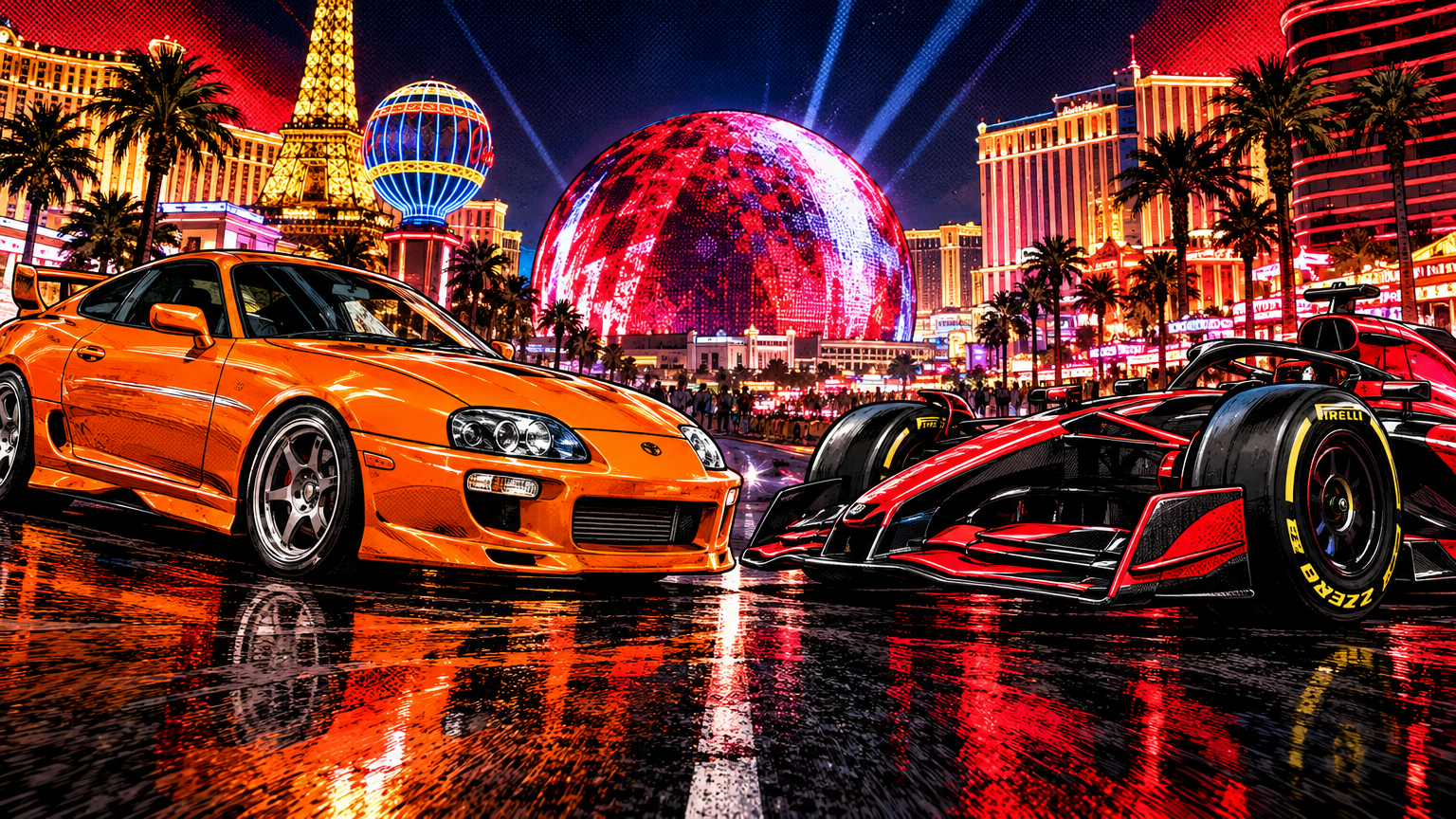
What happens if the Toyota Supra Mk IV picks a fight with a Formula 1 car?
What happens is a fair fight, scored the way this series always scores it: the stock car, as Toyota sold it, on the numbers that can be checked. No thousand horsepower internet builds. No movie magic.
The Supra does not need the help, and the help would not be honest anyway. Let us score the real car.
First, Which Toyota Supra Are We Talking About?
The Mk IV name covers a family, and this family gets blended online more than almost any other car in the series. So let us pin it down.
The family, kept separate the way this series always keeps it:
- The US Supra Turbo, our challenger: the fourth generation car, code A80, sold in the United States from 1993 to 1998, with the twin turbo engine and the six speed manual gearbox. This is the scored car.
- The naturally aspirated Supra: same shape, 2JZ-GE engine, 220 hp. A fine car, and not this car. Plenty of listings blur the two, which is lesson one for buyers below.
- The Japanese market Turbo: same basic car, rated at 280 PS under the Japanese manufacturers agreement of the era. Later Japanese cars gained variable valve timing from 1997. Different rating, different details, not scored.
- The automatic Turbo: a four speed automatic was offered alongside the manual. Real, quick, and not the car the legend is built on. Not scored.
- Every modified Supra on the internet: single turbo conversions, built engines, four figure power claims. Culture, not a factory car. They get their own section later, and zero points.
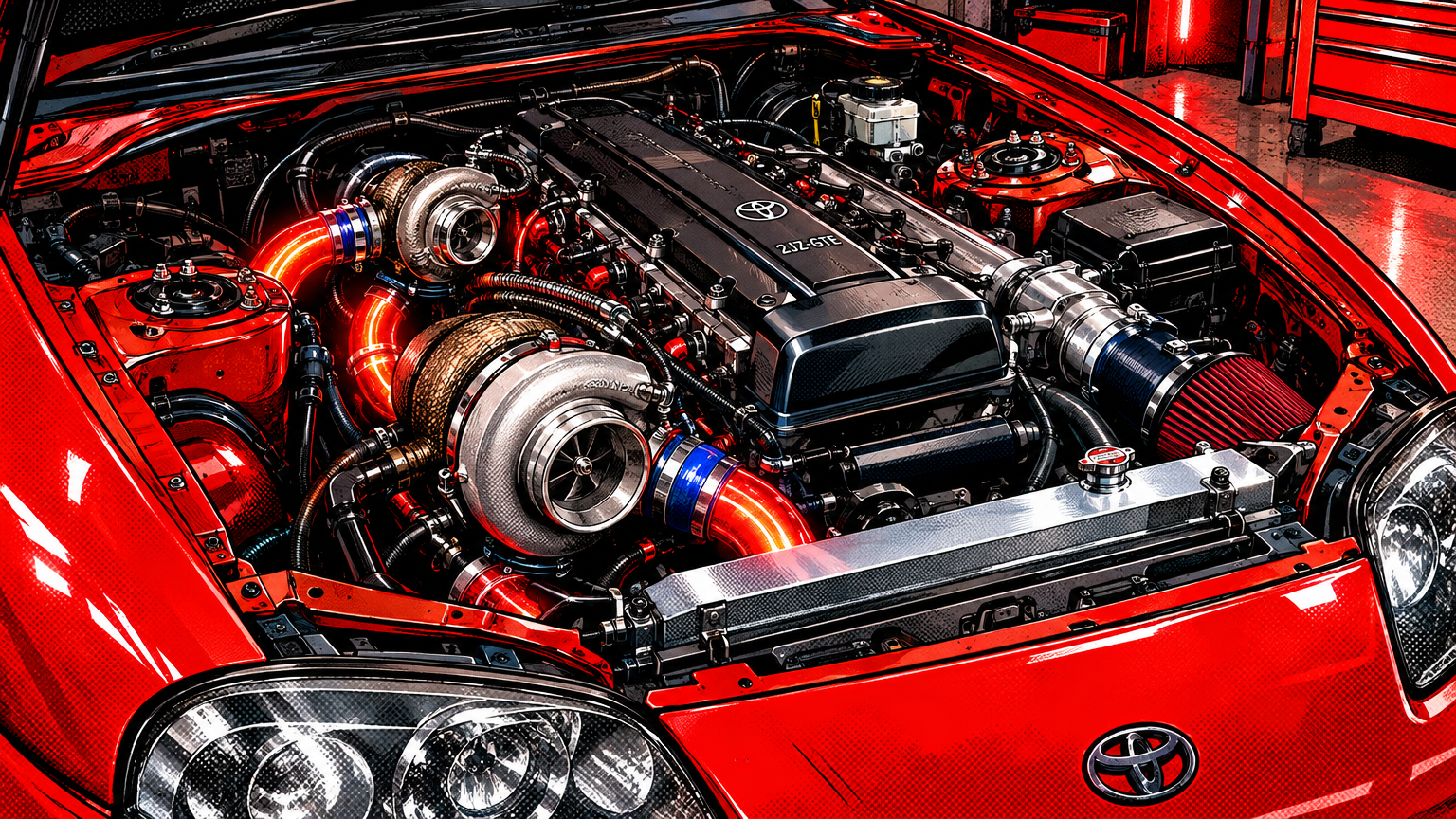
Now the scored car, Toyota figures first. The engine is the 2JZ-GTE, a 2,997 cc double overhead cam inline six with a cast iron block and an aluminum head.
It breathes through two turbochargers working in sequence, plus an intercooler. One turbo spools early for response, the second joins as revs climb, and both work together at the top.
Toyota rated the US car at 320 hp at 5,600 rpm and 315 lb-ft of torque at 4,000 rpm. Those are the honest factory numbers, and they were serious numbers in 1993.
For context, that output embarrassed plenty of European metal costing far more. The Supra was not a budget hero punching up on price. At launch it cost real money, and we will get to that too.
The rest of the Toyota sheet:
- Gearbox: Getrag V160 six speed manual, co developed for this car and Toyota first six speed. Rear wheel drive, with a Torsen limited slip differential.
- Weight: about 3,450 lb, roughly 1,565 kg, as a commonly listed US Turbo curb weight. Japanese catalogue weights run lighter by grade, which is why online figures wander.
- Size: about 4,520 mm long, 1,810 mm wide, 1,275 mm tall, on a 2,550 mm wheelbase.
- Suspension: double wishbones at all four corners, an expensive layout Toyota chose over cheaper struts.
- Brakes: ventilated discs all round with four sensor anti lock braking. The front rotors measure 12.7 inches across, and Round Four will show why period testers kept talking about them.
- Price new: 39,900 dollars at its US debut in 1993, per Hemmings. Prices climbed with the yen during the run, which is part of why so few sold.
Now the three ideas that make this car a landmark. First, the weight hunt.
Chief engineer Isao Tsuzuki and his team chased kilos everywhere. Toyota launch material describes an aluminum hood, a plastic fuel tank, hollow fibre carpet, and a hollow rear spoiler, and the new car came in more than 100 kg lighter than the Supra before it.
Second, the iron block. In an era moving to aluminum, Toyota built the 2JZ around cast iron, with a closed deck and serious cooling and oil control underneath.
That decision looked old fashioned in 1993. It is the single biggest reason the engine later survived tuning levels Toyota never sold, and it is a useful reminder that the strongest material choice is not always the lightest one.
Third, the gearbox. The Getrag V160 was built far stronger than a 320 hp car strictly needed, and owners found that out the enjoyable way.
Hold those three ideas. They explain why a car that sold in small numbers became, a decade later, one of the most valuable Japanese cars on Earth.
One sales reality before we fight. The Mk IV was a low volume car, with only about 11,000 plus sold in the United States across the whole run, and commonly cited worldwide counts land near 45,000 cars built from 1993 to 2002.
Japan kept building it after US sales ended in 1998. Tightening emissions rules ended production in 2002, and Toyota did not replace it for a very long time.
Meet the 2026 Formula 1 Car
The other corner needs no tuning folklore. A 2026 Formula 1 car arrives with everything already turned up by regulation and physics.
Its 1.6 litre turbocharged V6 hybrid pairs an internal combustion engine limited to about 400 kW with an MGU-K of up to 350 kW. Formula 1 describes the total package as more than 1,000 hp.
Minimum weight is 768 kg including the driver, so the F1 car weighs about half what the Supra weighs, while making more than three times the power. That maths problem sits underneath every round below.
Add carbon construction, active front and rear aero, and racing tires that work in a temperature window road tires never visit. This is not a faster road car. It is a different category of machine that happens to share four wheels and a steering wheel.
For the full picture of Grand Prix racing in this city, the Las Vegas Grand Prix hub is where this series keeps its context.
Toyota Supra Mk IV vs. F1: The Numbers
| Category | Toyota Supra Mk IV Turbo (US, stock, manual) | 2026 Formula 1 Car |
|---|---|---|
| Engine | 3.0 litre sequential twin turbo inline six (2JZ-GTE), cast iron block | 1.6 litre turbo V6 hybrid |
| Power | 320 hp at 5,600 rpm (Toyota, US rating) | More than 1,000 hp (Formula 1 figure) |
| Torque | 315 lb-ft at 4,000 rpm | No single published figure |
| Weight | About 3,450 lb (about 1,565 kg), US curb | 768 kg minimum (about 1,693 lb), including driver |
| Power to weight | About 205 hp per tonne | More than 1,300 hp per tonne |
| 0 to 60 mph | 5.2 sec (Car and Driver production car test, September 1993) | No universal official figure published |
| Top speed | 155 mph, electronically limited (154 mph in period test) | 353.9 km/h trap, Gasly, 2026 Chinese GP qualifying (FIA) |
| Drive | Rear wheel drive | Rear wheel drive |
| Gearbox | 6 speed Getrag manual | Sequential racing gearbox |
| Brakes | Vented discs, four sensor ABS; 149 ft from 70 mph in a 1997 Car and Driver test | Carbon racing brakes |
| Built | US sales 1993 to 1998; production in Japan to 2002 | Built for one season, by a factory race team |
| Price | 39,900 dollars new in 1993; clean stock Turbos now trade far above that | Not for sale at any price |
| Vegas valet factor | 9/10. The wing, the shape, and thirty years of movie fame do the work before the engine starts | 0/10. No passenger seat, no starter motor of its own, and it needs a crew to leave the driveway |
Read the power to weight line first, because it settles the fight. More than 1,300 hp per tonne against about 205 is not a gap. It is a different sport.
Then read the engine line, because it explains why this article exists. The F1 engine is a jewel built for a season. The 2JZ was built like a bank vault, and the world spent thirty years testing exactly how much that vault could hold.
Three lessons fall out of this table, and all three will help you read any Supra listing, or any hero car claim, from now on:
- Ask which test car earned the number. The famous 4.6 second sprint came from an early prototype test. The production car test that followed recorded 5.2 seconds, and the magazine itself favoured the later result. Both numbers are real. Only one describes a car you could buy.
- Ask which market rated the power. The same engine wore 320 hp in America and 280 PS in Japan, where makers observed a shared cap. Different rulers again, just like the Gullwing yesterday, in the Mercedes-Benz 300 SL Gullwing fight.
- Ask what has been changed. A stock Turbo, a lightly tuned Turbo, and a single turbo build are three different cars wearing one badge. The price, the reliability, and this fight all depend on which one is actually in front of you.
Round One: Acceleration
Give the Supra its full respect first. A production car running 0 to 60 mph in 5.2 seconds and the quarter mile in 13.8 seconds at 106 mph, as Car and Driver recorded in September 1993, was elite company in 1993.
That test car beat or matched exotics costing multiples of its price. The sequential turbos deserve the credit: boost arriving early and staying, instead of the all or nothing punch older turbo cars were famous for.
The prototype story belongs here too, told straight. An earlier Car and Driver test of a pre production car recorded 4.6 seconds to 60 mph and a 13.1 second quarter mile, and that is the number the internet tattooed on the car forever.
It is not fake. It is just not a production car, and when a number sounds too good for its spec sheet, asking which car earned it is the whole skill. You now own that skill.
Now the other side. The Formula 1 car carries more than six times the Supra power to weight, on tires built purely to convert power into forward motion.
Formula 1 publishes no universal 0 to 60 figure, and this series does not invent one. It does not need one here either. Physics files the result before the lights go out.
Round One to Formula 1. The Supra keeps a real era trophy, and one honest footnote: in 1993, almost nothing at its price could stay with it.
Round Two: Top Speed
This round comes with a limiter, and the limiter is the story. Toyota electronically limited the US Supra Turbo to 155 mph, and period tests recorded 154 to 155 mph against that ceiling.
Toyota engineers were quoted at the time saying the stock car, freed from its limiter, was capable of about 180 mph. Read that sentence the way this series reads every claim: it is an engineer estimate, reported in period, never a verified run.
So the scored number is 155 mph. Claimed potential does not win rounds here, as the Saleen S7 learned in this series when its round win had to be labelled a claim, and as the Veyron and McLaren F1 showed when they won this round on verified numbers instead.
Now the Formula 1 evidence, which is speed trap data measured mid lap at real Grands Prix:
- 2026 trim: Pierre Gasly, 353.9 km/h (about 220 mph), qualifying at the Chinese Grand Prix, per FIA data.
- 2025 at Las Vegas: Yuki Tsunoda, 358.3 km/h (222.6 mph).
- 2024 at Las Vegas: Alex Albon, 368.9 km/h (229.2 mph), the highest through the first three editions of this race.
The slowest of those trap figures clears the Supra limiter by about 65 mph. And those F1 numbers were recorded in cornering trim, with a braking zone waiting, not on a top speed runway.
There is a usable lesson in that for road car shopping. A limiter is a policy, not a capability, and the two get swapped in sales talk constantly. Always ask which one a top speed figure describes.
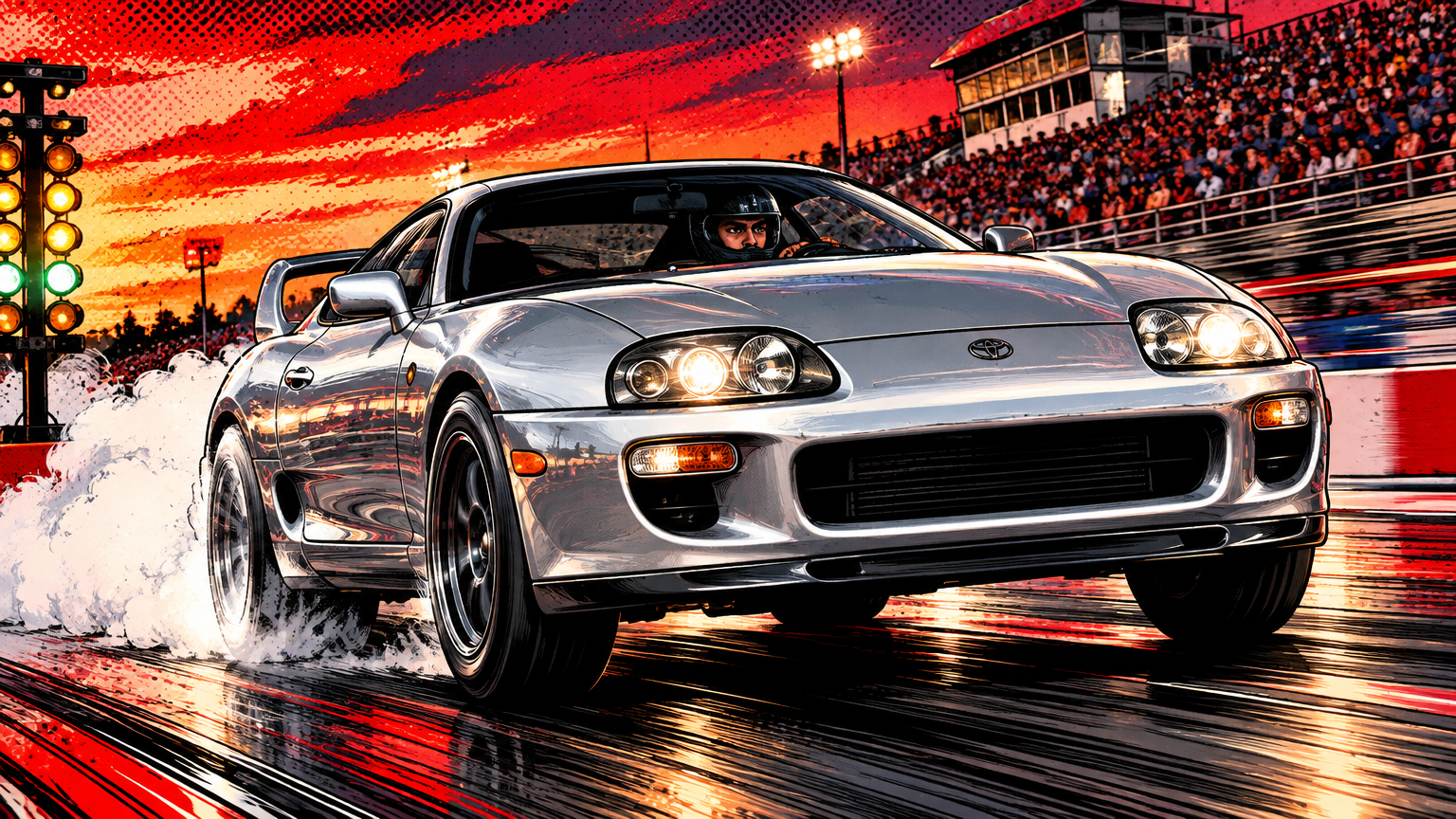
Round Two to Formula 1. The Supra was geared and shaped for more than its limiter allowed. The scoreboard can only count what was actually demonstrated, and it just was, by about 65 mph.


Round Three: Now Add a Corner
The Supra was no straight line special, and period testers said so loudly. Road and Track recorded 0.98 g on the skidpad, a figure that matched far pricier supercars of the day.
Double wishbones at both ends, a stiff shell, and that Torsen differential made a car testers described as balanced and exploitable. For a heavy Japanese GT of 1993, that is high praise, earned.
Its Japanese rival in this series, the Nissan Skyline GT-R R34, fought with all wheel drive brains. The Supra fought the older way: rear drive, mechanical grip, and a driver who had to be awake.
Now add the Formula 1 cornering ingredients. Downforce that grows with speed, slick tires in their working window, and a car weighing about half as much changing direction underneath it all.
A road car corners on the grip its tires can find. An F1 car corners on grip plus an invisible hand pressing it into the road, harder the faster it goes. That hand does not exist in the Supra world at any tuning level.
Round Three to Formula 1. The Supra keeps its 0.98 g receipt, and the respect that comes with it. Against downforce, receipts from 1993 cannot cash.
Round Four: Braking
This is the round where the stock Supra quietly shines brightest, so slow down for it. In a 1997 Car and Driver test, a Supra Turbo stopped from 70 mph in 149 feet.
That figure was reported at the time as a best ever stopping distance in the magazine testing history. Read that again. Not best for a Toyota.
Best for anything the magazine had put through that test, exotics included.
The hardware explains it: big vented discs, strong calipers, and a four sensor ABS system that could read yaw, in plain words it could tell the car was starting to rotate, not just that a wheel was locking.
The earlier production test recorded 160 feet from 70 mph, which shows the other half of the lesson. Brake figures move with tires, surface, and test year, so a single heroic number should always carry its date with it.
Against a Formula 1 car, though, even a record holding road system is outclassed. Carbon brakes working at racing temperature, half the mass to stop, and downforce still pressing down at braking speeds add up to a different universe of deceleration.
An F1 driver brakes later not because of courage. The car simply sheds speed at rates a road braking system cannot physically match, lap after lap, without fading.
Round Four to Formula 1. But this round carries an asterisk of honour: the Supra braking story is the best stock road car receipt in this fight, and it held a magazine all time record to prove it.
So, Does the Toyota Supra Mk IV Win Anything?
On the scored rounds, no. On everything that made this car immortal, it wins by a mile, and none of it needs inventing:
- The tuning ceiling. That iron block, overbuilt crank and internals, and a Getrag gearbox built well past its brief meant builders using widely available parts pushed these engines to 500 hp and far beyond, reliably enough to build an industry on. Toyota never sold that car. Owners created it, which is exactly why the culture trusts it.
- The movie. An orange Mk IV in The Fast and the Furious in 2001 turned a discontinued, slow selling coupe into the poster car of a generation. Film fame is not a spec, and it is also not nothing: it is a large part of why clean cars now trade the way they do.
- The value arc. A 39,900 dollar car in 1993 that depreciated like a normal Toyota, then climbed past six figures for the right stock Turbo manual cars at major auctions in recent years. Few cars in this series have a price chart that tells their whole cultural story in one line.
- The usability. Four seats in a pinch, a real boot for a GT, Toyota build quality, and parts thinking from a company that expected these cars to be serviced, not worshipped. It was a daily driver that happened to be a legend in waiting.
One buying briefing, because Supra shopping is where the money traps live:
- Verify it started life as a Turbo. Engine swaps are common and values are not close. The VIN and factory records matter more than the badge on the back.
- Verify the Getrag. A genuine V160 manual car and an automatic or swapped car are different assets. The gearbox is both rare and expensive to put right.
- Stock is the premium. Against every instinct of tuner culture, the unmodified cars now command the strongest money. Documented originality beats a parts list.
- Import by build date. Japanese market cars become US eligible car by car at 25 years from build, so a 2002 build waits until 2027. Check the individual car, never the model year headline.
That is not a consolation list. That is how a car that lost its sales battle in the 1990s won the thirty year war for relevance.
What Would Happen on the Las Vegas Strip Circuit?
The Strip Circuit is 6.201 km, about 3.85 miles, with 17 turns and a roughly 2 km straight down the Strip itself. Picture the Supra there on a November night, wing up, under the lights.
Down that straight, the Supra gets its one long moment. It would pull cleanly to its 155 mph limiter and sit there, turbos singing in sequence, while the grandstands blur.
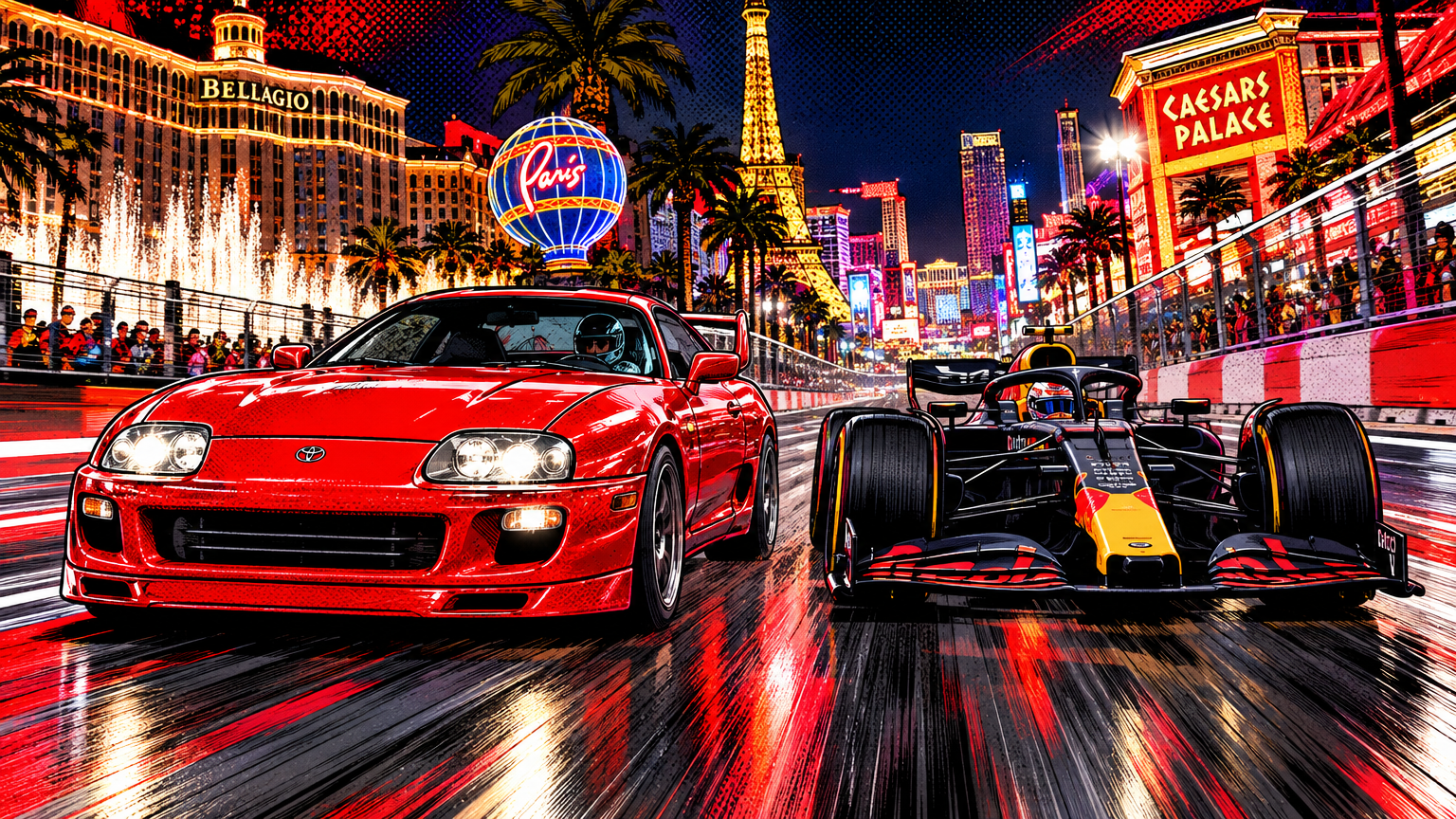
Then the braking zone arrives, and even that record holding road system has to start early, shedding speed for about 3,450 lb, while the F1 car, arriving about 65 mph faster, brakes later and still makes the corner.
Seventeen corners would repeat the lesson: mechanical grip and balance against downforce and half the mass. Over one lap the gap would be enormous. Over the Grand Prix distance of 50 laps, the Supra would be managing tire and brake heat in a different event entirely.
No invented lap times here, the way this series never invents them. Just the shape of the result, and one honest footnote: the Supra would be the car half the crowd is filming on their phones, and it would not be the fast one.
Las Vegas understands that trade better than anywhere. This city runs on the difference between being fastest and being the one everybody remembers.
The Final Call
Winner: Formula 1, four rounds to zero.
Acceleration went to a power to weight advantage of more than six to one. Top speed went to verified trap figures that clear the Supra limiter by about 65 mph. Cornering and braking went to downforce, slicks, and carbon, against the best mechanical grip and braking 1993 could sell you.
That is a clean sweep. On paper, it looks closed and shut.
It is not, where it counts. Every other challenger in this series was finished the day it left the factory. The Supra was a starting point, and thirty years of owners, tuners, and one very famous film proved the factory had built far more car than it ever sold.
Scored stock, it loses. Remembered honestly, it is the rare car whose legend is not the factory version at all, and whose strongest numbers were always the ones its community wrote after the warranty expired.
Formula 1 may win the fight. But the Toyota Supra Mk IV still owns the strongest straight six reputation in production car history, still owns its generation of car culture, and still makes a Formula 1 car look, just for a second, like it is missing the point of a car you can actually own.
There are plenty more cars waiting to pick a fight with Formula 1. Next up: Formula 1 vs. Jaguar XJ220: the twin turbo V6 supercar that was promised a V12, briefly held the production car speed crown, and arrived just as its market vanished.
Can the forgotten record holder land a punch the tuner king could not?