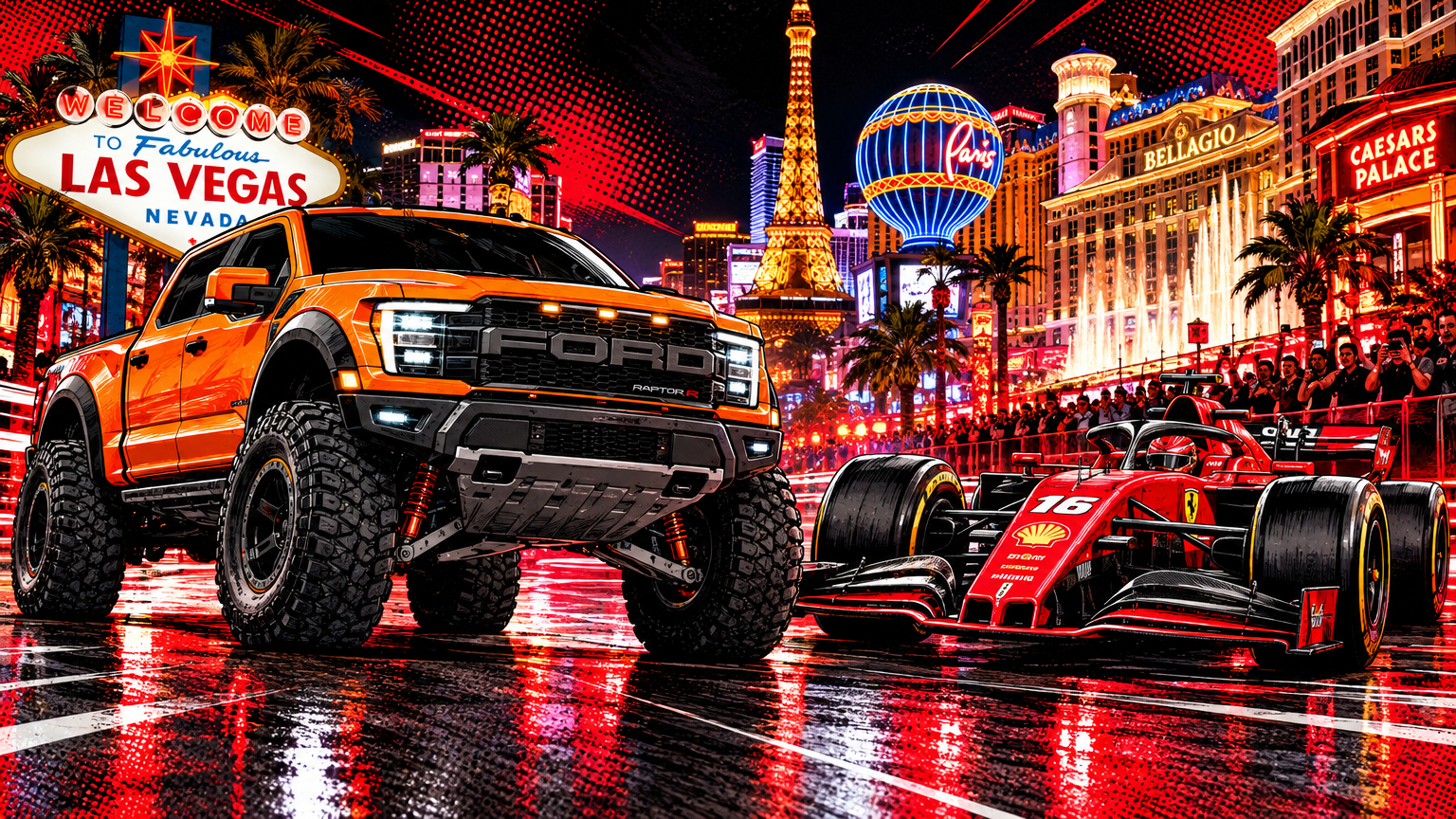
This is the first challenger in this series that can jump.
Not metaphorically. Literally. The Ford F-150 Raptor R is a full size pickup truck built to leave the ground at desert speed, land on its suspension, and keep going like nothing happened.
Every other car in this fight so far has been a road car, a supercar, or a legend on tarmac. This one is a trophy truck with license plates, a bed, five seats, and a Mustang Shelby GT500 engine.
Ford built the Raptor name on Baja racing. The first F-150 Raptor debuted for 2010 with 310 horsepower, which sounded wild at the time.
Then the Raptor went turbo V6 for two generations, got faster and smarter, and still heard the same complaint at every cars and coffee in America. Where is the V8?
Ford answered with the Raptor R. Then, for 2024, Ford answered again, louder, with 720 horsepower.
What happens if the Ford F-150 Raptor R picks a fight with a Formula 1 car?
What happens is a weight class problem wearing a cowboy hat. On one side, a 2026 Formula 1 car, the lightest, sharpest, most aerodynamically obsessed machine in motorsport. On the other side, a truck that weighs about four Formula 1 cars, rides 13.1 inches off the ground, and can tow a boat to Lake Mead after the fight.
The Raptor R is not here to be elegant. It is here to be enormous, loud, and shockingly fast for something with a cargo bed.
Bring earplugs. This challenger brought a supercharged V8.
First, Which Ford F-150 Raptor R Are We Talking About?
Precision matters here, because the Raptor R changed after its first year, and the internet loves quoting the launch numbers against the updated truck.
The family, kept separate the way this series always keeps it:
- Raptor R, 2023: the launch truck. A 5.2 liter supercharged V8 making 700 horsepower and 640 lb-ft of torque, announced by Ford on July 18, 2022, with production starting late that year at Dearborn Truck Plant. The independent test numbers in this article come from this car, and they are labeled that way every time.
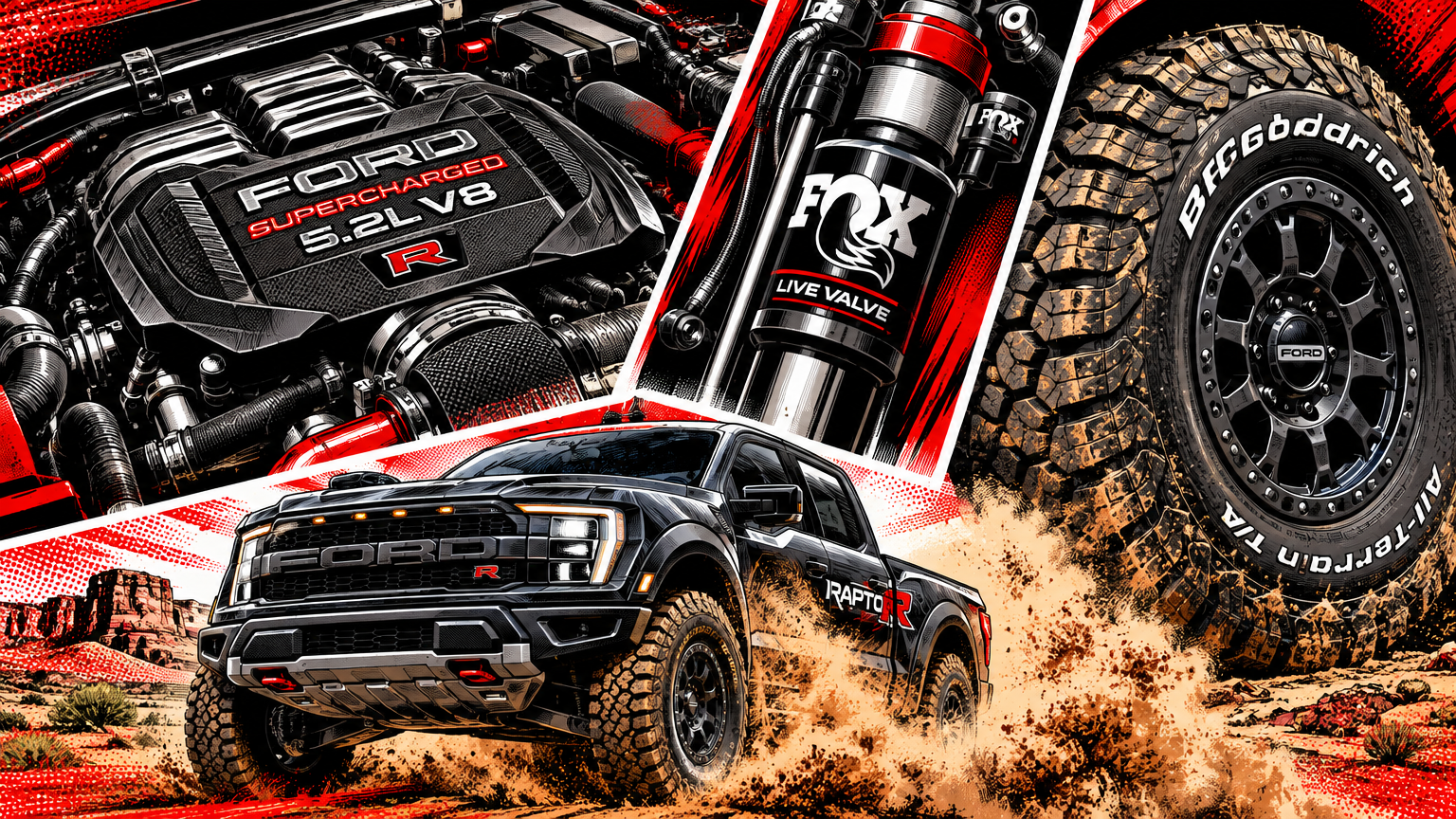
- Raptor R, 2026: our challenger, the truck Ford sells today. It carries the 720 horsepower update Ford made for 2024, with reduced air inlet losses and an optimized calibration that also widened the torque curve, per Ford, plus the updated FOX Dual Live Valve shocks, controlling compression and rebound.
- Standard F-150 Raptor: the 3.5 liter twin turbo EcoBoost V6 truck, 450 horsepower and 510 lb-ft of torque per Ford. A serious off road machine in its own right, and not scored here.
- Mustang Shelby GT500: the engine donor, not a truck at all. Its version of this 5.2 liter supercharged V8 made 760 horsepower in the Mustang. Ford Performance recalibrated the supercharger and fitted a new pulley for the Raptor R, trading peak power for stronger low and mid range torque for off road use.
So the scored truck is the 2026 Ford F-150 Raptor R, SuperCrew, the current truck in Ford showrooms, with factory figures per Ford for the 2026 model year. Here is the full card, Ford figures first:
- Engine: 5.2 liter (315 cubic inch) supercharged and intercooled V8, 90 degree overhead cam design, cast aluminum block and head with plasma transfer wire arc cylinder liners, forged aluminum pistons, built in Dearborn, Michigan.
- Power: 720 hp at 6,650 rpm, on premium fuel, per SAE ratings in the Ford spec sheet.
- Torque: 640 lb-ft (868 Nm) at 4,300 rpm.
- Compression and appetite: 9.5 to 1 compression, premium unleaded required, 11.5 quarts of oil, and a 36 gallon fuel tank. Hold those last two numbers. They tell you exactly what kind of truck this is.
- Gearbox: 10 speed SelectShift automatic.
- Drive: four wheel drive through a two speed torque on demand Hi-Lock transfer case, with a 2.64 to 1 low range, a 4.10 axle ratio, and an electronic locking rear differential.
- Body: SuperCrew only, high strength steel frame with an aluminum cabin and bed, assembled at Dearborn Truck Plant. The bed measures 67.1 inches at the floor, and cargo volume is 52.8 cubic feet.
- Size: 145.4 inch wheelbase, 232.6 inches long, 87.0 inches wide without mirrors, and 80.6 inches tall.
- Clearance and angles: 13.1 inches of ground clearance, a 33.1 degree approach angle, a 24.9 degree departure angle, and a 24.4 degree breakover angle.
- Suspension: independent double wishbone front with coil over shocks, and a five link coil rear with a Panhard rod. The shocks are FOX Racing Shox, 3.1 inch dampers, electronically controlled.
- Wheel travel: 13.0 inches in front and 14.1 inches in back, standard on the Raptor R with its 37 inch tires.
- Wheels and tires: 37x12.5R17LT BFGoodrich All-Terrain T/A KO2 tires on 17 by 8.5 inch forged aluminum beadlock capable wheels, with a full size matching spare under the bed.
- Brakes: power anti lock vented discs, 350 by 34 mm in front and 336 by 20 mm in back, per Ford.
- Work ratings: maximum payload of 1,400 lb and maximum conventional towing of 8,700 lb, per Ford.
- Price: $110,930 to start for the 2026 model year, before the $2,795 destination charge, per Ford build and price, with well optioned trucks climbing higher. The 2023 launch price was $109,145 including destination, a figure reported at launch and confirmed with Ford.
Independent tests, kept separate from the factory figures the way this series always keeps them, and labeled with the model year that earned them. Car and Driver instrument tested the 2023 launch truck and recorded 0 to 60 mph in 3.6 seconds, 0 to 100 mph in 9.1 seconds, and a quarter mile in 12.0 seconds at 112 mph.
That same test weighed the truck at 6,077 lb, recorded a governor limited top speed of 114 mph, a stop from 70 mph in 205 feet, a stop from 100 mph in 430 feet, and 0.71 g on the skidpad. Car and Driver called it the quickest gasoline fueled truck it had ever strapped its test gear to.
Read that again. A three ton pickup on knobby 37 inch all terrain tires ran to 60 mph in 3.6 seconds.
That is quicker than the standard Porsche 959 figure we scored in our previous fight, in a truck that can also carry plywood. The previous challenger wrote the modern supercar playbook. This one can haul the playbook, the bookshelf, and a generator.
Meet the 2026 Formula 1 Car
The other corner holds the current Formula 1 machine, built to the 2026 regulations. Keep it honest, the way this series always keeps it: there is no single universal Formula 1 specification sheet, because every team builds its own car inside the same rulebook.
The verified shared facts for the 2026 car:
- Power unit: 1.6 litre turbocharged V6 hybrid. The combustion engine is limited to about 400 kW, and the MGU-K electric motor contributes up to 350 kW. Formula 1 describes the total package as more than 1,000 hp.
- Weight: minimum regulatory weight of 768 kg, about 1,693 lb, including the driver.
- Drive and construction: rear wheel drive, carbon construction, racing tyres, and active aerodynamics at the front and rear.
- Measured speed evidence: Pierre Gasly recorded 353.9 km/h, about 220 mph, in a qualifying speed trap at the 2026 Chinese Grand Prix, per FIA data. That is a trap speed on a circuit, in cornering trim, not a top speed attempt.
Put the two machines side by side and the comedy writes itself. The Formula 1 car is a scalpel that happens to have an engine. The Raptor R is a sledgehammer that happens to have a supercharger.
One of them was designed by people who count grams. The other was designed by people who count inches of suspension travel, and who fitted a fuel tank the size of a bathtub because the engine drinks like it means it.
Ford F-150 Raptor R vs. F1: The Numbers
| Category | Ford F-150 Raptor R (2026) | 2026 Formula 1 Car |
|---|---|---|
| Engine | 5.2 litre supercharged V8 | 1.6 litre turbo V6 hybrid |
| Power | 720 hp (Ford) | More than 1,000 hp (Formula 1 figure) |
| Torque | 640 lb-ft at 4,300 rpm | No single published figure |
| Weight | 6,077 lb as tested (Car and Driver, 2023 truck) | 768 kg minimum, including driver |
| Power to weight | About 237 hp per tonne, on the tested weight | More than 1,300 hp per tonne |
| 0 to 60 mph | 3.6 sec (Car and Driver test, 2023 truck) | No universal official figure published |
| Top speed | 114 mph, governor limited (Car and Driver test) | 353.9 km/h trap, Gasly, 2026 Chinese GP qualifying (FIA) |
| Drive | Four wheel drive, low range, locking rear differential | Rear wheel drive |
| Gearbox | 10 speed automatic | Sequential racing gearbox |
| Ground clearance | 13.1 inches | Rides millimetres off the ground |
| Suspension travel | 13.0 inches front, 14.1 inches rear | A few centimetres, by design |
| Seats and bed | Five seats, 52.8 cubic foot cargo bed | One seat, no bed |
| Towing | 8,700 lb maximum (Ford) | Zero. It is towed, on a transporter |
| Price | $110,930 to start (Ford, 2026 model year) | Not for sale at any price |
| Vegas valet factor | 9/10. It will not fit in some valet lanes, and nobody in line will care, because everyone is looking at it | 0/10. No passenger seat, no bed, and it cannot legally park anywhere |
Read the weight line twice, because it decides most of this fight before it starts. The Raptor R, on its tested weight, carries about 237 horsepower per tonne. The Formula 1 car carries more than 1,300 horsepower per tonne.
That is not a gap. That is a different universe with the same speedometer font.
And yet the truck number deserves respect on its own terms. Three tons, 37 inch tires, and a 3.6 second sprint is physics being bullied by torque, gearing, and four driven wheels.
Round One: Acceleration
Winner: Formula 1.
Give the Raptor R its flowers first, because its launch is the most violent party trick in this entire series. Four wheel drive puts the power down. The 10 speed automatic fires off shifts, the rear end squats, the nose lifts, and 6,077 lb of truck hits 60 mph in 3.6 seconds.
Car and Driver noted the technique, and it is gloriously uncomplicated. Select Sport mode, which puts the transfer case into 4Auto, use the brake hold feature, and go. No delicate launch ritual, no tyre warmers, no engineer with a laptop whispering about clutch bite points.
The quarter mile tells the same story. Twelve seconds flat at 112 mph, in a truck, on all terrains, with a bed.
Here is the reader takeaway hidden inside that number, and it is genuinely useful. A fast 0 to 60 time in a heavy vehicle is mostly about traction and torque delivery, not headline horsepower. The Raptor R launches hard because all four tires work, the low gearing multiplies the torque, and the supercharger delivers that torque right now, with no waiting for boost.
That is why modern four wheel drive performance cars feel so fast in the real world, at real speeds, on real roads. The Raptor R is that lesson, supersized.
And it still loses this round. More than 1,000 hp against 768 kg beats 720 hp against roughly 2,756 kg every single time the surface is smooth and the run lasts longer than a blink. This series never invents a universal Formula 1 0 to 60 figure, because none is officially published, so score it on the physics both sides publish.
The Formula 1 car has more than five times the power to weight, racing tires, and a launch honed by the best engineers in the sport. The Raptor R wins the bar argument. The Formula 1 car wins the round.
Round Two: Top Speed
Winner: Formula 1.
This round is not close, and the reason why is the most useful thing in this whole article. The Raptor R stops at 114 mph, and it does not stop there because it runs out of power.
It stops there because of its tires.
Those 37 inch BFGoodrich all terrain tires are built to survive rocks, sand, and desert punishment at speed. Tires like that carry a speed rating, and 112 to 114 mph is the neighborhood where big off road rubber says enough. Ford governs the truck to respect the tires, and the engine simply accepts the decision.
With 720 horsepower on tap, the Raptor R is a sports car engine wearing a leash made of rubber. Remove the leash in your imagination and the aerodynamics of a barn door with a cargo bed would collect the debt a moment later.
Use that lesson every time you shop tires for anything fast. The tire is not an accessory. The tire is the limit, for speed, for braking, and for cornering, and the Raptor R wears its limit on the sidewall for anyone to read.
Now look at the other side of the table. Gasly trapped 353.9 km/h, about 220 mph, in 2026 qualifying trim, in a car carrying wings that exist to trade straight line speed for cornering grip.
Go further back in this series record book and it gets sillier. Yuki Tsunoda trapped 358.3 km/h at Las Vegas in 2025, and Alex Albon trapped 368.9 km/h there in 2024, the highest figure through the first three editions of the race.
The slowest Formula 1 trap number in that paragraph is nearly double the Raptor R maximum. Round Two is a rout, and the truck never pretended otherwise.
Its speed was always meant for a different surface. On a desert two track, at 100 mph, with the suspension working flat out, the Raptor R is in its natural habitat and the Formula 1 car is a very expensive sled. But this round is scored on tarmac, on the clock, and on the evidence.


Round Three: Now Add a Corner
Winner: Formula 1.
On a skidpad, the Raptor R recorded 0.71 g in Car and Driver testing. For a tall truck on tall tires, that number is honest work.
For a cornering contest against a Formula 1 car, it is a polite way of saying the truck should sit this one out. The Formula 1 car generates downforce with active aero front and rear, weighs 768 kg including the human, and turns on racing tires built for one glorious purpose.
The Raptor R turns the way a building turns. Slowly, with body roll, on sidewalls that flex like marshmallows, because those sidewalls are suspension out in the desert. What saves you over rocks betrays you on a road course, and the truck makes no apology for it.
There is a corner case worth naming, because it is the Raptor R party trick and it is real. Move this round off the tarmac and onto a loose surface, gravel, sand, or a rutted desert track with a corner in it.
Now the long travel suspension, the ground clearance, the locking differential, and the terrain modes are the whole game. The Formula 1 car, riding millimetres off the ground, would beach itself on the first rut and become a very fast, very loud paperweight.
On tarmac, this round ends the way the table said it would. In the desert outside Las Vegas, on the roads this truck was actually built for, the result flips so hard it is not even a contest. Both facts are true, and knowing which surface you are scoring on is the entire point.
Round Four: Braking
Winner: Formula 1.
The Raptor R braking numbers are the ones that should be printed on a card in every owner glovebox. From 70 mph, the tested truck needed 205 feet to stop. From 100 mph, it needed 430 feet.
Four hundred and thirty feet is more than a football field, goal line to goal line, plus a chunk of the end zone. In a three ton truck on all terrain tires, speed is easy and stopping is a planning exercise.
That is not a flaw in the truck. That is mass, tire tread blocks squirming under load, and a high center of gravity doing exactly what physics ordered. Ford fitted vented discs at both ends, 350 mm in front and 336 mm in back, and the system does its job honestly.
The job is just enormous. Kinetic energy grows with the square of speed, which is why the 100 mph stop is so much longer than the 70 mph stop, and why the smartest Raptor R owners leave truck sized gaps in traffic on the I-15.
There is your second genuinely useful takeaway in this fight. Whatever you drive, your stopping distance is set by your tires and your mass far more than by your brake brand.
Big brakes resist fade. They do not repeal physics.
Formula 1 braking lives in another category entirely. Carbon brakes, enormous downforce pressing the car into the road, and deceleration strong enough that drivers train their necks like boxers. The Raptor R stops like a heavy truck that is trying its best.
The Formula 1 car stops like the road got shorter. Every road vehicle loses this round. This one loses it while carrying five people and a bed full of camping gear, which softens the blow exactly none, and also completely.
So, Does the Ford F-150 Raptor R Win Anything?
It wins everywhere the Formula 1 car cannot go, which is almost everywhere on Earth.
Start with the list the Formula 1 car scores zero on, line by line:
- The desert. Thirteen inches of front travel, 14.1 inches in back, 13.1 inches of clearance, and FOX shocks that adjust damping electronically as the terrain changes. The Raptor line earned its name in Baja racing, and a stock F-150 Raptor famously finished the Baja 1000 in its class in 2017 and drove home afterward. The R is that idea with a supercharged V8 on top.
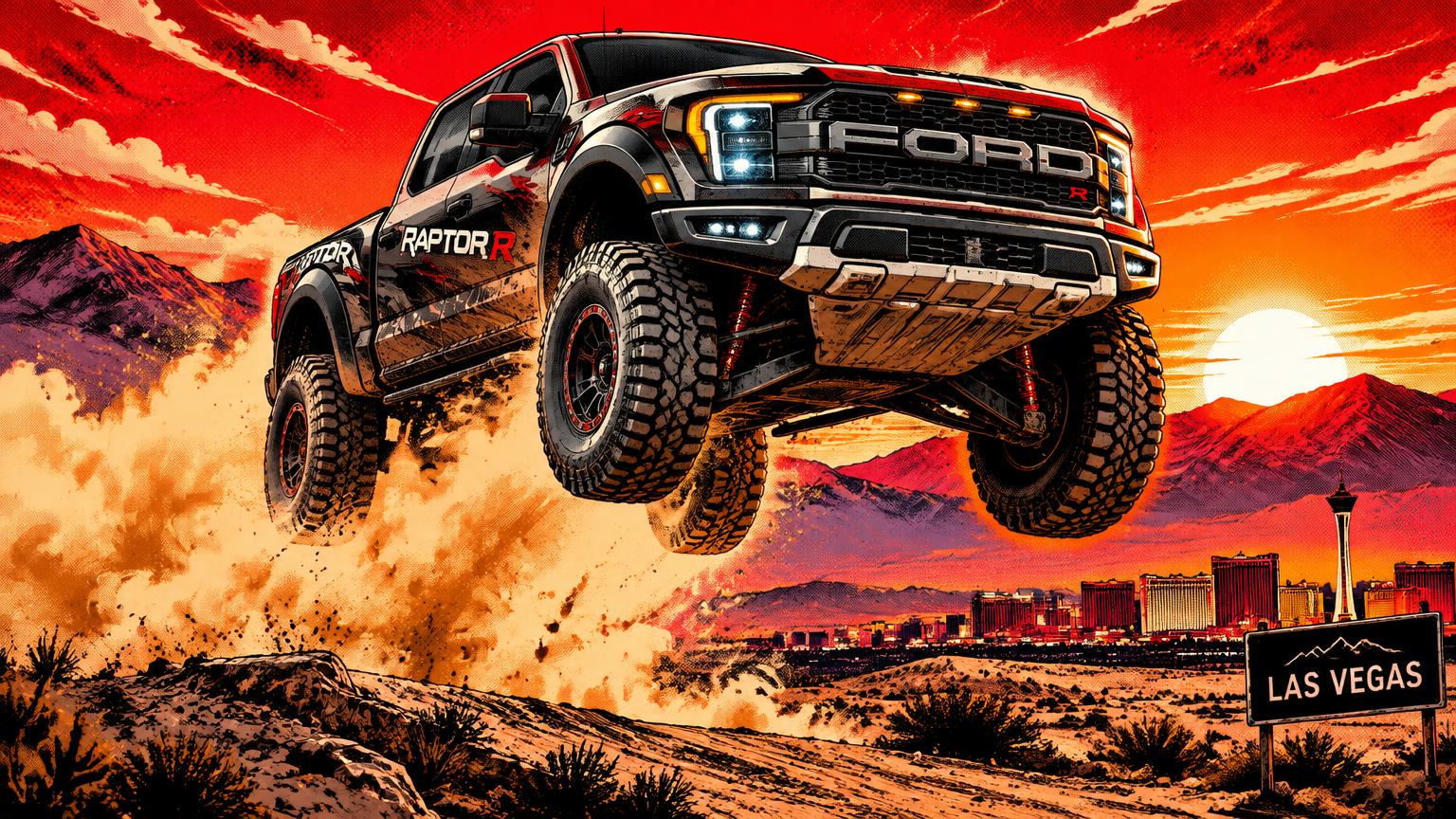
- The jump. This is the only challenger in 15 fights that can catch air on purpose and land it as a feature, not an accident report. Suspension travel is its superpower, and no Formula 1 car will ever have it.
- The work. Eight thousand seven hundred pounds of towing and 1,400 lb of payload, per Ford. It can pull a trailer to the track, carry the tools, and seat the crew of five in air conditioned comfort on the way home.
- The weather and the road home. Four wheel drive, a low range for crawling, a locking rear differential, and 37 inch tires. Rain, sand on the road out by Red Rock, a flooded wash after a desert storm. The truck treats all of it as a scheduling detail.
- The sound. A supercharged American V8 at full chat is one of the great noises in modern motoring. The Formula 1 car is louder in raw decibels. The Raptor R is the one you would record on your phone.
It also wins the ownership briefing, which matters if you ever shop for one. Budget for fuel first, because a 720 horsepower supercharged V8 in a three ton truck drinks premium by the gallon, and the 36 gallon tank exists for a reason.
Budget for tires second. Thirty seven inch all terrains are not economy car rubber, and they are the reason the top speed, the braking, and the cornering numbers look the way they do. Respect them, rotate them, and replace them on time.
And measure your parking spot before you fall in love. At 87.0 inches wide without mirrors and 80.6 inches tall, the Raptor R makes some Las Vegas parking garages and valet lanes a genuine negotiation.
The truck is not too big for this town. Some of this town is too small for the truck.
None of that dims the achievement. Ford took the most powerful engine in its lineup, retuned it for torque, dropped it into its most capable off road truck, and built the quickest gasoline fueled pickup Car and Driver had ever tested. The Raptor R is the V8 answer its fans demanded for a decade, delivered with interest.
What Would Happen on the Las Vegas Strip Circuit?
The home track: the Las Vegas Strip Circuit, 6.201 km, about 3.85 miles, with 17 turns, 50 laps, and a straight of roughly 2 km running along the Strip itself. Full Grand Prix coverage lives on our Las Vegas Grand Prix hub, and the circuit is where this series always runs its final experiment.
Picture the Raptor R launching onto that straight at night. The supercharger wails, the truck squats and charges, and it reaches its 114 mph ceiling with most of the straight still in front of it.
The crowd would love it anyway. This town respects a big entrance, and nothing makes an entrance like a three ton truck doing a burnout under casino lights.
Then come the braking zones, and the arithmetic. Four hundred and thirty feet to stop from 100 mph is a different sport from Formula 1 braking, repeated 17 times a lap, for 50 laps. The tires would surrender, the brakes would plead, and the lap times would tell a story nobody needs a stopwatch to predict.
No invented lap times here. This is an informed comparison, not a recorded race, and nobody has timed a Raptor R around this circuit for us to quote.
What we can say honestly is how the night ends. The Formula 1 car goes back on a transporter under a cover, to be rebuilt by a small army.
The Raptor R drives home. It drives to breakfast in the morning. It tows a boat on Sunday, hauls a bed full of gear on Monday, and jumps a desert wash next weekend, all on the same tires it wore to the fight.
The Final Call
Winner: Formula 1.
Four rounds to none, a clean sweep, the fifth straight clean sweep in this series. Acceleration went to a power to weight advantage of more than five to one. Top speed went to a Formula 1 trap figure nearly double the truck governed maximum.
Cornering and braking went to the car that weighs 768 kg including its driver and uses the air itself as glue and as a brake. The Raptor R was never built to beat a Formula 1 car on a circuit. It was built to be the fastest, loudest, most capable desert truck Ford has ever sold, and on that evidence it is exactly that.
And what a truck it is. A GT500 engine retuned for torque, a 3.6 second sprint in a three ton pickup, suspension that lands jumps as a party trick, and a work rating that lets it tow the toys it just raced. The Raptor R answered a decade of V8 demands with 720 horsepower and a supercharger whine you can hear across a valley.
Formula 1 may win the fight. But the Ford F-150 Raptor R still owns the desert, still jumps what the winner has to drive around, and is still the only challenger in this series that can win the fight, lose the fight, and then tow the winner home.
There are plenty more cars waiting to pick a fight with Formula 1.
Next up: Formula 1 vs. Lexus LFA.
A carbon fiber supercar with a V10 that revs like a Formula 1 car and a soundtrack engineered with a concert hall. The truck brought the muscle. The LFA brings the music.