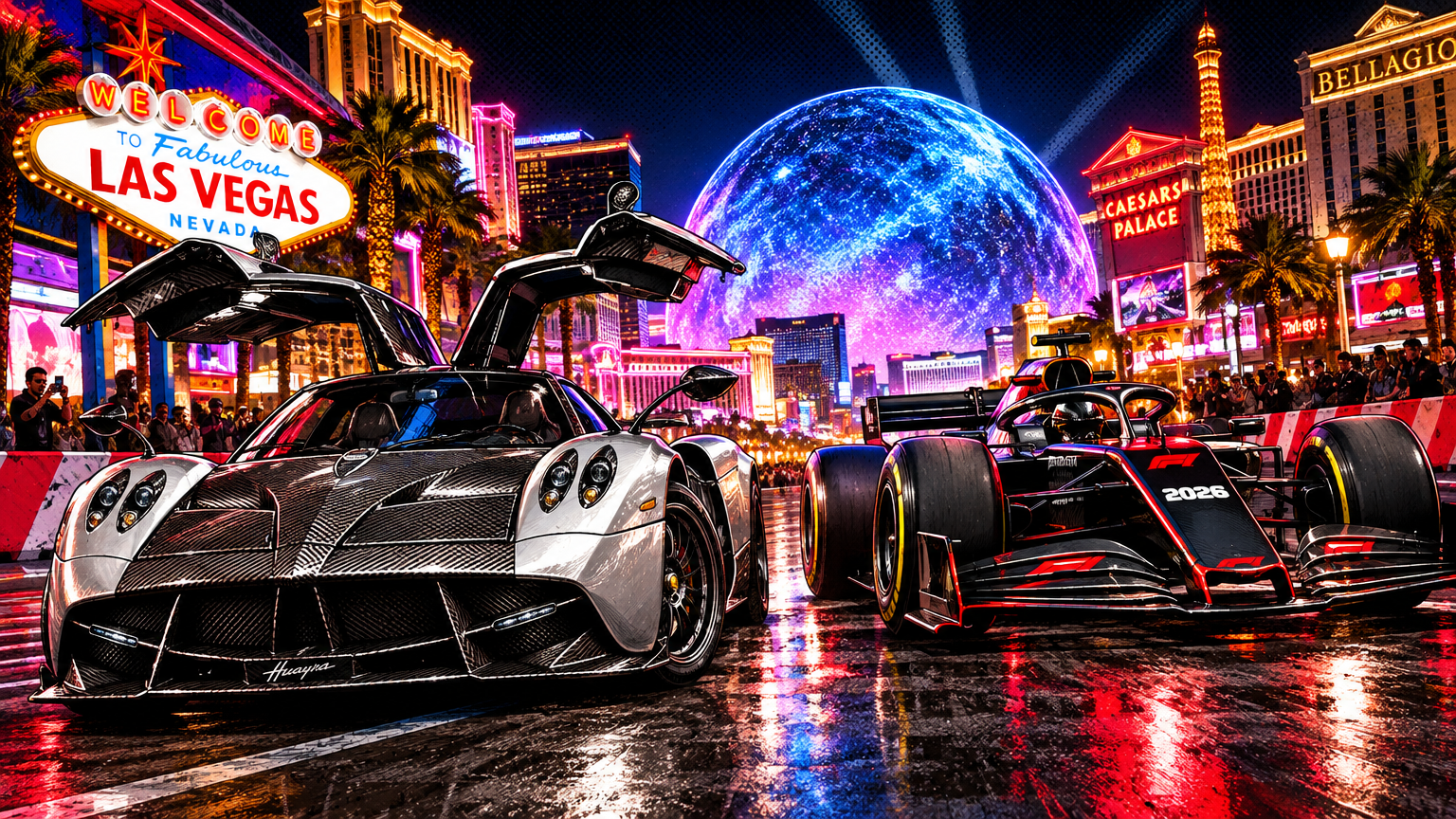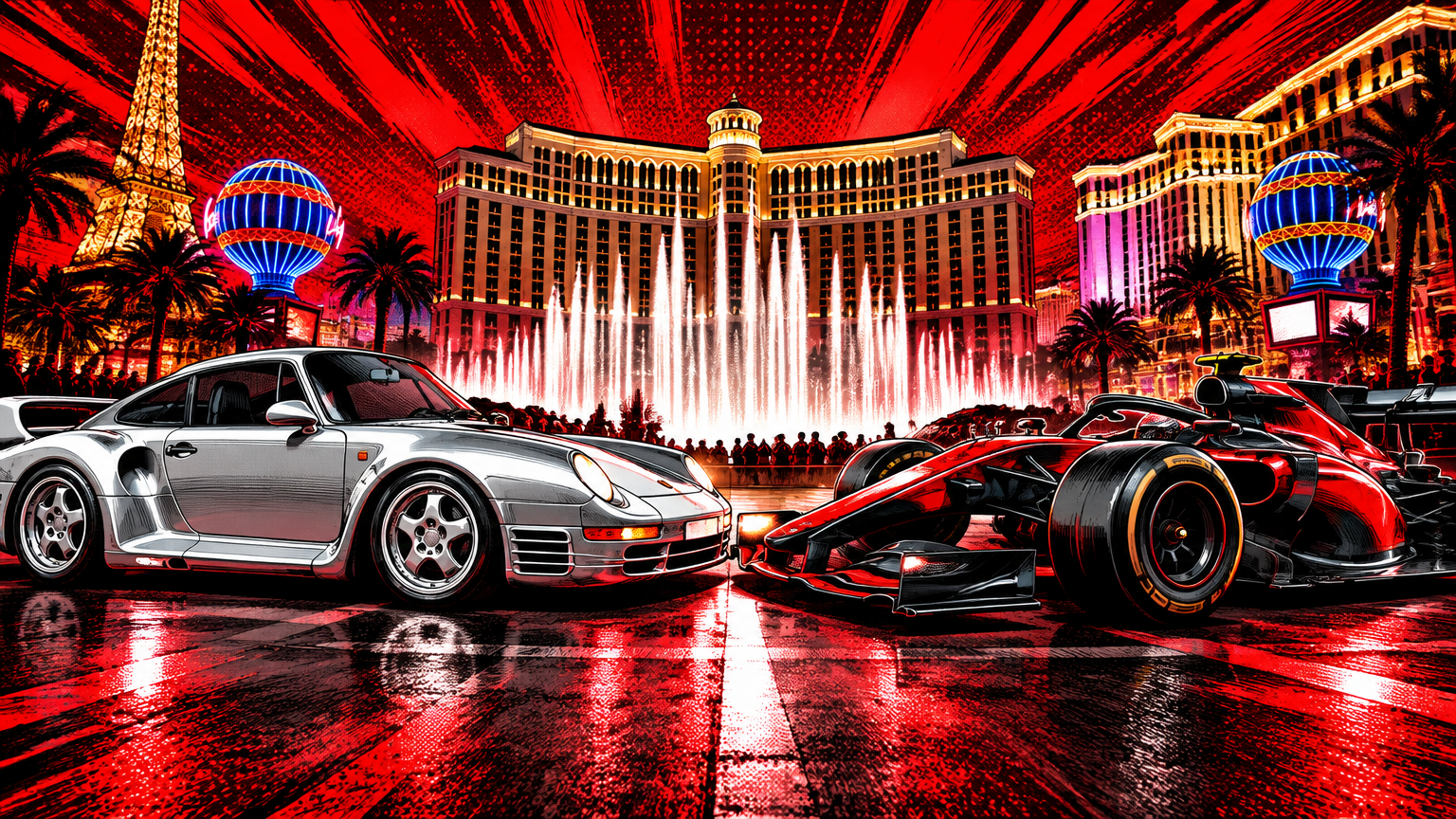
Every modern supercar owes this car money.
Not literally. Porsche never sent invoices. But look at the recipe under almost every flagship performance car built in the last thirty years and you will find the Porsche 959 fingerprints all over it.
All wheel drive that thinks. Turbos that work in sequence so the power never falls off a cliff. A tyre pressure monitoring system.
Suspension that adjusts itself. In 1986, when most supercars were beautiful, loud, and about as high tech as a microwave, the 959 arrived looking like a smoothed out 911 and behaving like a computer with a racing licence.
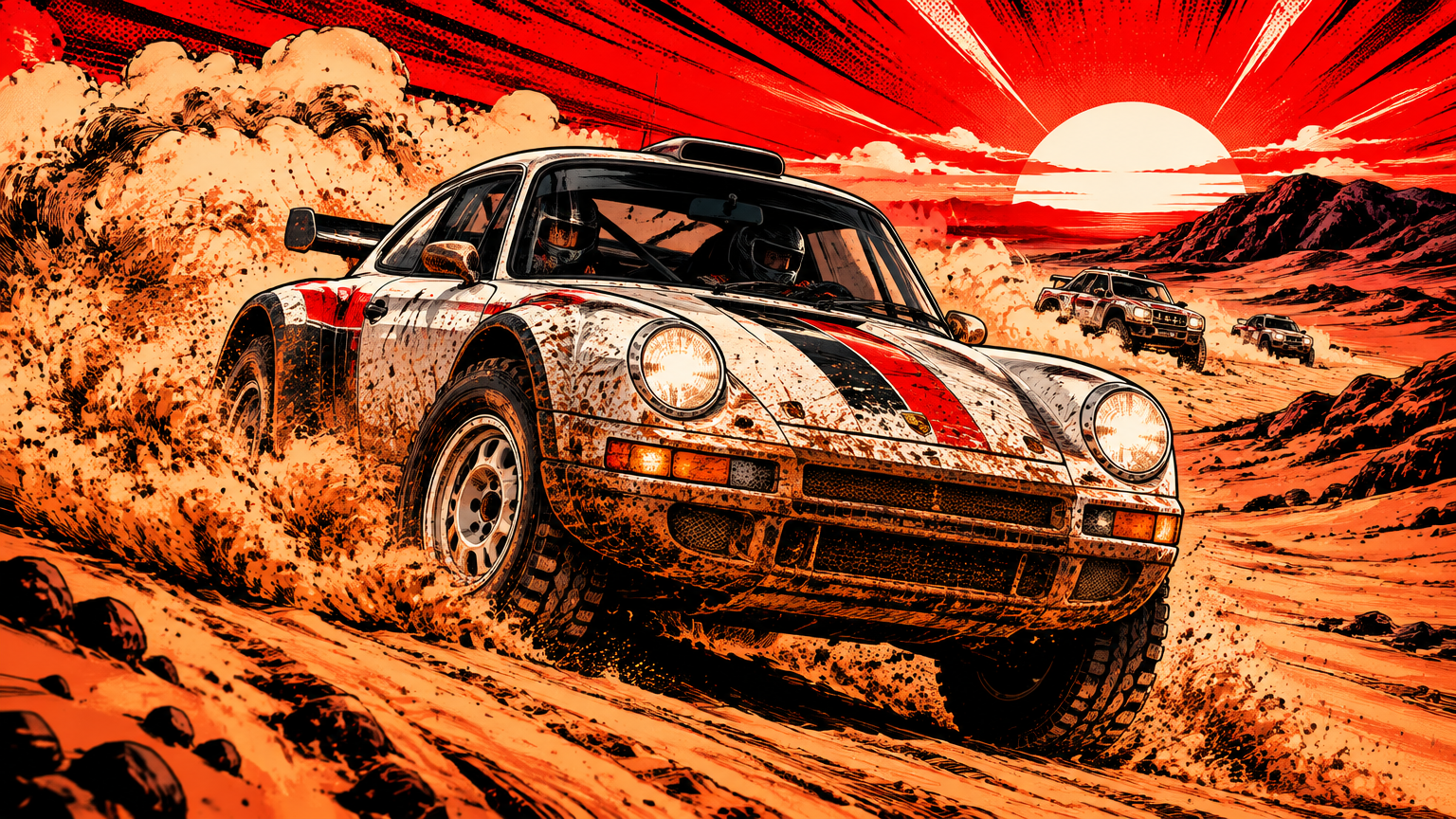
Porsche built it for Group B, the wildest rally formula ever written, and Group B got cancelled before the car ever got its shot. So the 959 did something arguably better. It won the Paris Dakar Rally, the toughest race on Earth, finished first and second, and then went on sale as the fastest production car in the world.
A rally refugee became the template for the modern supercar. You cannot script that.
What happens if the Porsche 959 picks a fight with a Formula 1 car?
What happens is the teacher meets the final exam. On one side, the smartest road car of the 1980s, a car that used electronics to go faster when electronics were still treated with suspicion. On the other side, a 2026 Formula 1 car, which is what happens when that same idea gets forty years, an unlimited research budget, and a rulebook that basically dares engineers to cheat physics legally.
The 959 invented half the tricks in this fight. The Formula 1 car perfected all of them.
Bring a notebook. This challenger wrote the textbook.
First, Which Porsche 959 Are We Talking About?
Precision matters here, because 959 prices and figures swing by version, and the internet loves quoting the rare Sport numbers against the standard car.
The family, kept separate the way this series always keeps it:
- 959 Komfort, 1987 to 1988: our challenger. The standard road car with full equipment, electronic ride height control, and the complete technology package. Nearly all of the 292 series production cars were built to this spec.
- 959 Sport, 1987 to 1988: the lighter, sharper sibling. Commonly counted at 29 cars, with larger turbos, about 515 PS, roughly 100 kg less weight, and a 339 km/h top speed recorded at the Nardo test track in 1988. A different, rarer car. Not scored here.
- Factory power upgrade: Porsche offered customers an optional upgrade to about 530 PS. Period tests credited it with about 336 km/h and 0 to 100 km/h in about 3.4 seconds. Optional then, excluded now.
- 953 and 961 racers: the 953 was the all wheel drive 911 based car that won the Paris Dakar in 1984 and proved the drivetrain. The 961 was the circuit racing version of the 959, which won its class at Le Mans in 1986 and finished seventh overall. Racing cars, context only, never blended into the road car numbers.
- The last eight, 1992 to 1993: eight extra Komfort cars assembled from spare parts after the main run ended, four red and four silver. Same spec family, built later. Not a separate model.
So the scored car is the standard 959 Komfort, exactly as Porsche delivered it to customers from 1987. Here is the full card, Porsche figures first:
- Engine: 2,849 cc flat six, sequential twin turbocharging, air cooled cylinders with water cooled four valve heads, Bosch Motronic engine management. The engine descends from the Porsche 956 and 962 racing powerplants, two of the most successful racing engines ever built.
- Power: 450 PS (444 hp, 331 kW) at 6,500 rpm.
- Torque: 500 Nm (369 lb-ft) at 5,000 rpm.
- Gearbox: six speed manual, including a very low first gear intended for off road use, a Dakar inheritance hiding in a supercar.
- Drive: all wheel drive through the Porsche Steuer Kupplung system, called PSK. A computer controlled multi plate clutch varies the torque split continuously, from 50:50 in slippery conditions to as much as 80 percent to the rear wheels under hard acceleration, per Porsche.
- Weight: 1,450 kg (3,197 lb), achieved with aluminium and aramid composite body panels over a Nomex floor.
- Acceleration: 0 to 100 km/h in 3.7 seconds, Porsche figure.
- Top speed: 317 km/h (197 mph), Porsche figure, which made it the fastest production car in the world at launch.
- Aero: drag coefficient of 0.31 with aerodynamic lift effectively eliminated, remarkable figures for a road car in 1986.
- Brakes: ventilated and drilled discs with four piston aluminium calipers and anti lock braking, the largest brakes Porsche had fitted to a production car at the time.
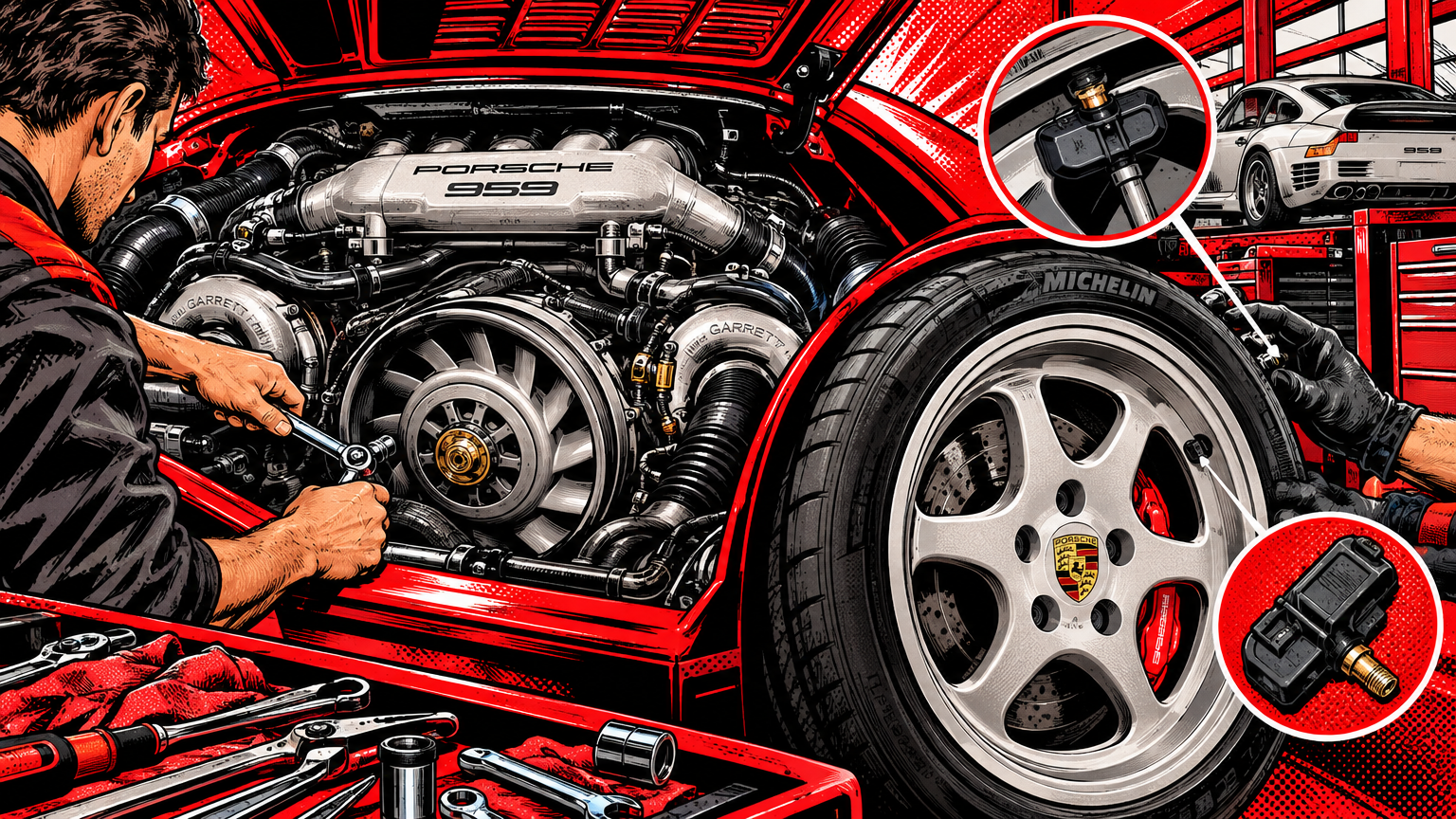
- Wheels and tyres: hollow spoke magnesium wheels forming a sealed chamber with the tyre, fitted with a built in tyre pressure monitoring system and run flat capable tyres.
- Production and price: 292 series production cars built from 1987 to 1988, priced at US$225,000 new per Porsche. Auction prices today run past $1.5 million, per Porsche.
Independent tests, kept separate from the factory claims the way this series always keeps them: Road & Track measured 0 to 60 mph in 3.6 seconds, a quarter mile in 11.9 seconds at 119.5 mph, and a top speed of 198 mph. Auto, Motor und Sport measured 0 to 100 km/h in 3.7 seconds and 318 km/h flat out. Car and Driver, testing the car in 1987, called it as close to perfect as any car they had driven.
The testers agreed with the brochure for once. That almost never happens.
One more fact belongs in this section, because it explains the car better than any spec. The 959 was never certified for sale in the United States when new. Porsche declined to supply cars for US crash testing on such a tiny production run, so American buyers waited years, and some famous cars sat in storage, until the Show and Display rule in 1999 and later the 25 year import rule let the cars in legally.
The smartest car in the world spent a decade as American forbidden fruit. Sound familiar? The Nissan Skyline GT-R R34 in our previous fight lived the exact same story, one generation later.
Meet the 2026 Formula 1 Car
The other corner holds the current Formula 1 machine, built to the 2026 regulations. Keep it honest, the way this series always keeps it: there is no single universal Formula 1 specification sheet, because every team builds its own car inside the same rulebook.
The verified shared facts for the 2026 car:
- Power unit: 1.6 litre turbocharged V6 hybrid. The combustion engine is limited to about 400 kW, and the MGU-K electric motor contributes up to 350 kW. Formula 1 describes the total package as more than 1,000 hp.
- Weight: minimum regulatory weight of 768 kg, about 1,693 lb, including the driver.
- Drive and construction: rear wheel drive, carbon construction, racing tyres, and active aerodynamics at the front and rear.
- Measured speed evidence: Pierre Gasly recorded 353.9 km/h, about 220 mph, in a qualifying speed trap at the 2026 Chinese Grand Prix, per FIA data. That is a trap speed on a circuit, in cornering trim, not a top speed attempt.
Put the two philosophies side by side and the family resemblance is almost funny. The 959 used a computer to split torque between four wheels. The Formula 1 car uses computers for torque, aero, braking balance, energy recovery, and about a thousand decisions per lap the driver never hears about.
The 959 was the first road car that thought while it drove. The Formula 1 car is what thinking while driving grew up to become.


Porsche 959 vs. F1: The Numbers
| Category | Porsche 959 Komfort | 2026 Formula 1 Car |
|---|---|---|
| Engine | 2,849 cc flat six, sequential twin turbos | 1.6 litre turbo V6 hybrid |
| Power | 450 PS (444 hp) | More than 1,000 hp (Formula 1 figure) |
| Torque | 500 Nm (369 lb-ft) | No single published figure |
| Weight | 1,450 kg | 768 kg minimum, including driver |
| Power to weight | About 310 PS per tonne | More than 1,300 hp per tonne |
| 0 to 100 km/h | 3.7 sec (Porsche); 3.6 sec to 60 mph in Road & Track testing | No universal official figure published |
| Top speed | 317 km/h (197 mph), fastest production car in the world in 1986 | 353.9 km/h trap, Gasly, 2026 Chinese GP qualifying (FIA) |
| Drive | Computer controlled all wheel drive, up to 80 percent rear | Rear wheel drive |
| Gearbox | Six speed manual | Sequential racing gearbox |
| Brakes | Steel discs, four piston calipers, anti lock braking | Carbon brakes |
| Built | 292 series production cars | One off per team, per season |
| Price | US$225,000 new; past $1.5 million at auction today | Not for sale at any price |
| Vegas valet factor | 10/10. The valet was a teenager when this poster went up, and his dad still talks about it | 0/10. No passenger seat, no luggage space, and it cannot legally park anywhere |
Read the power to weight line twice, because it decides most of this fight before it starts. The 959 carries about 310 PS per tonne, a monster number for 1986. The Formula 1 car carries more than four times that.
The 959 brought a computer to a horsepower fight. Admirable. Brave.
Historically important. But the other car brought a bigger computer and more than double the power in half the weight.
Round One: Acceleration
Winner: Formula 1.
Give the 959 its flowers first, because its launch is the cleverest part of this round. All wheel drive with a computer splitting torque means all 450 PS reach the road with almost no waste. No wheelspin drama, no sideways theatre, just a 3.7 second run to 100 km/h that humiliated every rival of its day.
Road & Track even beat the factory claim, recording 3.6 seconds to 60 mph. In 1987, nothing this side of a racing car launched like it.
The sequential turbos deserve their own sentence, because they solved the era defining problem. One small turbo spools early for response, then the big turbo joins at about 4,800 rpm and the car surges again. Andrew Frankel, driving a 959 decades later for the piece Porsche quotes, described that second turbo arriving like an artillery shell.
Turbo lag was the tax every fast car paid in the 1980s. The 959 found the loophole.
And it still loses this round, cleanly. More than 1,000 hp against 768 kg is a different sport from 450 PS against 1,450 kg. This series never invents a universal Formula 1 0 to 60 figure, because none is officially published, so score it on the physics both sides publish.
The Formula 1 car has over four times the power to weight, racing tyres, and launch systems refined over decades. The 959 wins the first metre on traction cleverness. Then arithmetic takes over and does not give the lead back.
Reader takeaway, and it is a useful one: the 959 is why your modern all wheel drive performance car launches so hard. Torque vectoring and computer controlled splits, the stuff advertised on family SUVs today, started here, in a car built to win rallies that no longer existed.
Round Two: Top Speed
Winner: Formula 1.
This round hurts, because top speed was the 959 headline act. At 317 km/h, the 959 was the fastest production car in the world when it launched in 1986, and it held that crown until the Ferrari F40 arrived in 1987. Road & Track measured 198 mph, a hair over the claim.
For context, most supercars of the day topped out around 275 km/h. The 959 was not a little faster than its era. It was an era ahead of its era.
The problem is the measuring stick on the other side. Formula 1 trap speeds are recorded on circuits, in cars trimmed to corner, carrying wings that exist to slow the car down in a straight line in exchange for grip. Even so, Gasly trapped 353.9 km/h in 2026 qualifying trim.
Look further back in this series records and the gap grows: Yuki Tsunoda trapped 358.3 km/h at Las Vegas in 2025, and Alex Albon trapped 368.9 km/h there in 2024, the highest figure through the first three editions of the race. Every one of those numbers beats 317 km/h, and none of them was a top speed run.
Score it honestly and the round is not close. But keep the footnote in giant letters: the 959 did its 317 km/h on a public road specification, on road tyres, with a warranty, air conditioning, and a passenger seat. The Formula 1 car does its number for about four seconds at the end of a straight before braking for its life.
Different achievements. One of them changed what road cars believed was possible, and it is not the one that wins this round.
Round Three: Now Add a Corner
Winner: Formula 1.
The 959 was a handling landmark, and the reasons are worth learning. Zero lift aerodynamics meant the body stayed planted instead of trying to take off. The ride height lowered itself automatically at speed.
The dampers adjusted. The PSK system shuffled torque to whichever end had grip, and dashboard gauges even showed the driver how much power was going to the front axle and how much the rear differential was slipping. In 1986, that dashboard readout was science fiction.
Today, half of it lives in a rental car.
None of it survives contact with a Formula 1 corner. The 2026 car generates downforce with active aero front and rear, weighs 768 kg including the human, and turns on racing tyres built for one purpose. The 959, for all its genius, is a 1,450 kg road car on road tyres, asking physics politely.
The Formula 1 car does not ask.
There is one corner case worth naming, because it is the 959 party trick. Give both cars a wet, greasy, low grip surface, the kind of night Las Vegas gets about twice a year, and the gap shrinks hard. The 959 was designed for rally stages and desert tracks, and its brain was built for exactly that chaos.
On a soaked road, the smartest drivetrain of the 1980s would make the Formula 1 car look genuinely uncomfortable for a few corners. Then the surface dries, the tyres wake up, and the round ends the way the table said it would.
Round Four: Braking
Winner: Formula 1.
The 959 braking story starts with a first. It carried the largest brakes Porsche had ever put on a production car, ventilated and drilled discs with four piston aluminium calipers, plus anti lock braking at a time when ABS on a supercar was headline news. Period testing recorded a stop from 70 mph in about 166 feet, a figure that embarrassed contemporaries and still reads respectably today.
The hollow magnesium wheels even monitored tyre pressure while all this happened, because of course they did.
Formula 1 braking is a different category of event. Carbon brakes, enormous downforce pressing the car into the road, and deceleration strong enough that the driver trains his neck like a boxer. The 959 stops like the best road car of its decade.
The Formula 1 car stops like the road got shorter. There is no shame in losing this round. Every road car ever built loses this round, including every other challenger in this series so far.
What the 959 actually wins here is the history point. ABS, tyre pressure monitoring, and brakes sized for the performance instead of the parts bin are standard practice now because cars like this one proved they belonged on a flagship. When your modern car warns you about a soft tyre, that is the 959, still on duty, almost forty years later.
So, Does the Porsche 959 Win Anything?
It wins the argument about what a supercar should be. Before the 959, a flagship was an engine, a shape, and a prayer. After the 959, a flagship was a system.
Here are the five lessons it taught the entire industry, in order:
- All wheel drive belongs on supercars. Porsche itself decided after the 959 that its future turbocharged sports cars would be all wheel drive, per Porsche, and the rest of the industry followed.
- Sequence your turbos and lag dies. One small turbo for response, one big turbo for power. Modern anti lag and twin scroll systems are this idea, refined.
- Tyre pressure is performance data. The 959 monitored it in 1986. It is now legally required equipment on new cars in major markets.
- Suspension should think. Automatic ride height and adjustable damping were 959 party tricks. Adaptive suspension is now a brochure line on ordinary cars.
- A supercar can win in the desert. First and second at the 1986 Paris Dakar, after the 953 prototype won in 1984, plus a Le Mans class win for the 961 circuit version the same year. No other car in this series has a trophy cabinet that varied.
It also wins the ownership briefing, which matters if you ever shop for one. Budget past $1.5 million for a good car, then budget respect for the systems: the PSK drivetrain, the hydraulic ride height hardware, the sequential turbo controls, and magnesium wheels that are now decades old all need specialist care. This is not a car you service on hope.
It is a rolling computer from 1986, and it rewards owners who treat it like one.
And it wins the poster war against almost everything. The McLaren F1 took the speed crown years later and kept it with a naturally aspirated engine, a magnificent achievement we scored in this series.
But the 959 got there first with a computer, two turbos, and four driven wheels, in a decade when rivals were still arguing about carburetors versus injection. First matters.
What Would Happen on the Las Vegas Strip Circuit?
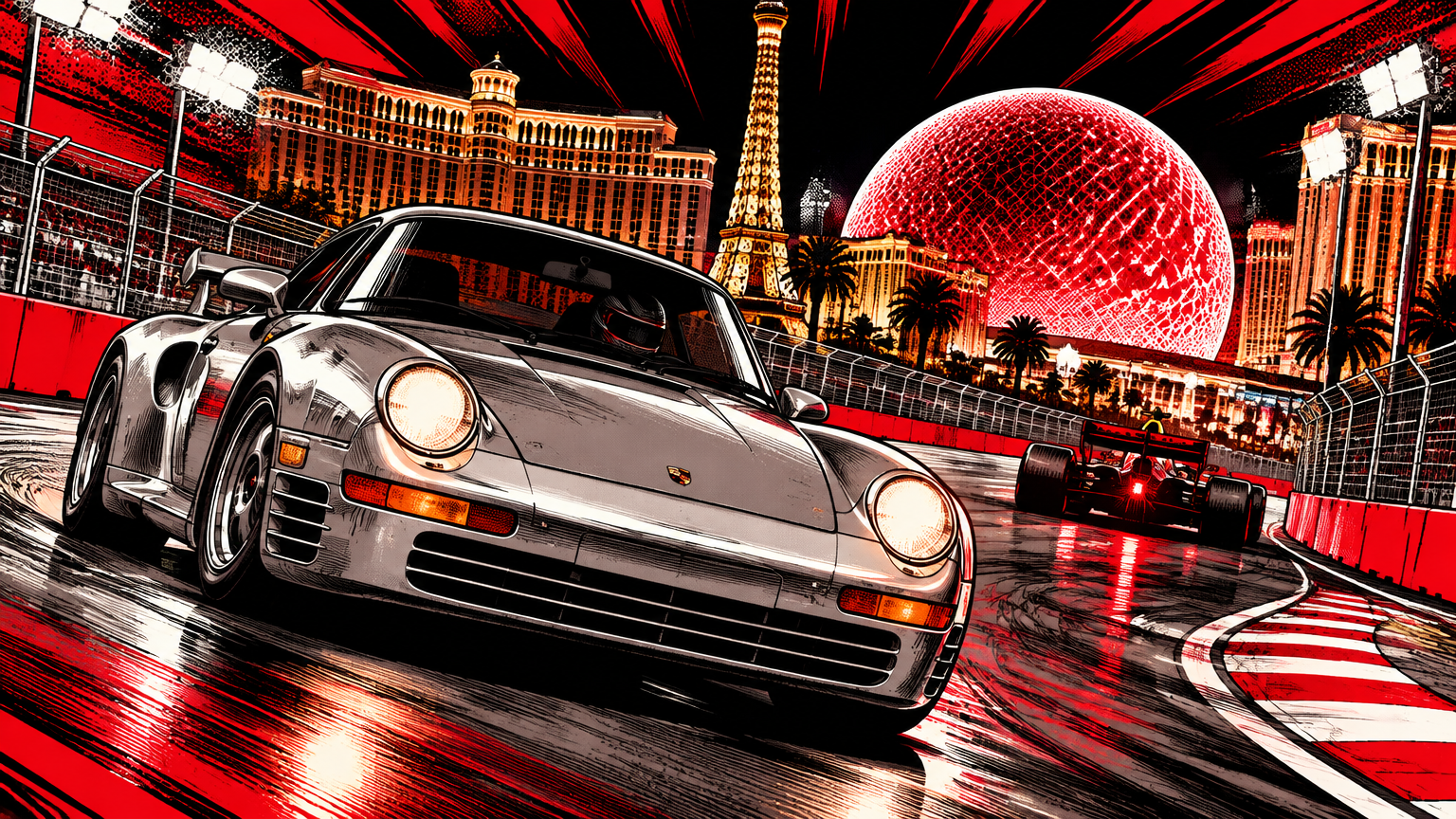
The home track: the Las Vegas Strip Circuit, 6.201 km, about 3.85 miles, with 17 turns, 50 laps, and a straight of roughly 2 km running along the Strip itself. Full Grand Prix coverage lives on our Las Vegas Grand Prix hub, and the circuit is where this series always runs its final experiment.
Picture the 959 on that straight at night. It launches out of the final corner with all four tyres hooked up, the small turbo already working, the big one arriving at 4,800 rpm like a second engine checking in for its shift. It runs hard toward its 317 km/h ceiling under the casino lights, and for a few glorious seconds the most advanced car of 1986 owns the most advanced street circuit of 2026.
The crowd would love it. This town respects a legend that still shows up ready to work.
Then come the braking zones, sixteen more corners, and fifty laps of them. The Formula 1 car brakes later, turns harder, and repeats the trick without fading, at 768 kg with active aero and carbon everything. No invented lap times here.
This is an informed comparison, not a recorded race, and nobody has timed a 959 around this circuit for us to quote. What we can say honestly is how the night ends. The Formula 1 car goes back on a transporter under a cover.
The 959 drives home, in comfort, past the same casinos, with its headlights on and its tyre pressures monitored, like it has somewhere nice to be. In this town, that is not a consolation prize. That is a headline act.
The Final Call
Winner: Formula 1.
Four rounds to none, a clean sweep, the fourth straight clean sweep in this series. Acceleration went to a power to weight advantage of more than four to one. Top speed went to measured Formula 1 traps that clear the 959 maximum by a wide margin, even in cornering trim.
Cornering and braking went to the car that weighs 768 kg including its driver and uses the air itself as glue and as a brake. The 959 was never built to beat a Formula 1 car. It was built to show the entire car industry its own future, and on the evidence of every all wheel drive, turbocharged, self monitoring performance car built since, it spent forty years doing exactly that.
And what a future it predicted. A rally car that never got to rally, so it won the Dakar instead. A road car banned from America when new, so it became a legend Americans chased for decades, with owners like Bill Gates and Jerry Seinfeld on the list Porsche itself publishes.
A top speed crown, a Le Mans class win, and a dashboard that showed its working like a student who knew the answer. The 959 did not just move the supercar goalposts. It replaced the field.
Formula 1 may win the fight. But the Porsche 959 still wrote the playbook the winner is running, still wears the Dakar crown no Formula 1 car will ever chase, and is still the smartest car the 1980s ever produced.
There are plenty more cars waiting to pick a fight with Formula 1.
Next up: Formula 1 vs. Ford F-150 Raptor R. A 700 plus horsepower super truck with long travel suspension leaves the desert floor and picks a fight on asphalt.