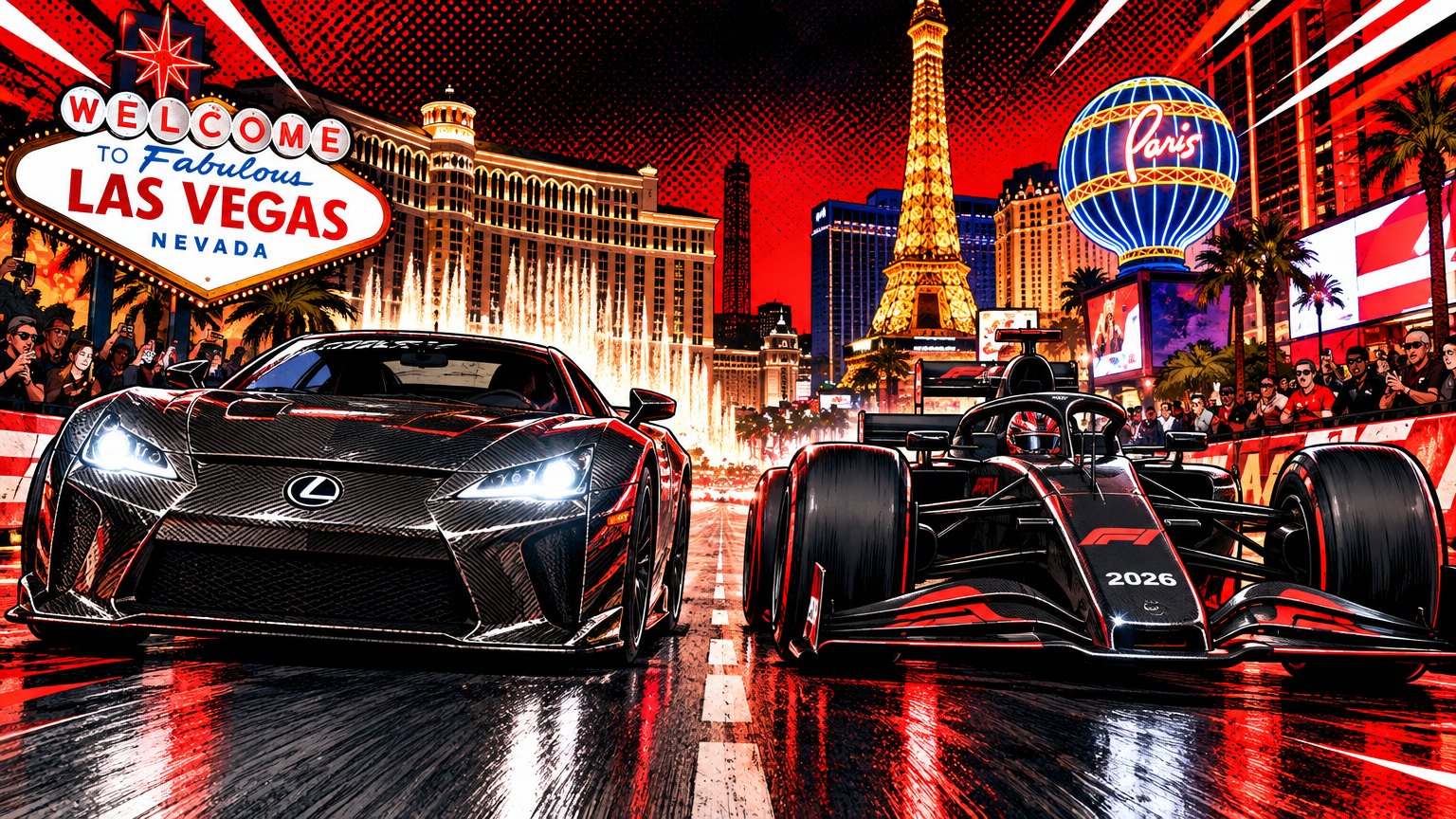
This challenger does not arrive quietly.
Every car in this series makes some kind of noise. The Lexus LFA makes the noise.
Ask a room full of car people to name the best sounding road car ever built and this car ends the argument in about four seconds. That is roughly how long it takes the V10 to climb from a cruise to its 9,000 rpm redline and rearrange your priorities.
Lexus is the luxury brand that built its name on silence. Quiet cabins, soft rides, cars that glide.
Then, after a decade of development, Lexus built a carbon fiber supercar with a V10 tuned like a musical instrument and a digital tachometer because a normal needle could not keep up. It is the least quiet thing the company has ever sold, and it is glorious.
What happens if the Lexus LFA picks a fight with a Formula 1 car?
What happens is the closest thing this series has to a family argument. The LFA engine was inspired by Formula 1, tuned with help from a company that also makes pianos, and wrapped in the same carbon fiber thinking that Formula 1 pioneered.
The student brought a soundtrack. The teacher brought more than 1,000 horsepower and a weight advantage of about two to one.
Turn it up. This is the loudest fight we have staged yet.
First, Which Lexus LFA Are We Talking About?
Precision matters here, because the LFA story has one famous special edition that loves stealing the standard car headlines.
The family, kept separate the way this series always keeps it:
- Standard LFA: our challenger. The production car built from December 2010 to December 2012 at the LFA Works inside Toyota Motomachi plant in Japan, hand assembled at a rate of about 20 cars a month. Exactly 500 LFAs were built in total, including the special edition below.
- LFA Nurburgring Package: a track focused edition inside that same 500 car run. Lexus announced it as a 50 car run, with about 10 more horsepower, quicker shifts, a fixed rear wing, and tuned suspension. Later counts commonly put the final total at 64 cars. Its famous lap time is kept separate below and is never scored as the standard car.
- The concepts and racers: the LF-A concepts shown from 2005 onward, and the GAZOO Racing prototypes that ran the Nurburgring 24 Hours during development. Important history, not the scored car.
- The engine donor that never was: there is not one. The 1LR-GUE V10 was built only for this car, which is part of why this car costs what it costs.
So the scored car is the standard Lexus LFA, exactly as Lexus listed it at launch. Here is the full card, Lexus figures first:
- Engine: 1LR-GUE 4,805 cc (4.8 liter) naturally aspirated V10, 72 degree bank angle, even firing, dry sump lubrication, dual VVT-i, titanium connecting rods and valves, forged aluminium pistons, 12.0 to 1 compression. Co-developed and built by Yamaha, at a pace of about one engine a day, each with a plate naming the craftsman who assembled it.
- Power: 552 hp (560 PS, 412 kW) at 8,700 rpm, per Lexus.
- Torque: 354 lb-ft (480 Nm) at 6,800 rpm, with 90 percent of that torque available from 3,700 rpm, per Lexus.
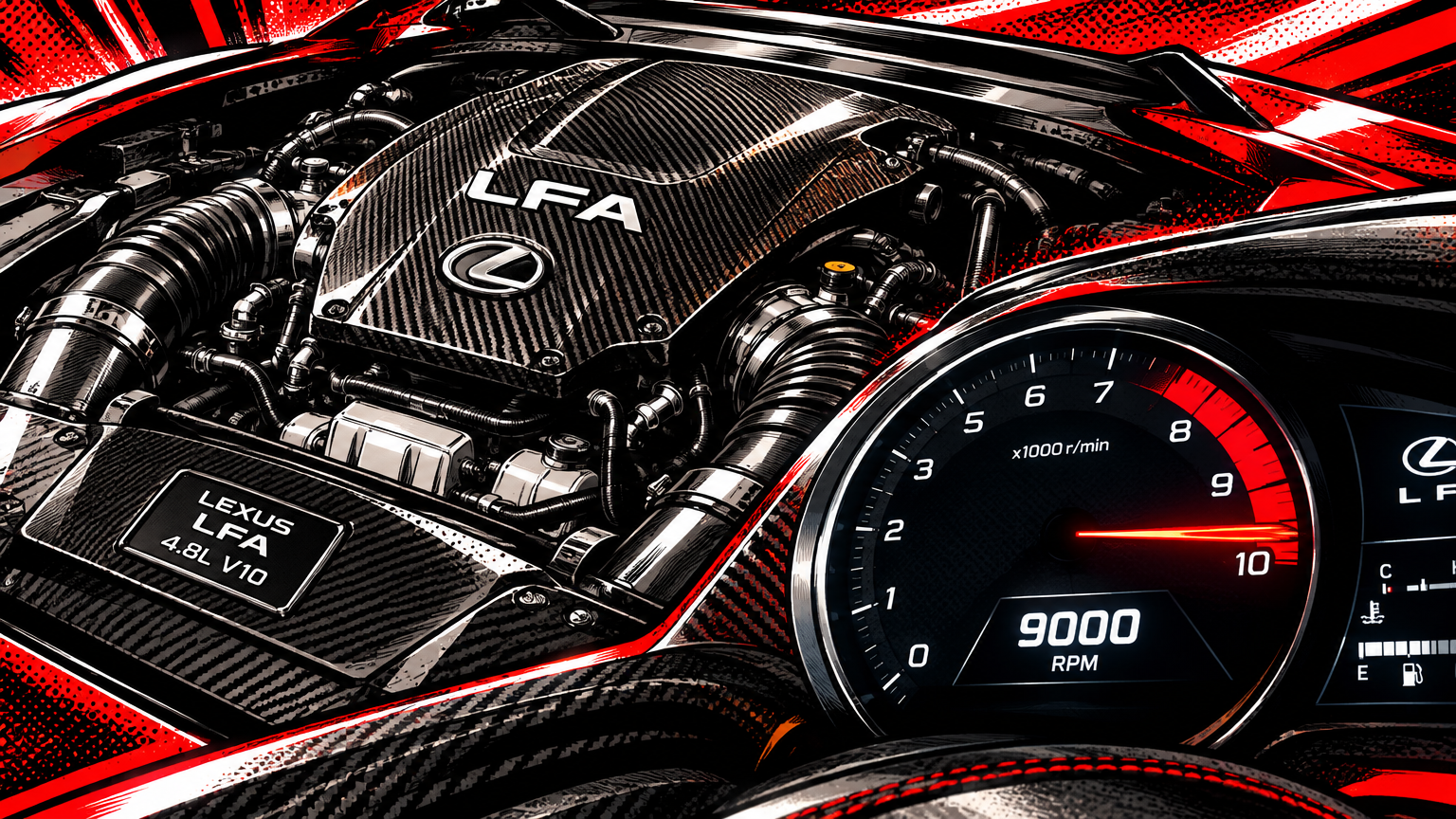
- Redline: 9,000 rpm. Lexus says the engine revs from idle to redline in about 0.6 seconds, which is why the tachometer is digital. A mechanical needle physically could not swing that fast and stay honest.
- Gearbox: six speed Automated Sequential Gearbox built by Aisin, mounted at the rear as a transaxle and linked to the engine by a carbon fiber propeller shaft. Lexus quoted shift times of about 0.2 seconds in its fastest setting. Rear wheel drive with a limited slip differential.
- Body and chassis: carbon fiber reinforced plastic monocoque built in house. About 65 percent of the structure is carbon fiber reinforced plastic and 35 percent is aluminium. Lexus switched the car from aluminium to carbon fiber mid development, a change Lexus figures saved about 100 kg and added stiffness.
- Weight: 1,480 kg (3,263 lb) headline kerb weight per Lexus, with Lexus market specifications listing a 1,480 to 1,580 kg range depending on equipment. Either way, this is a light supercar, not a heavy one.
- Size: 4,505 mm long, 1,895 mm wide, 1,220 mm tall, on a 2,605 mm wheelbase, per Lexus.
- Balance: 48:52 front to rear weight distribution, per Lexus. The engine sits behind the front axle, the gearbox sits at the back, the fuel tank sits ahead of the rear axle, and radiators sit at the rear to push mass toward the middle and the driven wheels.
- Brakes: carbon ceramic discs as standard, 390 mm in front with six piston calipers and 360 mm at the rear with four piston calipers in the test specifications published by major outlets.
- Wheels and tires: 20 inch wheels with Bridgestone Potenza RE070 tires, 265/35 in front and 305/30 at the rear in period specifications.
- Price: $375,000 in the United States when new, per Lexus.
- Chief engineer: Haruhiko Tanahashi. The project began in 2000, the first LF-A concept appeared at Detroit in 2005, and the production car was revealed at the Tokyo Motor Show in October 2009 for the 20th anniversary of Lexus.
Independent tests, kept separate from the factory figures the way this series always keeps them. Car and Driver track tested the LFA in November 2010 in Wales and recorded 0 to 60 mph in 3.6 seconds with launch control, 0 to 100 mph in 7.6 seconds, and a quarter mile in 11.7 seconds at 125 mph.
Edmunds Inside Line tested a 2012 car against a Porsche 911 GT2 RS and recorded 0 to 60 mph in 3.9 seconds without a rollout adjustment, 3.6 seconds with the rollout, and a quarter mile in 11.6 seconds at 124 mph. That same test recorded a stop from 60 mph in 106 feet, 1.02 g on the skidpad, and a 75.2 mph slalom, one of the quickest slalom speeds the outlet had recorded at the time.
Motor Trend tests varied by car and day, as honest tests do. Its figures included 0 to 60 mph in 3.8 to 4.0 seconds in two tests, a quarter mile in 11.9 seconds at 123.7 mph, and in one comparison a stop from 60 mph in 94 feet with 1.05 g on the skidpad.
Read those numbers as a range, not a single magic figure. Launch technique, tires, surface, and whether launch control was used move this car by tenths.
The factory claim and the best independent tests agree on the headline. This is a 3.6 second car on its best day.
One more factory story tells you why this car took ten years. Lexus started building the LFA in aluminium, then threw that structure away and started again in carbon fiber because the aluminium car was not light enough or stiff enough.
Companies chasing a deadline do not do that. Companies chasing a legacy do.
The previous challenger in this series, the Ford F-150 Raptor R, answered a decade of customer demands with a supercharged V8 truck. The LFA spent its decade answering a question nobody had asked Lexus yet. Could the quiet company build a world class supercar from a clean sheet?
Meet the 2026 Formula 1 Car
The other corner holds the current Formula 1 machine, built to the 2026 regulations. Keep it honest, the way this series always keeps it: there is no single universal Formula 1 specification sheet, because every team builds its own car inside the same rulebook.
The verified shared facts for the 2026 car:
- Power unit: 1.6 litre turbocharged V6 hybrid. The combustion engine is limited to about 400 kW, and the MGU-K electric motor contributes up to 350 kW. Formula 1 describes the total package as more than 1,000 hp.
- Weight: minimum regulatory weight of 768 kg, about 1,693 lb, including the driver.
- Drive and construction: rear wheel drive, carbon construction, racing tyres, and active aerodynamics at the front and rear.
- Measured speed evidence: Pierre Gasly recorded 353.9 km/h, about 220 mph, in a qualifying speed trap at the 2026 Chinese Grand Prix, per FIA data. That is a trap speed on a circuit, in cornering trim, not a top speed attempt.
Put the two machines side by side and the family resemblance is real. Both use carbon fiber as their skeleton. Both chase balance, response, and heat management as obsessively as they chase power.
The difference is purpose. The LFA had to be a road car, a luxury car, and a halo car at the same time, with leather, navigation, and a Mark Levinson sound system competing for weight against the performance parts. The Formula 1 car has one job, for about two hours, and then a team rebuilds it.
That difference is about to show up in every round. It also explains why the LFA still matters after the scoreboard is done.
Lexus LFA vs. F1: The Numbers
| Category | Lexus LFA (standard car) | 2026 Formula 1 Car |
|---|---|---|
| Engine | 4.8 litre naturally aspirated V10 | 1.6 litre turbo V6 hybrid |
| Power | 552 hp at 8,700 rpm (Lexus) | More than 1,000 hp (Formula 1 figure) |
| Torque | 354 lb-ft at 6,800 rpm | No single published figure |
| Redline | 9,000 rpm | Higher, and hybrid assisted |
| Weight | 1,480 kg headline kerb (Lexus) | 768 kg minimum, including driver |
| Power to weight | About 373 hp per tonne, on the headline weight | More than 1,300 hp per tonne |
| 0 to 60 mph | 3.6 sec (Lexus figure and best independent tests) | No universal official figure published |
| Top speed | 202 mph, 325 km/h (Lexus) | 353.9 km/h trap, Gasly, 2026 Chinese GP qualifying (FIA) |
| Drive | Rear wheel drive, rear transaxle | Rear wheel drive |
| Gearbox | 6 speed automated sequential, single clutch | Sequential racing gearbox |
| Weight distribution | 48:52 front to rear | Built around the driver and the tyres |
| Production | 500 cars, Dec 2010 to Dec 2012 | Built per team, per season |
| Price | $375,000 new in the US | Not for sale at any price |
| Vegas valet factor | 10/10. Arrive at 9,000 rpm once and the valet stand will talk about it for a month | 0/10. No passenger seat, no road registration, and it needs a crew to start the evening |
Read the power to weight line twice, because it decides most of this fight before it starts. The LFA carries about 373 horsepower per tonne on its headline weight. The Formula 1 car carries more than 1,300 horsepower per tonne.
That is the honest math, and no soundtrack, however perfect, changes it. What the table does not show is response.
The LFA makes its power without turbos and without electric help, from an engine smaller in outside dimensions than a conventional V8, in the words of Lexus engineers at launch. Throttle response in a naturally aspirated engine like this is not a statistic you read. It is a thing your right foot feels, instantly, and it is the first lesson this car teaches.
Round One: Acceleration
Winner: Formula 1.
Give the LFA its full respect first, because its launch is better than its reputation in bench racing arguments. Rear wheel drive, 552 hp, launch control, and a best test figure of 3.6 seconds to 60 mph.
The quarter mile backs it up. Eleven point six to 11.7 seconds at 124 to 125 mph in independent tests is serious speed in a front engine road car with no turbos, no all wheel drive, and no electric motors filling in the gaps.
Here is the reader takeaway hidden inside that number, and you can use it on any car you ever test drive. Watch what happens after 60 mph, not just to 60 mph.
The LFA reaches 100 mph in 7.6 seconds in the Car and Driver test. Its power keeps building to 8,700 rpm, so the car gets stronger as the speed rises, instead of feeling breathless at the top of each gear. That top end hunger is the naturally aspirated signature, and it is why high revving engines feel alive even when a turbo car posts a similar sprint time.
Now the honest weakness, because this series never hides it. The single clutch automated gearbox was already old technology when the car launched.
Shifts quoted at about 0.2 seconds sound quick until you compare them with the dual clutch gearboxes rivals were adopting, which shift with no real pause in drive. In period reviews the gearbox was the one part of the LFA that felt a step behind the engine and the chassis, and that pause costs tenths in a straight line.
And it still would not matter against this opponent. More than 1,000 hp against 768 kg beats 552 hp against 1,480 kg on power to weight by more than three to one.
This series never invents a universal Formula 1 0 to 60 figure, because none is officially published, so score it on the physics both sides publish. Racing tires, active aero trimmed for launch, and that power to weight advantage end this round early.
The LFA wins the sound of the launch, by a mile. The Formula 1 car wins the launch itself.
Round Two: Top Speed
Winner: Formula 1.
This round needs care, because top speed rounds in this series have gone to the road car before when the verified numbers said so. The Bugatti Veyron and the McLaren F1 both took this round on verified figures.
The LFA number is clean and verified. Two hundred and two miles per hour, 325 km/h, per Lexus, for the standard car.
That is a genuine 200 mph supercar, in the club that actually matters, achieved with a naturally aspirated engine and a drag conscious body with an active rear wing. Nothing about that figure needs dressing up.
It just is not enough here. Gasly trapped 353.9 km/h, about 220 mph, in 2026 qualifying trim, in a car carrying wings that trade straight line speed for cornering grip.
Go back through the Las Vegas record in this series and the gap grows. Yuki Tsunoda trapped 358.3 km/h at Las Vegas in 2025, and Alex Albon trapped 368.9 km/h there in 2024, the highest figure through the first three editions of the race.
Every one of those Formula 1 trap speeds beats the LFA maximum, and none of them was a top speed attempt. They were laps, with braking zones at the end.
Use that as your shopping lesson from this round. A headline top speed and a speed trap on a circuit are different kinds of evidence.
A top speed is what a car can do once, on a long enough road, in its slipperiest setup. A trap speed is what a car actually recorded, in traffic trim, on a day when it also had to turn and stop. When the trap speed of the racer beats the headline maximum of the road car, the round is not close, and pretending otherwise would be unfair to both cars.
Round Two to Formula 1, on verified numbers on both sides.


Round Three: Now Add a Corner
Winner: Formula 1.
The LFA cornering case is stronger than a lot of people remember, and it starts with balance. A 48:52 weight distribution, an engine behind the front axle, a gearbox over the rear axle, and a low carbon structure give the car the manners of a mid engine car with the stability of a front engine car.
The test numbers support the story. Inside Line recorded 1.02 g on the skidpad and a 75.2 mph slalom. Motor Trend recorded up to 1.05 g in one test and 1.07 g average lateral acceleration in its formal test data for a 2012 car.
For a road car on road tires, anything at or above 1.00 g is elite company. The slalom speed matters just as much, because it shows the car changes direction willingly instead of just gripping in a steady circle. That willingness is the carbon structure and the mass placement doing their work.
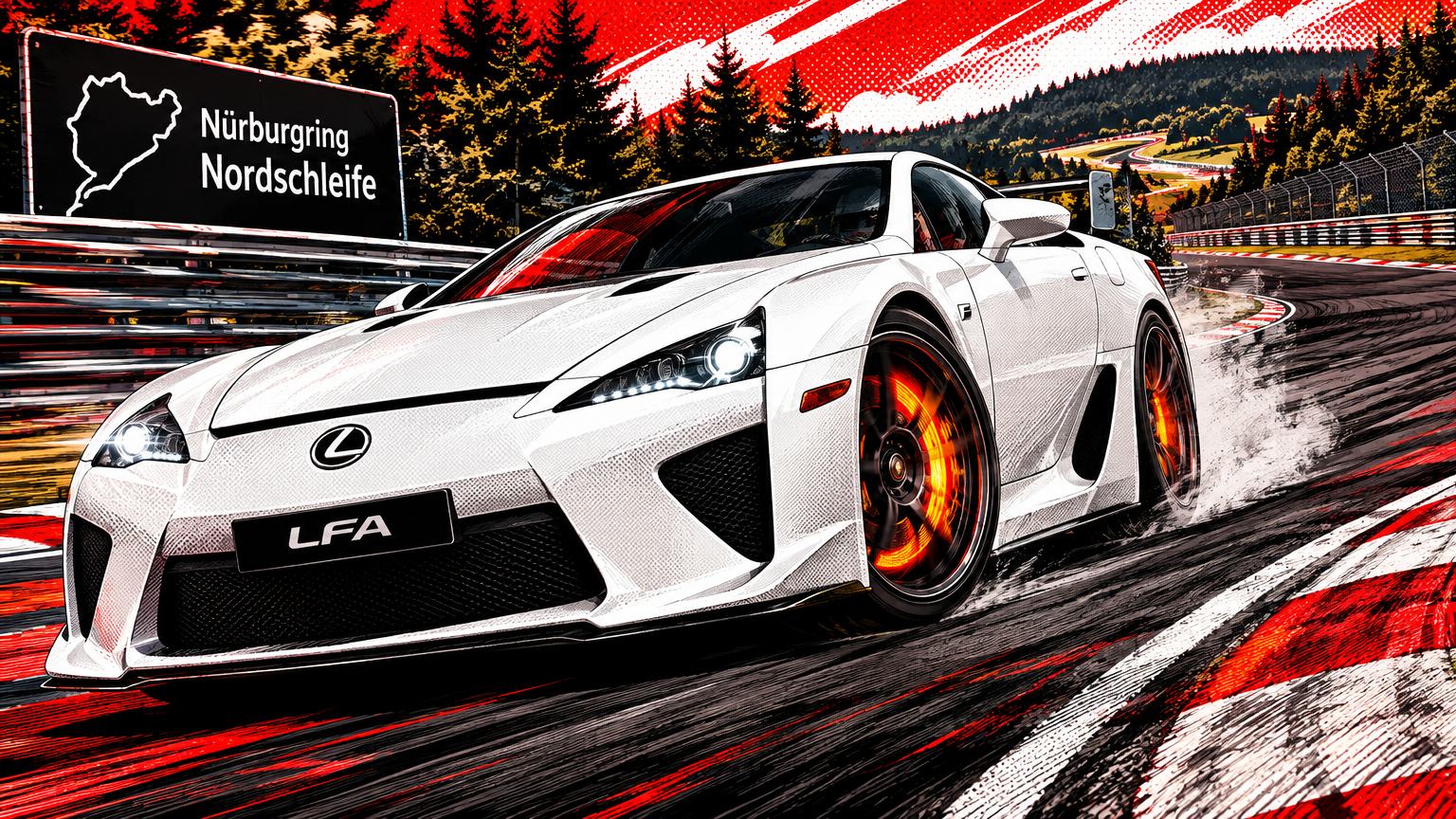
Then there is the lap that made the car legend, kept in its correct box. On August 31, 2011, LFA test and race driver Akira Iida lapped the Nurburgring Nordschleife in 7 minutes 14.64 seconds in an LFA with the Nurburgring Package.
Lexus said the car was unmodified from production specification and ran on the standard Bridgestone Potenza RE070 tires. Lexus presented the time as the fastest lap then recorded for a road registered series production car at the circuit, and it beat the headline times of several famous rivals at that moment.
That lap belongs to the Package car, with its extra power, fixed wing, and tuned suspension, not to the standard car we are scoring. It still tells you what the underlying chassis could do when Lexus sharpened it, and no honest cornering section should leave it out.
None of it closes the gap to a Formula 1 car. Active aero front and rear, racing tires, 768 kg including the driver, and downforce that grows with speed put Formula 1 cornering in a category road cars do not enter.
Here is the usable insight from this round, and it applies to every performance car ad you will ever read. Grip is a system, not a part.
The LFA grips because its structure is stiff, its mass sits low and central, its tires are wide and matched to the car, and its suspension can actually use those tires. Bolting sticky tires onto a soft, heavy car does not reproduce that system. When you shop, ask about weight, balance, and structure before you ask about tire width.
On a circuit, with corners that reward downforce most of all, this round belongs to Formula 1. On a mountain road at road speeds, the LFA balance and response are exactly the point, and the Formula 1 car cannot legally be there at all.
Round Four: Braking
Winner: Formula 1.
The LFA braking hardware is the real supercar specification. Carbon ceramic discs as standard, sized at 390 mm in front and 360 mm at the rear in published test specifications, with six piston front calipers and four piston rear calipers.
The results are exactly what that hardware promises when it is warm and working. Inside Line stopped from 60 mph in 106 feet. Motor Trend recorded 106 feet in one test and 94 feet in another comparison, a reminder that surface, tires, and temperature move braking numbers as surely as they move acceleration numbers.
Ninety four to 106 feet from 60 mph is outstanding for a road car. It is also a perfect place to learn the carbon ceramic lesson, because owners get this one wrong in both directions.
Carbon ceramic brakes are not mainly about one shorter stop on a cool morning. Steel brakes can match a single stop when everything is fresh. Carbon ceramics earn their money on the tenth stop, and the twentieth, because they resist fade at temperatures that would cook a steel setup, and they last far longer under hard use.
The trade off is cost and feel. Replacement carbon ceramic discs are a major expense, quoted per corner in supercar money, and the pedal can feel less giving when the brakes are cold.
If you ever shop a used supercar, ask for a brake wear measurement and a disc condition report before you fall for the paint. A cheap supercar with worn carbon ceramics is not cheap.
Formula 1 braking still lives in another world. Carbon brakes, enormous downforce pressing the car into the road at speed, and deceleration that drivers train physically to endure.
The LFA stops like one of the best road cars of its era, repeatedly, without drama. The Formula 1 car stops like physics got an upgrade. Round Four to Formula 1, with the LFA holding its head high.
So, Does the Lexus LFA Win Anything?
It wins the argument that matters most in the real world. It wins the experience.
Start with the list the Formula 1 car cannot touch, line by line:
- The sound. Yamaha Motor co-developed the engine, and Yamaha Corporation, the musical instrument company, helped tune the acoustics. Lexus called the result Octave Harmony, three sound layers built from intake, exhaust, and cabin resonance, inspired by a Formula 1 engine at full revs. Yamaha later described the exhaust note with a phrase that stuck: the roar of an angel. No modern turbo hybrid Formula 1 car sounds like this, and everyone in the sport knows it.
- The response. Idle to 9,000 rpm in about 0.6 seconds, with no turbo lag and no electric delay. The digital tachometer exists because the engine outruns a needle. That single detail teaches the whole car: response was the religion, not a byproduct.
- The carbon lesson. Lexus learned to build carbon fiber structures at low volume on this car, then spent the next decade working out how to bring carbon thinking to higher volume cars. The LFA was a research program you could buy, and its 100 kg saving over the abandoned aluminium structure is the receipt.
- The rarity and the ritual. Five hundred cars, about 20 a month, engines built one a day with the builder name on a plate. Owners did not just buy a car. They joined a production story with their name in the sequence, even if we never tell anyone their number in line.
- The everyday supercar brief. Two seats you can use, a proper cabin, navigation, and a 12 speaker Mark Levinson system in a car that laps the Nurburgring in the low sevens in Package form. The Formula 1 car is faster at everything and usable for almost nothing outside a circuit.
It also wins the ownership briefing, which is where this car gets serious. An LFA is not a used car purchase. It is a stewardship decision.
Budget for specialists first. A bespoke V10, a carbon structure, and a single clutch gearbox need technicians who know this specific car, and there were only 500 chances to learn. Ask who will service it before you ask what it costs.
Budget for consumables second. Carbon ceramic discs, model specific tires, and low volume parts carry low volume prices. The purchase price is the entry ticket, not the whole bill.
And buy the story with the car. Service records, original specification, and Package status matter enormously on a 500 car run, because the Nurburgring Package cars are a distinct and more valuable subset.
Paperwork is part of the car at this level. Treat it that way.
None of that dims what Lexus achieved. A luxury brand famous for quiet built a 9,000 rpm V10 supercar in carbon fiber, took a decade to do it, lost the comfort of an aluminium shortcut, and produced the car that still anchors every best sounding car debate more than a decade later.
That is not a footnote. That is a legacy.
What Would Happen on the Las Vegas Strip Circuit?
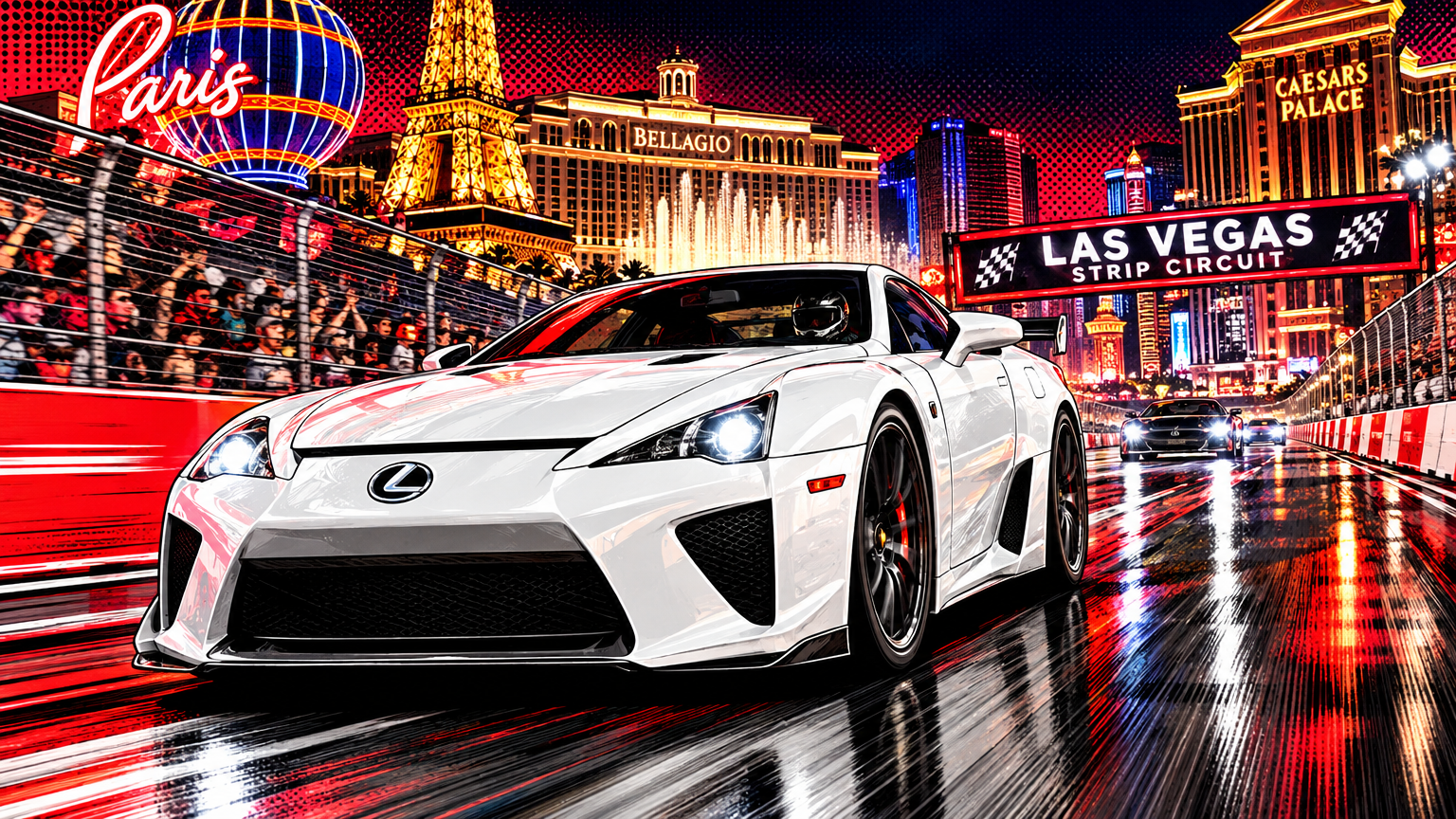
The home track: the Las Vegas Strip Circuit, 6.201 km, about 3.85 miles, with 17 turns, 50 laps, and a straight of roughly 2 km running along the Strip itself. Full Grand Prix coverage lives on our Las Vegas Grand Prix hub, and the circuit is where this series always runs its final experiment.
Picture the LFA launching onto that straight at night. No turbos, no hybrid chime, just a V10 climbing through three intake and exhaust layers toward 9,000 rpm while the casino lights reflect off carbon fiber.
The crowd would hear this challenger before they saw it, and they would remember the sound after the lap times were forgotten. Las Vegas understands a headline act, and at full revs the LFA is one.
Then come the braking zones and the corners, 17 of them, lap after lap. The LFA carbon ceramics would do honest, repeatable work. The balance would flatter the car in the medium speed sections.
And the Formula 1 car, with more than three times the power to weight and downforce the LFA does not have, would still walk away on the clock.
No invented lap times here. This is an informed comparison, not a recorded race, and nobody has timed an LFA around this circuit for us to quote.
What we can say honestly is how the night ends. The Formula 1 car goes back on a transporter, to a garage full of engineers and data.
The LFA drives down the Strip with its windows down, at legal speed, making a noise at 4,000 rpm that most cars cannot make at any speed. It parks. It gets photographed.
It drives home, and it will still be a road car in the morning.
The Final Call
Winner: Formula 1.
Four rounds to none, a clean sweep, the sixth straight clean sweep in this series. Acceleration went to a power to weight advantage of more than three to one. Top speed went to verified Formula 1 trap speeds that beat the LFA 202 mph maximum in cornering trim.
Cornering and braking went to the car that weighs 768 kg including its driver and uses downforce as grip and as a brake. The LFA was never going to beat that math, and this series never pretends math is optional.
And what a car it still is. A V10 that revs like a race engine because a piano company helped tune it, a carbon body that rewrote what Lexus knew how to build, and a decade of stubborn engineering that refused the easy aluminium answer. Five hundred cars, one engine per day, and a soundtrack that has outlived cars twice as powerful.
Formula 1 may win the fight. But the Lexus LFA still owns the soundtrack, still teaches every car that followed it what response feels like, and is still the loudest proof in this series that the quietest company in the business was saving its voice for one perfect shout.
There are plenty more cars waiting to pick a fight with Formula 1.
Next up: Formula 1 vs. Pagani Huayra.
A twin turbo V12 from AMG, a carbon titanium body, and active aero flaps that move like wings. The LFA brought the music. The Huayra brings the wind.