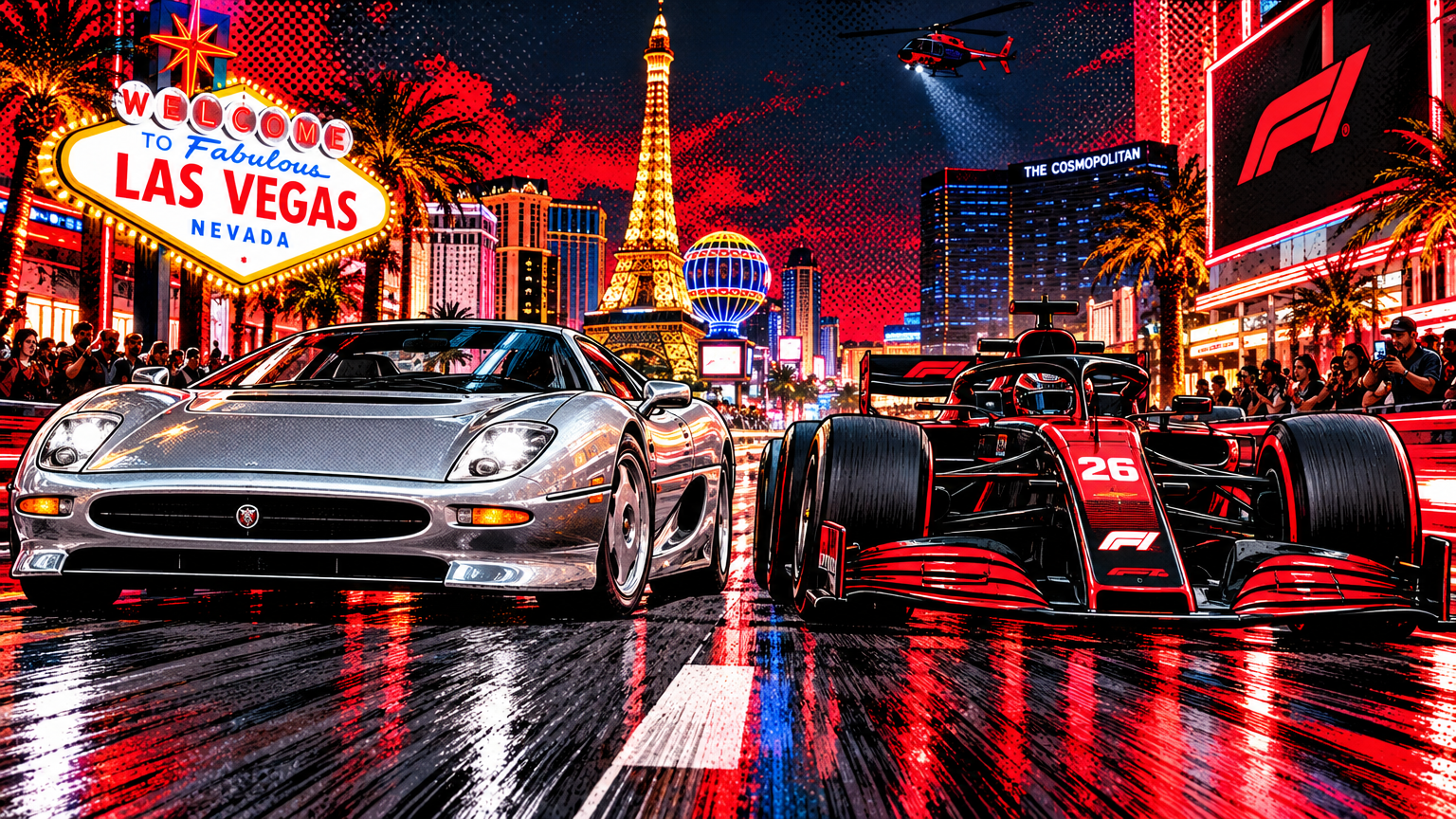
Some cars get named after an animal. Some get named after a founder. The Jaguar XJ220 got named after a speed it never quite reached.
That sounds like an insult. It is not. This car held the title of fastest production car in the world, and it still missed its own name by a few miles per hour.
What happens if the Jaguar XJ220 picks a fight with a Formula 1 car?
What happens is a history lesson with teeth. The XJ220 brings a racing V6, a world record from 1992, and one of the strangest origin stories in supercar history.
The Formula 1 car brings more than 1,000 horsepower and weighs about half as much. Let us score the real car, in standard trim, on numbers that can be checked.
First, Which Jaguar XJ220 Are We Talking About?
The XJ220 name covers two very different cars. Blending them is the first mistake almost every quick summary makes.
The family, kept separate the way this series always keeps it:
- The production XJ220, our challenger: built by JaguarSport, the Jaguar and Tom Walkinshaw Racing joint venture, at Bloxham in Oxfordshire from 1992 to 1994. Twin turbo V6, rear wheel drive, five speed manual. This is the scored car.
- The 1988 concept: a 6.2 liter V12, all wheel drive, and scissor doors, shown at the British Motor Show in Birmingham in October 1988. Gorgeous, and never sold. Not scored.
- The XJ220 S: a later, lighter, more powerful road version with carbon panels and roughly 680 hp in period reporting. Rare, wild, and a different car. Not scored.
- The racing XJ220s: competition cars built for track use. Context only. Not scored.
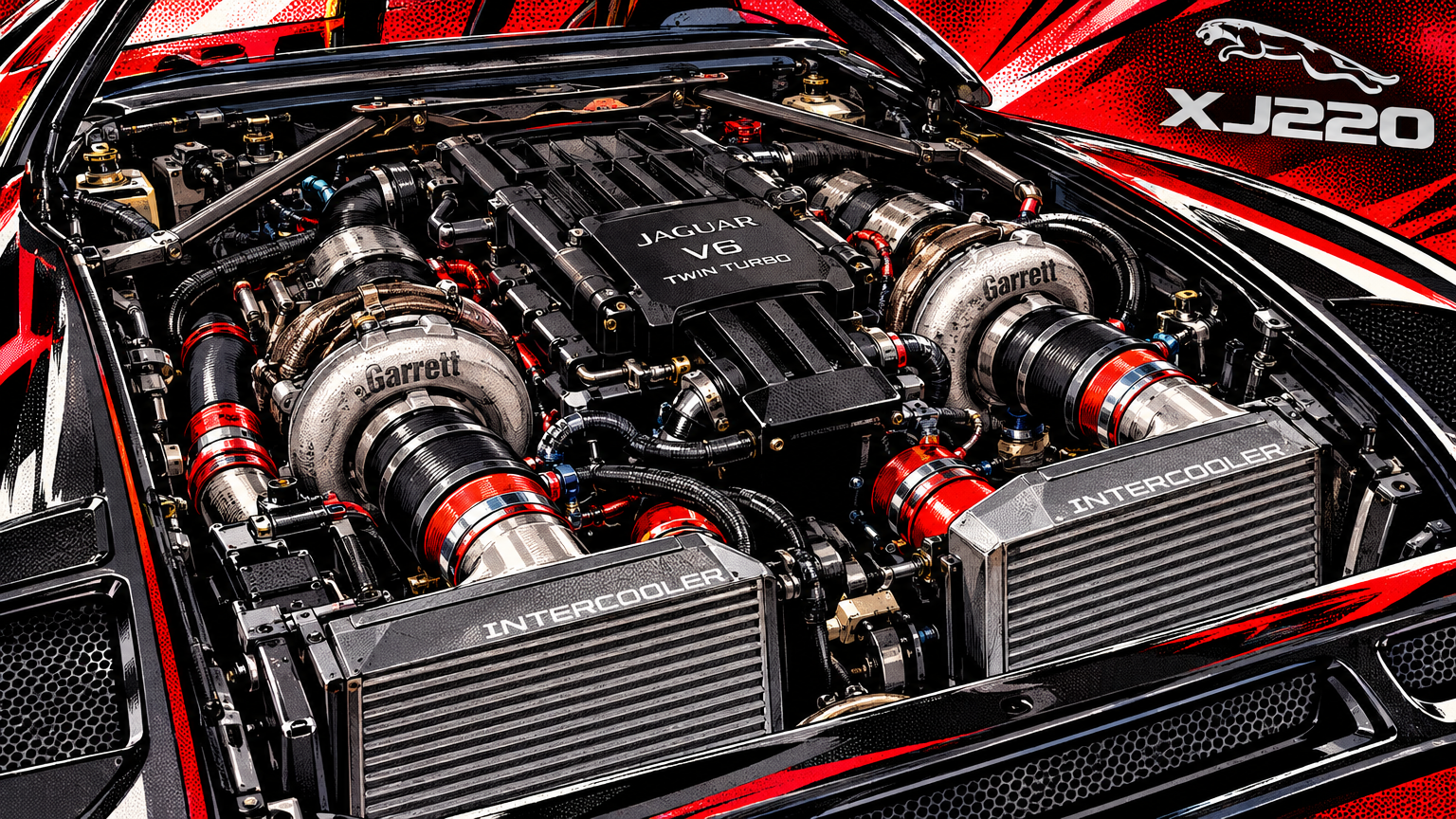
Now the scored car, Jaguar figures first. The engine is the Jaguar JRV-6, a 3,498 cc twin turbocharged V6 with four cams and 24 valves.
Its roots are pure racing. The design traces back through the Jaguar XJR-10 and XJR-11 Group C racers and the Metro 6R4 rally car program, and it was developed with Tom Walkinshaw Racing.
Jaguar rated it at 542 bhp at 7,200 rpm. That is 550 PS, or about 404 kW, if you prefer the other scales.
Torque peaks at 475 lb-ft at 4,500 rpm. Two Garrett turbochargers and twin intercoolers do the heavy lifting, and period drivers all describe the same delivery.
Nothing, nothing, then everything. Turbo lag was part of the character, and learning to drive around it was part of the job.
The rest of the Jaguar sheet:
- Gearbox: five speed manual transaxle, rear wheel drive, with a limited slip differential and an AP Racing twin plate clutch.
- Weight: Jaguar quoted 1,470 kg. Published weights wander by source and by how the car was measured, which is a buyer lesson we will come back to.
- Size: about 4,930 mm long and about 2,000 mm wide, on a 2,640 mm wheelbase. This is a very wide car, and owners feel that width on real roads.
- Chassis: bonded aluminum honeycomb structure, with aluminum body panels. Light and stiff was the whole point.
- Brakes: AP Racing ventilated discs, about 330 mm at the front and 300 mm at the rear, with four piston calipers. No anti lock brakes on the production car.
- Steering: unassisted. No power steering, no traction control, and no stability control. The driver is the electronics package.
- Tires: specially developed Bridgestone Expedia tires, with huge 345 section rears on 18 inch Speedline wheels.
- Price new: 470,000 pounds in 1992, per Jaguar. At launch it sat among the most expensive cars in the world.
Now the origin story, because you cannot understand this car without it. The XJ220 started as a spare time project.
Jaguar engineering chief Jim Randle and a small group of colleagues, nicknamed the Saturday Club, worked on it after hours. Designer Keith Helfet shaped the body.
They wanted a modern echo of the Jaguar Le Mans winners of the 1950s. They also wanted a target top speed of 220 mph, following the XK120 naming idea from four decades earlier.
The 1988 concept stopped the Birmingham show. Jaguar took deposits and signed off production in December 1989, with TWR as the partner.
Then reality edited the car. The big V12 was heavy and hard to pass through tightening emissions rules, so the racing V6 replaced it.
All wheel drive went away. Scissor doors went away. Rear wheel steering and anti lock brakes went away too.
What survived was lighter, simpler, and in a straight line, faster than the concept brief required. What also survived was disappointment, because buyers had paid deposits for the V12 car.
That disappointment shadowed the XJ220 for years. It is also unfair, and the numbers in this piece show why.
Production counts need the same honesty. Jaguar media marking 20 years since launch said 275 cars had been built by 1994.
The Jaguar Daimler Heritage Trust says 281 cars were produced from 1992 to 1994. Other listings say 282, usually by counting a car the other totals treat differently.
Useful takeaway for buyers: never argue about the total in a listing. Verify the individual chassis number, the sill plate, and the build record for the car in front of you.
Meet the 2026 Formula 1 Car
The other corner needs no mythology. A 2026 Formula 1 car is a hybrid racing machine built to a tight rule book, and this series uses the same verified facts every time.
- Engine: 1.6 liter turbocharged V6 hybrid. The combustion engine is limited to about 400 kW, and the MGU-K electric motor adds up to 350 kW.
- Total output: described by Formula 1 as more than 1,000 hp for the full package.
- Weight: minimum regulatory weight 768 kg, about 1,693 lb, including the driver.
- Drive and construction: rear wheel drive, carbon construction, active front and rear aero, and racing tires built only for this job.
One fact matters more than the rest here. The F1 car weighs about 702 kg less than the Jaguar quoted weight, and it makes roughly double the power.
That math shapes every round below. The XJ220 was a record breaker in its day, but its day was 1992.
Speed trap evidence keeps us honest. Pierre Gasly recorded 353.9 km/h, about 220 mph, in qualifying at the 2026 Chinese Grand Prix, per FIA data.
That is a circuit figure in cornering trim, not a top speed attempt. Keep that label in mind for Round Two, because this series always does.
Jaguar XJ220 vs. F1: The Numbers
| Category | Jaguar XJ220 | 2026 Formula 1 Car |
|---|---|---|
| Engine | 3.5L twin turbo V6 | 1.6L turbo V6 hybrid |
| Power | 542 bhp at 7,200 rpm | More than 1,000 hp (F1 figure) |
| Torque | 475 lb-ft at 4,500 rpm | Not published as one combined figure |
| Weight | 1,470 kg (Jaguar quoted) | 768 kg minimum, with driver |
| Gearbox | 5 speed manual | Sequential racing gearbox |
| Drive | Rear wheel drive | Rear wheel drive |
| 0 to 60 mph | 3.6 sec (Jaguar figure) | No universal official figure |
| Top speed | 212.3 mph in standard trim | 353.9 km/h trap, 2026 China qualifying |
| Built | 275 per Jaguar media, 281 per Heritage Trust | Built per team, per season |
| Vegas valet factor | 10 out of 10. Valets will fight over the keys. | 0 out of 10. No valet is insured for this. |
Read the table the right way. The XJ220 line was elite in 1992, and the F1 line is elite in a different sport entirely.
One number deserves its own paragraph. Power to weight for the Jaguar works out near 369 bhp per tonne on the quoted weight.
For the F1 car, the same rough math lands well past 1,300 hp per tonne. That gap is not tuning. That gap is category.


Round One: Acceleration
Jaguar quoted 0 to 60 mph in 3.6 seconds, and period reporting repeats figures in the 3.5 to 3.7 second range. For a wide, rear drive, manual car on early 1990s tires, that is serious pace.
The catch is delivery. The turbos need revs before they deliver, the clutch is a racing twin plate unit, and there is no launch control to tidy any of it up.
A good driver in the XJ220 is busy. A good driver in an F1 car is also busy, but the car helps with systems the Jaguar never had.
Formula 1 publishes no universal 0 to 60 time, and this series never invents one. The verdict rests on power to weight, traction, and gearing instead.
On all three, the F1 car is in another league. It weighs half as much, makes double the power, and puts it down on racing rubber.
Winner: Formula 1. The XJ220 launches like a 1992 record breaker. The F1 car launches like a racing car, because it is one.
Round Two: Top Speed
This is the round the XJ220 was built for, so let us give its record the full, careful version. Most summaries flatten it into one number, and that flattening hides the best part.
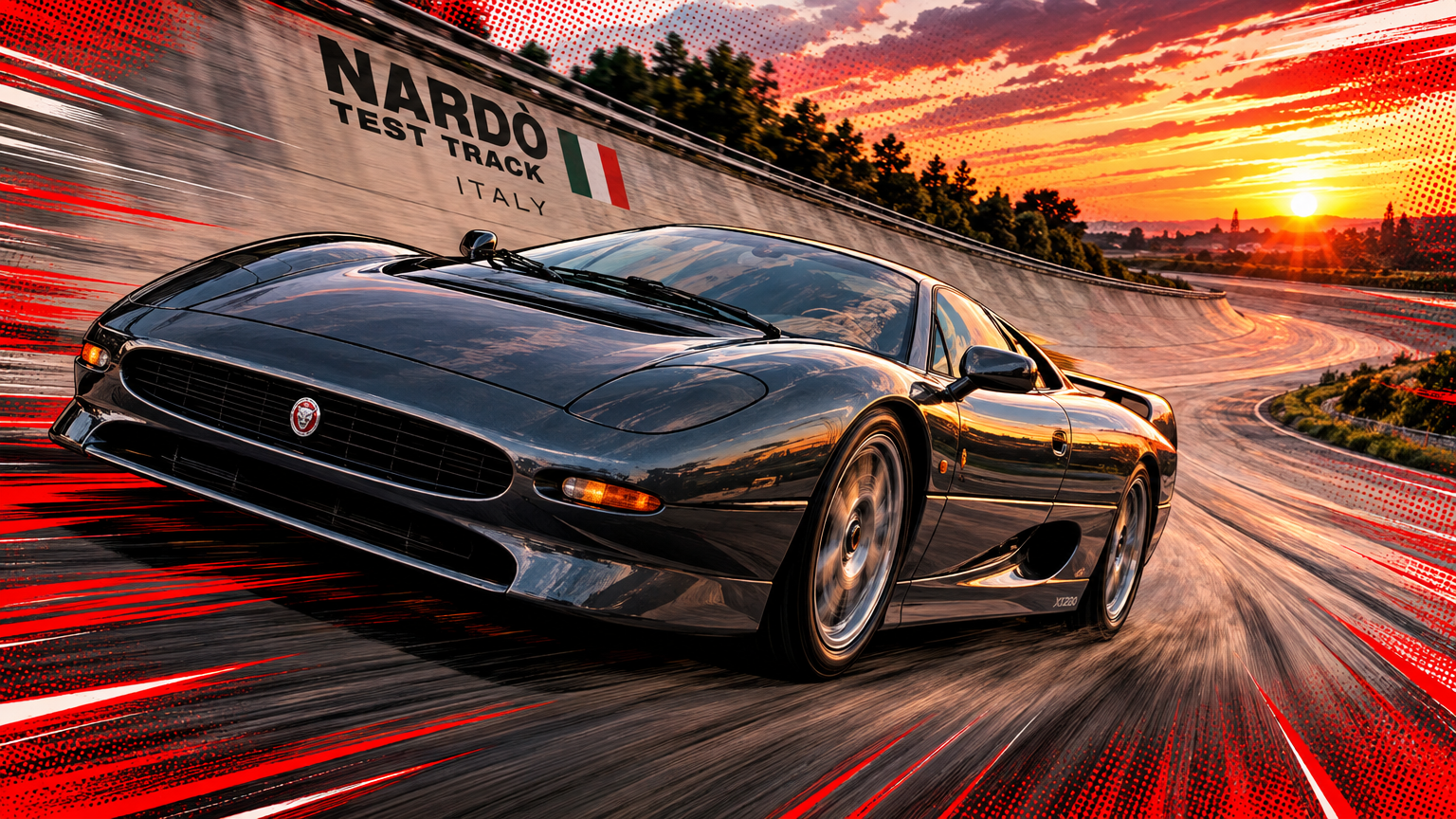
- Fort Stockton, Texas, 1991: pre production chassis 004, with Andy Wallace driving, recorded 212.3 mph. Jaguar Heritage confirms Wallace reached 213 mph in that car during testing, rounding the same run.
- Nardo, Italy, June 1992: in standard trim, catalytic converters connected and the lower rev limit in place, Martin Brundle recorded 212.3 mph again. Independent witnesses were present, including magazine journalists.
- Nardo, same test, modified trim: with the catalytic converters disconnected and the rev limit raised from about 7,200 to 7,900 rpm, Brundle recorded 217.1 mph. That is a real run, but it is not the standard car, so this series does not score it as one.
Jaguar itself rounds the headline to 213 mph. Its own media release calls the XJ220 the fastest Jaguar ever produced, with the highest maximum speed of any production car at launch in 1992.
That title held until the McLaren F1 arrived and took the record in the next round of this series. The XJ220 also held a Nurburgring production car lap record of 7:46.36, set by a prototype in 1991 per Jaguar.
Now the F1 side, labeled correctly. The highest trap figures in this series are 368.9 km/h by Alex Albon in Las Vegas in 2024, 358.3 km/h by Yuki Tsunoda in Las Vegas in 2025, and Gasly at 353.9 km/h in China in 2026.
Even the lowest of those, Gasly at about 220 mph, clears the standard XJ220 figure of 212.3 mph. The modified 217.1 mph run still sits below all three trap figures.
Fairness note, stated plainly: F1 traps are measured on circuits in cornering trim, not on a banked bowl chasing a record. That makes the F1 numbers stronger, not weaker, in this comparison.
Winner: Formula 1. The XJ220 was the fastest production car in the world. Formula 1 traps, on ordinary race weekends, run faster than its record.
Round Three: Now Add a Corner
The XJ220 was not a one trick car. Jaguar reported that Nurburgring lap because the car could turn, brake, and change direction at a level no production car had matched before it.
Its tools were real. A stiff aluminum honeycomb chassis, double wishbone thinking, huge rear tires, and underbody venturis that helped generate downforce.
Its limits were real too. It is nearly two meters wide, the steering is unassisted and heavy at low speed, and the turbo delivery can arrive mid corner if the driver gets greedy.
There is no anti lock braking and no traction control to catch a mistake. On a modern track day, that honesty is thrilling. Against an F1 car, it is a handicap.
The F1 car corners on active aero, carbon brakes, and tires that exist for one purpose. Its downforce at speed exceeds its own weight, a sentence the XJ220 could never honestly print.
Winner: Formula 1. The Jaguar held a production car lap record for years. The F1 car operates on a lap time scale production cars still cannot reach.
Round Four: Braking
Braking is where period road tests were kindest and cruelest to the XJ220 at the same time. The AP Racing hardware was proper racing kit for 1992.
Ventilated discs at both ends and four piston calipers were serious specification. Repeated high speed stops, though, asked a lot of a 1,470 kg car with no anti lock system.
Later buying guides still flag the standard brakes as a known weak point for the performance on offer. Many owners have upgraded them, which is useful context for anyone shopping today.
The F1 car brakes with carbon discs, enormous downforce pressing it into the road, and a hybrid system harvesting energy under braking. Stopping is one of its party tricks, repeated lap after lap.
Useful insight you can actually use: single stop distance and repeated stop stamina are different tests. The XJ220 story teaches the second one, and it matters in any fast road car you buy.
Winner: Formula 1. Racing brakes from 1992 meet a braking system three decades newer, built to do this 50 laps in a row.
So, Does the Jaguar XJ220 Win Anything?
Yes. It wins the story, and it is not close.
- The record: fastest production car in the world in 1992, and still the fastest Jaguar ever produced, per Jaguar itself.
- The lap: a 7:46.36 Nurburgring production record in 1991, years before lap records became a marketing sport.
- The origin: a world record car designed after hours by engineers who were not asked to build it. Try finding that story in a modern product plan.
- The lesson: the V6 everyone complained about made the car lighter and faster than the V12 brief. The unpopular choice was the right engineering choice.
It also wins on presence. Park an XJ220 on the Las Vegas Strip and the crowd forms before the door finishes opening.
And it wins a buyer briefing worth having:
- Verify the chassis, not the total. Production counts differ by source, so the individual build record matters more than any headline number.
- Ask about the brakes. Upgraded systems are common and can be a plus for use, but they change originality. Know which you are paying for.
- Budget for specialist care. A racing V6 with twin turbos needs people who know this exact car, not general exotic experience.
- Check tires and width. The special rear tires and the two meter width shape where and how you can actually enjoy the car.
Missed the last matchup? Catch up on Formula 1 vs. Toyota Supra Mk IV, where the tuner king fought on stock power.
What Would Happen on the Las Vegas Strip Circuit?
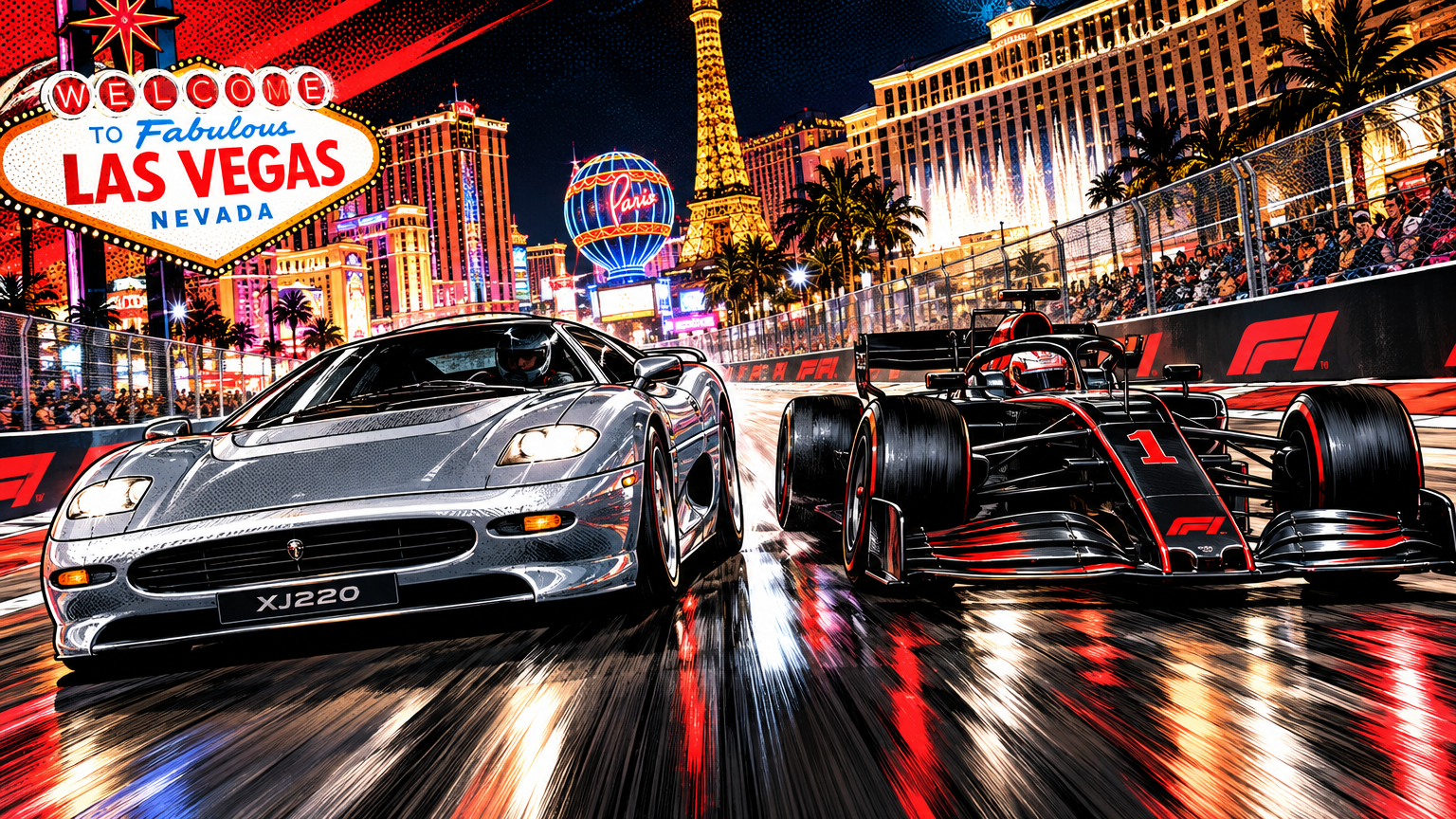
The Las Vegas Strip Circuit runs 6.201 km, about 3.85 miles, with 17 turns over a 50 lap Grand Prix distance. Its signature is the roughly 2 km straight along the Strip itself.
That straight is the one place the XJ220 would feel at home. Give it a long, flat run and the twin turbo V6 would pull hard toward speeds few road cars of any era can match.
Then Turn 1 arrives. Then the braking zones, the tight sections, and the surface changes of a street circuit, repeated again and again.
No invented lap times here, because none exist for this pairing. The informed comparison is simple: the F1 car would brake later, turn harder, and get back to full power sooner at every one of the 17 turns.
Over one lap the gap would be large. Over 50 laps, heat, brakes, and tires would make it larger.
For the full picture of the race itself, visit our Las Vegas Grand Prix hub. It is the home base for this series and for race week coverage.
The Final Call
Score it clean. Acceleration to Formula 1, top speed to Formula 1, corners to Formula 1, and braking to Formula 1.
That is 4 to 0, and the score flatters nobody. It simply measures a 1992 road car, however extraordinary, against a 2026 racing car built without compromise.
The XJ220 deserves better than a footnote about a V6 swap and a missed name. It was the fastest production car on Earth, it set a Nurburgring record, and it was dreamed up after hours by people who loved the idea too much to wait for permission.
Formula 1 may win the fight. But the Jaguar XJ220 still holds a world record story no modern committee would ever approve, and that is exactly why it matters.
There are plenty more cars waiting to pick a fight with Formula 1.
Next up: Formula 1 vs. Lamborghini Revuelto: the V12 flagship goes hybrid, gains all wheel drive, and brings more than 1,000 horsepower of its own. Can the new bull finally make this interesting?