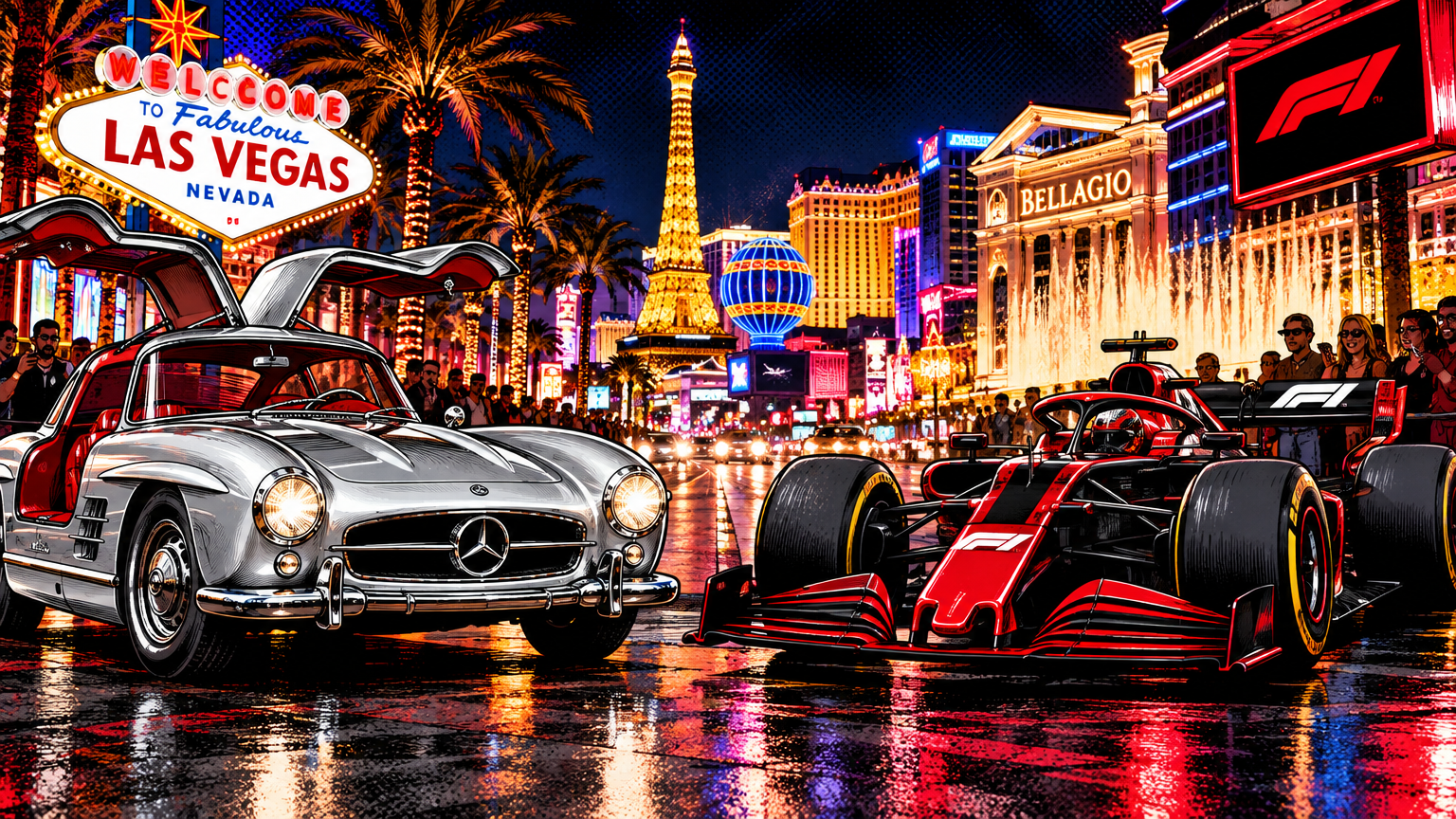
The doors go up before the argument even starts.
Every other car in this series arrives with a spec sheet. The Mercedes-Benz 300 SL Gullwing arrives with a silhouette that people who know nothing about cars can draw from memory.
It was the fastest production car on Earth when it was new. It was the first production car with direct fuel injection. And its doors were not a styling trick, they were an engineering confession.
What happens if the Mercedes-Benz 300 SL Gullwing picks a fight with a Formula 1 car?
What happens is a fight across seventy two years of progress. On one side, 215 horsepower, drum brakes, and a steel tube frame welded together like a bridge. On the other side, more than 1,000 horsepower and a car that weighs barely half as much.
The Gullwing has no business winning this. It also has nothing left to prove, which makes it the most dangerous kind of challenger. Let us score it anyway.
First, Which Mercedes-Benz 300 SL Are We Talking About?
The 300 SL name covers more than one car, so let us pin this one down before the doors close.
The family, kept separate the way this series always keeps it:
- The Gullwing coupe, our challenger: the standard steel body production car, code W198, built from August 1954 to May 1957 at Sindelfingen. Mercedes-Benz built 1,400 of them.
- The W194 racer: the 1952 competition car the road car was based on, with carburetors instead of fuel injection. It won at Le Mans and in the Carrera Panamericana in 1952. Context only, not scored.
- The 300 SL Roadster: the open car that replaced the coupe from 1957 to 1963, with normal doors and handling changes of its own. A different car, not scored.
- The alloy body Gullwings: just 29 coupes built with light alloy bodies, roughly 80 kg lighter than the steel car. Rare, valuable, and not our scored car.
- The 300 SLR: a full racing machine with a different engine and a famous, tragic history. It shares letters and little else. Not scored.
Now the scored car, Mercedes-Benz figures first. The engine is the M198, a 2,996 cc single overhead cam inline six, canted over at 45 degrees so it could fit under that low hood line.
It uses dry sump lubrication, which lets the engine sit lower and keeps oil moving under hard cornering. It also uses the feature that changed car history, and we will give that its own moment below.
Mercedes-Benz rated the standard car at 215 PS at 5,800 rpm, quoted in America at the time as 215 hp DIN, with the American SAE gross rating listed at 240 hp. Torque was rated at 275 Nm, about 203 lb-ft, at 4,600 rpm.
That DIN and SAE gap is your first free lesson in reading old spec sheets. The two systems measured power differently, so the same engine wore two honest numbers.
When a 1950s American ad says 240 and a German sheet says 215, nobody is lying. They are just using different rulers, and now you know to ask which ruler any old car claim used.
Power runs through a four speed all synchromesh manual gearbox to the rear wheels. No automatic, no paddles, no launch control. Your right foot and your left foot do all the computing.
The rest of the Mercedes-Benz sheet:
- Weight: 1,295 kg, about 2,855 lb, in ready to drive condition including the spare wheel, tools, and fuel, per Mercedes-Benz. The tubular spaceframe itself weighed just 82 kg.
- Size: 4,520 mm long, 1,790 mm wide, 1,300 mm tall, on a 2,400 mm wheelbase.
- Suspension: double wishbones and coil springs at the front, and a swing axle with coil springs at the rear. That rear design matters, and Round Three will explain why.
- Brakes: finned drum brakes at all four wheels, hydraulically operated with servo assistance. Yes, drums. At up to 161 mph. Round Four will have words about that.
- Price new: 29,000 marks in Germany, and 6,820 dollars in America in 1954, per RM Sotheby's. Hold that number for the value story later.
Now the two ideas that make this car a landmark instead of just a pretty coupe. First, the frame.
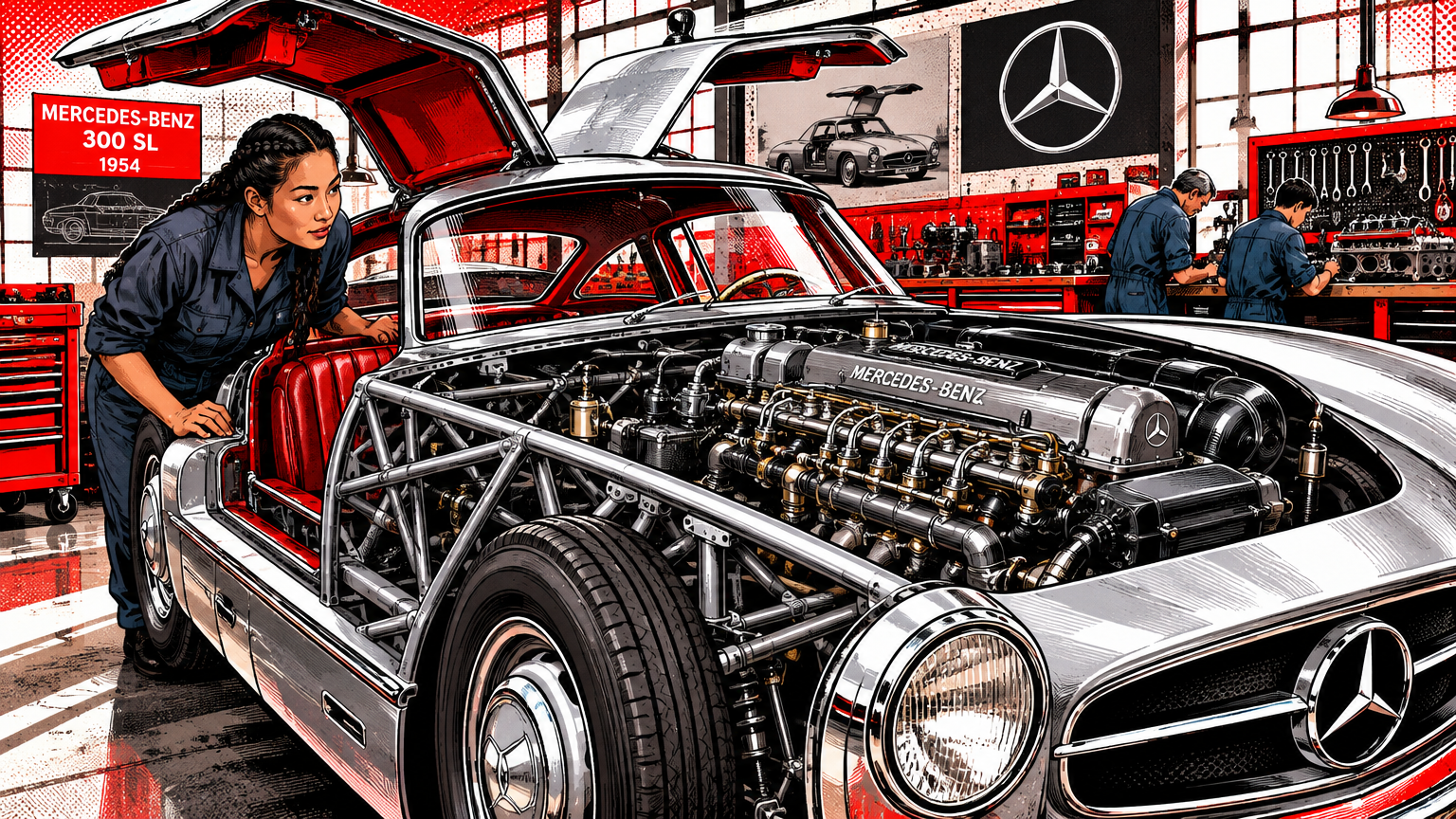
Chief engineer Rudolf Uhlenhaut and his team built the car around a welded tubular spaceframe, a cage of thin steel tubes arranged in triangles. Triangles are strong, tubes are light, and the result was a stiff structure that weighed about as much as a modern racing bicycle collection.
The catch was height. The frame tubes ran high along both sides of the cockpit to keep the structure strong, and a normal door cut into the side would have cut into the frame itself.
So the engineers hinged the doors in the roof. The doors carry a section of roof with them, the steering wheel tilts to help you climb over the wide sill, and the most famous doors in car history exist because a frame tube was in the way.
Second, the fuel system. The M198 sprayed fuel directly into the cylinders with a Bosch mechanical direct injection system.
Mercedes-Benz Group states it plainly: this was the first four stroke direct injection system in a production car. The technology came from aircraft engine practice, and it lifted output well beyond what the carbureted racing version had made.
Here is why that should stop you for a second. Direct injection did not become normal in ordinary gasoline cars until decades later.
The Gullwing had it in 1954, when most cars still mixed fuel and air in a carburetor and hoped for the best. If your modern car has a little badge bragging about direct injection, its great grandfather is silver and has funny doors.
One more factory choice shaped the whole car, and it is the most usable lesson in this article. Mercedes-Benz offered five rear axle ratios, from 4.11 at the acceleration end to 3.25 at the top speed end, with 3.64 as the standard choice.
The axle ratio is a lever. A shorter ratio multiplies torque harder, so the car jumps off the line faster and runs out of revs sooner. A longer ratio relaxes the engine at speed, so the car accelerates more gently and keeps going to a higher top speed.
Mercedes-Benz laid the trade out in its own figures. The standard 3.64 car was set up for rapid acceleration and was capable of 235 km/h, about 146 mph.
Fit the longest 3.25 ratio and the top speed rose to as much as 260 km/h, about 161 mph. Same engine, same body, same 215 PS. The only change was the lever.
That is a lesson you can use on any car, in any era. When two examples of the same model post wildly different test numbers, check the gearing before you accuse anyone of cheating.
Independent tests, kept separate the way this series always keeps them: Road and Track tested a production car in 1955 and recorded 0 to 60 mph in 7.4 seconds, with 0 to 100 mph in just over 17 seconds. The test car topped out at 140 mph, which fits a car fitted with one of the shorter axle ratios.
Other period tests recorded slower sprint times, up to about 8.8 seconds to 60 mph. That spread is not a scandal. It is the axle ratio menu showing up in print, exactly as Mercedes-Benz designed it to.
The origin story is short and worth knowing. Mercedes-Benz returned to racing in 1952 with the W194 coupe, and the car won the 24 Hours of Le Mans and the Carrera Panamericana that year, with a second place at the Mille Miglia.
Max Hoffman, the importer who sold Mercedes-Benz cars in America, argued that wealthy American buyers would pay for a road version of that racer. He was right loudly enough that the production car made its debut not in Germany, but at the International Motor Sports Show in New York in February 1954.
America got the point. About 1,100 of the 1,400 Gullwings were sold in the United States, per Mercedes-Benz. The original supercar was, in commercial terms, an American idea built by German engineers.
Meet the 2026 Formula 1 Car
Across the garage sits the usual suspect, seventy two years younger and built with tools the Gullwing's engineers could not have imagined.
The 2026 Formula 1 car pairs a 1.6 litre turbocharged V6 with a much bigger electric contribution than the old cars had, the combustion side limited to about 400 kW and the MGU-K allowed up to 350 kW.
Formula 1 describes the total package as more than 1,000 hp. Against 215 PS, that is not a gap you bridge with bravery.
Then read the weight line. The Formula 1 car's minimum weight is 768 kg, about 1,693 lb, including the driver. The Gullwing weighs 1,295 kg before its driver climbs over that famous sill.
Add active aerodynamics at both ends, carbon construction, and racing tires built to live one furious hour at a time. The shape of this fight is set, and it was set by arithmetic before either engine started.
For the full picture of Grand Prix racing in this city, the Las Vegas Grand Prix hub is where this series keeps its context.
Mercedes-Benz 300 SL Gullwing vs. F1: The Numbers
| Category | Mercedes-Benz 300 SL Gullwing (standard steel car) | 2026 Formula 1 Car |
|---|---|---|
| Engine | 3.0 litre naturally aspirated inline six (M198), direct injection | 1.6 litre turbo V6 hybrid |
| Power | 215 PS at 5,800 rpm (Mercedes-Benz, DIN) | More than 1,000 hp (Formula 1 figure) |
| Torque | 275 Nm (about 203 lb-ft) at 4,600 rpm | No single published figure |
| Weight | 1,295 kg (about 2,855 lb), ready to drive | 768 kg minimum (about 1,693 lb), including driver |
| Power to weight | About 166 hp per tonne | More than 1,300 hp per tonne |
| 0 to 60 mph | 7.4 sec (Road and Track test, 1955); period tests up to about 8.8 sec by axle ratio | No universal official figure published |
| Top speed | Up to 260 km/h (about 161 mph) with the longest axle ratio (Mercedes-Benz) | 353.9 km/h trap, Gasly, 2026 Chinese GP qualifying (FIA) |
| Drive | Rear wheel drive | Rear wheel drive |
| Gearbox | 4 speed manual | Sequential racing gearbox |
| Brakes | Finned drums, all four wheels, servo assisted | Carbon racing brakes |
| Doors | Gullwing, hinged in the roof | None. The driver climbs in from the top |
| Price | 6,820 dollars in America in 1954; typical auction results now well past 1 million dollars | Not for sale at any price |
| Vegas valet factor | 10/10. The doors alone are the show, and the valet stand becomes a photo line | 0/10. No doors, no passenger seat, and it needs a crew to start the evening |
Read that power to weight line twice, because it explains every round that follows. The Formula 1 car carries more than eight times the power per tonne.
Now read the doors line, because it explains why this article exists at all. One of these cars needs a crew and a starter motor trolley. The other one upstages it in a hotel driveway without turning a wheel.
Three quick lessons fall out of this table, and all three will help you read any car, old or new:
- Ask which ruler measured the power. DIN and SAE gross gave this same engine 215 and 240. Modern ratings have their own fine print. The system matters as much as the number.
- Ask which gearing the test car wore. Five axle ratios meant five slightly different Gullwings. One test result never tells the whole model story.
- Ask what the weight includes. Mercedes-Benz quoted this car ready to drive, with fuel, tools, and the spare aboard. Plenty of makers, then and now, quote friendlier numbers. The honest basis is the one you can compare.
Round One: Acceleration
Give the Gullwing its full respect first. In 1955, 0 to 60 mph in 7.4 seconds was not quick for a road car. It was absurd.
Family sedans of the era needed twice that time on a good day, downhill, with encouragement. The Gullwing did it with 215 PS, skinny tires, and a driver working a clutch and a four speed gate by hand.
The direct injection is part of that story. Precise fuel delivery meant clean response and full power run after run, in an age when carburetors drifted with heat and altitude.
Now the other side. The Formula 1 car makes more than 1,000 hp and weighs 768 kg with its driver belted in. More than 1,300 hp per tonne against about 166 is not a contest, it is a census of two different centuries.
Formula 1 publishes no universal 0 to 60 figure, and this series does not invent one. It does not need one. A power to weight advantage this size decides a standing start before the tires finish their first rotation argument with the road.
Round One to Formula 1. The Gullwing keeps the era trophy, and it is a real one: in its day, almost nothing on a license plate could stay with it.
Round Two: Top Speed
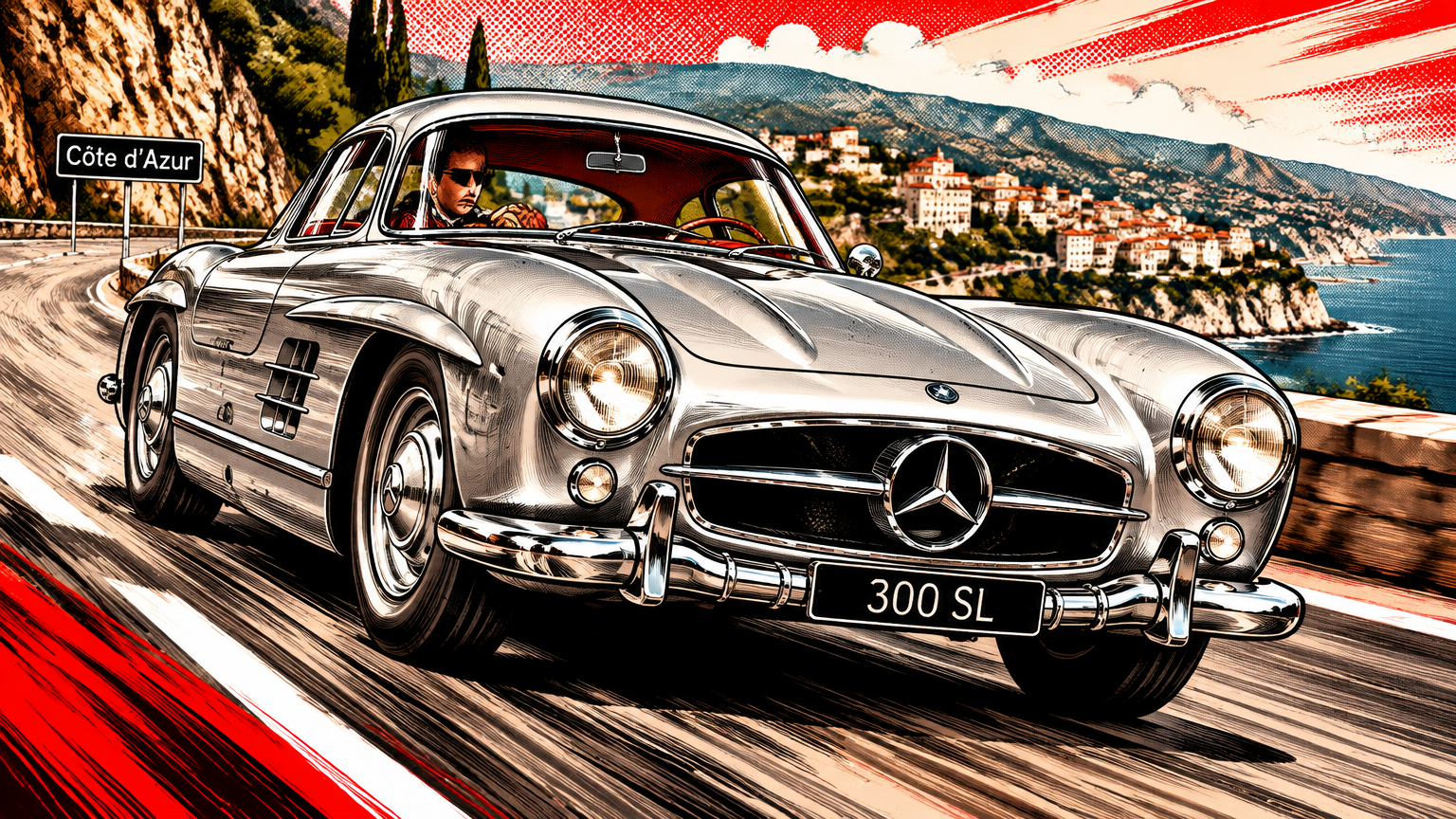
This was the Gullwing's home round in 1954, so let us set the scene honestly. With the longest axle ratio fitted, Mercedes-Benz quoted up to 260 km/h, about 161 mph.
That made the Gullwing the fastest production car of its time, full stop. Not the fastest German car, not the fastest coupe. The fastest thing a civilian could buy, anywhere.
The standard ratio car still reached 235 km/h, and the Road and Track test car recorded 140 mph on its shorter gearing. Three numbers, one car, all explained by that axle menu from earlier.
Now line those numbers up against the Formula 1 evidence this series uses, which is speed trap data measured mid lap at real Grands Prix:
- 2026 trim: Pierre Gasly, 353.9 km/h (about 220 mph), qualifying at the Chinese Grand Prix, per FIA data.
- 2025 at Las Vegas: Yuki Tsunoda, 358.3 km/h (222.6 mph).
- 2024 at Las Vegas: Alex Albon, 368.9 km/h (229.2 mph), the highest through the first three editions of this race.
The slowest of those three trap figures beats the Gullwing's best factory top speed by more than 90 km/h. And those Formula 1 numbers were recorded in cornering trim, on circuits, with a braking zone waiting at the end.
There is no shame in that scoreline. Top speed was the Gullwing's crown in 1954, and it wore the crown for years. Time simply kept building faster claimants, and this series is a parade of them.
The Chevrolet Corvette ZR1 that fought yesterday in this series took this round on a verified 233 mph. The Gullwing's 161 mph shows you how far the frontier has marched in seventy years, and how brave 161 mph on drum brakes and skinny tires really was.
Round Two to Formula 1. The Gullwing was once the answer to this exact question. Today it is the reason the question got interesting.


Round Three: Now Add a Corner
The Gullwing's chassis was genuinely advanced, and the spaceframe is only half of that story. Fully independent suspension at both ends was serious equipment in 1954, and the stiff frame gave that suspension a proper platform to work from.
Driven smoothly, a Gullwing flows down a fast road with a poise that still surprises people today. That is the good news, and it is real.
Now the famous catch. The rear suspension is a swing axle design, where each rear wheel pivots from a joint near the differential.
As the wheel moves, its angle to the road changes a lot. Push hard, then lift off the throttle suddenly mid corner, and the rear wheels can tuck under, grip falls away, and the back of the car steps out with very little patience for apologies.
Period drivers learned the rule quickly: set your speed before the corner, keep your inputs smooth, and never panic lift in a Gullwing. It rewards planning and punishes improvisation.
That lesson transfers directly to your own driving, in any car. Sudden mid corner changes, a stabbed brake, a lifted throttle, a yanked wheel, upset every chassis ever built. The Gullwing just explains the physics louder than most.
Against the Formula 1 car, none of this nuance changes the result. The modern car weighs 768 kg with its driver, generates downforce the Gullwing era could not measure, and corners on slick racing tires.
Through the 17 corners of the Las Vegas Strip Circuit, the gap would not be measured in car lengths. It would be measured in the Gullwing driver needing a whole different relationship with the word limit.
Round Three to Formula 1. The Gullwing taught a generation of drivers to be smooth. Formula 1 pays drivers to be smooth at three times the speed.
Round Four: Braking
Here is the round where 1954 shows its age the loudest. The Gullwing stops with finned drum brakes at all four wheels.
Drums were normal in 1954, and the Gullwing's were good ones, large, finned to shed heat, and servo assisted. For one firm stop from speed, they do their job.
The problem is the second stop, and the fifth. A drum is a closed can, and heat builds inside it faster than it escapes. As the drums and linings get hot, the pedal goes long and stopping power fades, exactly when a fast road asks for it most.
That is why disc brakes took over the performance world within a few years, and why the later Roadster in this family eventually gained discs at the front. Open discs shed heat into the air, stop after stop.
Your usable lesson: brakes are a heat management system, not a strength contest. Fade is not your foot getting tired. It is the hardware getting too hot to work, and it is why descent technique and brake cooling matter in any heavy or fast car.
The Formula 1 car stops with carbon brakes on a 768 kg car, helped by aerodynamic drag and regenerative braking from the MGU-K. It sheds speed with a violence that rearranges the driver's organs as a side effect.
A Gullwing driver braking from 140 mph planned the stop the way a pilot plans a landing. A Formula 1 driver braking from that speed is mostly deciding how late to begin.
Round Four to Formula 1. The Gullwing's drums were fine engineering for 1954. This round is simply where seven decades of brake development send their regards.
So, Does the Mercedes-Benz 300 SL Gullwing Win Anything?
It wins the things that outlast lap times. Stack them up:
- The innovation championship. First production car with four stroke direct fuel injection, a welded tubular spaceframe, and a canted dry sump engine, in one car, in 1954. Half the modern performance playbook starts here.
- The doors. Still the most recognized doors ever fitted to a car, and they were an engineering solution, not a fashion shoot idea. Form following a frame tube is the purest design story in this series.
- The fastest car on Earth, in its day. Top speed rounds are scored on current evidence, but history keeps its own table. In 1954, this was the top of it.
- The value story. The car cost 6,820 dollars new in America. RM Sotheby's puts a typical Gullwing around 1.3 million euros today, and a rare alloy body car sold for 6,825,000 dollars in 2022. Few spec sheets in this series come with that kind of footnote.
- The lineage. The Mercedes-AMG ONE that fought earlier in this series, with a Formula 1 engine in a road car, is this car's spiritual grandchild. The Gullwing put a racer on the road in 1954. Mercedes is still cashing that idea in.
That is not a consolation list. That is the resume of the car most historians point to when they say the word supercar and mean the first one.
One buying note, because these cars trade hands for house money and the details are the whole game. If you are ever close to one, the checks that matter are matching numbers, the factory data card, steel versus alloy body, and details like the optional Rudge center lock wheels.
Originality is the currency. A documented car and a similar looking car can be a million dollars apart, and the difference lives in paperwork, not paint.
What Would Happen on the Las Vegas Strip Circuit?
The Strip Circuit is 6.201 km, about 3.85 miles, with 17 turns and a roughly 2 km straight down the Strip itself. Picture the Gullwing there on a November night, silver under the lights.
Down that straight, the Gullwing gets its one long moment of era glory. With the tall axle fitted it would stretch toward 161 mph, engine canted, injection singing, past the fountains and the marquees it predates by decades.
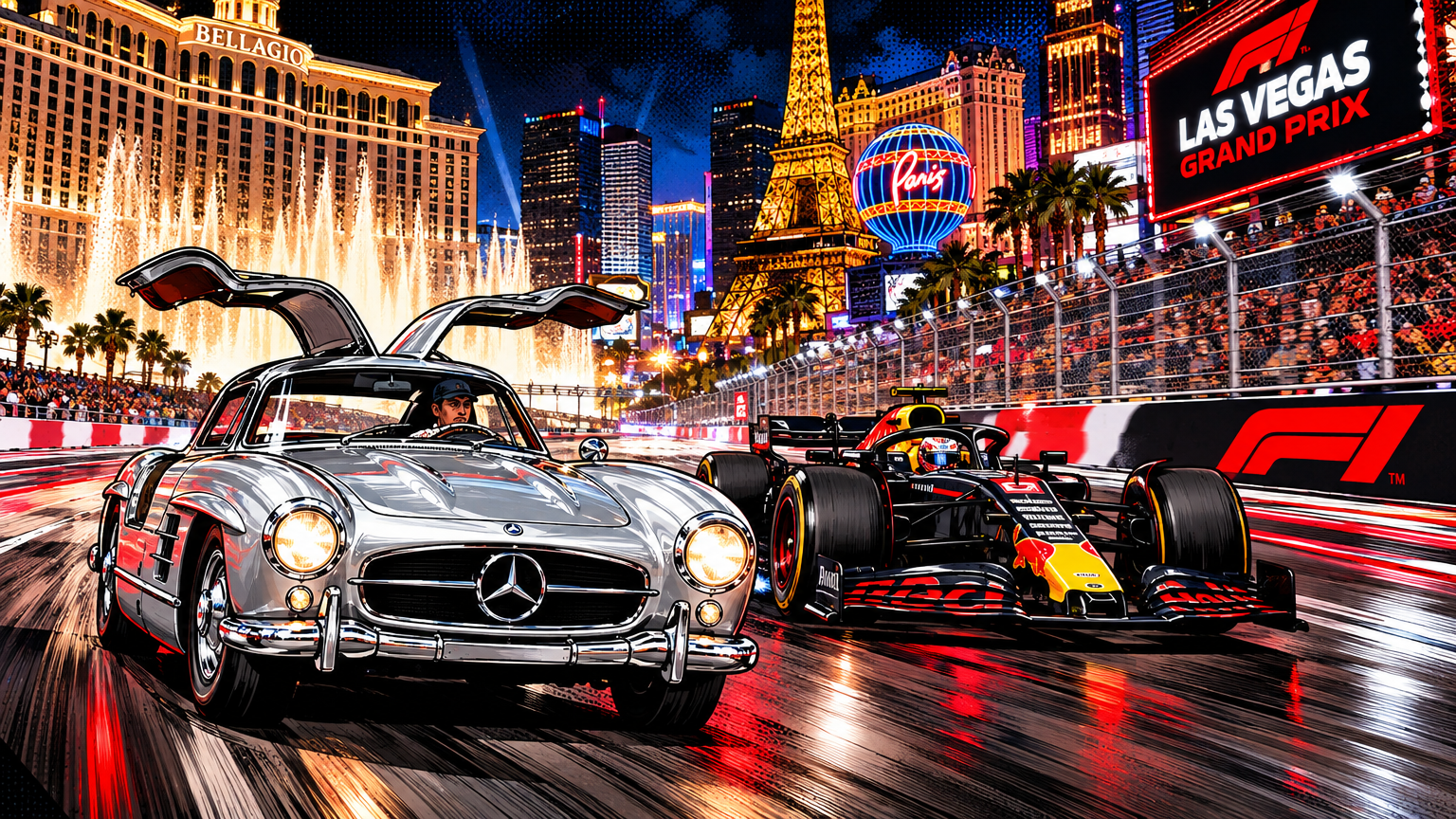
Then the braking zone arrives, and the drums send their invoice. Every stop asks 1954 hardware to shed speed for 1,295 kg, on tires a modern economy car would find narrow.
Every corner asks the swing axle to behave, and the driver to plan, breathe, and stay smooth while a carbon car disappears up the road. Over one lap the gap would be enormous. Over the Grand Prix distance of 50 laps, the Gullwing would be managing heat, tires, and brakes in a different event entirely.
No invented lap times here, the way this series never invents them. Just the shape of the result, and one honest footnote: of every challenger in this series, the Gullwing might draw the biggest crowd on the Strip while losing.
Las Vegas understands that trade. This is a city that has always known the difference between being fastest and being unforgettable.
The Final Call
Winner: Formula 1, four rounds to zero.
Acceleration went to a power to weight advantage of more than eight to one. Top speed went to trap figures that clear the Gullwing's factory best by more than 90 km/h. Cornering and braking went to downforce, slicks, and carbon, against swing axles and drums.
That is a clean sweep. On paper, it looks like a rout.
It is not a rout where it counts. Every modern challenger in this series, from the Corvette ZR1 to the Mercedes-AMG ONE, is built from ideas this car proved in public: take racing technology seriously, build the structure light and stiff, feed the engine with precision, and make the road car a real relative of the racer.
The Gullwing did all of that in 1954, with slide rules, and then opened its doors upward for the photograph. Formula 1 cars today are what that line of thinking became after seventy years of compounding.
Formula 1 may win the fight. But the Mercedes-Benz 300 SL Gullwing still owns the doors, still owns the first direct injection production engine, and still stands as the car that invented the job every other challenger in this series is applying for.
There are plenty more cars waiting to pick a fight with Formula 1. Next up: Formula 1 vs. Toyota Supra Mk IV: the 2JZ legend, a turbo straight six with a tuning ceiling that became folklore, and a movie career that made it immortal. Can the tuner king land a punch the original supercar could not?