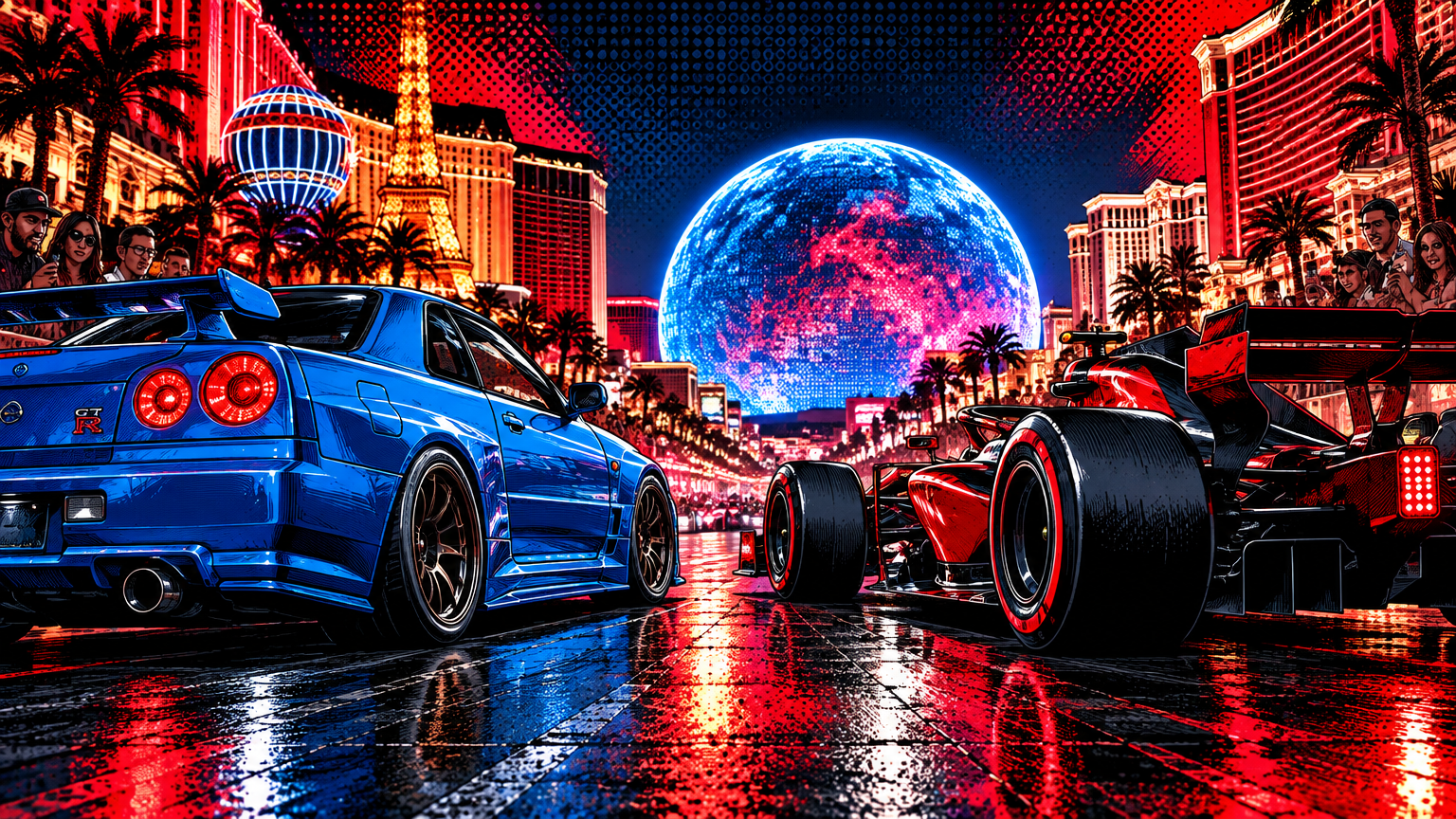
For a whole generation, this car was not real.
Oh, it existed. It just existed somewhere else. If you grew up in America, the Nissan Skyline GT-R R34 lived inside a television screen. It was the car you won in Gran Turismo after a weekend of grinding races. It was the silver streak that opened a Fast and Furious movie. It was Bayside Blue on a poster, in a magazine, in a game, anywhere except a Nissan showroom in the United States, because Nissan never sold it here. Forbidden fruit with four round taillights and a wing.
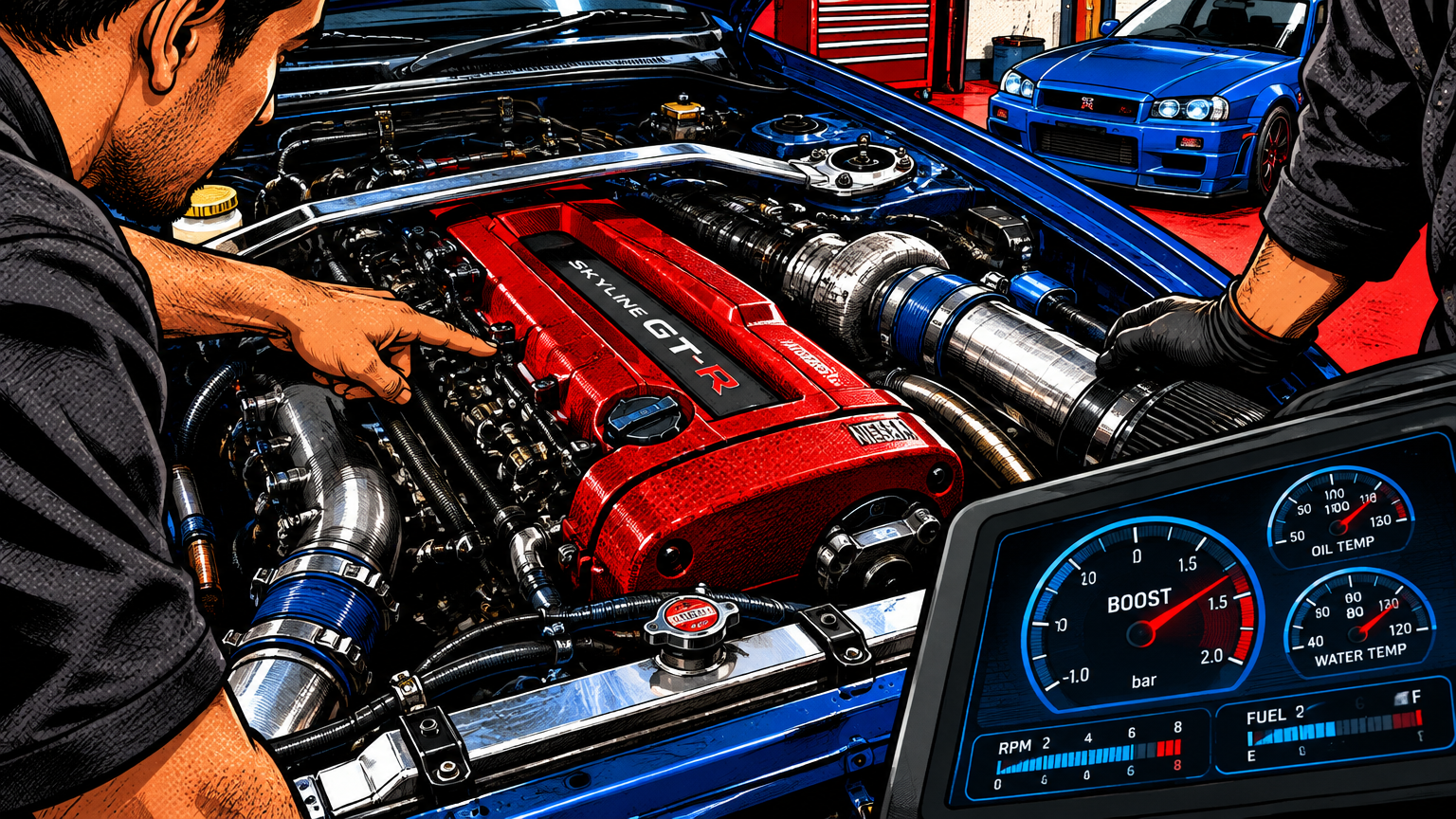
Here is what the screen never told you. Under the legend lives one of the smartest performance cars Japan ever built. A twin turbo straight six with a horsepower rating that was, officially, a polite fiction agreed between gentlemen. An all wheel drive system that thinks faster than you do. Four wheel steering. A dashboard screen showing live boost data in 1999, when most cars still bragged about having a CD player. And a lap time at the Nurburgring that made it, on the record of its day, the fastest road legal series production car on Earth.
What happens if the Nissan Skyline GT-R R34 picks a fight with a Formula 1 car?
What happens is the video game final boss meets an actual boss. On one side, Godzilla, the car that used electronics and traction to humiliate bigger and pricier machines. On the other side, a 1.6 liter hybrid making more than 1,000 horsepower in a car that weighs about half as much, built by people who treat electronics like a religion. The R34 rewrote the rulebook for road cars. The Formula 1 car is what the rulebook looks like when money stops mattering.
Press start. This challenger brought its own cheat codes, and every single one of them is real.
First, Which Nissan Skyline GT-R R34 Are We Talking About?
Precision matters here, because R34 GT-R prices now swing wildly by version, and the internet loves to quote the rarest special edition numbers against the standard car, or the other way around when it suits a listing.
The family, kept separate the way this series always keeps it:
- GT-R, 1999 to 2002: our challenger. The standard car, chassis code BNR34, and the foundation every other version stands on.
- V-Spec and V-Spec II, 1999 to 2002: Victory Specification cars with the ATTESA E-TS Pro system, an active rear limited slip differential, lower and firmer suspension, extra aero, and, on the V-Spec II from 2000, a carbon fiber hood with a NACA duct. Sharper cars. Different cars. Not scored here.
- M-Spec, 2001 to 2002: the comfort leaning sibling, named for chief engineer Kazutoshi Mizuno, with leather and softer damper tuning. Not scored here.
- Nur editions, 2002: final year V-Spec II and M-Spec cars with the reinforced N1 based engine, bigger turbos with steel internals, gold valve covers, and output reported well above the official rating. 1,003 built in total. Not scored here.
- Nismo Z-tune, 2005: a tiny run of rebuilt cars created by Nismo after production ended, with far more power. A wonderful thing, and not a factory production R34 in the sense this series scores. Not scored here.
Our challenger is the standard Nissan Skyline GT-R, BNR34, built from January 1999 to August 2002. Nissan unveiled the R34 GT-R at the Tokyo Motor Show in October 1998, and production started the following January. It was the fifth generation Skyline GT-R and the last one to carry the Skyline name, the RB26 engine, and a manual gearbox as standard issue. Everything about it was a sharpening of the R33 before it. The wheelbase shrank from 2,720 mm to 2,665 mm, overall length dropped by 75 mm, and body rigidity jumped by a claimed 56 percent. Nissan built this car at the Nurburgring, and it shows.
Now the engine, because the engine is where the polite fiction lives. The facts, in one clean list:
- Engine: RB26DETT, 2,568 cc twin turbocharged inline six, double overhead cams, 24 valves, bore and stroke of 86 mm by 73.7 mm, compression ratio 8.5 to 1, individual throttle bodies, twin ball bearing ceramic turbochargers, cherry red valve covers
- Power: 280 PS, which is 276 horsepower, at 6,800 rpm, as the official Nissan rating. Hold that number loosely. We will explain why in a moment
- Torque: 392 Nm, which is 289 pound feet, at 4,400 rpm, up from the R33 figure of 271 pound feet at the same revs
- Gearbox: Six speed Getrag V160 manual, a stronger box than the five speed used in the R33, and manual only
- Drive: ATTESA E-TS all wheel drive. In normal driving the car runs essentially as a rear wheel drive car, and the system can send up to 50 percent of torque to the front wheels the moment slip is detected
- Steering: Super HICAS four wheel steering, heavily revised for the R34, with power assistance
- Weight: 1,540 kg for the standard car. The V-Spec, for comparison, added about 20 kg
- Size: About 4,600 mm long, 1,785 mm wide, 1,360 mm tall, on a 2,665 mm wheelbase
- Brakes: Brembo ventilated discs with aluminum calipers, 324 mm discs with four piston calipers in front, 300 mm discs with two piston calipers at the rear, plus a new ABS control unit
- Wheels and tires: 18 inch six spoke alloys, wider rubber than the R33 wore, Bridgestone Potenza tires as standard fitment
- Launch price: 4,998,000 yen in Japan on January 8, 1999. The V-Spec launched at 5,598,000 yen
- Built: 11,578 R34 GT-Rs in total across every version from January 1999 to August 2002, with the standard car commonly counted at 3,977 cars plus 20 pre production cars
About that power figure, because it is the most famous number in this whole article and it deserves an honest label. In this era, Japanese manufacturers observed a voluntary industry agreement that capped advertised power at 280 PS. So Nissan advertised 280 PS. Period reporting and later dyno experience have long suggested healthy stock R34s made more than that in reality, and the final Nur cars were reported at over 330 horsepower, but this series scores the car on its official rating and on labeled tests, not on folklore. When you see an R34 listing bragging about huge stock power, that is the folklore talking. The honest sentence is this: the official rating was capped by agreement, the real output was widely believed to be higher, and nobody at Nissan ever seemed in a hurry to correct the record.
Two technology details separate this car from everything else on the road in 1999, and both still feel modern. First, that ATTESA system. It does not split power evenly and hope for the best. It leaves the car rear driven while grip is good, which keeps the steering honest and the balance playful, then feeds the front axle up to half the torque when the rears start to slip, hundreds of decisions a second, under your right foot. Second, the dashboard. Mounted on top of the center console sat a 5.8 inch Multi Function Display showing seven live readings, including turbo boost pressure and torque distribution. In 1999. Your favorite modern car with its app connected telemetry was beaten to the idea by a Nissan with a cassette era interior and a screen that looked like it escaped from an arcade cabinet.
Now the performance figures, labeled the way this series always labels them. The quoted figures for the standard car are zero to 62 mph in 5.4 seconds and a top speed electronically limited to 251 km/h, which is 156 mph. Period tests of V-Spec cars, which are different cars and are labeled as such, landed quicker, around the high fours to low fives to 60 mph depending on the market and the test. And then there is the lap. The R34 was credited with a 7 minute 52 second lap of the Nurburgring Nordschleife, which made it the fastest road legal series production car of its moment. Its predecessor, the R33, had been the first production car under eight minutes there, with Nissan own heritage records listing a 7:59.887 for the factory test car. The R34 took the family crown lower still. Treat those Ring times as period claims with period methods, not modern certified records, and they still tell you exactly what kind of car this was.
One cultural footnote, kept strictly separate from the spec sheet. The R34 became an American icon without ever being sold in America. Gran Turismo put it in millions of living rooms. The Fast and Furious films made a silver R34 one of the most recognized Japanese cars on the planet. Fans in the United States called it Godzilla, a nickname the GT-R line earned in Australia with the R32 a decade earlier, and then they waited. And waited. The waiting itself is part of the machine we are scoring today, and the final section before the verdict will hand you the one fact about this car that can genuinely save you money.
Meet the 2026 Formula 1 Car
Across the garage sits a 2026 Formula 1 car, and for once the challenger is not even the most electronic car in the room.
The shared facts for this series, reused in every fight: the 2026 car runs a 1.6 liter turbocharged V6 hybrid. The combustion engine is limited to about 400 kW, the MGU-K electric motor contributes up to 350 kW, and Formula 1 describes the total package as more than 1,000 horsepower. Minimum regulatory weight is 768 kg, about 1,693 pounds, including the driver. It is rear wheel drive, built from carbon, wears racing tires, and carries active front and rear aerodynamics that change the car shape for straights and corners.
Line the two cars up and the comedy writes itself. The Nissan has the bigger engine, 2.6 liters against 1.6, two turbos against one, and all wheel drive against rear wheel drive, and it still shows up giving away roughly 700 horsepower and about 770 kg. The Nissan has a back seat, a trunk, and a screen that shows boost pressure. The Formula 1 car has a screen too. It is on the steering wheel, it shows everything, and the car around it costs more than a street of R34s at today auction prices. The R34 was the most electronic road car of 1999. The Formula 1 car is what electronics did next.
For top speed evidence on the Formula 1 side, this series uses measured speed traps, labeled by year, never an invented universal top speed. In 2026 qualifying trim, Pierre Gasly was trapped at 353.9 km/h, about 220 mph, at the Chinese Grand Prix, per FIA data. In Las Vegas, Yuki Tsunoda reached 358.3 km/h in 2025, and Alex Albon reached 368.9 km/h, about 229.2 mph, in 2024, the highest trap figure through the first three editions of the race. Keep the R34 limited 251 km/h in your head. It is about to meet numbers that start more than 100 km/h higher.


Nissan Skyline GT-R R34 vs. F1: The Numbers
| Category | Nissan Skyline GT-R R34 (standard car, 1999 to 2002) | 2026 Formula 1 Car |
|---|---|---|
| Engine | 2,568 cc twin turbo inline six, 24 valves, individual throttle bodies | 1.6 liter turbocharged V6 hybrid |
| Power | 280 PS (276 hp) at 6,800 rpm, official rating capped by the Japanese industry agreement | More than 1,000 hp (Formula 1 figure for the package) |
| Torque | 392 Nm (289 lb-ft) at 4,400 rpm | No single comparable published figure used in this series |
| Gearbox | 6 speed Getrag manual | Semi automatic racing gearbox |
| Drive | All wheel drive, rear biased, up to 50 percent of torque to the front on slip | Rear wheel drive |
| Weight | 1,540 kg | 768 kg minimum, including driver |
| Zero to 62 mph | 5.4 sec quoted for the standard car; quicker times recorded in tests of V-Spec cars | No universal official figure; see Round One |
| Top speed | 251 km/h (156 mph), electronically limited | 353.9 km/h trapped in 2026 qualifying (Gasly, China); 368.9 km/h best Las Vegas trap in this series (Albon, 2024) |
| Seats | 4, with a trunk and a boost gauge screen from the future | 1, with no trunk and a data team |
| Built | 11,578 GT-Rs across all versions, 1999 to 2002; never sold new in the United States | Built for one racing season at a time |
| Video game factor | Total. A generation met this car on a screen years before they could meet one in person | High, but it loses points for being legally obtainable only by owning a racing team |
Three lessons hide in that table, and they will make you sharper at reading every Japanese performance car listing you ever scroll past:
- An official power figure can be a ceiling agreed in a boardroom, not a measurement. The 280 PS cap means R32, R33, and R34 GT-Rs all advertise near identical power while making different torque and delivering different performance. When the headline number is capped by agreement, read the torque curve, the gearing, and the independent tests instead. That one habit will save you from misreading an entire era of Japanese cars.
- All wheel drive does not have to mean front heavy and dull. ATTESA leaves the R34 rear driven while grip lasts and only calls the front axle in when slip starts. That is why the car rotates like a rear drive coupe and then claws its way out of the corner like something with twice the traction. When a listing or a review calls a car all wheel drive, ask how the torque is split and when. The answer is the car.
- On an R34, the build month is a legal document. These cars were never sold new in the United States. Under the federal 25 year import rule, each car becomes eligible only when it personally turns 25. The first 1999 cars cleared in 2024, month by month, and the last 2002 cars do not clear until 2027. Two identical looking R34s can be a legal import and a seizure risk at the same time, separated only by the month on the build plate. Check the date before you fall in love.
Use those three checks on any R34 auction listing and you will read the page like an importer instead of a fan. That is the most useful thing this article can hand you, and it is free.
Round One: Acceleration
Winner: Formula 1.
Give Godzilla the launch it deserves first, because launching is the thing this car was engineered to be rude about. All wheel drive traction off the line. A Getrag six speed built to take abuse. Torque up over the R33, arriving at 4,400 rpm and pulling through a chassis 56 percent stiffer than before. The quoted 5.4 seconds to 62 mph for the standard car sells the experience short, because the R34 does not waste its launch spinning tires and making smoke for the cameras. It just goes, in the wet, in the cold, on a bad surface, on surfaces where rear wheel drive supercars of its era were busy having a meeting about traction. Period tests of the V-Spec cars found the high fours to low fives to 60 mph, and the standard car was right there with them. In 1999, against Ferraris and Porsches costing far more, this Nissan was a standing start ambush.
The Formula 1 car does not do ambushes. It does physics demonstrations. More than 1,000 horsepower. 768 kg including the driver. Racing tires, warm and sticky. Run the ratio that decides this round, using the honest official rating: the R34 carries about 179 horsepower per tonne. Grant the folklore its rumored extra power and it still sits under 220 per tonne. The Formula 1 car carries roughly 1,300 horsepower per tonne. That is a six to one gap, and no launch control strategy, no all wheel drive claw, and no amount of Gran Turismo muscle memory closes six to one.
This series never invents a universal Formula 1 zero to 60 time, because none exists as an official figure. It does not need one here. Round One goes to Formula 1 by a distance that starts at the launch and never stops growing. But note how the Nissan loses. It loses while putting its power down better than almost any road car of its decade, in all weather, driven by a human being working a clutch and a lever. The Mazda RX-7, its Japanese stablemate from an earlier fight in this series, won hearts with balance. The R34 wins them with grip. It is the bouncer of Japanese performance cars. Polite shirt. Terrifying launch.
Round Two: Top Speed
Winner: Formula 1.
This round has been generous to the legends lately. The Bugatti Veyron took it on verified numbers. The McLaren F1 took it on a verified record. The R34 arrives with a limiter and a problem.
Line up the numbers, with their labels on. The Nissan figure is 251 km/h, 156 mph, electronically limited. That limiter matters. The R34 story was never about the last kilometer per hour. It was about how completely the car worked everywhere below it, and Nissan capped the top end and spent the engineering budget on the Nurburgring instead. The Formula 1 traps in this series start where the Nissan stops: Gasly at 353.9 km/h in 2026 qualifying trim, Tsunoda at 358.3 km/h in Las Vegas in 2025, and Albon at 368.9 km/h in Las Vegas in 2024. Every one of those numbers was recorded mid lap, in cornering trim, by a car that then had to brake and turn at the end of the straight. The Nissan limited maximum loses to the Formula 1 car commuting speed by more than 100 km/h.
The fairness note, because this series always prints it. A trap speed is not a top speed attempt, and a limited road car figure is a policy choice as much as an engineering one. Both of those things are true, and neither rescues the challenger. What the R34 figure actually tells you is more interesting than a win would have been. By 1999, the smart Japanese manufacturers had quietly walked away from the top speed arms race and put their money into lap time, traction, and response. The R34 is the monument to that decision. It gave up this round on purpose, years before the fight was scheduled, and bought the Nurburgring with the change. Round Two goes to Formula 1. The Nissan keeps the receipt for what it bought instead.
Round Three: Now Add a Corner
Winner: Formula 1.
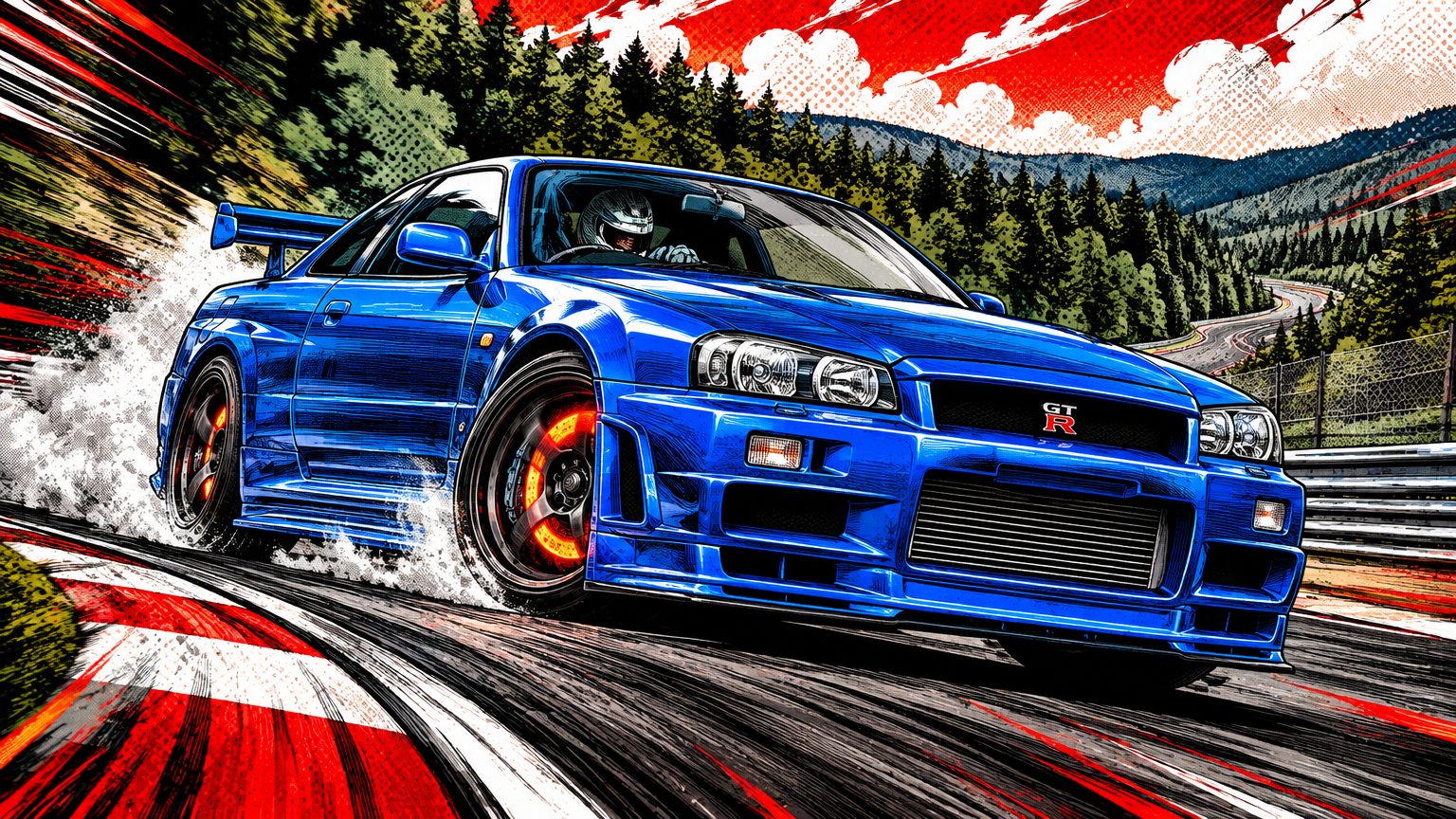
Here is where the R34 earns every bit of its reputation, so let us spend the respect properly before the score lands. This is a car with a 7 minute 52 second Nurburgring credit at a time when that made it the fastest road legal series production car in the world. The engineering behind that lap is a masterclass in making a heavy car feel light. A shell 56 percent stiffer than the R33. A shorter wheelbase for agility. Aluminum front suspension arms trimming unsprung weight. Super HICAS steering the rear wheels to sharpen turn in. And above it all, ATTESA, feeding torque forward only when the rear tires ask for help, so the car pivots like a rear drive coupe on entry and fires out of the corner on all four tires. Drivers who know this car talk about the same thing. It feels like it is thinking one corner ahead of you, because in a very real electronic sense, it is.
Then the Formula 1 car turns a wheel, and thinking ahead stops mattering. It weighs 768 kg including its driver, which is 772 kg less than the Nissan, and that is not a typo, it is just the gap. It wears slick racing tires. Its active aerodynamics press it into the road harder the faster it travels, so its cornering ceiling rises with speed in a way no road car can imitate. It carries speed through corners that the Nissan, for all its genius, has to brake down to road car numbers to survive. There is a reason no production car lap record anywhere is within shouting distance of what a Formula 1 car does on the same ribbon of asphalt. The R34 was built to hunt supercars. The Formula 1 car is the thing supercars have nightmares about.
Round Three goes to Formula 1, by the usual enormous margin. The R34 leaves with the title it actually earned, and it is a serious one: the car that taught the whole industry that computers, torque splits, and four wheel steering could make a 1,540 kg coupe dance like a light one. Half the performance cars on sale today are running lessons this Nissan taught in 1999. Las Vegas gets that. This is a town built on the house learning every trick and then dealing it back to you.
Round Four: Braking
Winner: Formula 1.
The Nissan braking story is short, strong, and era correct. Brembo hardware at all four corners, ventilated discs of 324 mm in front with four piston aluminum calipers and 300 mm discs at the rear, backed by a new ABS control unit for the R34. For a 1,540 kg road car in 1999, that was serious, fade resistant kit, and it was part of how the car could run its Nurburgring pace lap after lap in testing. Brakes on a GT-R were never an accessory. They were half the lap time strategy, and Nissan specced them like it.
It meets the same wall every challenger meets in this round. A Formula 1 car stops on carbon brakes, slick tires, and aerodynamic downforce that presses the rubber into the road hardest exactly when the car is fastest and braking is hardest. At high speed the air itself works as a brake, and the 2026 car adds hybrid energy recovery under braking on top of the friction brakes. Against 768 kg, carbon, and the wind, a 1,540 kg steel bodied coupe on 1999 discs and road tires is not losing an argument. It is visiting a different department of physics.
The usable insight for your own driving is the one the R34 generation teaches best. This car was fast enough, early enough, that its owners learned a modern lesson in the 1990s: electronic traction and strong brakes make a car feel invincible right up to the moment physics presents the bill. When you drive any car from this era, budget your braking distances like it is 1999, because for the tires and the hardware, it is. The R34 stops like the best road car of its year. The Formula 1 car stops like the calendar insulted it. Round Four, and the sweep, go to Formula 1.
So, Does the Nissan Skyline GT-R R34 Win Anything?
It wins the future. Arguably, it wins the culture war so completely that the fight above barely matters. Let us be specific.
It wins the technology argument against its entire decade.
- A dashboard screen displaying live boost and torque data in 1999, years before telemetry became a road car selling point
- An all wheel drive system that defaults to rear drive feel and adds front traction only on demand, the template half the industry now follows
- Four wheel steering, a stiffened shell, and an active differential on the Pro cars, all working together instead of as separate party tricks
- A Nurburgring time that stood as the road car benchmark of its moment, set by a coupe with a back seat
It wins the forbidden fruit championship, and it is not close.
Nissan never sold the R34 in the United States. No dealer demos, no press fleet, no lease specials. America met this car through a game controller and a cinema seat, and wanting what you cannot have is the oldest performance upgrade in the world. The RX-7 in this series was sold here and loved here. The R34 was denied here and worshipped here. When the 25 year rule finally started unlocking 1999 cars in 2024, it did not feel like an import regulation changing. It felt like a prison gate opening on a schedule, one build month at a time.
It wins the honest buying briefing, which this series counts as a win.
- Verify the version before you verify anything else. V-Spec, V-Spec II, M-Spec, and Nur cars are different cars with different values, and badges are cheap
- Check the build month against the 25 year rule before money moves. Eligibility follows the individual car, not the model year on the listing
- Treat any huge stock power claim as folklore. The official rating was capped by agreement, real output was believed higher, and a dyno sheet beats a story
- Gold valve covers and a gold VIN plate mark the Nur cars. Small details, real money, worth knowing before a seller explains them to you creatively
Nissan Skyline GT-R R34 wins: the technology crown for 1999, the forbidden fruit championship, the video game generation, and the most patient fan base in car culture.
What Would Happen on the Las Vegas Strip Circuit?
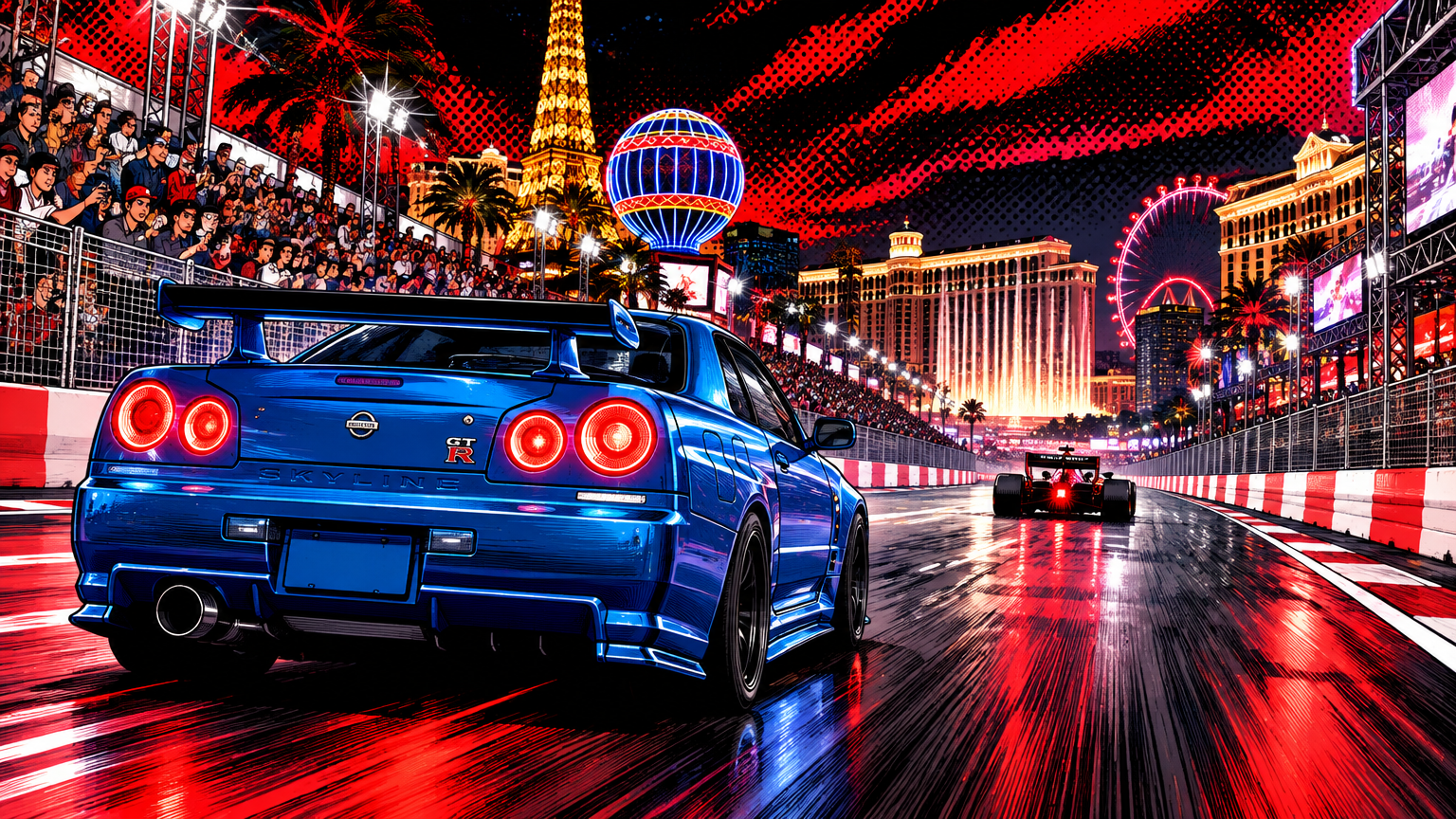
Now we bring the fight home, to the Las Vegas Strip Circuit, home of the Las Vegas Grand Prix.
The circuit runs 6.201 kilometers, about 3.85 miles, with 17 turns, and the Grand Prix lasts 50 laps. Down the Strip there is roughly a two kilometer straight, under the neon, past the casinos.
That straight is where the R34 would put on its show, and what a show it would be. Picture it at night. Bayside Blue paint under casino light, quad round taillights glowing, twin turbos spooling down the longest straight in this series while the crowd does the thing crowds have done for this car for twenty five years, which is lose their minds for a Nissan. The R34 would launch out of the final corner with that ATTESA claw, run hard toward its limited 251 km/h, and for about twenty seconds the most famous Japanese car in the world would own Las Vegas. The Ferrari Testarossa in the previous fight owned the same straight on nostalgia. The R34 owns it on recognition plus a generation of saved game files.
Then come the other sixteen corners and the braking zones, fifty laps of them. The Formula 1 car, at 768 kg with downforce and carbon brakes, laps in a different time zone, and over a Grand Prix distance the gap stops being a number and becomes a genre difference. No invented lap times here. This is an informed comparison, not a recorded race, and nobody has timed an R34 around this circuit for us to quote. What we can say honestly is how the night ends. The Formula 1 car goes back on a transporter under a cover. The R34 drives home. It drives home on public roads, in comfort, with a back seat and a trunk, past the same casinos, getting waved at like royalty the whole way down the Strip. In this town, that is not a consolation prize. That is a headline act.
The Final Call
Winner: Formula 1.
Four rounds to none, a clean sweep. Acceleration went to a power to weight advantage of about six to one. Top speed went to measured Formula 1 traps that clear the Nissan limited maximum by more than 100 km/h. Cornering and braking went to the car that weighs 768 kg including its driver and uses the air itself as glue and as a brake. The R34 was never built to beat a Formula 1 car. It was built to beat every other road car on Earth at its own game, and on the evidence of the Nurburgring record, the technology it pioneered, and a fan base that waited a quarter century just to import one legally, it spent three years doing exactly that.
And what a three years it was. A horsepower number agreed in a boardroom that nobody believed and nobody needed to. A computer deciding torque splits before the driver felt the slip. A screen on the dashboard reading out the car secrets in real time while rival brands were still selling cassette decks. A back seat, a trunk, a manual gearbox, and a lap time that embarrassed supercars. The last Skyline GT-R was not just the end of a model line. It was a preview of what every performance car would become, delivered in 1999, in Bayside Blue, mostly to people lucky enough to live where Nissan would sell it.
Formula 1 may win the fight. But the Nissan Skyline GT-R R34 still owns the save file, the poster, and the longest waiting list in car culture, and it is still the car a whole generation would pick if the garage could only hold one.
There are plenty more cars waiting to pick a fight with Formula 1.
Next up: Formula 1 vs. Porsche 959. The original German tech flagship, the car that taught Porsche all wheel drive and twin turbos, steps into the ring.