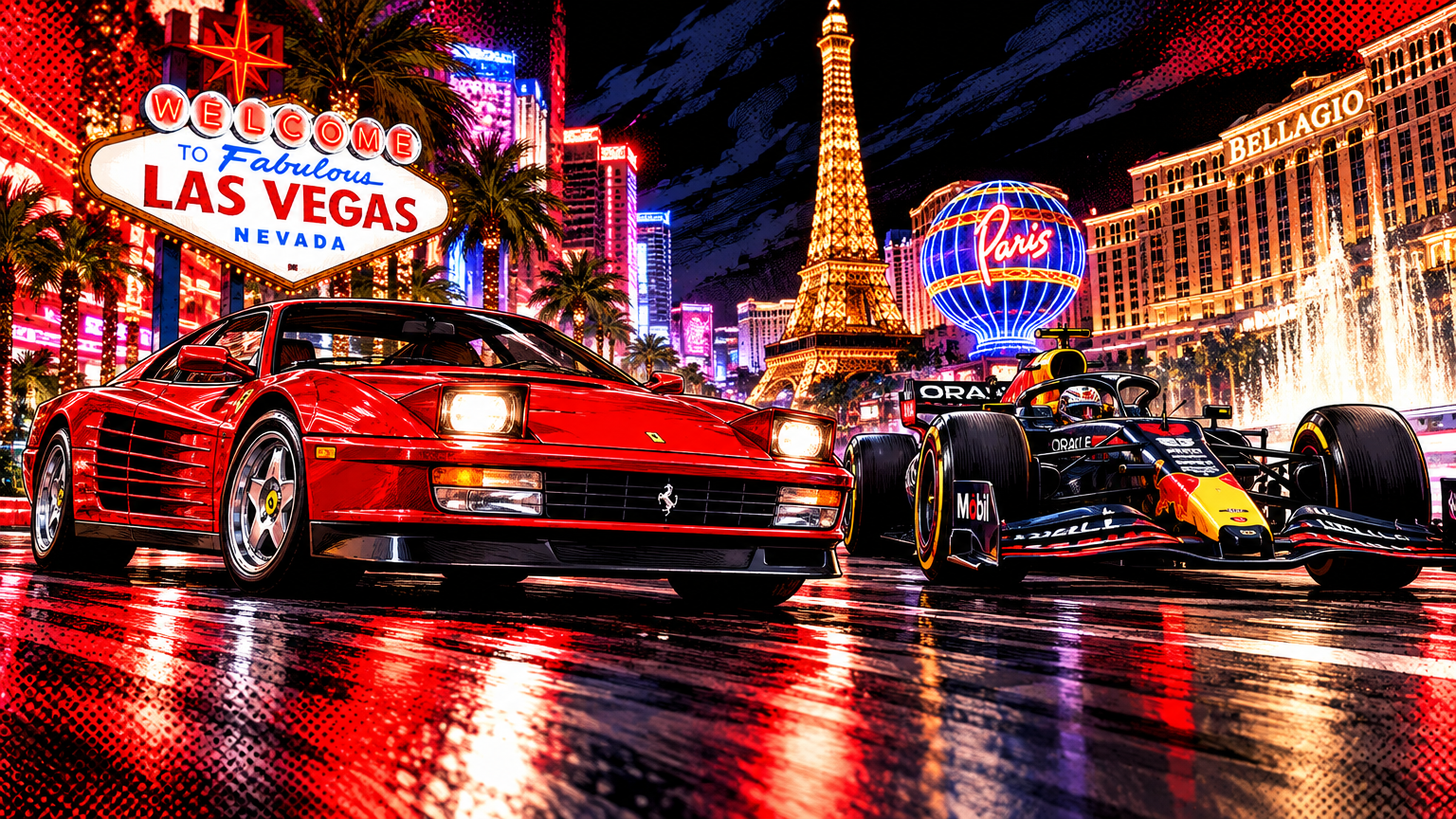
If you grew up in the 1980s, this car was already on your wall.
It did not need your permission. Between the poster, the television show, and the arcade game, the Ferrari Testarossa basically moved into your childhood rent free and never moved out. White car, night city, pastel suit, synthesizer soundtrack. You know the picture. Everybody knows the picture.
Here is what gets lost in all that nostalgia. Under the poster lives a serious machine. A 4.9 liter flat twelve with 48 valves. A top speed of 290 km/h at a time when that made it one of the fastest road cars on Earth. And a design so functional that its most famous styling feature, those cheese grater side strakes, exists because of radiator placement and safety rules, not because a stylist felt dramatic that morning.
What happens if the Ferrari Testarossa picks a fight with a Formula 1 car?
What happens is the 1980s meet the 2020s at full volume. On one side, a naturally aspirated flat twelve, a gated five speed manual, and the widest hips Ferrari had ever put on a road car. On the other side, a 1.6 liter hybrid that makes more than 1,000 horsepower and weighs about half as much. One of these cars defined a decade. The other one defines lap times. Those are not the same job, and that is exactly what makes this fight fun.
Bring your poster. This challenger brought its own legend.
First, Which Ferrari Testarossa Are We Talking About?
Precision matters here, because the Testarossa name covers three cars across twelve years, and the internet loves to blend them into one imaginary super Ferrari that never existed as a single car.
The family, kept separate the way this series always keeps it:
- Testarossa, 1984 to 1991: our challenger. The original. Flat twelve, side strakes, pop up headlights, 7,177 built.
- 512 TR, 1992 to 1994: a thorough rework with 428 horsepower and a 314 km/h top speed. A better car by most measures, and a different car. Not scored here. 2,261 built.
- F512 M, 1994 to 1996: the final evolution, 440 horsepower, fixed headlights, the last Ferrari ever built with the flat twelve engine. 501 built. Also not scored here.
Our challenger is the original Ferrari Testarossa, Type F110, built from 1984 to 1991. Ferrari unveiled it at the Paris Motor Show in October 1984, and the launch itself tells you what kind of car this was. On the eve of the show, the French Ferrari dealer Charles Pozzi rented the famous Lido nightclub on the Champs-Elysees to reveal it, and guests got in with a magnetic card carrying the new model logo. Per Ferrari, the only launch card still in existence is number 0001, reserved for Enzo Ferrari, who never used it. That is how you launch a flagship.
The car replaced the 512 BBi, and it fixed the Boxer two biggest complaints in one move. The BBi ran its radiator up front, which meant hot coolant pipes running through the cabin and a trunk that cooked. The Testarossa moved the cooling to twin radiators mounted at the sides, behind the doors. The cabin got cooler, the front got a real luggage space, and the car got enormous side intakes to feed those radiators. Safety rules in several countries would not allow openings that large to sit exposed, so Pininfarina covered them with horizontal strakes. The most copied design detail of the decade started life as a plumbing fix with a legal department. Remember that the next time someone calls the strakes a gimmick.
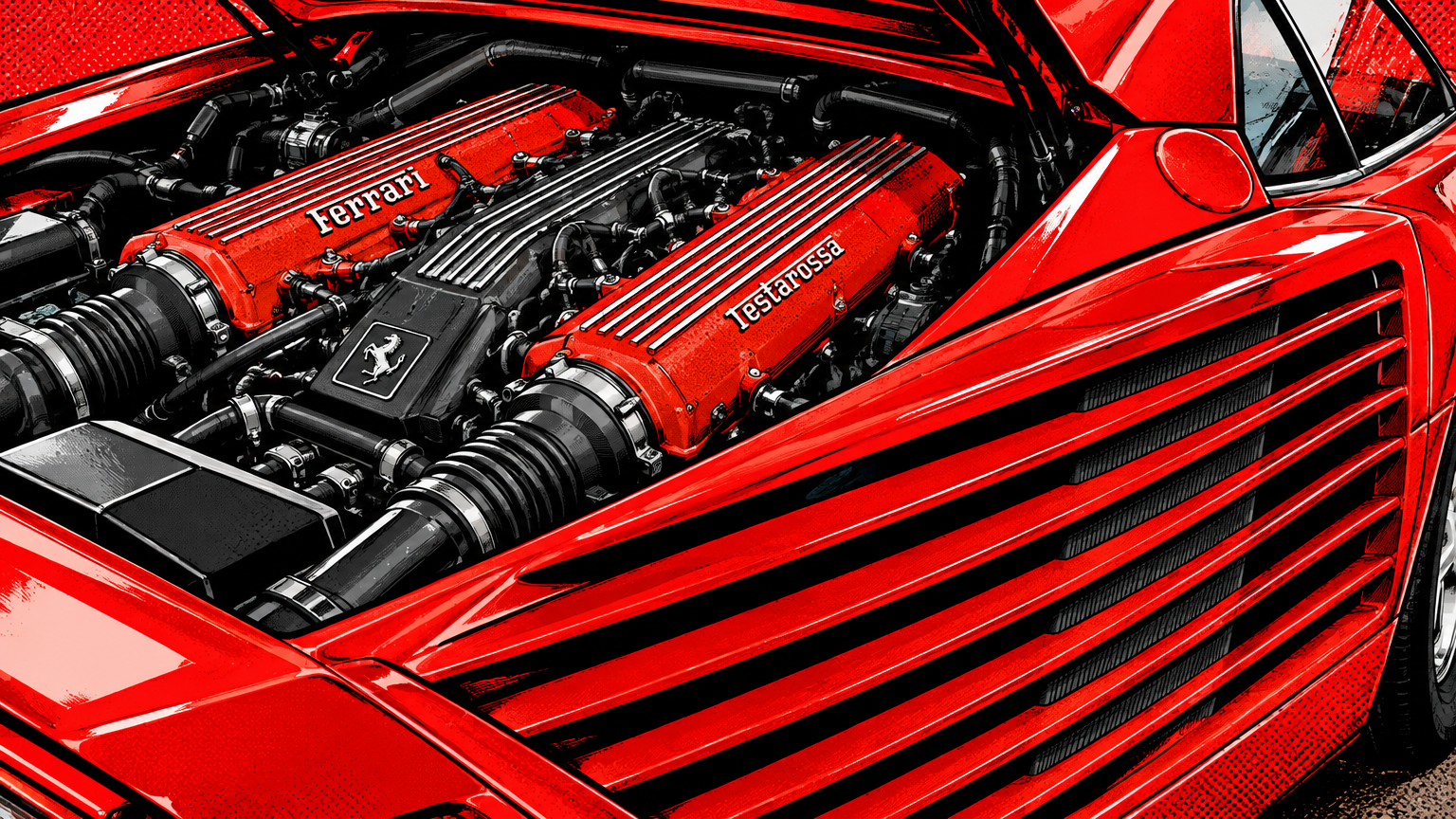
The design came from Pininfarina, with the team led by Leonardo Fioravanti and the shape originated by Emanuele Nicosia. The name is simpler than people think. Testarossa means red head in Italian, a nod to the red painted cam covers on the engine, and a revival of the name worn by Ferrari famous 1950s Testa Rossa racers. The facts, in one clean list:
- Engine: Tipo F113, 4,943 cc flat twelve, a 180 degree V12 layout, naturally aspirated, double overhead cams, four valves per cylinder for 48 valves total, dry sump lubrication, Bosch K-Jetronic fuel injection
- Power: 390 horsepower (287 kW) at 6,300 rpm in European specification, per Ferrari. Early United States cars, fitted with catalytic converters, were rated at 380 horsepower
- Torque: 490 Nm, which is 361 pound feet, at 4,500 rpm in European specification
- Gearbox: Five speed manual, mounted at the rear, no automatic ever offered
- Drive: Rear wheel drive, engine mounted longitudinally behind the cabin
- Weight: 1,506 kg dry in European specification; United States cars are commonly listed at about 1,708 kg curb weight, so always check which figure a seller or a spec sheet is quoting
- Size: 4,485 mm long, 1,976 mm wide, just 1,130 mm tall, on a 2,550 mm wheelbase. That width made it half a foot wider than the Boxer it replaced, with a rear track of 1,660 mm against a front track of 1,518 mm
- Weight distribution: 40 percent front, 60 percent rear
- Brakes: Ventilated discs all around, about 309 mm in front and 310 mm in the rear
- Built: 7,177 Testarossas from 1984 to 1991, making it one of the highest volume 12 cylinder Ferraris in history to that point
- Launch price: About $94,000 in the United States in 1985, and climbing steeply from there as the decade and the waiting lists rolled on
Two details separate the early cars, and collectors pay for both. Cars built from 1984 into 1986 carried a single mirror mounted high on the driver side A pillar, the famous monospecchio, plus single bolt center lock wheels called monodado. Roughly the first 1,000 cars wore both. If you see a Testarossa with one mirror perched up by the roofline, you are looking at the earliest and most collectible version of the shape.
Now the performance figures, labeled the way this series always labels them. These are Ferrari figures for the scored car: zero to 100 km/h in 5.8 seconds and a top speed of 290 km/h, which is 180 mph. Ferrari itself describes the launch engine as the most powerful installed on a standard sports car at the time, delivering 390 horsepower and pushing the car to over 290 km/h. Independent period tests, kept separate as always, found the car quicker off the line than the factory claim. Car and Driver and Road & Track both recorded zero to 60 mph in about 5.0 seconds, Motor Trend managed 5.29 seconds, and quarter mile times landed around 13.3 to 13.5 seconds at about 107 mph. That gap between the claim and the tests is a lesson in itself, and Round One will spend it well.
One cultural footnote, kept strictly separate from the spec sheet, because it explains why this car and not another one became the poster. Ferrari supplied two Testarossas to the television show Miami Vice for its 1986 season, replacing a replica Daytona the show had been using. The cars arrived black, and producer Michael Mann had them repainted white so they would read better in night scenes. The white Testarossa became one of the most recognized cars on the planet, Sega put a Testarossa on the cover of its 1986 arcade hit Out Run, and Road & Track put the car on its cover nine times in five years. Enzo Ferrari was enough of a fan of the show that he personally gifted star Don Johnson a new silver 1989 Testarossa. None of that makes the car faster. All of it makes the car immortal.
Meet the 2026 Formula 1 Car
Across the garage sits a 2026 Formula 1 car, and for once the challenger is the one with the bigger engine by a factor of three.
The shared facts for this series, reused in every fight: the 2026 car runs a 1.6 liter turbocharged V6 hybrid. The combustion engine is limited to about 400 kW, the MGU-K electric motor contributes up to 350 kW, and Formula 1 describes the total package as more than 1,000 horsepower. Minimum regulatory weight is 768 kg, about 1,693 pounds, including the driver. It is rear wheel drive, built from carbon, wears racing tires, and carries active front and rear aerodynamics that change the car shape for straights and corners.
Line the two cars up and the contrast is pure comedy with a physics degree. The Ferrari makes 390 horsepower from a 4,943 cc flat twelve that displaces more than three times the Formula 1 engine. The Formula 1 car answers with more than 1,000 horsepower from 1.6 liters and a hybrid system, in a car that weighs about half what the Ferrari weighs even in its lightest dry figure. The Ferrari has a luggage compartment and leather seats. The Formula 1 car has a data engineer.
For top speed evidence on the Formula 1 side, this series uses measured speed traps, labeled by year, never an invented universal top speed. In 2026 qualifying trim, Pierre Gasly was trapped at 353.9 km/h, about 220 mph, at the Chinese Grand Prix, per FIA data. In Las Vegas, Yuki Tsunoda reached 358.3 km/h in 2025, and Alex Albon reached 368.9 km/h, about 229.2 mph, in 2024, the highest trap figure through the first three editions of the race. Hold those numbers. The Testarossa 290 km/h factory figure is about to meet them, wearing pop up headlights.


Ferrari Testarossa vs. F1: The Numbers
| Category | Ferrari Testarossa (original, 1984 to 1991) | 2026 Formula 1 Car |
|---|---|---|
| Engine | 4,943 cc naturally aspirated flat twelve, 48 valves | 1.6 liter turbocharged V6 hybrid |
| Power | 390 hp at 6,300 rpm (European spec, Ferrari figure); 380 hp early US spec | More than 1,000 hp (Formula 1 figure for the package) |
| Torque | 490 Nm (361 lb-ft) at 4,500 rpm | No single comparable published figure used in this series |
| Gearbox | 5 speed manual, rear mounted | Semi automatic racing gearbox |
| Drive | Rear wheel drive | Rear wheel drive |
| Weight | 1,506 kg dry (European spec); about 1,708 kg US curb weight | 768 kg minimum, including driver |
| Zero to 60 mph | 5.8 sec to 100 km/h (Ferrari figure); period tests about 5.0 to 5.3 sec to 60 mph | No universal official figure; see Round One |
| Top speed | 290 km/h (180 mph), Ferrari figure | 353.9 km/h trapped in 2026 qualifying (Gasly, China); 368.9 km/h best Las Vegas trap in this series (Albon, 2024) |
| Seats | 2, with a front luggage compartment | 1, with no luggage and no doors worth the name |
| Built | 7,177 cars, 1984 to 1991 | Built for one racing season at a time |
| Miami Vice factor | Total. The white car from the show is one of the most recognized automobiles on Earth | Zero. It would need a pit crew to make a coffee run, and Crockett never once drove one |
Three lessons hide in that table, and they will make you sharper at reading every classic supercar listing you ever scroll past:
- Factory claims can be conservative, not just optimistic. Ferrari quoted 5.8 seconds to 100 km/h. Car and Driver and Road & Track both went quicker to 60 mph in period tests. Brands sandbag sometimes, gearing and test methods differ, and a single factory number is a claim, not a law of physics. Check the tests before you repeat the brochure.
- Always ask which weight you are being quoted. The same Testarossa is 1,506 kg dry in European trim and about 1,708 kg as a US curb weight. That is a difference of roughly 200 kg hiding inside one honest spec sheet, before you even get to fuel and driver. Dry, curb, and as tested are three different cars wearing one number.
- Famous styling is often engineering wearing a costume. The strakes exist because the radiators moved to the sides and the law required the intakes to be covered. When a design detail looks wild, ask what problem it solves. On the great cars, there is almost always a real answer, and the answer makes the car more interesting, not less.
Use those three checks on any 1980s supercar auction listing, and you will read the page like an engineer instead of a fan. That is the most useful thing this article can hand you, and it is free.
Round One: Acceleration
Winner: Formula 1.
Give the Ferrari its full due first, because 390 horsepower was a mountain of power in 1984. Ferrari called this the most powerful engine in a standard sports car at launch, and the period testers backed the car with their stopwatches. Zero to 60 mph in about 5.0 seconds in both Car and Driver and Road & Track hands, a standing quarter mile in roughly 13.3 to 13.5 seconds, and a flat twelve that pulls with real muscle from low revs and then keeps pulling to a 6,300 rpm power peak and beyond, all through a five speed manual you shift yourself. For a luxury lined grand tourer with a luggage compartment, that is not quick for its era. That is quick, full stop, and it still feels fast today.
The Formula 1 car plays a different sport on a different planet. More than 1,000 horsepower. 768 kg including the driver. Racing tires, warm and sticky. A gearbox built for racing shifts. Run the ratio that decides this round: the Testarossa carries about 259 horsepower per tonne at its dry weight. The Formula 1 car carries roughly 1,300 horsepower per tonne. That is about five to one, and there is no launch technique, no gated shifter skill, and no amount of 1980s confidence that closes a five to one power to weight gap.
This series never invents a universal Formula 1 zero to 60 time, because none exists as an official figure. It does not need one here either. Round One goes to Formula 1 by a distance you can measure in car lengths, then zip codes. But save your respect for the way the Ferrari loses. It loses with a manual gearbox, rear wheel drive, and a driver doing all the work, and the testers still coaxed five seconds flat out of it forty years ago, on 1980s tires. The Lamborghini Countach, its great 1980s rival and an earlier challenger in this series, fought the same fight with the same basic tools. The Testarossa was the one you could actually drive every day while doing it. Hold that thought. It is about to become the whole story.
Round Two: Top Speed
Winner: Formula 1.
This round has been kind to the legends lately. The Bugatti Veyron took it on verified numbers. The McLaren F1 took it on a verified record. The Testarossa arrives with a proud figure and runs into a wall of arithmetic.
Line up the numbers, with their labels on. The Ferrari figure is 290 km/h, 180 mph, a Ferrari figure for the European car, and a genuine landmark for 1984, when it put the Testarossa at the very top of the road car world. The Formula 1 traps in this series start higher than that and keep climbing: Gasly at 353.9 km/h in 2026 qualifying trim, Tsunoda at 358.3 km/h in Las Vegas in 2025, and Albon at 368.9 km/h in Las Vegas in 2024. The slowest Formula 1 trap on that list clears the Ferrari top speed by more than 60 km/h, and those traps were recorded mid lap, in cornering trim, on street circuits and race tracks, not on a closed high speed bowl with a tailwind and a prayer.
The fairness note, because this series always prints it. A trap speed is not a Formula 1 car trying to set a top speed record, and a Ferrari top speed figure is a sustained maximum on a long enough run. They answer different questions. Here, it does not rescue the challenger. It convicts it more gently. The Testarossa top speed was the headline number of its decade, the figure that sold the posters. Against the measured evidence in this series, 290 plays 354, and 354 wins.
What 290 km/h in this car actually means deserves its sentence, though. It means a leather trimmed grand tourer with a front trunk, a quiet enough cabin for a conversation, and a heater that worked could run with the fastest machinery on Earth in 1984, then drive you home in comfort afterwards. The Countach made similar speed with drama and misery as standard equipment. The Testarossa made it feel like a business trip. Round Two goes to Formula 1. The Ferrari still owns the decade the number came from.
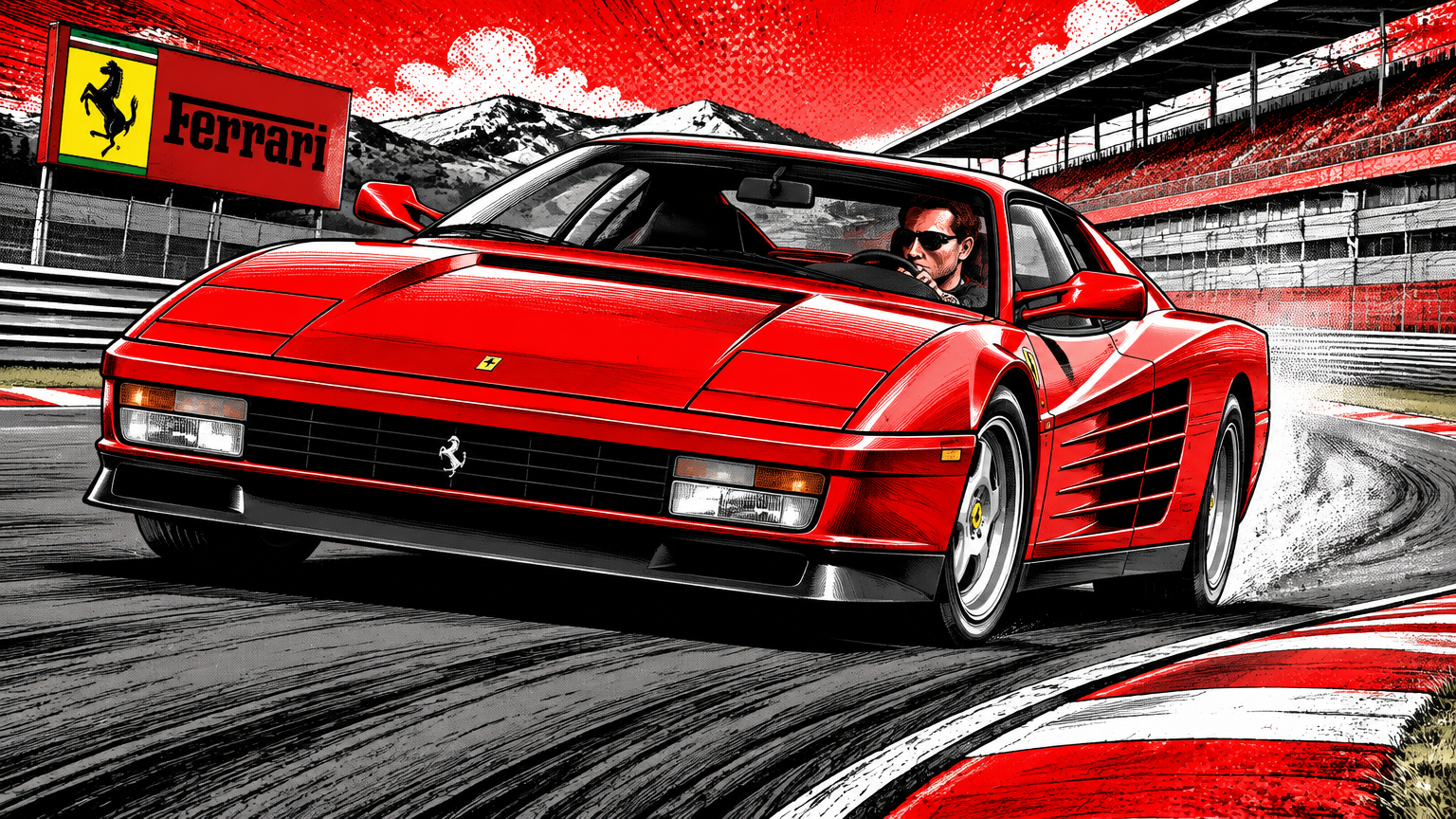
Round Three: Now Add a Corner
Winner: Formula 1.
Here is where the Testarossa honest identity matters, because this car was never a racer wearing license plates. Ferrari never campaigned the Testarossa as a factory race car the way it had the Boxer before it. The Testarossa was built as a grand tourer, a fast road car for long distances, and everything about its cornering story flows from that brief.
Judge it on that brief and it shines. The flat twelve sits low and behind the cabin, giving that 40 front, 60 rear weight distribution. Double wishbone suspension works at both ends, with twin dampers at the rear. The rear track stretches to 1,660 mm, a full 142 mm wider than the front, which is why the car looks like it is pouring itself over its rear wheels, and why it puts its power down with a composure the twitchier exotics of the era could not match. Period testers praised exactly this: a supercar that felt planted, predictable, and usable at speed on real roads, with steering and brakes that talked to you instead of shouting at you. On a mountain road in 1986, this was the fastest point to point car most drivers could actually use, because confidence is a performance figure no spec sheet prints.
Then the Formula 1 car turns a wheel. It weighs 768 kg including its driver, roughly half the Ferrari dry figure. It wears slick racing tires. Its active aerodynamics press it into the road with downforce that grows with speed, so the faster it goes, the harder it can corner, which is a sentence that breaks road car physics and delights racing engineers. It brakes later, turns harder, and changes direction like the road insulted it. There is no version of this round, on any circuit, in any weather, where a 1,506 kg road car on road tires keeps up, and pretending otherwise would insult a car that deserves better than flattery.
Round Three goes to Formula 1, by the usual huge margin. The Testarossa leaves with the title it actually earned: the 1980s supercar you could drive across a continent, at speed, and arrive feeling like a person instead of a survivor. Las Vegas understands that trade. This town runs on the long drive in.
Round Four: Braking
Winner: Formula 1.
The Ferrari braking story is a period piece, and it deserves a fair telling. Ventilated discs at all four corners, about 309 mm in front and 310 mm at the rear, with period test compilations recording stops from 60 mph in roughly 150 feet. For a heavy, 180 mph grand tourer in 1984, that was respectable hardware, and the pedal feel and consistency were part of why testers trusted the car at speed. Brakes you trust are brakes you use later and harder, and that trust is a real part of how fast a road car actually is.
It meets the same wall every challenger meets in this round. A Formula 1 car stops with carbon brakes, slick tires, and downforce pressing the rubber into the road harder the faster it travels. At high speed, the air itself is a braking system. That is why Formula 1 drivers brake at boards that look like typos, and why the 2026 car adds hybrid energy recovery under braking on top of it. Against 768 kg, carbon, and the wind itself working as a brake, a 1,506 kg steel era grand tourer on 1980s discs and 1980s tires is not in a contest. It is in a history lesson.
The usable insight for your own driving is the one this car teaches best. Braking performance ages faster than any other kind. Tire compounds, pad materials, and disc technology have transformed stopping distances since 1984, while top speeds from that era still impress people today. When you drive any classic supercar, budget your braking distances like it is 1984, because for the hardware, it is. The Testarossa stops the way its decade stopped. The Formula 1 car stops like the future is annoyed with it. Round Four, and the sweep, go to Formula 1.
So, Does the Ferrari Testarossa Win Anything?
It wins the decade. Arguably, it wins the culture. Let us be specific.
It wins the recognition championship, and it is not close.
- The white Miami Vice car is one of the most recognized automobiles on Earth, four decades later
- It headlined Sega Out Run, the arcade game that taught a generation of kids what a supercar was
- Road & Track put it on the cover nine times in five years, because nothing else on the road looked like news the way this car did
- Show a silhouette of those strakes to anyone over forty and watch them name the car before you finish the sentence
It wins the usability argument against its own era.
The Countach was faster theater and worse transportation. The Testarossa gave you a cooler cabin than the Boxer, a front luggage compartment, a heater and air conditioning that worked, and road manners testers called composed and predictable. It is the 1980s supercar you can drive to Las Vegas from Los Angeles without needing a chiropractor at the state line. Among collectors, that usability is a big part of why 7,177 people bought one, a huge number for a flagship Ferrari twelve.
It wins the design lesson forever.
The strakes were not styling. They were radiators, packaging, and the law, solved so elegantly that the solution became the most copied shape of a decade. Every young designer should study this car once. Solve the engineering honestly, and the beauty has a chance to be real. Ferrari even built exactly one factory Testarossa Spider, a silver one off made for Fiat boss Gianni Agnelli, because when the chairman of Fiat wants your coupe as a convertible, the answer is a car, singular.
It wins the honest ownership briefing, which this series counts as a win.
- Major engine services on a Testarossa mean the engine comes out of the car. Budget for it, and any car with a documented recent major service is worth more for a real reason
- Early cars wore metric Michelin TRX tires, a known ownership quirk to check before you fall in love with a listing
- The single mirror monospecchio cars are the collectible early build, so a second mirror on an early car is a question worth asking
- US cars traded a little power for emissions equipment, so a European spec car and a US spec car are not the same spec sheet
Ferrari Testarossa wins: the recognition championship, the 1980s usability crown, the greatest design lesson of its decade, and a permanent place on the wall.
What Would Happen on the Las Vegas Strip Circuit?
Now we bring the fight home, to the Las Vegas Strip Circuit, home of the Las Vegas Grand Prix.
The circuit runs 6.201 kilometers, about 3.85 miles, with 17 turns, and the Grand Prix lasts 50 laps. Down the Strip there is roughly a two kilometer straight, under the neon, past the casinos.
That straight was built for this car, emotionally if not literally. Picture it. A white Testarossa, flat twelve singing through a five speed manual, strakes catching the casino light, on the longest straight in this series, in the city that made white cars and night drives a religion. Miami had the television show. Las Vegas would have the real thing, at night, at full song, and there is not a camera position on the circuit that would make this car look anything less than perfect. On the straight, the Ferrari would run hard toward its 290 km/h figure while the crowd remembered every poster they ever owned.
Then come the other sixteen corners and the braking zones, fifty laps of them. The Formula 1 car, at 768 kg with downforce and carbon brakes, would lap in a different time zone, and over a Grand Prix distance the gap stops being a number and becomes a genre difference. No invented lap times here. This is an informed comparison, not a recorded race, and nobody has timed a Testarossa around this circuit for us to quote. The Cadillac CTS-V in the previous fight lost the same way and won the ride home. The Testarossa adds one more trick: when the night ends, it does not need a transporter. It needs a valet stand, a crowd, and about thirty seconds of flat twelve noise to remind the whole Strip which car they all had on the wall.
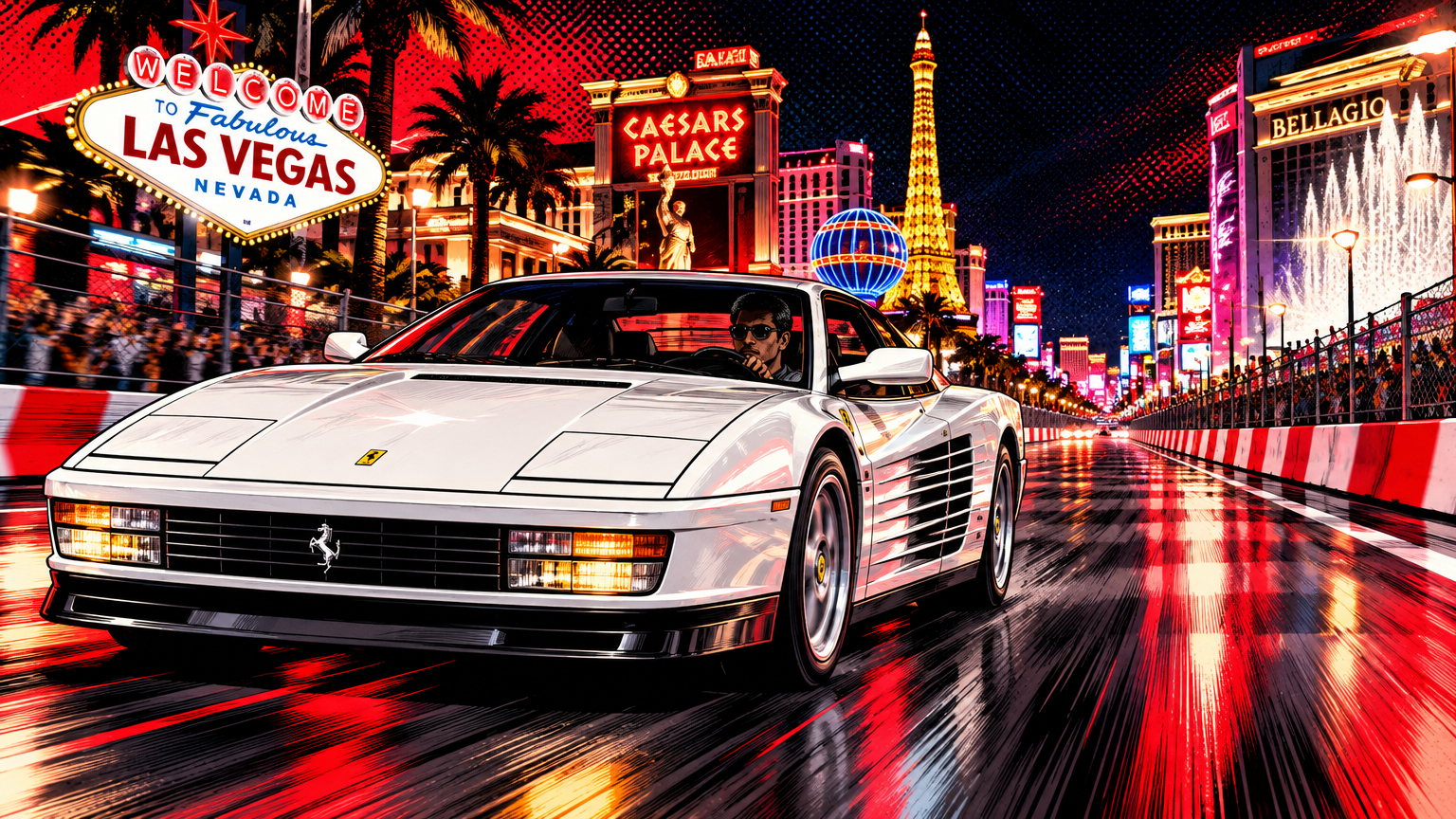
The Final Call
Winner: Formula 1.
Four rounds to none, a clean sweep. Acceleration went to a power to weight advantage of about five to one. Top speed went to measured Formula 1 traps that clear the Ferrari factory figure by more than 60 km/h, in cornering trim, mid lap. Cornering and braking went to the car that weighs 768 kg including its driver and uses the air itself as glue and as a brake. The Ferrari Testarossa was never built to win a Grand Prix. It was built to be the flagship road car of a decade, and on the evidence of 7,177 cars, nine magazine covers in five years, a television legend, and an arcade generation, it made that case so completely that we are still arguing about it forty years later.
And what a case it is. The most powerful engine in a standard sports car at its launch. A top speed figure that ruled its era. Radiators moved to the sides to fix a hot cabin, and a styling icon born from the fix. A grand tourer so usable that it outsold every twelve cylinder Ferrari before it, and so striking that a white one became the most famous car on television. All of it with a manual gearbox, a front trunk, and pop up headlights.
Formula 1 may win the fight. But the Ferrari Testarossa still owns the poster, the night drive, and the decade that taught a generation to fall in love with cars.
There are plenty more cars waiting to pick a fight with Formula 1.
Next up: Formula 1 vs. Nissan Skyline GT-R R34. The all wheel drive video game legend from Japan steps out of the screen and into the ring.