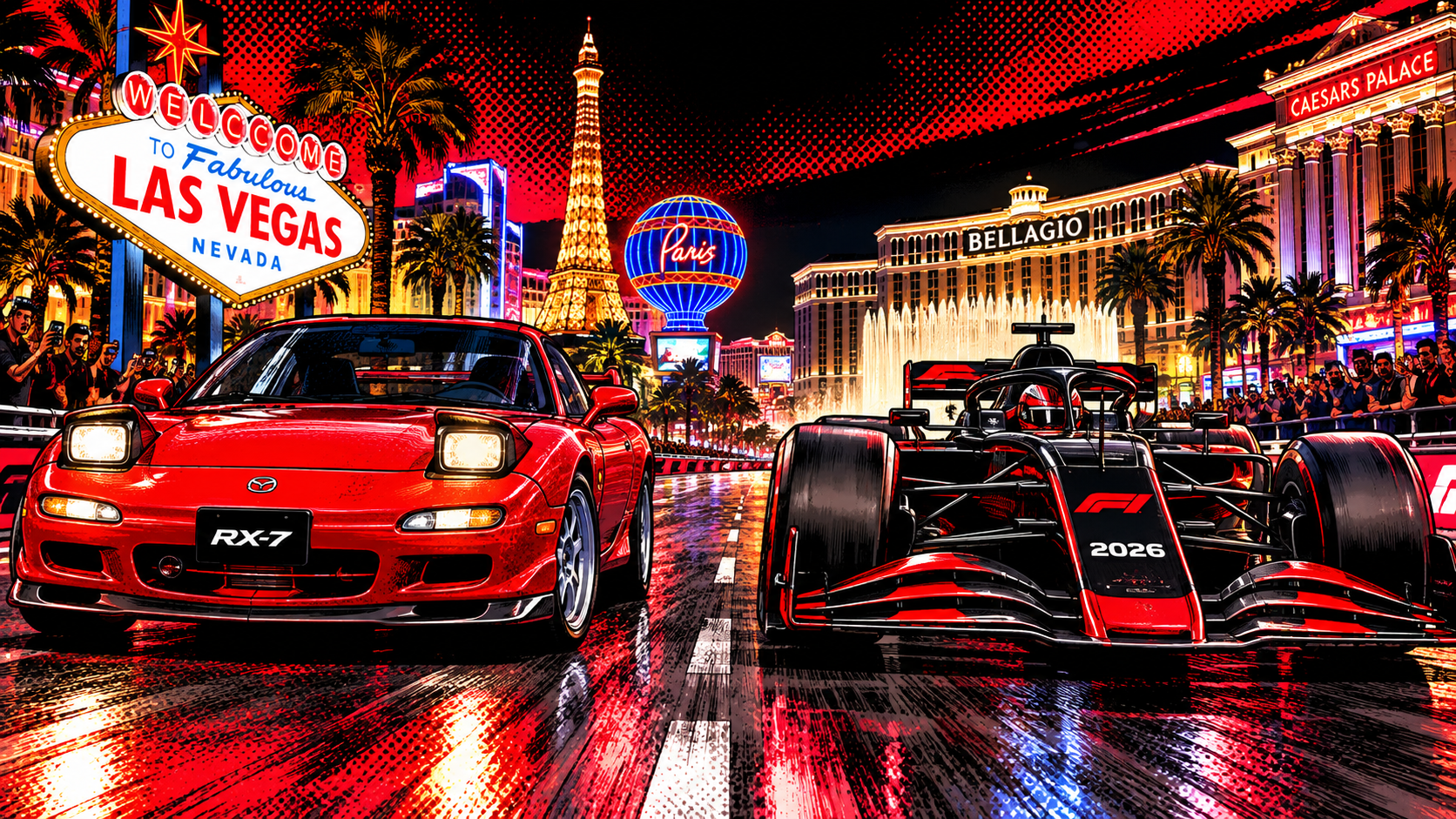
Every challenger so far in this series has tried to beat Formula 1 the obvious way. More power. More speed. More everything.
This one shows up with 255 horsepower and a smile.
The third generation Mazda RX-7, the FD, is the lightest kind of trouble. It weighs about 2,800 pounds. Its engine has no pistons at all. It makes its power from 1.3 liters, which is less displacement than a lot of motorcycles carry, and it spins to 8,000 rpm like it is trying to leave the engine bay through the hood.
It is also, by near universal agreement among people who have driven one hard, one of the finest handling road cars ever sold. Period testers did not just like this car. They wrote poetry about it, and then it went to Australia and won the Bathurst 12 Hour three years in a row.
What happens if the Mazda RX-7 picks a fight with a Formula 1 car?
What happens is the purest test this series has run yet. No giant horsepower claim to hide behind. No 248 mph brochure number. Just balance, lightness, and bravery, against a car that has balance, lightness, and bravery plus about 750 extra horsepower.
Bring a scalpel. This challenger brought one, and it is beautiful.
First, Which RX-7 Are We Talking About?
Precision matters here, because Mazda built the FD for a decade, on two sides of the Pacific, at three different power levels, and the internet blends them into one imaginary car that never existed.
Our challenger is the car America actually got: the United States specification Mazda RX-7 FD, sold for the 1993 to 1995 model years. The FD generation, chassis code FD3S, first went on sale in Japan in December 1991, and Japan kept building it until August 2002. The United States only got three model years, and fewer than 13,900 cars were imported before Mazda pulled the plug here. Total FD production across the full run is commonly listed at 68,589 cars.
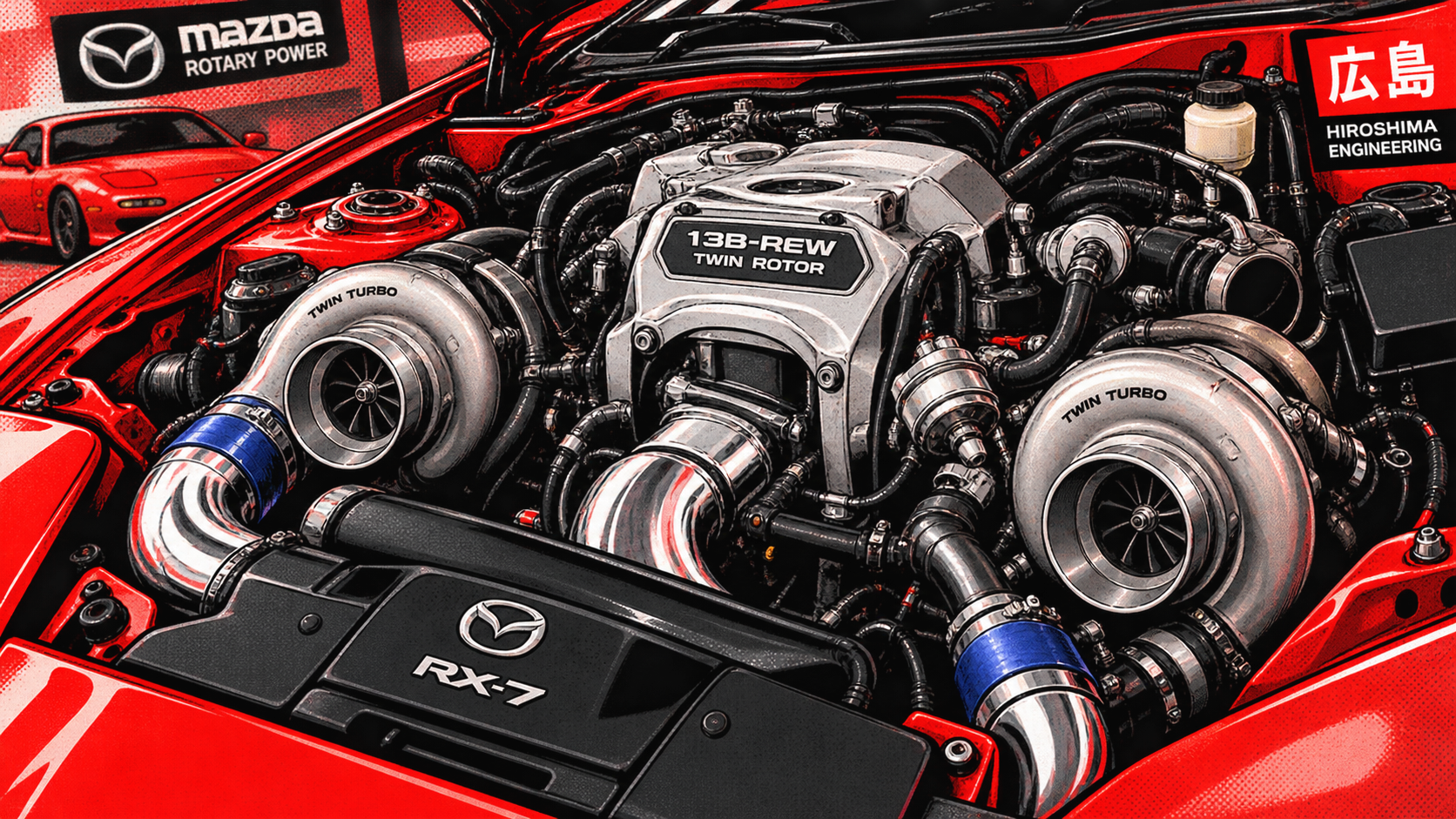
The engine is the whole story, so let us get it exactly right. The 13B-REW is a twin rotor Wankel rotary, rated at 1,308 cubic centimeters, built from two 654 cc chambers. There are no pistons, no valves, and no camshafts. Two triangular rotors spin inside figure eight housings, and the whole engine is small enough that Mazda tucked it behind the front axle line, which is how the car earns the front mid engine label you will see in the history books.
Breathing for the rotary is a sequential twin turbocharger system, developed with Hitachi and first used on the Japan only Eunos Cosmo. One smaller turbo works from low rpm for response. The second turbo joins in around 4,000 rpm for the top end. Mazda billed it as the first mass produced sequential twin turbo system exported from Japan, and the point of the complexity was simple: a rotary with one big turbo would have been a laggy mess, and Mazda wanted power everywhere.
The United States rating is 255 horsepower at 6,500 rpm and 217 pound feet of torque at 5,000 rpm, with an 8,000 rpm redline. The gearbox in the car we are scoring is the five speed manual, driving the rear wheels through a Torsen limited slip differential. A four speed automatic existed and almost nobody wanted it. It is not our car.
Weight is the headline after the engine. Period sources put the United States car at about 2,800 pounds, roughly 1,270 kilograms, with small differences by trim and year. The structure is a steel monocoque lightened with aluminum panels and aluminum double wishbone suspension at all four corners, tied together by what Mazda called the Power Plant Frame, a rigid link between engine, transmission, and differential. Weight distribution is the famous part: 50:50, front to rear, the number every sports car brochure chases and almost none actually hit.
The price explains why so few Americans bought one. The 1993 car started at about 32,500 dollars, serious money for a Mazda in 1993, and it climbed to about 37,500 dollars by 1995. Buyers cross shopping a Corvette did the math and walked. Drivers who knew, knew.
Now the performance numbers, labeled the way this series always labels them. These are period independent test results, not a single Mazda claim, and period tests vary, so here is the honest range. Testers recorded zero to 60 mph in about 4.9 to 5.3 seconds depending on the magazine and the car, quarter mile times in the mid 13 to about 14 second range, and top speeds of about 155 to 159 mph. Sports Car Market cites a skidpad figure of 0.97 g, remarkable then and respectable now. Fast car. Not a straight line monster. That was never the point of it.
Two more versions, kept strictly separate so nobody blends them into our car. In Japan, Mazda raised the rating to 265 PS in January 1996, and the Type R and Type RS reached 280 PS in January 1999. The final word was the Spirit R, announced by Mazda on March 25, 2002 and sold in Japan only, with a planned run of 1,500 cars. The two seat, five speed manual Spirit R Type A carried the 280 PS rating, Recaro full bucket seats, large drilled ventilated discs at all four wheels, and Bilstein dampers, and Mazda called it the ultimate RX-7 with the most outstanding driving performance in the model's history. It is a wonderful car. It is not the car America bought, and it is not the car we are scoring. Our scores belong to the 255 horsepower United States car, the FD the rest of the world fell in love with.
That is the challenger. The lightest car in this series so far on spirit, if not quite on the scale, and the only one whose engine goes around instead of up and down.
Now it has to fight a car with four times the power.
Meet the 2026 Formula 1 Car
Across the garage sits a 2026 Formula 1 car, and on paper this looks less like a fight and more like a rounding error.
The 2026 Formula 1 car runs a 1.6 liter turbocharged V6 hybrid. The combustion side is limited to about 400 kW. The electric MGU-K can deliver up to 350 kW where maximum deployment is allowed. Formula 1 describes the total package as producing more than 1,000 horsepower.
Read that against the Mazda one more time. More than 1,000 horsepower against 255. The Formula 1 car makes roughly four times the power of the RX-7, from an engine only 300 cc larger on paper. Displacement is a funny thing when one side counts chambers and the other side counts a hybrid system.
Then comes the number that usually saves a lightweight challenger, except this time it does not. The minimum regulatory weight for a 2026 Formula 1 car is 768 kilograms, about 1,693 pounds, including the driver. The RX-7 weighs about 2,800 pounds before the driver gets in. The lightest hearted car in this series is still more than 1,100 pounds heavier than the Formula 1 car, while making a quarter of the power. The RX-7 built its whole legend on power to weight. Formula 1 just plays that game at a level no road car reaches.
For 2026, Formula 1 also runs active front and rear aerodynamics, low drag on the straights and high downforce in the corners, on carbon construction and racing tires built for one job only.
The RX-7 is a masterclass in balance. Balance was never going to be the problem.
The problem is the other car is balanced too, and it is a Formula 1 car.


RX-7 vs. F1: The Numbers
| Category | Mazda RX-7 FD (US spec, 1993 to 1995) | 2026 Formula 1 Car |
|---|---|---|
| Engine | 13B-REW twin rotor Wankel rotary, 1,308 cc, sequential twin turbochargers | 1.6 liter turbocharged V6 hybrid |
| Power | 255 hp at 6,500 rpm, US rating | 400 kW combustion engine plus up to 350 kW MGU-K deployment; more than 1,000 hp total per Formula 1 |
| Torque | 217 lb-ft at 5,000 rpm, US rating | No single standardized series figure |
| Weight | About 2,800 lb (about 1,270 kg), varies slightly by trim and year | 768 kg minimum regulatory weight, driver included |
| 0 to 60 mph | About 4.9 to 5.3 sec in period independent tests | No universal official 2026 figure |
| Quarter mile | Mid 13 to about 14 sec in period independent tests | Not a Formula 1 measure; no official figure |
| Top speed | About 155 to 159 mph in period tests and listings | 2026 FIA speed trap data has already exceeded 219 mph in qualifying trim |
| Drivetrain | Rear wheel drive, five speed manual, Torsen limited slip differential | Rear wheel drive |
| Weight distribution | 50:50 front to rear, engine behind the front axle | Set by regulation and ballast, roughly balanced by design |
| Signature tires | Road legal performance tires | Formula 1 racing slicks |
| Aerodynamics | Low, clean fastback body with pop up headlights | Active front and rear aerodynamics |
| Street legal | Yes | No |
| Production | 68,589 FD cars in total; fewer than 13,900 imported to the United States | One per driver, per team, per season, roughly |
| Racing family | Won the Bathurst 12 Hour outright in 1992, 1993, and 1994 in production based form | It is the racing family |
| Vegas valet factor | Very high. Vintage Red, pop up headlights up, and a rotary idle that sounds like nothing else in the line | Cannot be valeted. Needs a pit crew and a laptop |
Round One: Acceleration
Give the little rotary its flowers first, because the launch is genuinely good.
Two hundred fifty five horsepower moving about 2,800 pounds is a healthy ratio in any decade, and period testers proved it: zero to 60 mph in about five seconds flat, with the best runs dipping under it. The sequential turbos are the reason it feels even stronger than the stopwatch says. The small turbo is already working low in the rev range, the big one arrives around 4,000 rpm, and the rotary just keeps spinning, smoother and higher, all the way to 8,000 rpm. There is no wheeze at the top. There is barely a top.
Then physics clears its throat.
The Formula 1 car makes more than 1,000 horsepower and weighs 768 kilograms with the driver in it. That is not a better power to weight ratio than the Mazda. It is a different universe of power to weight ratio, roughly four times the horsepower per pound, delivered through racing slicks with aerodynamic load pressing them into the ground. There is no universal official zero to 60 figure for a 2026 Formula 1 car, and we are not inventing one. We do not need one. Five seconds to 60 mph is a great sports car number. It is not a Formula 1 number.
The Dodge Challenger SRT Demon 170 won this round two fights ago because straight line violence was its entire religion. The RX-7 never claimed that religion. It claimed the corner at the end of the straight.
Quick for a road car. Outgunned in this garage.
Round One Winner: Formula 1
Round Two: Top Speed
This is the shortest round of the day, and the Mazda would be the first to tell you so.
Period tests and listings put the United States specification FD at about 155 to 159 mph at the top end. That is a proper top speed, faster than most drivers will ever go anywhere, and it comes from a clean shape and gearing chosen for a balanced road car, not for a land speed headline. Mazda was not chasing 200 mph with this car. Mazda was chasing feel.
The Formula 1 car's receipts are measured by the FIA and written down. During qualifying for the 2026 Chinese Grand Prix, Pierre Gasly was recorded at 353.9 kilometers per hour, about 220 mph in the speed trap. Here on the Las Vegas Strip Circuit, earlier editions were faster still: in 2025, Yuki Tsunoda was recorded at 358.3 kilometers per hour, about 222.6 mph, and in 2024, Alex Albon hit 368.9 kilometers per hour, about 229.2 mph, the highest figure through the first three editions. Those years are labeled on purpose.
Sixty plus miles per hour is not a gap. It is a different weather system. And remember, the Formula 1 car hits those numbers while carrying wings big enough to corner at speeds the Mazda cannot reach on a straight. Trimmed for top speed alone, the conversation gets sillier, not closer.
The RX-7 tops out where a great nineties sports car should. The Formula 1 car is still accelerating hard at that speed, in a car built to brake and turn at the end of it.
Some rounds you score with a stopwatch. This one you score with binoculars.
Round Two Winner: Formula 1
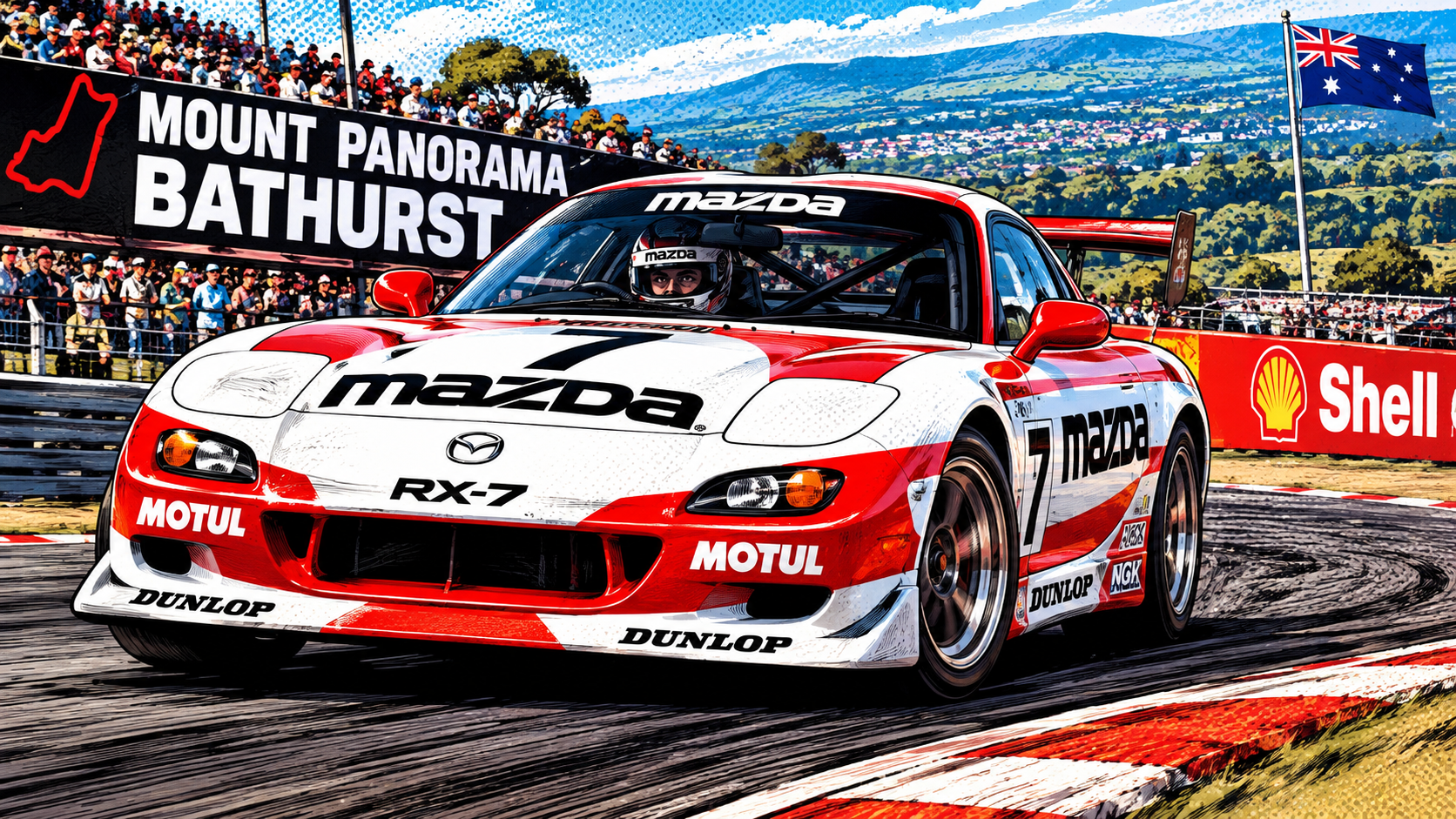
Round Three: Now Add a Corner
Here it is. The round this car was born for. If any road car in this series earns a hearing before the score lands, it is this one.
The FD case is not nostalgia. It is engineering. The engine sits behind the front axle, so the mass lives in the middle of the car. The weight split is 50:50. The suspension is double wishbones at all four corners, in aluminum, tuned by people who had just watched their rotary prototype win at Le Mans in 1991 with the 787B, a different car we are keeping separate, but the same rotary obsessed company. Period skidpad testing reached 0.97 g on road tires. Road & Track famously timed the FD lapping faster than an Acura NSX at Streets of Willow. And in Australia, production based FDs did not just handle well in magazine tests. They won the Bathurst 12 Hour outright three years running, 1992, 1993, and 1994, against Porsches and everything else, then won the Eastern Creek 12 Hour in 1995 for good measure. Corners are not this car's hobby. Corners are its career.
And then the Formula 1 car turns in.
It weighs 768 kilograms including the driver, against about 1,270 kilograms for the Mazda before the driver climbs in. It generates its grip with active aerodynamics pressing racing slicks into the pavement, slicks with no tread, no rain compromise, and no apology. It changes direction at cornering loads that would slide the Mazda, heroically and beautifully, right past the apex and into the scenery. The RX-7 at its absolute limit is one of the great handling experiences in road car history. The Formula 1 car cruises past that limit on a warm up lap.
This is the closest this round has felt since the series started, because feel counts for something and the FD has more of it than cars with triple its horsepower. But this round is scored on cornering speed and lap time, not on grins. On grins, call us. On the clock, there is one winner.
Respect the scalpel. Score the stopwatch.
Round Three Winner: Formula 1
Round Four: Braking
Braking is the round where light weight usually buys a road car some dignity, and the Mazda has real hardware to argue with.
The FD stops with four wheel ventilated disc brakes and anti lock braking, on a car weighing about 2,800 pounds. That combination was praised throughout its life. Period reviewers called the brakes excellent, the pedal feel is a known FD strength, and the car's low mass means there is simply less energy to throw away every time the driver stands on the middle pedal. Mazda took the idea further on the final Spirit R, with large drilled discs at all four wheels and stainless mesh hoses, kept separate from our car as always, but it tells you where the company's head was at: braking was part of the FD's balance religion, not an afterthought.
The Formula 1 car starts every braking zone with 768 kilograms to slow, driver included. That is roughly 1,100 fewer pounds than the Mazda carries before its driver sits down. It adds aerodynamic load that peaks exactly when the car is fastest and braking hardest, and carbon brakes built to deliver maximum stops, seventeen braking events a lap, fifty laps in a row, at temperatures that would fade a road car's brakes into a suggestion by the third lap of a track day.
The Mazda brakes like the balanced car it is: short, stable, and honest, lap after lap at road car pace.
The Formula 1 car brakes like the stop itself is an attack. Because in Formula 1, it is.
Round Four Winner: Formula 1
So, Does the RX-7 Win Anything?
It wins no rounds today, and it might still win the whole series where it counts. Here is the case.
It wins balance, outright.
Fifty fifty weight distribution, a front mid engine layout, and steering feel that reviewers were still writing poems about thirty years later. Plenty of cars in this series are faster. Almost none are this balanced. The FD is the answer enthusiasts give when someone asks what a sports car is supposed to feel like, and that answer has not changed since 1993.
It wins the engine argument nobody else can enter.
Every other challenger in this series, and the Formula 1 car itself, uses pistons. The RX-7 spins. A 1,308 cc twin rotor making 255 horsepower, revving to 8,000 rpm with turbine smoothness, is not a spec. It is a magic trick Mazda performed for decades after every other major manufacturer gave up on the rotary. There will never be another production car like it.
It wins Bathurst.
Three straight outright wins at the Bathurst 12 Hour, 1992 to 1994, plus Eastern Creek in 1995, in production based cars run by a factory team staffed in part by Mazda apprentices. Supercars with double the power in this series cannot show you that trophy shelf. The little rotary earned its legend at the hardest endurance venue in Australia, three years in a row.
It wins the street, and the design museum.
It is street legal, it has pop up headlights, and its fastback shape is regularly called one of the most beautiful Japanese cars ever drawn. It drives to dinner, to the coast, to the track, and home again. The Formula 1 car needs a crew, a laptop, and a closed circuit just to exist.
RX-7 wins: balance, the rotary itself, Bathurst, and the title of best feeling car in this entire series.
What Would Happen on the Las Vegas Strip Circuit?
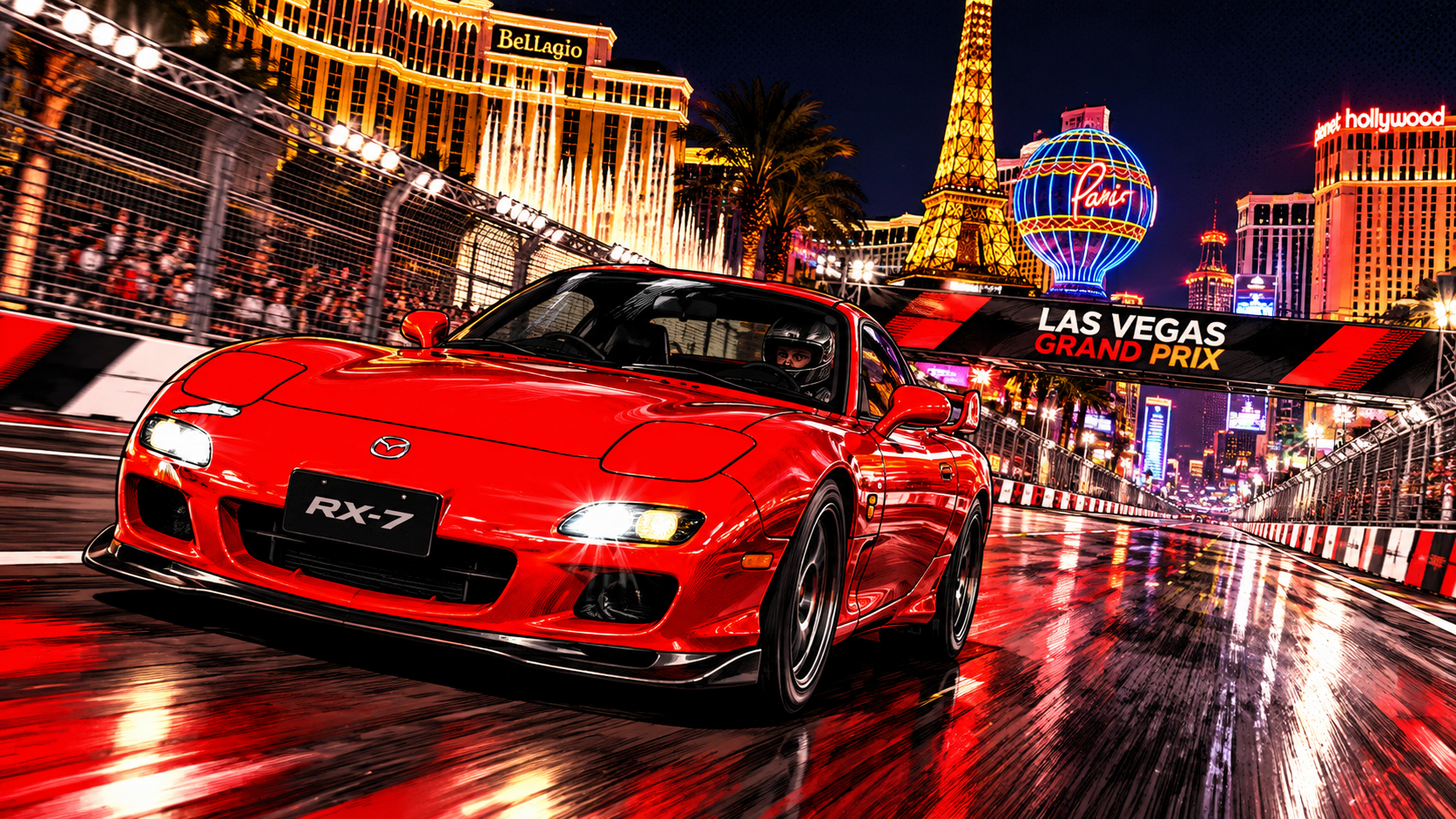
Now we bring the fight home, to the Las Vegas Strip Circuit, home of the Las Vegas Grand Prix.
The circuit runs 6.201 kilometers, about 3.85 miles, with 17 turns, and the Grand Prix lasts 50 laps. Running down the Strip there is roughly a two kilometer straight, under the neon, past the casinos.
Let us be honest about that straight first. Two kilometers is a long time at full throttle, and the RX-7 would run out of speedometer at about 155 to 159 mph while the Formula 1 car keeps pulling toward 220. The crowd would see the gap open like a zipper. No romance changes that math.
But watch the Mazda everywhere else. Through the tight sections, the FD would be the happiest road car this series has put on this circuit: light on its feet, rotating around its middle, the rotary singing at 8,000 rpm off every corner at a pitch no piston car makes. Over one lap, the Formula 1 car's power, weight, aero, tires, and brakes would build a gap measured in many seconds. Over 50 laps, it would be a Grand Prix car running a Grand Prix, and an RX-7 running an exhibition the crowd talks about on the walk home. No invented lap times here. This is an informed comparison, not a recorded race, and nobody has timed a United States specification FD around this circuit for us to quote.
And here is the Vegas twist, and it fits this car like a tailored suit.
Las Vegas loves the underdog with style. The FD is a Vintage Red, pop up headlight, rotary powered lightweight that America mostly ignored when it was new, and has spent thirty years apologizing to ever since. It would lose this race by a mile. It would win the parking lot, the photo ops, and every heart in the grandstand that ever shifted its own gears.
The Final Call
Winner: Formula 1.
Four rounds to none, the first clean sweep in a few fights, and the score still does not tell the story of this car.
Acceleration went to a four to one power to weight advantage. Top speed went to measured FIA traps against a 155 to 159 mph road car. Cornering and braking went to the car built only for cornering and braking. The RX-7 was never going to win a Grand Prix in Las Vegas. It was built to prove that lightness, balance, and a weird little engine that spins could beat brute force in the places drivers actually live: the corners.
And that proof still stands. This is the car that arrived in America in 1993 at about 32,500 dollars, sold in tiny numbers, left in 1995, and then spent three decades becoming a legend anyway. The car that won Bathurst three straight years. The car whose engine has no pistons and whose balance has no equal in this series. Values climb, parts get reproduced, and every young enthusiast still knows exactly what an FD is.
Formula 1 may win the fight. But the RX-7 still owns the corner, the sound, and the argument that how a car feels beats how fast it is, every single time you are the one driving.
There are plenty more cars waiting to pick a fight with Formula 1.
Next up: Formula 1 vs. Bugatti Veyron. One thousand horsepower, four turbochargers, and the top speed crown of the production car world comes for Formula 1.