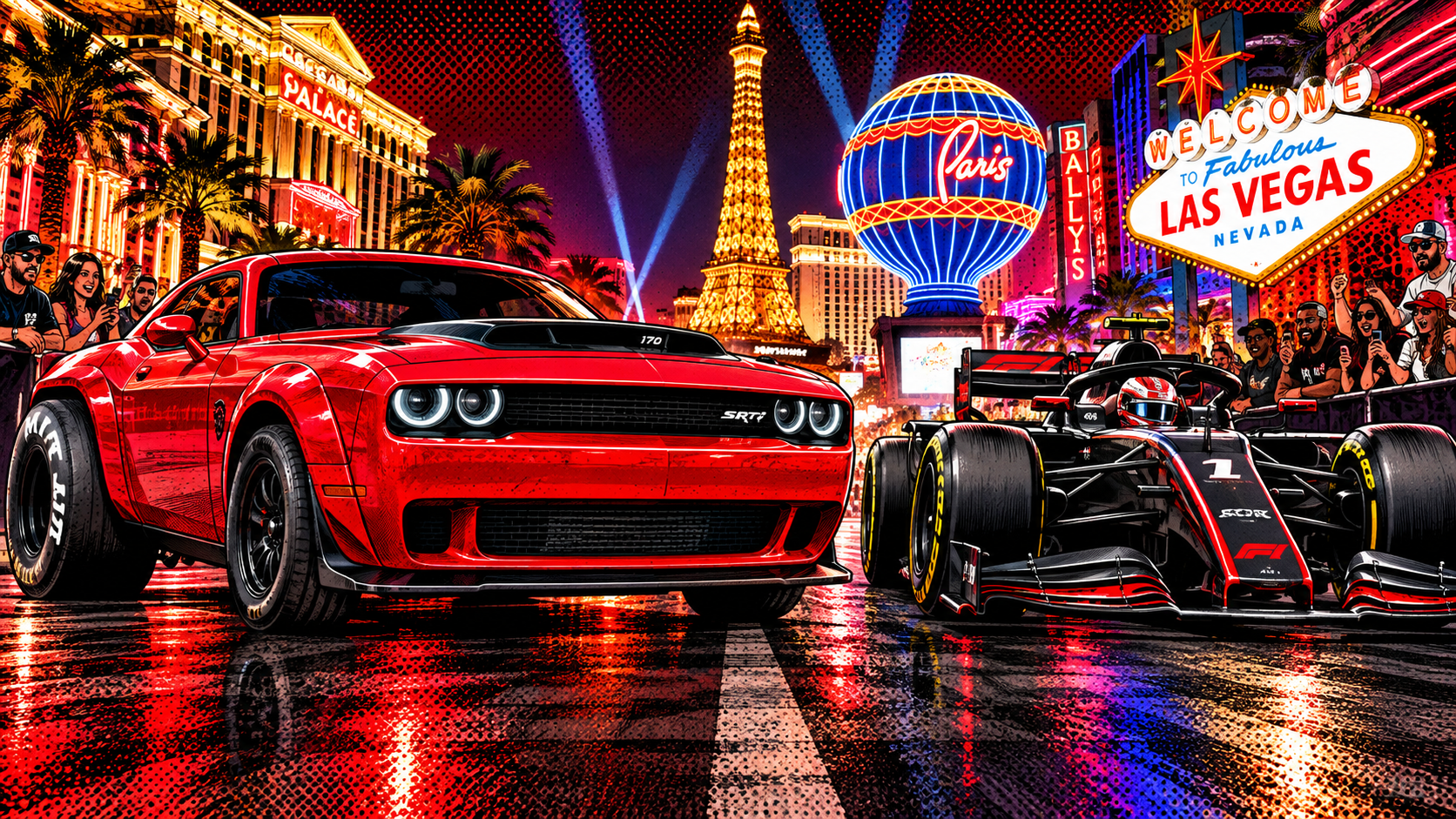
Every challenger in this series so far has tried to beat a Formula 1 car at the Formula 1 car's own game.
Lightweight British sports cars. German legends. An Italian poster car. A hypercar with an actual Formula 1 engine in it.
The Dodge Challenger SRT Demon 170 looked at that game, laughed, and brought a different game entirely.
This car does not care about corners. It does not care about lap times, downforce figures, or braking zones. It cares about one quarter of one mile, in a straight line, and it cares about it more than any factory car in history.
Dodge built this thing as a goodbye. It is the seventh and final Last Call special edition, the last word in the HEMI muscle car era, and Dodge chose to reveal it right here in Las Vegas, at The Strip at Las Vegas Motor Speedway, in March 2023. A car named after the proof rating of corn alcohol, dropped into Sin City to end an era. Somebody at Dodge understands theater.
And the numbers are pure theater too, except they are also real, certified, and slightly unhinged.
What happens if the Dodge Challenger SRT Demon 170 picks a fight with a Formula 1 car?
What happens is the strangest fight in this series so far. Because in one very specific place, on one very specific surface, this big American coupe has a number that should make even a Formula 1 car sit up and pay attention.
Everywhere else, well. Gravity, physics, and corners are waiting. Let us get into it.
First, Which Demon Are We Talking About?
Precision matters here, because Dodge has used the Demon name twice and the two cars are not the same animal.
We are not talking about the 2018 Challenger SRT Demon, mighty as it was with 840 horsepower and a 9.65 second quarter mile. We are talking about the 2023 Dodge Challenger SRT Demon 170, one model year only, the final Last Call car, unveiled on March 20, 2023.
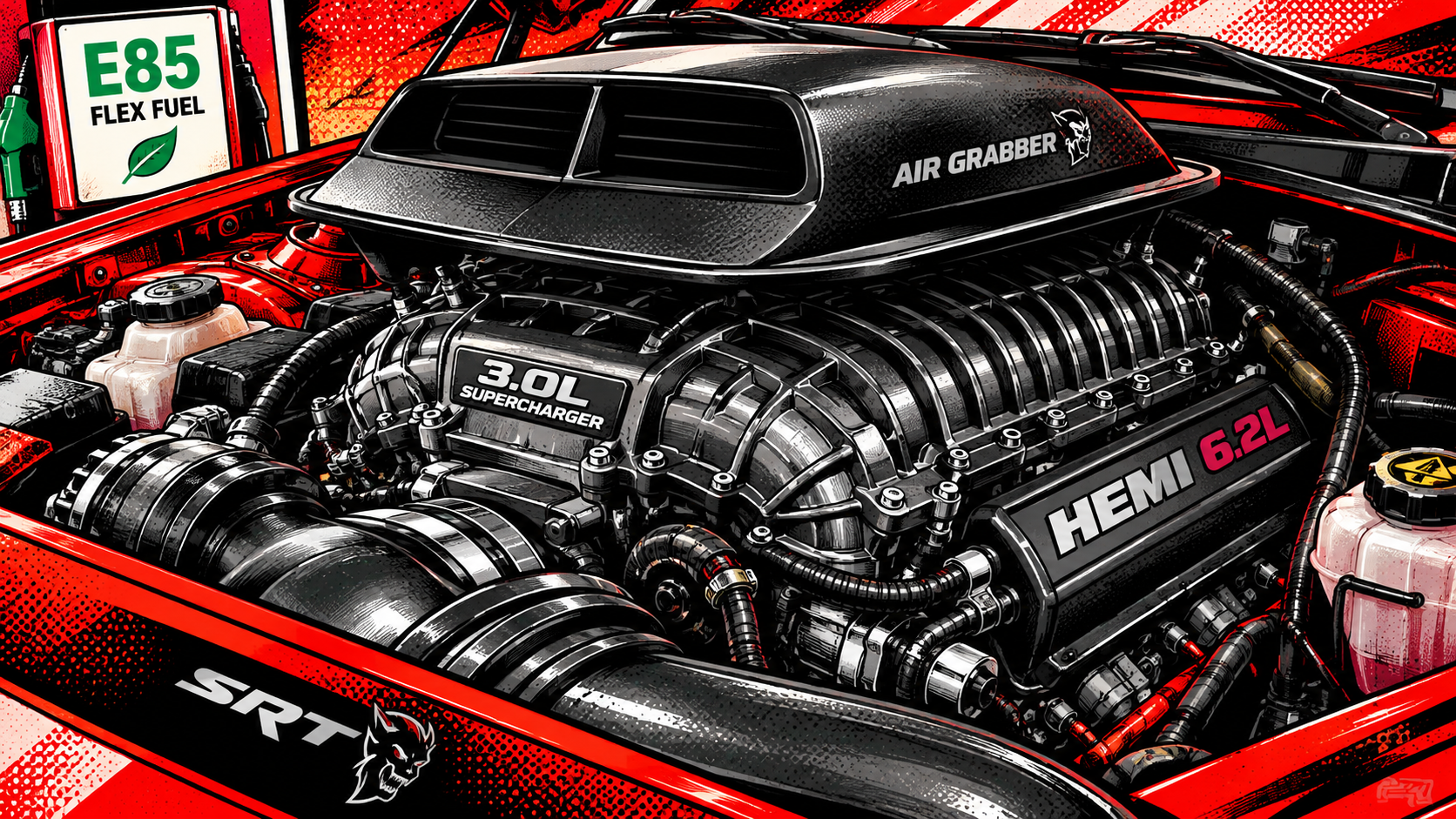
The 170 in the name is the proof rating of E85 fuel, and the fuel is not a footnote. It is the whole trick.
Under the Air Grabber hood sits a 6.2 liter supercharged HEMI V8, and calling it a development of the old Demon engine is generous. Per Dodge, almost every primary power component was upgraded. The camshaft is about the only significant part carried over untouched.
The supercharger grew to 3.0 liters, with a larger snout, a 105 millimeter throttle body, and a 3.02 inch pulley, making 21.3 psi of boost, which Dodge says is 40 percent more boost pressure than the Challenger Hellcat Redeye Widebody. Cylinder pressure on E85 measures 2,500 psi. The fuel system can flow 164 gallons per hour, which Dodge, with a straight face, compared to more than the average United States shower head. The engine even shares DNA with the Direct Connection Hellephant C170 crate engine.
Feed it E85 ethanol and, per Dodge, it makes 1,025 horsepower at 6,500 rpm and 945 pound feet of torque at 4,200 rpm. Feed it regular E10 premium and it makes a still ridiculous 900 horsepower and 810 pound feet. There is no black key and red key dance this time. The car senses the ethanol percentage in the fuel on its own, shows it in the instrument cluster, and adjusts the power to match. The driver just has to find the right gas station.
Power goes through the proven TorqueFlite 8HP90 eight speed automatic to the rear wheels only. No all wheel drive safety net. The driveline was rebuilt for the violence: a 240 millimeter rear axle with a housing Dodge says is 53 percent stronger, a prop shaft 30 percent stronger than the original Demon's, and stronger half shafts.
The tires tell you what this car is for. Out back, Mickey Thompson P315/50R17 ET Street R drag radials on 17 by 11 inch wheels, a tire Dodge says had never been offered on a production car before. Up front, skinny 245/55R18 Mickey Thompson front tires on 18 by 8 inch wheels. Dodge calls it the first factory production car built with staggered drag radials and fender flares, and note the flares only live at the back. Deleting the front flares saved weight, because of course it did.
The drag toolbox is factory fitted and faintly absurd. TransBrake 2.0 lets the driver dial in launch torque profiles for different grip levels. Line Lock warms the rear tires with smoky burnouts. Launch Control and Launch Assist manage the hit. Torque Reserve keeps the supercharger ready. The SRT Power Chiller diverts the air conditioning to cool the supercharger intercooler, cutting intake air temperature by up to 45 degrees Fahrenheit per Dodge. The Drag Mode suspension uses adaptive Bilstein shocks with softer springs, tuned to transfer weight backward and plant those rear tires.
Weight? In its lightest form, with the standard single driver seat setup, the Demon 170 comes in at about 4,275 pounds, roughly 1,939 kilograms, a figure Dodge boss Tim Kuniskis walked through at the reveal: about 25 pounds heavier than the original Demon, and 157 pounds lighter than a Hellcat Redeye Widebody thanks to seat deletes, lightweight brakes, and hollow sway bars. Add the optional seats and luxury gear back in and the number climbs, because physics accepts bribes from nobody.
And the receipts. Per Dodge, zero to 60 mph in 1.66 seconds, with a launch force of 2.004 g, which Dodge billed as the highest g force acceleration of any production car. The quarter mile: an NHRA certified 8.91 seconds at 151.17 mph, making it history's first ever eight second factory muscle car. The NHRA also handed it a violation letter, a ban, for running under nine seconds without a safety cage and a parachute. Dodge will happily sell you a parachute mounting system through Direct Connection, which tells you everything about this car's priorities.
Production was limited to at most 3,300 cars, 3,000 for the United States and 300 for Canada, at an MSRP of 96,666 dollars before destination and fees. The devil, as they say, is in the pricing details.
That is the challenger. A street legal drag car with a corn habit, a ban letter from the sanctioning body, and the quickest launch Dodge has ever sold.
Now it has to fight a car that does not even know what a drag strip is.
Meet the 2026 Formula 1 Car
Across the garage sits a 2026 Formula 1 car, and it could not be more different if it tried.
The 2026 Formula 1 car runs a 1.6 liter turbocharged V6 hybrid. The internal combustion side is limited to about 400 kW. The electric MGU-K can deliver up to 350 kW where maximum deployment is allowed. Formula 1 describes the total package as producing more than 1,000 horsepower, with the honest caveat that the electrical help is managed around the lap.
So on headline power, this fight is weirdly close. One thousand twenty five horsepower for the Dodge, on the right fuel. More than a thousand for the Formula 1 car. If this were a dyno contest, we could all go home early.
It is not a dyno contest, because here comes the number that ruins the Demon 170's day. The minimum regulatory weight for a 2026 Formula 1 car is 768 kilograms, about 1,693 pounds, including the driver.
The Demon 170 weighs about 4,275 pounds before anyone climbs in. The Formula 1 car weighs well under half of that, driver included, while making similar headline power. The Dodge carries a passenger seat delete and a parachute option. The Formula 1 car carries almost nothing at all.
For 2026, Formula 1 also runs active front and rear aerodynamics, low drag on the straights and high downforce in the corners, on carbon construction and racing tires that exist for one purpose only.
The Demon 170 is the most specialized challenger this series has seen. Specialized is a compliment and a warning at the same time.
This seems unfair, because it is.


Demon 170 vs. F1: The Numbers
| Category | Dodge Challenger SRT Demon 170 | 2026 Formula 1 Car |
|---|---|---|
| Engine | 6.2 liter supercharged HEMI V8, 3.0 liter supercharger | 1.6 liter turbocharged V6 hybrid |
| Power | 1,025 hp at 6,500 rpm on E85; 900 hp on E10 premium, Dodge figures | 400 kW combustion engine plus up to 350 kW MGU-K deployment; more than 1,000 hp total per Formula 1 |
| Torque | 945 lb-ft at 4,200 rpm on E85; 810 lb-ft on E10, Dodge figures | No single standardized series figure |
| Weight | About 4,275 lb (about 1,939 kg) in lightest single seat form | 768 kg minimum regulatory weight, driver included |
| 0 to 60 mph | 1.66 sec, Dodge figure, on a prepared drag strip surface | No universal official 2026 figure |
| Quarter mile | 8.91 sec at 151.17 mph, NHRA certified, Dodge figure | Not a Formula 1 measure; no official figure |
| Top speed | 215 mph, reported top speed | 2026 FIA speed trap data has already exceeded 219 mph |
| Drivetrain | Rear wheel drive, TorqueFlite eight speed automatic | Rear wheel drive |
| Signature tires | Mickey Thompson ET Street R drag radials, 315/50R17 rear | Formula 1 racing slicks |
| Aerodynamics | Air Grabber hood, rear fender flares, drag first design | Active front and rear aerodynamics |
| Street legal | Yes | No |
| Production | At most 3,300 cars, 2023 only | One per driver, per team, per season, roughly |
| Official paperwork | NHRA violation letter for running under nine seconds without a cage and parachute | FIA technical regulations, several hundred pages of them |
| Vegas valet factor | High risk. The valet has heard about this car and has been waiting all week | Cannot be valeted. Needs a pit crew and a laptop |
Round One: Acceleration
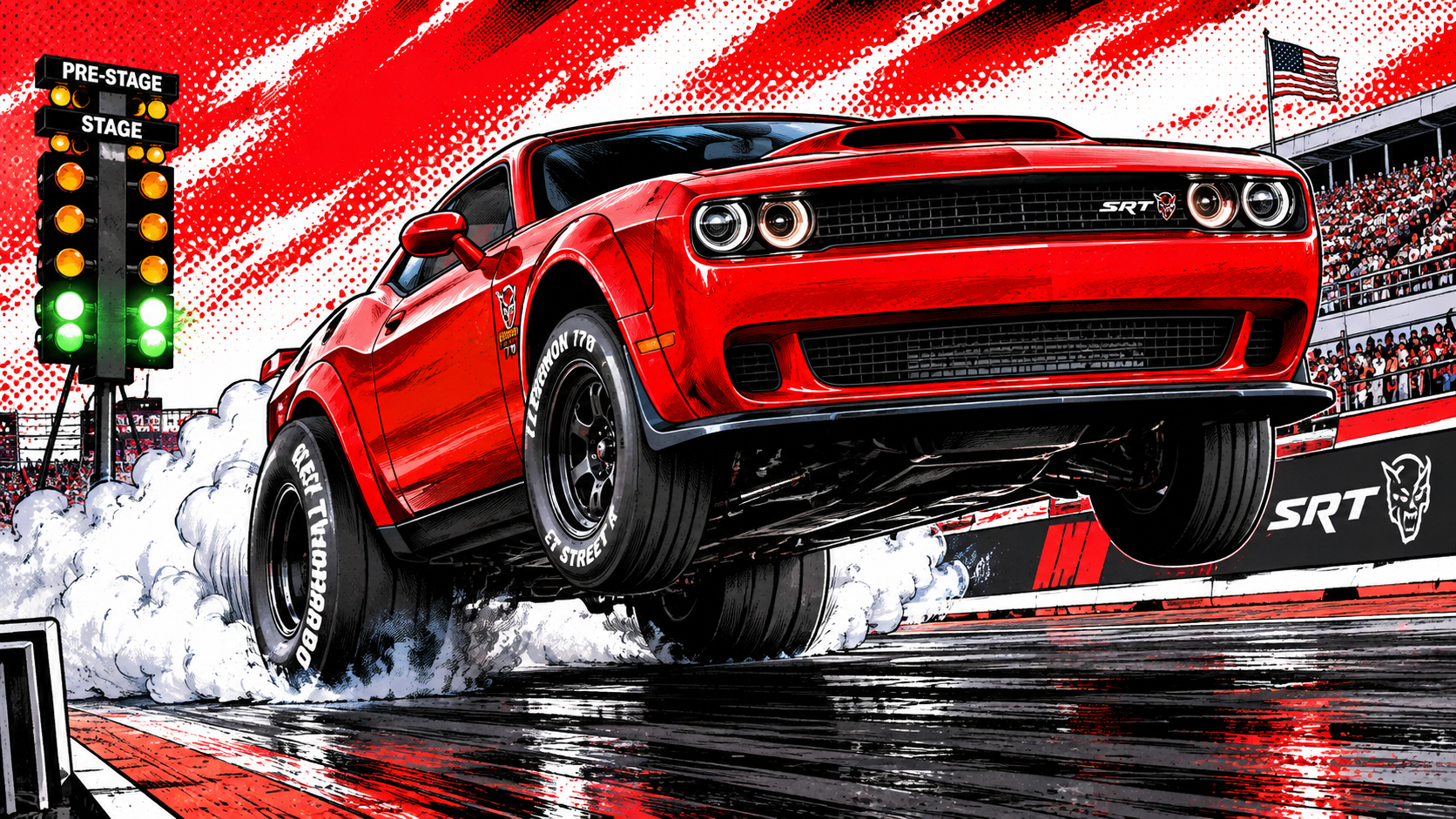
Clear the track. Heat the tires. This is the Demon's home game, and we are going to judge it on the Demon's home terms: a standing start, on a prepared drag strip surface, over the sprint this car was built for.
On those terms, the Demon 170's paper is outrageous. Zero to 60 mph in 1.66 seconds, per Dodge. A launch force of 2.004 g, per Dodge, the highest of any production car at launch. A 60 foot time and a quarter mile, 8.91 seconds at 151.17 mph, certified by the NHRA, the first eight second pass ever by a factory muscle car.
Now the honesty, because Sam Soto does not joke with the facts, and this round needs more honesty than most.
Those numbers carry conditions, and Dodge said so itself. The 1.66 second run happens on a specially prepared, high grip drag strip, with the rollout drag racers use, on E85, with TransBrake 2.0 and the full drag toolbox working. Dodge's own boss pointed out at the reveal that it will not run that number on an ordinary street. On an unprepared surface, expect something closer to two seconds, which is still fast enough to rearrange your understanding of a green light.
And on the other side of the lane, there is no single official zero to 60 figure that applies to every 2026 Formula 1 car, and we are not going to invent one. Formula 1 does not measure itself that way. It has never lined up on a prepped drag strip on drag radials, because that is not its sport.
So here is the fair call, scoped exactly to what the evidence supports. In a standing start launch, on a prepared surface, over the first 60 mph, the Demon 170 owns a verified style of number that no Formula 1 car has ever officially chased, delivered by a car you could buy from a dealer. It is the one round in this entire series where the challenger's receipt book is thicker than the champion's.
Enjoy it, Demon fans. Savor it. Frame it.
Because from here on, the fight moves onto ground where weight, aero, and corners run the show, and the receipt book gets very thin, very fast.
Round One Winner: Dodge Challenger SRT Demon 170, in the launch, on a prepared drag strip, on the evidence on paper
Round Two: Top Speed
Keep both cars running past the quarter mile and the story flips, hard.
The Demon 170's reported top speed is 215 mph. That is a serious number for a big coupe shaped like a beloved brick, and it makes the Demon 170 the fastest muscle car Dodge ever built, as well as the quickest. But read the fine print on its own quarter mile: it crossed the finish line at 151.17 mph, because a drag car is geared and built to do its best work early and then be done. Top speed was never the mission. The mission ends at 1,320 feet.
Formula 1's evidence, as usual, is already written down by the FIA, and it happens between corners on road courses.
During qualifying for the 2026 Chinese Grand Prix, official speed trap data recorded Pierre Gasly at 353.9 kilometers per hour, about 220 mph. Already past the Demon 170's top speed, in 2026 trim, on a circuit, with corners waiting at the end of the straight.
And here on the Las Vegas Strip Circuit, the traps from earlier editions have been ruder still. In 2025, Yuki Tsunoda was recorded at 358.3 kilometers per hour, about 222.6 mph. In 2024, Alex Albon hit 368.9 kilometers per hour, about 229.2 mph, the highest figure through the first three editions of the race. Those were earlier spec cars, and we are labeling the years on purpose. They show the neighborhood the Formula 1 car lives in at full stretch.
The Demon 170 tops out where the Formula 1 car's working day is just getting started, and the Formula 1 car holds its speed lap after lap, braking and turning in between. In a short enough race, the Dodge is a legend. In a long one, it runs out of gearing, aero, and eventually road.
Round Two Winner: Formula 1
Round Three: Now Add a Corner
Oh no.
Let us be kind and start with what the Demon 170 does well. Its Drag Mode suspension is genuinely clever. Adaptive Bilstein shocks, softer springs front and rear, a revised rear suspension camber, all tuned to squat, transfer weight, and keep those giant rear drag radials planted under full power. As a system for going straight, it is superb engineering.
As a system for turning left or right at speed, it is the wrong answer to the question, and Dodge never pretended otherwise. Skinny front tires, 245 section, built to reduce rolling resistance in a straight line. Soft springs built to let the car rock back on launch. Rear drag radials built to wrinkle and grip going forward, not to hold lateral loads through a fast sweeper. This car was tuned, proudly and on purpose, to do one direction brilliantly.
The Formula 1 car, meanwhile, is a cornering instrument and almost nothing else. It weighs 768 kilograms with the driver in it. Its active wings press racing slicks into the road with downforce the Demon cannot dream about, because the Demon barely has wings at all. Its steering, brakes, and chassis exist to change direction at speeds that would have the big Dodge leaning, sliding, and asking its front tires questions they were never built to answer.
The Mercedes-AMG ONE in the previous fight at least brought a Nurburgring record to this round. The Lotus Exige brought lightness and balance. The Demon 170 brings a parachute option and a sincere note saying corners were not in the job description.
Respect the honesty. Score the round.
Round Three Winner: Formula 1, by the largest margin in this series so far
Round Four: Braking
Braking is where the Demon 170's priorities show up one last time, and in fairness, they show up on purpose.
To save weight, the Demon 170 runs lightweight Brembo four piston front brakes, smaller and lighter than the hardware on other big power Challengers. For a drag car, that trade makes sense. You make one huge stop from about 151 mph at the end of a quarter mile, with a long shutdown area ahead of you, and if you are running under nine seconds, the NHRA wants a parachute helping you out anyway. Dodge will sell you the parachute mount through Direct Connection. When your brake upgrade is a parachute, you are not confused about your mission.
Repeated, maximum effort stops, lap after lap, are simply not what this brake package was specced for. Add about 4,275 pounds of American coupe to slow down, on skinny front tires with a small contact patch, and the physics homework grades itself.
The Formula 1 car starts every braking event with well under half the Demon's mass to stop. Kinetic energy grows with weight, and the F1 car brings far less of it to the fight. It also brings vastly grippier racing tires, aerodynamic load pressing those tires down hardest exactly when the car is traveling fastest, and carbon brakes built to repeat maximum violence at the end of every straight, corner after corner, for a full Grand Prix distance.
The Demon 170 brakes exactly as well as a drag car needs to.
The Formula 1 car brakes like braking is half the sport. Because in Formula 1, it is.
Round Four Winner: Formula 1
So, Does the Demon 170 Win Anything?
It wins the launch, and it wins the history book, and neither of those is a small thing.
It wins the standing start, on paper, against everything.
Quickest production car launch claims are a knife fight among hypercars and electric supercars costing seven figures. The Demon 170 walked into that fight at 96,666 dollars with a supercharged V8, rear wheel drive, and a tank full of E85, and posted 1.66 seconds to 60 mph and an 8.91 second quarter mile, certified. The BMW M1 brought racing heritage to this series. The Demon 170 brought a time slip.
It wins the sendoff.
This was the last one. The seventh and final Last Call car, the end of the HEMI muscle car era, revealed under the lights in Las Vegas with the whole industry watching. Dodge could have ended it with a sticker package and a press release. Instead it ended it with the most powerful muscle car in the world and a ban letter from the NHRA. That is how you close a book.
It wins the street.
It is street legal. It drives to the strip on its own tires, runs an eight, and drives home. It has an Air Grabber hood, Air Catcher headlights, an optional leather interior with heated and ventilated seats and an 18 speaker stereo, if you want your eight second car with creature comforts. The Formula 1 car cannot legally drive to anything. It cannot even start without a crew and a laptop.
It wins value, in the most unhinged way possible.
Under 100,000 dollars at sticker, for 1,025 horsepower and the quickest factory launch of its day. Cost per horsepower, this might be the best deal in this entire series, and this series includes cars that cost millions. The Demon 170 is not cheap. It is just absurdly cheap for what it does in a straight line.
Demon 170 wins: the launch, the time slip, the sendoff, the street, and the receipt that says banned for being too fast.
What Would Happen on the Las Vegas Strip Circuit?
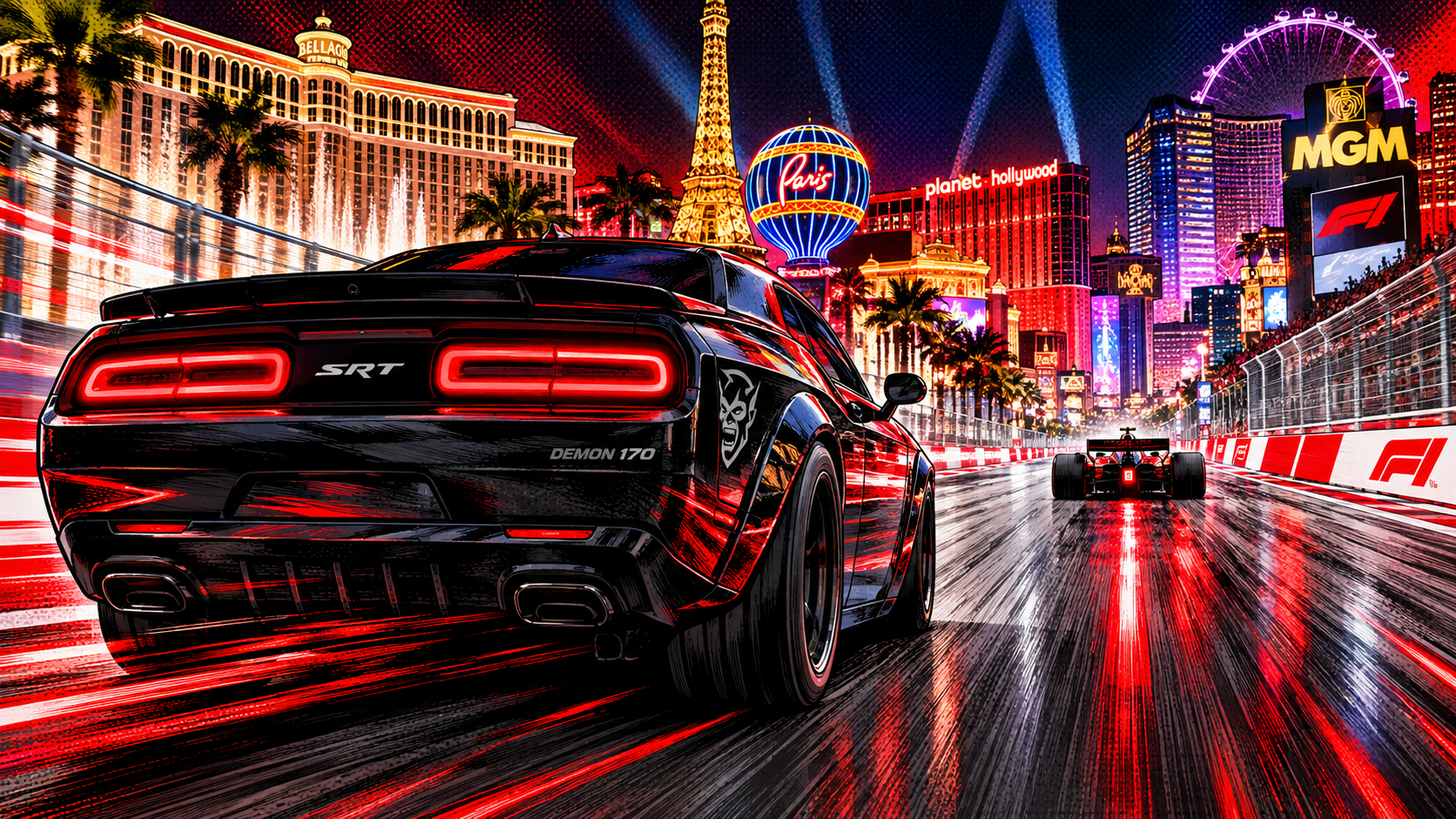
Now we bring the fight home, to the Las Vegas Strip Circuit, home of the Las Vegas Grand Prix.
The circuit runs 6.201 kilometers, about 3.85 miles, with 17 turns, and the Grand Prix lasts 50 laps. Running down the Strip there is roughly a two kilometer straight, under the neon, past the casinos.
That straight is the Demon 170's one happy place on this entire lap, and even there, the fine print shows up.
Off the final corner, the launch control, the weight transfer, and those wrinkling rear drag radials would fire the big Dodge down the Strip in a way no other challenger in this series could match. For the first few seconds, with the supercharger screaming at 21.3 psi and Las Vegas lit up around it, the Demon 170 would look like it belonged. A car unveiled in this city, flat out on its most famous street. The crowd would love it.
Then arithmetic arrives. The Formula 1 car traps higher than the Demon's 215 mph top speed. It brakes at the end of that straight like the road insulted it. And then come the other sixteen turns, where the Demon's drag suspension, skinny front tires, and two plus tons of enthusiasm become a full time job for the driver. Over one lap the gap would be large. Over 50 laps, the honest picture is the Formula 1 car running a Grand Prix while the Demon 170 runs the greatest straight line exhibition this circuit has ever hosted. No invented lap times here. This is an informed comparison, not a recorded race, and nobody has timed a Demon 170 around this circuit for us to quote.
But here is the Vegas twist, and it fits this challenger better than any before it.
The Demon 170 was born here. Dodge chose Las Vegas, The Strip at Las Vegas Motor Speedway, to unveil the end of the HEMI era. This city understands a big entrance, a bigger bet, and going out on your own terms. The Demon 170 would lose this race and win the crowd, and in Las Vegas, that has never been a bad night's work.
The Final Call
Winner: Formula 1.
Three rounds to one, and the one is a beauty.
Top speed went to the car that has already been trapped faster than the Demon's ceiling, in 2026 trim, during qualifying in China. Cornering and braking went to the car built only for cornering and braking, by margins this series has not seen before. The Demon 170 was never going to win a Grand Prix. It was built to win about nine seconds at a time.
And in those nine seconds, it is untouchable in a way no other challenger here can claim. A factory car, street legal, under six figures at sticker, that runs an NHRA certified eight second quarter mile, pulls 2.004 g off the line, and got itself banned from the strip for being too quick without a cage and a parachute. Dodge did not set out to beat Formula 1. Dodge set out to end the muscle car era so loudly that nobody could ever top it with a gasoline engine again. Mission accomplished.
Formula 1 may win the fight. But the Demon 170 still owns the launch, the time slip, and the greatest goodbye in muscle car history, and it did it all on corn, in Las Vegas, with the sanctioning body's ban letter framed like a trophy.
There are plenty more cars waiting to pick a fight with Formula 1.
Next up: Formula 1 vs. Saleen S7. An American supercar built for Le Mans, with a top speed claim that will make Round Two very interesting.