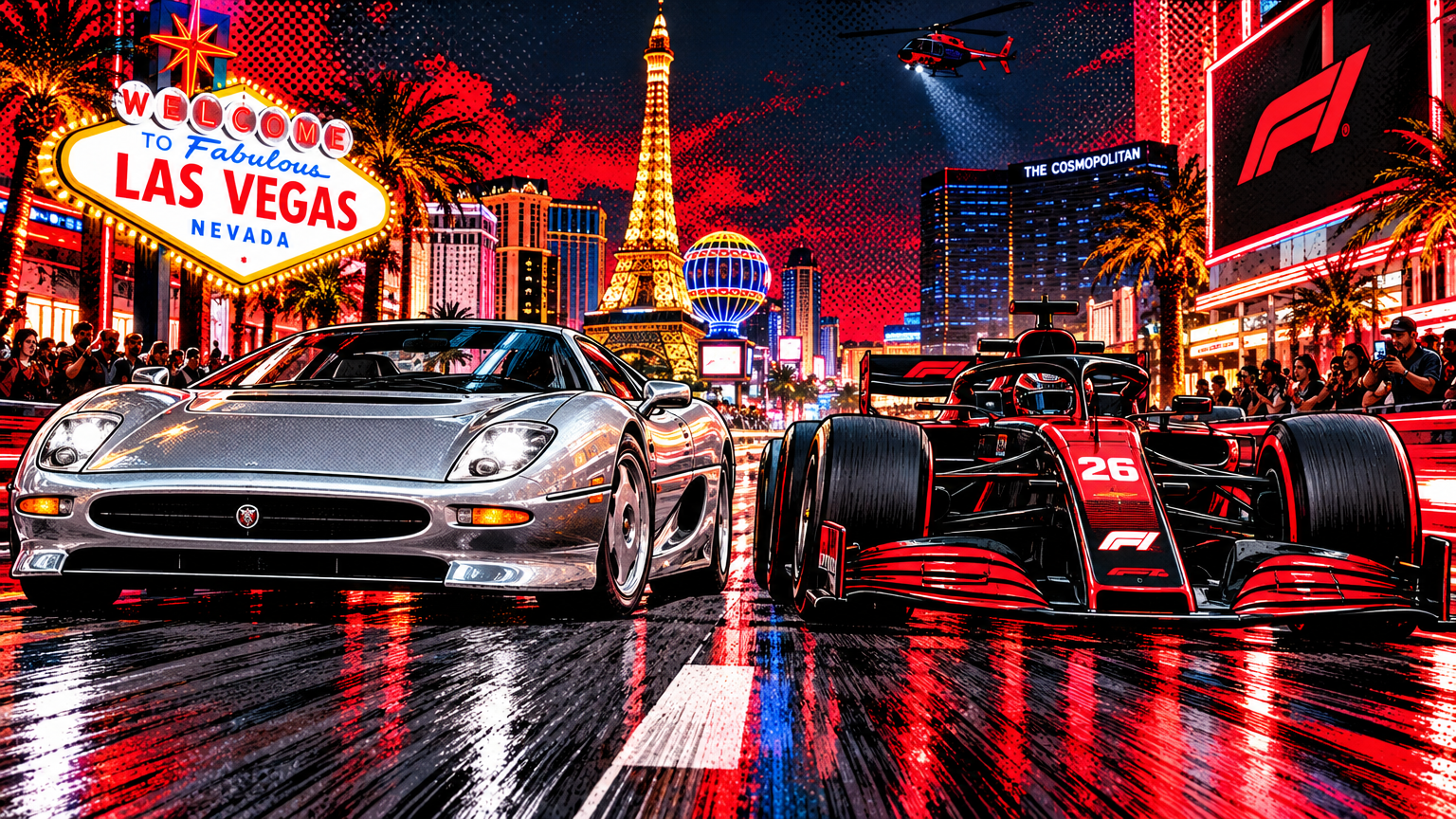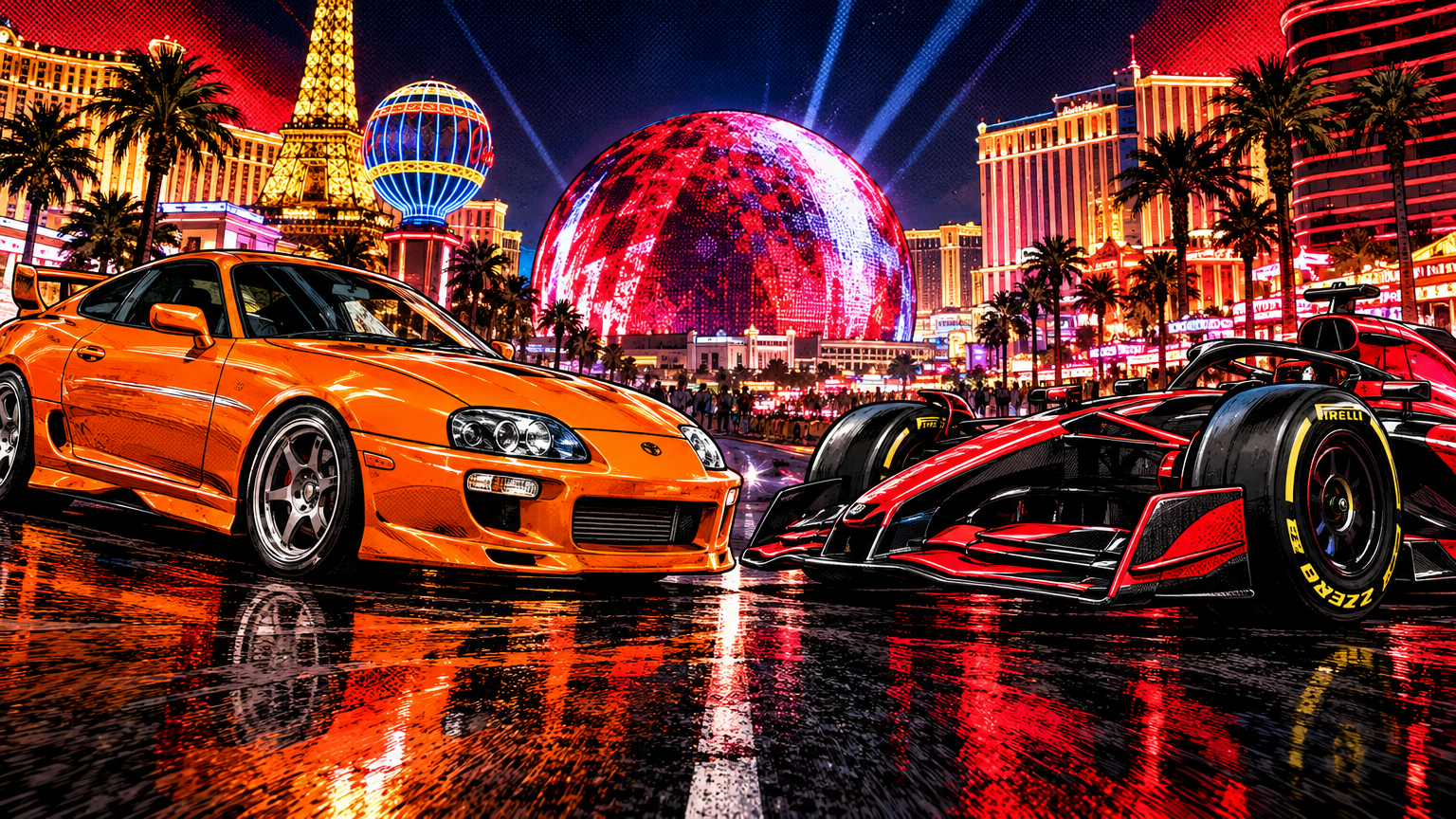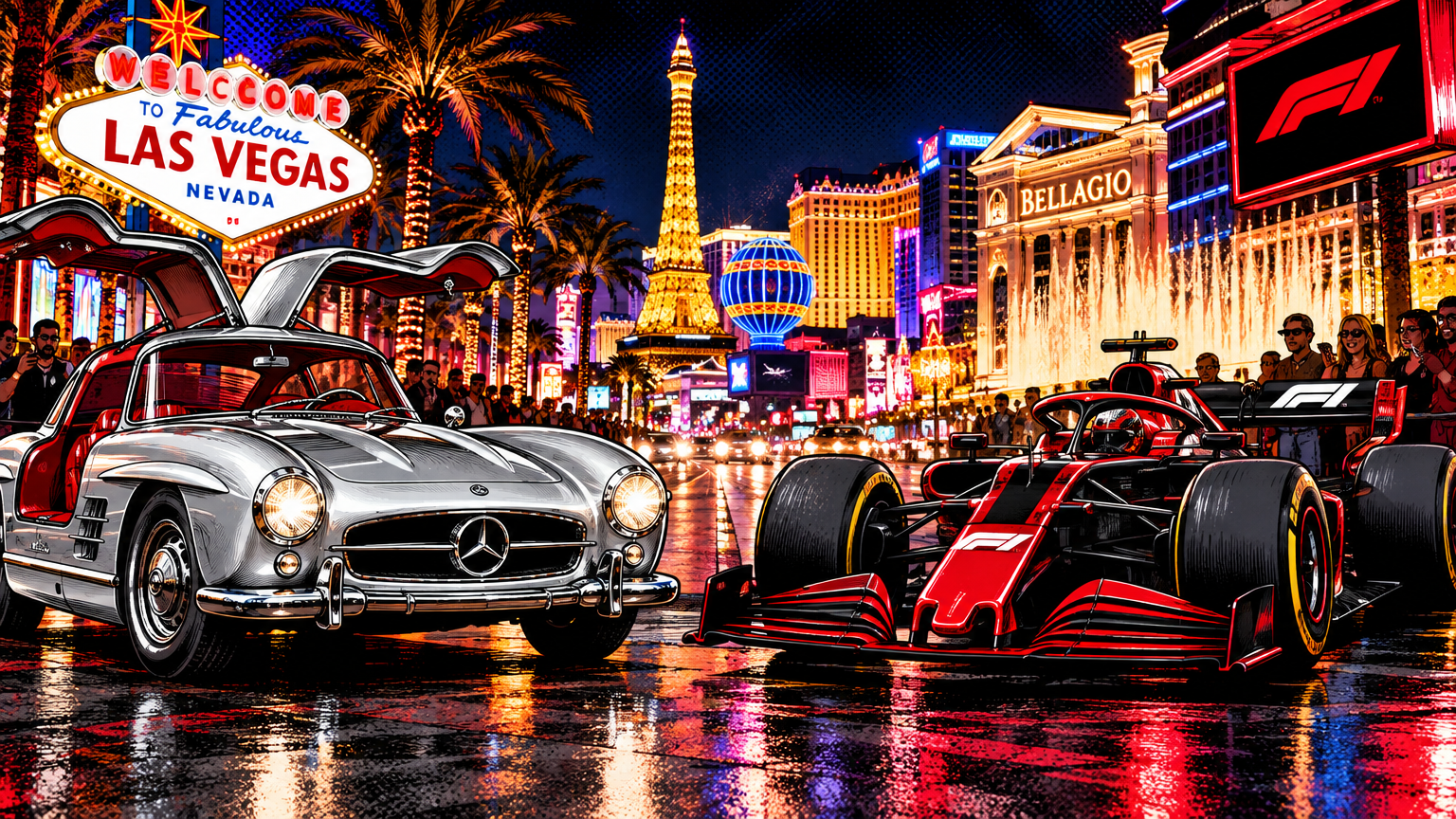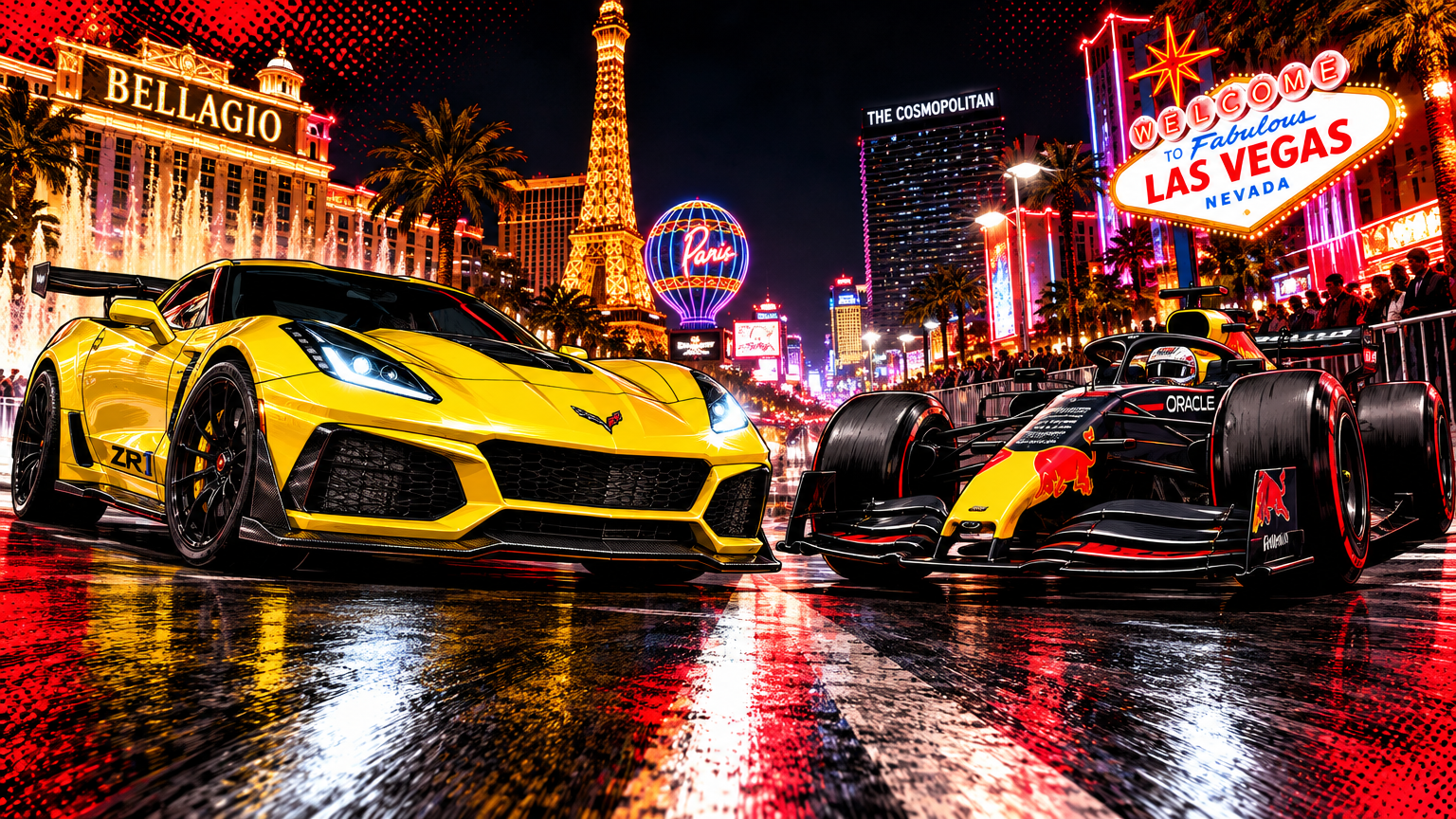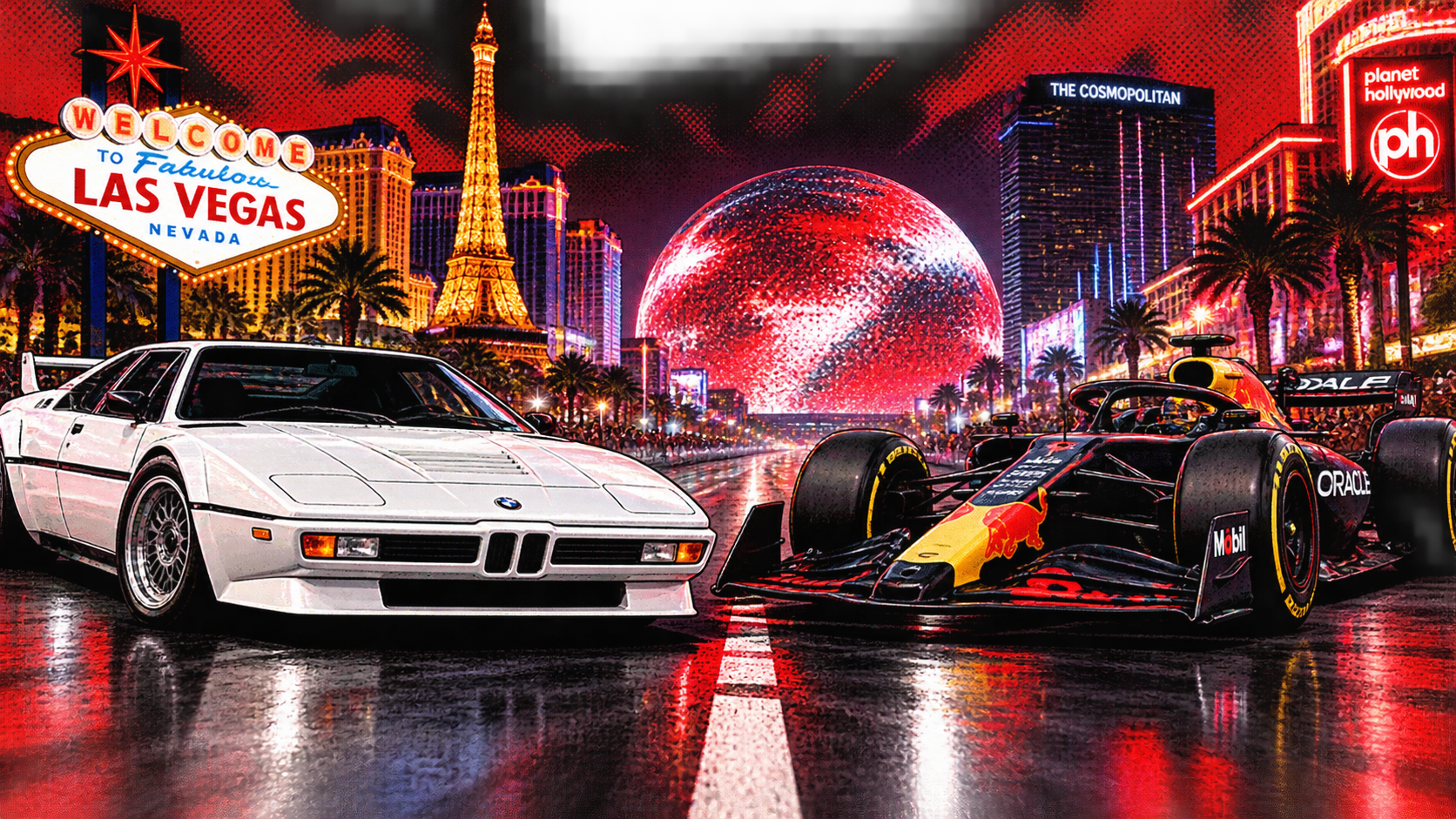
Most challengers in this series are strangers to Formula 1.
They show up, they look at the wings, they look at the tires, and they quietly wonder what they have gotten themselves into.
The BMW M1 is not a stranger.
The M1 has been inside the Formula 1 paddock. It has raced on Grand Prix weekends, on the same tracks, in front of the same crowds, with actual Formula 1 drivers strapped inside it.
For two glorious seasons, this car was the warm-up act for Formula 1 itself.
Which raises an obvious problem.
Warm-up acts are not supposed to fight the headliner.
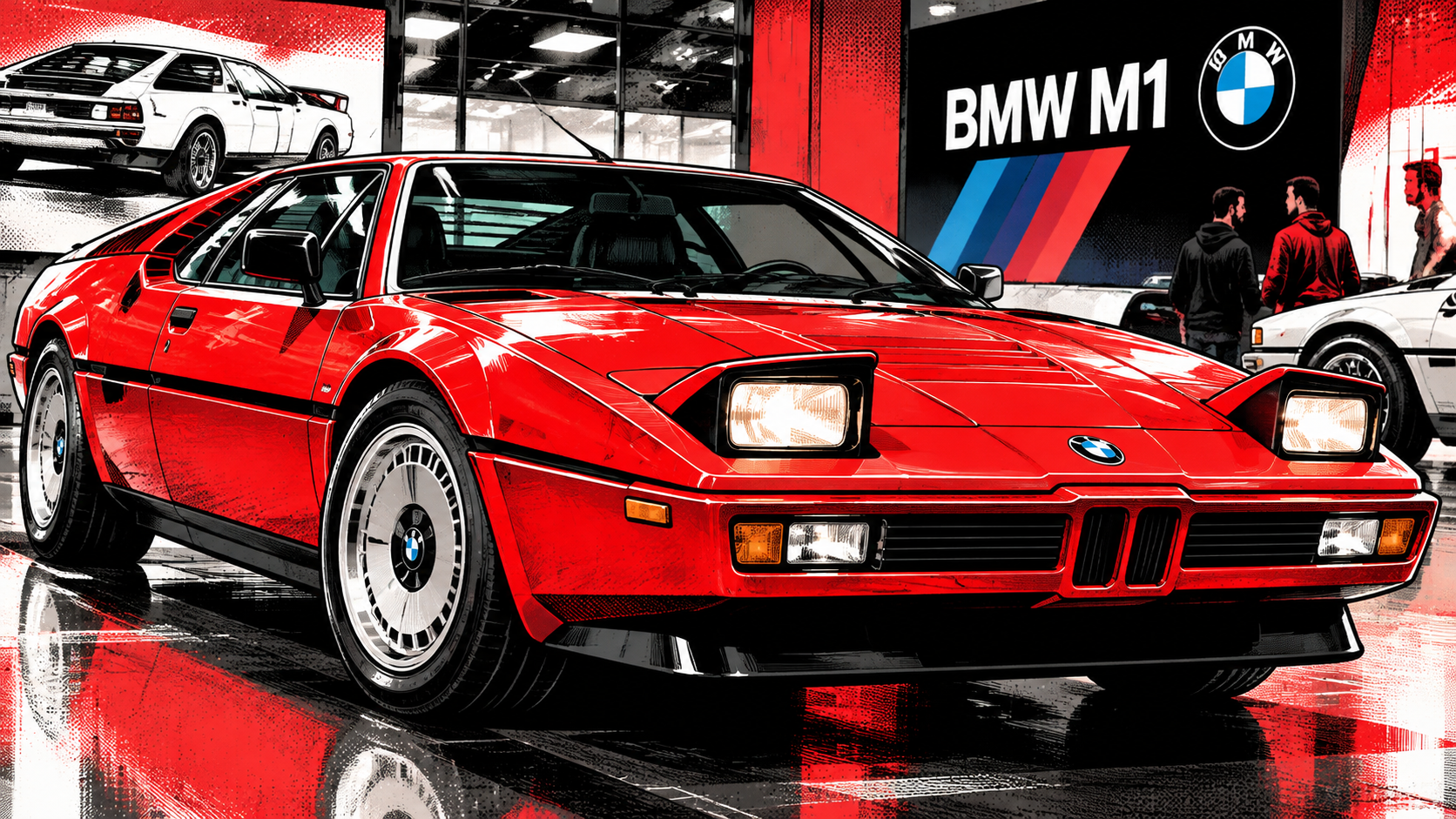
The M1 is a wedge. A proper, ruler-drawn, late 1970s wedge, designed by Giorgetto Giugiaro, built by a committee spread across two countries, and powered by one of the sweetest straight-six engines BMW ever made.
It is also, to this day, the only mid-engined production supercar BMW has ever sold. BMW has built faster cars since. It has built louder cars, richer cars, and cars with grilles the size of patio doors.
It has never built another one of these.
Standing across from it is a 2026 Formula 1 car. More than a thousand horsepower of hybrid violence, wrapped in carbon, wearing wings that change their minds depending on the corner.
So here comes today's completely unnecessary but extremely important question.
What happens if the BMW M1 picks a fight with a Formula 1 car?
The opening act is about to meet the main event, and the main event has had about 47 years to get faster since the M1 last shared its weekend.
First, Which M1 Are We Talking About?
Good news first. There is basically one road-going M1, and that makes this section refreshingly simple.
No alphabet soup of trims. No special edition with three extra horsepower and a stripe. If it is a street-legal BMW M1, it is the car we are about to describe.
The M1, internal code E26, made its public debut at the Paris Motor Show in the autumn of 1978, and production ran through 1981. It was the first car developed and built by BMW Motorsport GmbH, the racing division BMW had founded in 1972. Every M car you have ever heard of traces its family tree back to this wedge.
The shape came from Giorgetto Giugiaro at ItalDesign, developing an idea that started with Paul Bracq's 1972 BMW Turbo concept. The numbers tell the story before the engine even starts: 4,360 millimeters long, 1,824 millimeters wide, and just 1,140 millimeters tall.
Read that height again. One point one four meters. A modern BMW M3 stands at least 1.39 meters tall, according to BMW. The M1 is not low for its era. It is low, full stop.
Pop-up headlights. A flat little kidney grille. Black slats over the rear window. It looks like a doorstop that learned about revenge.
Behind the seats, mounted lengthwise in front of the rear axle, sits the M88 engine: a 3.5-liter, 3,453 cc naturally aspirated inline-six, built under engine chief Paul Rosche. Four valves per cylinder, mechanical fuel injection, individual throttle butterflies, and dry-sump lubrication, which is racing talk for an oil system that keeps working when cornering forces try to slosh everything sideways.
BMW rates the road car at 277 horsepower at 6,500 rpm and 330 newton-meters of torque, about 243 pound-feet, at 5,000 rpm. Power goes to the rear wheels through a ZF five-speed manual gearbox and a limited-slip differential with 40 percent locking action, per BMW.
BMW quotes an empty weight of 1,300 kilograms, about 2,866 pounds, with weight distribution of 44.1 percent front and 55.9 percent rear. That gives a power-to-weight ratio of 4.7 kilograms per horsepower, a figure BMW itself liked to brag about, and fair enough.
Performance, per BMW: zero to 100 kilometers per hour in 5.6 seconds, and a top speed of 265 kilometers per hour, about 165 mph. BMW called it the fastest German road sports car of its era, and a period German magazine test recorded 264.7 kilometers per hour, which backs the claim up nicely instead of just repeating it.
The price in 1978 was exactly 100,000 Deutschmarks, which BMW's own history notes was enough for four BMW 323is plus options. Nobody bought an M1 by accident.
Now, the production story, because it is gloriously messy.
BMW Motorsport did not have the capacity to build a mid-engined supercar alone, so Lamborghini was meant to handle much of the work. Then Lamborghini ran into serious financial trouble, and the plan fell apart. BMW took control back, and the M1 ended up built by a relay team: Marchesi made the space frame in Modena, T.I.R. made the glass-fibre body shell in Modena, ItalDesign assembled the body and fitted the interior, and Baur in Stuttgart installed the mechanical parts.
The car exists because four companies in two countries refused to let a paperwork disaster kill it. Respect.
How many were built? BMW says 460 M1s in total, counting road and racing versions together. The road cars, built to satisfy the rule that 400 near-identical cars were needed for Group 4 homologation, are commonly counted at 399. Either way, this is a rare car. Most supercars are rare. The M1 is museum rare.
One more version needs naming, because we are not going to sneak its numbers into the road car's fight.
The M1 Procar was the racing version: the same M88 six tuned the classic way, with new camshafts, larger valves and forged pistons, making 470 to 490 horsepower per BMW, in a car weighing just 1,020 kilograms, with a top speed around 310 kilometers per hour on its longest gearing. That is a race car, not the challenger in today's matchup. Our challenger is the 277 horsepower road car.
But remember the Procar exists. It matters in a minute.
Unfortunately for the road car, Formula 1 has also been busy.
Meet the 2026 Formula 1 Car
The 2026 Formula 1 car is what nearly five decades of unlimited obsession does to the same basic idea: engine in the middle, driver in front of it, speed everywhere.
At its center is a 1.6-liter turbocharged V6 hybrid. The internal-combustion side is limited to around 400 kilowatts. The electric MGU-K can deliver up to 350 kilowatts where maximum deployment is allowed.
Formula 1 describes the total package as producing more than 1,000 horsepower, with the honest caveat that the electrical help is managed around the lap. It is not a simple on-off bonfire. It is a bonfire with an accountant.
The minimum regulatory weight for a 2026 F1 car is 768 kilograms, about 1,693 pounds, including the driver.
Sit with that for a second.
The M1 weighs 1,300 kilograms before anyone climbs in. The F1 car weighs 768 with the driver already installed, and it brings roughly four times the power.
For 2026, Formula 1 also introduced active front and rear aerodynamics. The wings run in a low-drag setup on the straights and a high-downforce setup for the corners.
The M1's aero package is a beautiful wedge shape and optimism.
This seems unfair, because it is.


M1 vs. F1: The Numbers
| Category | BMW M1 (road car) | 2026 Formula 1 Car |
|---|---|---|
| Engine | 3.5-liter naturally aspirated inline-six (M88) | 1.6-liter turbocharged V6 hybrid |
| Power | 277 hp at 6,500 rpm, BMW figure | 400 kW combustion engine plus up to 350 kW MGU-K deployment; more than 1,000 hp total per Formula 1 |
| Torque | 330 Nm (243 lb-ft) at 5,000 rpm, BMW figure | No single standardized series figure |
| Weight | 1,300 kg empty, BMW figure | 768 kg minimum regulatory weight, driver included |
| Power-to-weight | 4.7 kg per hp, BMW figure | Not directly comparable because electrical deployment varies around the lap |
| 0-100 km/h | 5.6 sec, BMW figure | No universal official 2026 figure |
| Quarter-mile | No official BMW figure | No standardized F1 quarter-mile figure |
| Top speed | 265 km/h (about 165 mph), BMW figure | 2026 FIA speed-trap data has already exceeded 219 mph |
| Drivetrain | Rear-wheel drive, five-speed manual | Rear-wheel drive |
| Aerodynamics | Giugiaro wedge, fixed shape | Active front and rear aerodynamics |
| Street legal | Yes | No |
| Era | 1978 to 1981 | 2026 |
| Formula 1 weekend history | Its racing twin headlined the support bill in 1979 and 1980 | It is the support bill's reason to exist |
| Vegas valet factor | Peak wedge. Valets will fight over the keys | Cannot be valeted. Needs a pit crew and a laptop |
Round One: Acceleration
In 1978, the M1's launch was a genuine event.
Zero to 100 kilometers per hour in 5.6 seconds made it one of the quickest road cars on Earth. The engine sits over the driven wheels, the car weighs 1,300 kilograms, and the straight-six delivers its best work high in the rev range, so an M1 launch is a mechanical little ceremony: clutch, throttle, and a soundtrack climbing toward 7,000 rpm.
It feels fast because it is fast, and because you are sitting about four feet off the ground in a fiberglass wedge with an engine singing behind your shoulders.
Now the honesty.
There is no single official zero-to-60 or zero-to-100 figure that applies to every 2026 F1 car, and we are not going to invent one.
What we can line up is the math. The F1 car carries about 530 fewer kilograms than the M1 before the M1 even adds a driver. It has more than three and a half times the power when its hybrid system is deploying. It puts that power down through racing tires that were designed for nothing else.
The M1 would launch beautifully.
The F1 car would launch like the road owed it money.
Five point six seconds was world-class in 1978. Against a modern Formula 1 car, it is a lovely piece of history that loses this round before the first gear change.
Round One Winner: Formula 1
Round Two: Top Speed
Top speed was the M1's party trick, and BMW knew it.
At 265 kilometers per hour, the M1 was the fastest German road sports car of its time. On an empty autobahn in 1979, nothing wearing a German plate could outrun it. The long gearing helps, too. BMW's own period account notes you did not need fifth gear until about 213 kilometers per hour.
Fourth gear, in this car, goes to a speed that gets you arrested in every state in America. Wonderful.
Formula 1's evidence, as usual, is already written down by the FIA.
During qualifying for the 2026 Chinese Grand Prix, official speed-trap data recorded Pierre Gasly at 353.9 kilometers per hour, about 220 mph.
And here on the Las Vegas Strip Circuit, the traps have been even ruder. In 2025, Yuki Tsunoda was recorded at 358.3 kilometers per hour, about 222.6 mph. In 2024, Alex Albon hit 368.9 kilometers per hour, about 229.2 mph, the highest figure through the first three editions of the race. Those were earlier-spec cars, and we are labeling the years on purpose. They show the neighborhood, not a 2026 promise.
Either way you slice it, the F1 car has roughly 55 to 65 mph in hand over the mighty M1, and it finds that speed on a street circuit, between braking zones, while turning.
The M1 was the fastest car in Germany.
Formula 1 is faster than the fastest car in Germany's grandchildren.
Round Two Winner: Formula 1
Round Three: Now Add a Corner
If the M1 is going to make Formula 1 sweat anywhere, it is here.
This car was engineered for corners before it was engineered for anything else. Mid-engine layout. Weight distribution of 44.1 to 55.9. A center of gravity just 460 millimeters off the road, per BMW. Double wishbones at every wheel, gas-pressure dampers, and unassisted rack-and-pinion steering that tells you everything the front tires are thinking.
Period testers loved the balance, and BMW is cheerfully honest in its own history that the M1 rewards an experienced driver. Push past the limit and that low-inertia mid-engine layout will rotate quickly, and you had better be ready to catch it.
That is not a flaw. That is a personality.
The Procar version proved the chassis, too. Same basic car, 470-plus horsepower, racing on Grand Prix circuits against the best drivers alive, and holding its head up just fine.
But our challenger is the road car, on road tires, with a fixed wedge for aerodynamics.
The F1 car corners with active wings pressing it into the pavement, carbon brakes, racing slicks, and a weight figure the M1 can only dream about. It does not just turn. It changes direction like the corner insulted it.
The M1 would be the most fun car in this entire building through a tight section. Genuine, talkative, mechanical fun, the kind modern cars bottle and sell as a drive mode.
Fun is not the stopwatch, though.
Round Three Winner: Formula 1
Round Four: Braking
BMW did not cheap out here.
The M1 stops with four internally ventilated disc brakes, serious hardware for the late 1970s, and BMW engineered 30 percent anti-dive into the front axle so the nose stays composed when you stand on the pedal.
On a 1,300 kilogram car, that setup hauled the M1 down from autobahn speeds again and again, and period testers praised the stopping power in strong terms.
The problem is the comparison, as always.
An F1 car starts each braking event with barely more than half the M1's mass, on far grippier racing tires, with aerodynamic load pressing those tires into the track at speed. It then repeats that event, at maximum violence, for 50 laps.
M1 braking is excellent period engineering.
F1 braking is a controlled crash that the driver schedules on purpose, corner after corner.
Round Four Winner: Formula 1
So, Does the M1 Win Anything?
Oh, it wins plenty. Starting with the best party story in this entire series.
It wins Formula 1 history, because it was literally part of the show.
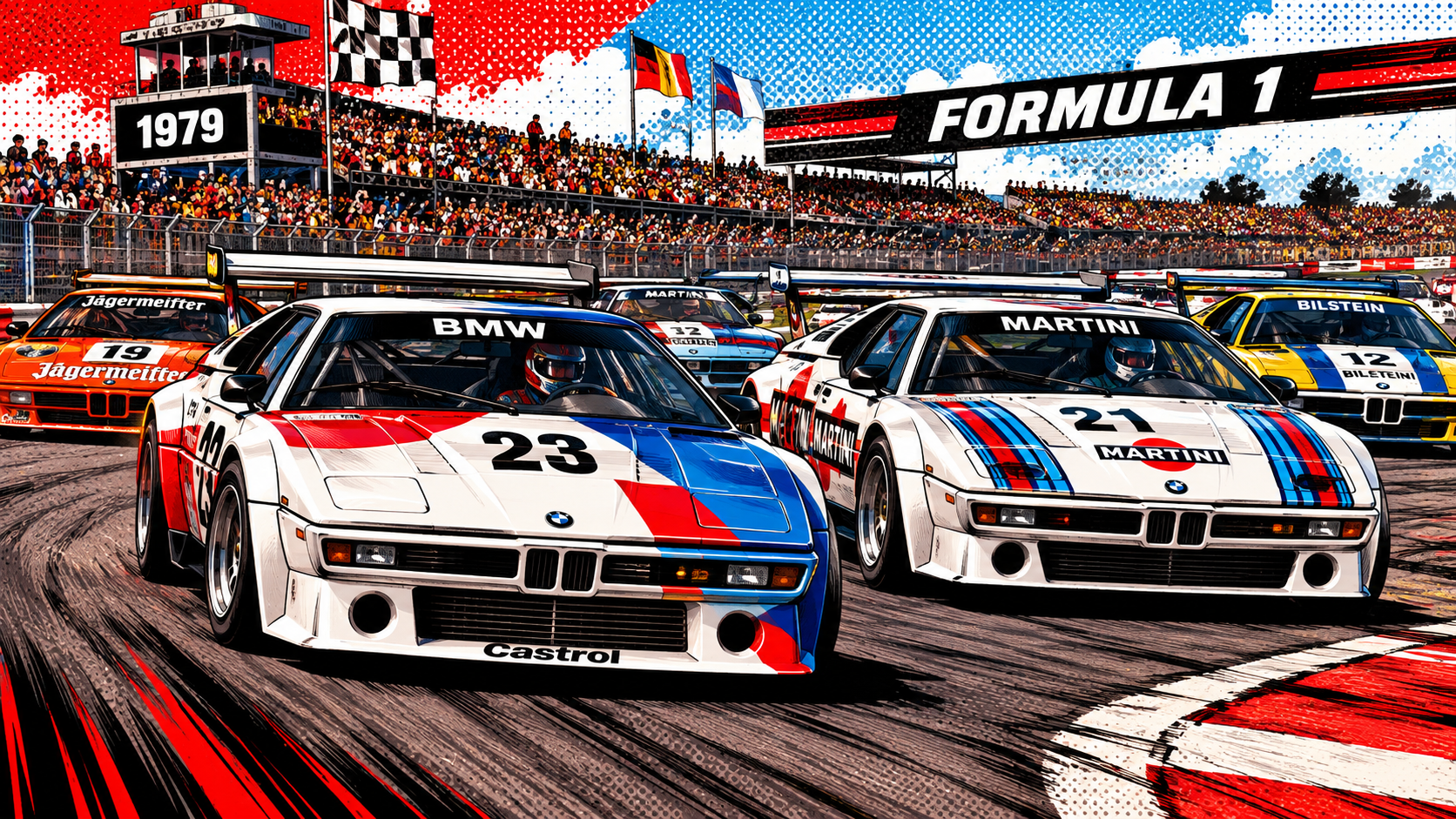
When production delays put the M1's Group 4 homologation at risk, BMW Motorsport boss Jochen Neerpasch, working with Bernie Ecclestone and Max Mosley, created the Procar Series: a one-make championship for racing M1s, run as a support event before most European Formula 1 Grands Prix in 1979 and 1980.
The format was genius. The five fastest Formula 1 drivers from Friday practice earned seats in identical M1 Procars, against a field of touring car specialists. Same car, same power, no excuses. The only variable was the human.
Niki Lauda won the 1979 championship. Nelson Piquet won it in 1980. Both went on to become triple Formula 1 world champions, and both had to beat their peers in a BMW wedge to do it.
Hans Stuck, who raced in both seasons, reckoned the Procar race was often better than the Grand Prix itself. Think about that. A support race, in identical road-car-based BMWs, upstaging Formula 1 on its own weekend.
No other challenger in this series can say that. The Lotus Exige speaks Formula 1's language of lightness. The Lamborghini Murcielago brought a V12 opera. The M1 brought a payslip from the paddock. It worked there.
It wins design.
Giugiaro's wedge has not aged a day in the wrong direction. Pop-up headlights, that slatted rear window, a roofline lower than most coffee tables. One of the racing versions even became an Andy Warhol Art Car and raced at Le Mans in 1979, which means the M1 is the only car in this series that is also a pop art exhibit.
It wins sound.
The F1 hybrid is an engineering marvel that makes a noise like an angry appliance with a turbo attached. The M88 straight-six at 7,000 rpm is music with a mechanical injection accent. No contest, and we will die on this hill.
It wins the weekend.
BMW's own history points out the M1 came with luggage space under the front lid sufficient for a weekend for two, and air conditioning was available. Try packing a weekend bag into a Formula 1 car. The driver is the luggage, and he is complaining.
And it wins rarity with receipts.
About 460 built in total, road and race cars combined, and no successor, ever. BMW has had more than four decades to build another mid-engined M supercar and has politely declined every time. The M1 stands alone, which is exactly how legends like it.
M1 wins: the history, the design, the soundtrack, the weekend trip, and the museum plaque.
What Would Happen on the Las Vegas Strip Circuit?
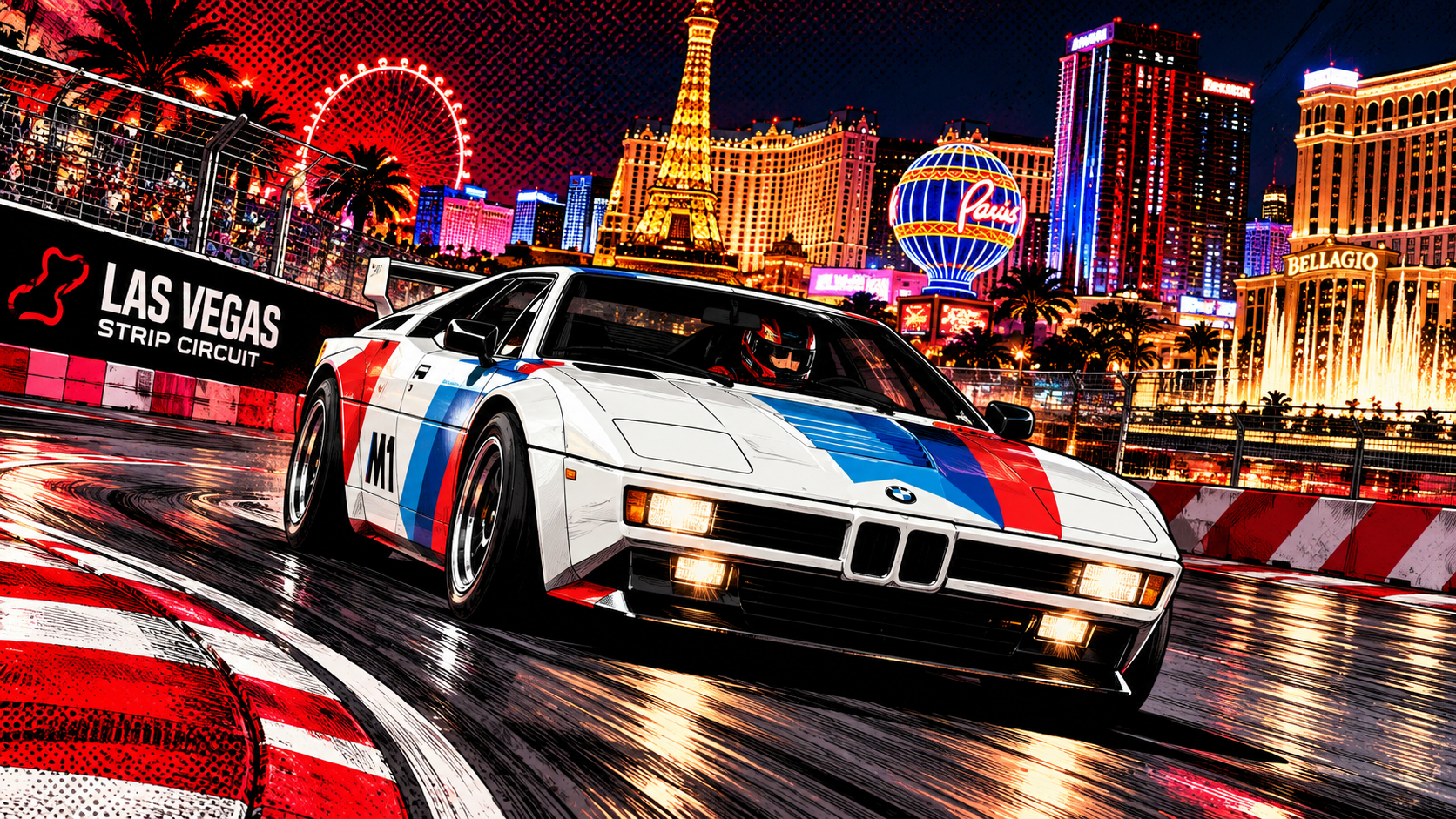
Now we bring the fight home, to the Las Vegas Strip Circuit, home of the Las Vegas Grand Prix.
The circuit runs 6.201 kilometers, about 3.85 miles, with 17 turns, and the Grand Prix lasts 50 laps. Running down the Strip there is roughly a two-kilometer straight, under the neon, past the casinos.
That straight is where this fight ends early.
The M1 tops out at 265 kilometers per hour. F1 cars have been trapped above 350 kilometers per hour at this circuit in earlier editions, and above 353 kilometers per hour already in 2026 trim elsewhere. On a two-kilometer straight, the F1 car would not just pass the M1. It would pass it, brake, turn, and start thinking about lapping it.
The tighter sections are where the M1 would look most like itself. Around the slower, technical parts of the lap, its balance, its steering feel, and its compact size would let a good driver lean on that famous mid-engine rotation and genuinely enjoy the place. This is a car built by racers, and it would show.
It would still be giving away weight, downforce, braking, and tire grip at every single corner. Enjoyment and competitiveness are different sports.
Over 50 laps, the honest picture is the F1 car running its own race while the M1 runs a beautiful one several laps behind. No invented lap times here. This is an informed comparison, not a recorded race, and nobody has timed an M1 around this circuit for us to quote.
But picture the M1 at night on the Strip, wedge nose under the lights, straight-six echoing off the casino facades, in the city where its racing twin once would have been the second biggest show in town.
In Las Vegas, being the second biggest show is still a headline act.
The Final Call
Winner: Formula 1.
Four rounds, four wins, and no shame in any of them.
Acceleration was never close once you line up 768 kilograms and four-figure hybrid power against 1,300 kilograms and 277 horsepower. Top speed is a rout. Braking is a rout with better scenery. Cornering is where the M1's breeding shows most clearly, and even there, active aerodynamics and racing slicks end the argument.
Here is the thing, though.
Every other car in this series is asking Formula 1 for a favor. The M1 is renewing an old acquaintance.
This is the car Formula 1's own drivers raced for fun and for a trophy on Saturday afternoons, while the crowd warmed up for Sunday. Lauda raced it. Piquet raced it. It earned its paddock pass the hard way, one identical car at a time, where talent was the only upgrade available.
Formula 1 may win the fight.
But the BMW M1 still holds the one credential no modern challenger can copy: it was once part of the Formula 1 show itself, and the show was better for it.
There are plenty more cars waiting to pick a fight with Formula 1. The Lamborghini Countach has already had its turn in this series, so we move down the list.
Next up: Formula 1 vs. Mercedes-AMG ONE. The car that brought an actual Formula 1 engine to the street, and now has to answer for it.