Some cars arrive.
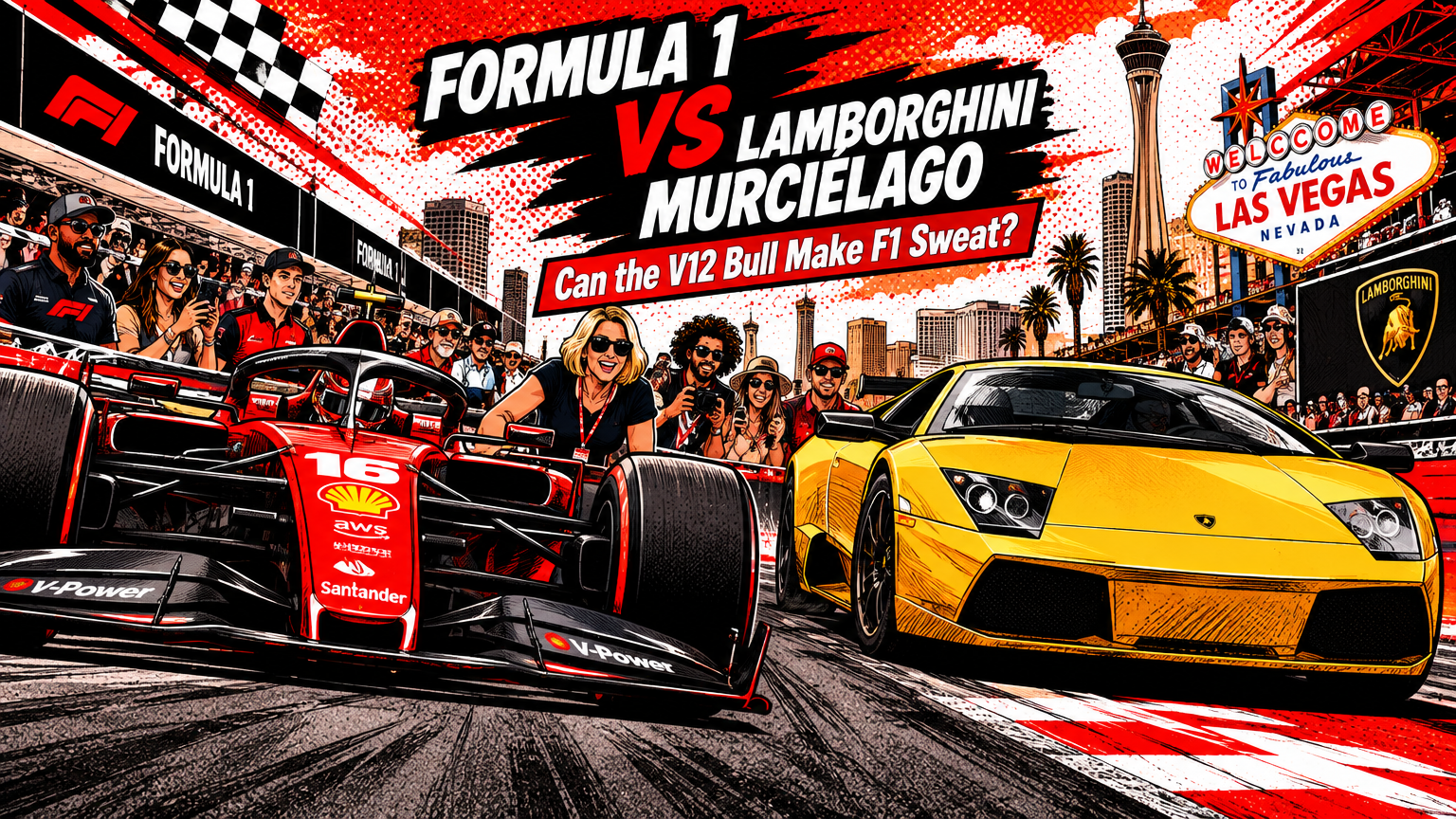
A Lamborghini Murciélago makes an entrance.
It's low. It's wide. The doors go up instead of behaving like normal doors. There's a V12 sitting behind your head, and the entire thing looks like it was designed by someone who heard the word "subtle" and took it personally.
This was Lamborghini's flagship for the first decade of the 2000s. The Murciélago picked up where the Diablo left off and carried the big-V12, scissor-door Lamborghini formula into a new century.
It even became a Bruce Wayne car. The Murciélago family appeared in both Batman Begins and The Dark Knight.
Because apparently a billionaire dressed like a bat still needed something flashy for the commute.
But we're not bringing just any Murciélago to this fight.
We're bringing the nasty one.
The Lamborghini Murciélago LP 670-4 SuperVeloce.
Six-point-five-liter V12. All-wheel drive. Carbon fiber. More power. Less weight. Big wing. Very little interest in moderation.
And standing across from it is a 2026 Formula 1 car.
So here comes today's completely unnecessary but extremely important question.
What happens when one of Lamborghini's wildest V12 road cars picks a fight with Formula 1?
For once, the Lamborghini might actually make this interesting.
First, Which Murciélago Are We Talking About?
The Murciélago had several versions during its life, so throwing around one set of numbers for every car wearing the badge would get messy fast.
We're using the 2009-2010 Lamborghini Murciélago LP 670-4 SuperVeloce.
That little "SV" matters.
SuperVeloce translates to "super fast," which is wonderfully direct. No focus group needed. Lamborghini took the existing LP640 and turned everything up.
The SV used a naturally aspirated 6.5-liter V12 producing 670 CV, or about 661 horsepower, along with 487 pound-feet of torque.
Power went through all four wheels.
Buyers could have a six-speed manual or Lamborghini's six-speed E-gear automated manual.
Lamborghini also put the Murciélago on a diet.
The company says the SV dropped about 100 kilograms compared with the LP640 through extensive use of lightweight materials, including carbon fiber.
Car and Driver estimated curb weight at roughly 3,850 pounds.
That is still a lot more Lamborghini than an F1 car has to haul around, but we'll get there.
Lamborghini's official performance figure is 0 to 100 kilometers per hour in 3.2 seconds, which is roughly zero to 62 mph.
Car and Driver estimated zero to 60 mph at about 3.0 seconds and the quarter-mile at roughly 11.2 seconds.
Those are estimates from the publication's 2009 first drive, not instrumented test results, so we're keeping that label attached.
Top speed gets interesting because the rear-wing configuration mattered.
Lamborghini's current technical page lists a maximum of 342 kilometers per hour, or about 213 mph. Car and Driver reported manufacturer claims of approximately 213 mph with the smaller spoiler and about 209 mph with the huge Aeropack wing.
Why would the bigger wing make it slower?
Drag.
The giant wing helps push the car into the pavement, which is lovely in a corner. Unfortunately, the air eventually sends Lamborghini an invoice.
The SV also came standard with massive carbon-ceramic brakes. Car and Driver reported 15-inch discs with six-piston calipers at all four corners.
So this isn't some soft grand tourer that wandered into the wrong parking lot.
The Murciélago SV came ready to fight.
Unfortunately, Formula 1 heard there was a fight.
Meet the 2026 Formula 1 Car
The 2026 Formula 1 machine is a very different animal from the cars F1 raced just one season earlier.
The regulations made the cars smaller and lighter, while dramatically increasing the role of electric power.
At the center is still a 1.6-liter turbocharged V6 hybrid.
The internal-combustion side is limited to around 400 kilowatts. The electric MGU-K can deliver as much as 350 kilowatts in the parts of the lap where maximum deployment is permitted.
Add those peaks together and you're in the neighborhood of 1,000 horsepower, although the electrical contribution isn't simply available at maximum output everywhere, all the time. Energy deployment and harvesting are controlled throughout the lap.
That's important.
We're comparing real machines here, not adding two numbers together and pretending physics went home early.
The minimum regulatory weight for a 2026 F1 car is 768 kilograms, about 1,693 pounds.
Yes.
The Lamborghini weighs well over twice that much.
Then there's the aero.
For 2026, Formula 1 introduced active front and rear aerodynamics. The wings move between configurations designed for low drag on straights and more downforce through corners.
In plain English, the car can change how aggressively it fights the air depending on what it's doing.
The Murciélago has a gigantic rear wing.
The F1 car has wings that take instructions.
This seems rude.
Murciélago vs. F1: The Numbers
Category | Lamborghini Murciélago LP 670-4 SV | 2026 Formula 1 Car |
|---|---|---|
Engine | 6.5-liter naturally aspirated V12 | 1.6-liter turbocharged V6 hybrid |
Power | 670 CV / about 661 hp | 400 kW combustion engine plus up to 350 kW MGU-K deployment |
Torque | 487 lb-ft | No single standardized series figure |
Weight | About 3,850 lb, Car and Driver estimate | 1,693 lb minimum regulatory weight |
Power-to-weight | About 5.8 lb per hp using C/D estimated weight | Not directly comparable because electrical deployment varies around the lap |
0-60 mph | About 3.0 sec, Car and Driver estimate | No universal official 2026 figure |
Quarter-mile | About 11.2 sec, Car and Driver estimate | No standardized F1 quarter-mile figure |
Top speed | Up to about 213 mph depending on aero configuration | 2026 FIA speed-trap data has already exceeded 219 mph |
Drivetrain | All-wheel drive | Rear-wheel drive |
Aerodynamics | Fixed splitter and rear-wing configurations | Active front and rear aerodynamics |
Street legal | Yes | No |
Era | 2009-2010 | 2026 |
Vegas valet factor | Valet whispers, "Please don't make me park this." | Valet suddenly remembers he's on lunch. |
Round One: Acceleration
This is where the Lamborghini gets to throw the first punch.
The Murciélago SV has something the F1 car doesn't.
All-wheel drive.
That gives the Lamborghini four driven tires to work with when all 661 horses wake up at once.
And a roughly three-second zero-to-60 estimate is still brutally quick.
But then we look at what the F1 car is working with.
Far less weight.
Massive power.
Racing tires.
A powertrain designed around immediate response.
A transmission built for racing.
And no requirement that the car be pleasant while crawling through traffic on Las Vegas Boulevard.
There isn't one official zero-to-60 number that applies to every 2026 F1 car, and we're not going to manufacture one because it would make the table prettier.
Different setups, tires, track surfaces, temperatures and energy deployment strategies matter.
What we can say is that the F1 machine enjoys an enormous weight advantage and a far more aggressive power-to-weight situation.
The Murciélago's all-wheel drive might make the opening few feet interesting.
Then things start becoming unfair.
Round One Winner: Formula 1
Round Two: Top Speed
Now we've got a real fight.
Unlike the Countach, the Murciélago SV can walk into the 200-mph club without asking anyone for directions.
Lamborghini lists a maximum speed of about 342 kilometers per hour, or roughly 213 mph, while the large Aeropack wing can trim a few mph from that number in exchange for more downforce.
That's serious speed.
Very serious.
Then we look at what the 2026 Formula 1 cars are actually doing.
During qualifying at the 2026 Chinese Grand Prix, official FIA speed-trap data recorded Pierre Gasly at 353.9 kilometers per hour, or roughly 220 mph.
That isn't a universal top speed for every 2026 F1 car. Setup, circuit layout, aerodynamic configuration, slipstream and energy deployment all affect the number.
And a speed-trap reading isn't exactly the same thing as taking a road car to its maximum terminal speed under manufacturer testing conditions.
Still, the evidence tells us something important.
A current F1 car can operate beyond the Murciélago SV's claimed top-speed neighborhood.
The Lamborghini doesn't get embarrassed here.
Not even close.
It just loses to something even more ridiculous.
Round Two Winner: Formula 1
Round Three: Now Add a Corner
This is where we send Lamborghini's confidence directly into a wall.
Figuratively.
Please don't put an LP 670-4 SV into an actual wall.
The SuperVeloce was substantially more track-focused than the regular Murciélago. Lamborghini cut weight, revised the aerodynamics and gave the car serious rubber, all-wheel drive and a big rear wing capable of generating useful downforce.
Car and Driver found that the Aeropack wing made the rear of the SV far more planted during track driving.
So the Murciélago isn't helpless once the steering wheel turns.
Far from it.
But Formula 1 lives here.
The 2026 F1 car weighs roughly half as much.
It uses purpose-built racing tires.
Its suspension, chassis and aerodynamics exist almost entirely to carry speed through corners.
And those active wings change configuration depending on whether the car is attacking a straight or carving through a corner.
The Lamborghini is a road car engineered to perform extremely well on a racetrack.
The F1 car is a racetrack with wheels attached.
That's the difference.
Round Three Winner: Formula 1
Round Four: Braking
Now the Lamborghini gets another chance to show it came prepared.
The Murciélago SV's carbon-ceramic brakes were serious hardware. Car and Driver reported 15-inch discs with six-piston calipers at all four corners.
That's not decorative jewelry hiding behind the wheels.
Those brakes have work to do.
But Formula 1 braking is operating on a different scale of purpose.
An F1 car needs to repeatedly dump huge amounts of speed lap after lap while remaining predictable enough for a driver to attack the next corner immediately.
It also begins the braking event with dramatically less mass to slow down.
Then add racing tires and aerodynamic load.
The faster an F1 car is traveling through many sections, the more aerodynamic forces can help push those tires into the track before the car slows enough for that effect to fade.
The Murciélago can stop.
The F1 car can make your internal organs ask what they did wrong.
Round Four Winner: Formula 1
So, Does the Murciélago Win Anything?
Absolutely.
First, it has all-wheel drive.
Second, it has a passenger seat.
Third, you can actually drive it somewhere.
This might sound like we're lowering the bar, but that's part of what makes cars like the Murciélago so insane.
Lamborghini built a 200-plus-mph V12 machine with scissor doors, carbon-ceramic brakes and styling that looks like it should require FAA clearance.
Then somebody put license plates on it.
The Murciélago also wins something Formula 1 can't really compete for.
The V12 experience.
That's subjective, of course. Plenty of people love the sound of an F1 power unit.
But a naturally aspirated 6.5-liter Lamborghini V12 sitting a few inches behind the cabin has a particular kind of drama.
It isn't trying to be efficient about the experience.
It's trying to make an event out of starting the engine.
And then there's the casino test.
Pull a Formula 1 car up to the front entrance of a Las Vegas resort and everyone will stop what they're doing.
Mostly because they'll be wondering why there's an F1 car blocking valet.
Pull up in a Murciélago SV, raise one of those scissor doors and climb out underneath the neon?
That's not transportation anymore.
That's Vegas.
Murciélago wins: street legality, passenger capacity, V12 theater and casino-entrance warfare.
We'll give the bull those.
What Would Happen on the Las Vegas Strip Circuit?
Now let's put this fight where it belongs.
The Las Vegas Strip Circuit.
The 2026 configuration is 6.201 kilometers, or about 3.85 miles, with 17 turns. The Grand Prix runs for 50 laps.
There's also roughly a two-kilometer stretch along the Strip.
That matters for our Lamborghini.
If there's anywhere on this circuit where the Murciélago SV gets to puff out its chest, it's the long, fast stuff.
Give that 6.5-liter V12 room to breathe and the car can work toward the other side of 200 mph.
We already know the Strip Circuit rewards enormous straight-line speed. During the 2025 race weekend, FIA speed-trap data recorded Yuki Tsunoda at 358.3 kilometers per hour, about 222.6 mph.
Those were 2025-spec F1 cars, not the current 2026 machines, so that number isn't being used as a prediction for this year's race.
It does show what Las Vegas does very well.
Fast.
Really fast.
The Murciélago would look spectacular charging down the Strip.
Then comes the problem.
Eventually, the Strip ends.
And there's a corner.
Every braking zone gives the F1 car another opportunity to pull away.
Every direction change favors the lighter machine.
Every higher-speed corner gives Formula 1's aerodynamics another chance to turn air into grip.
Then both cars fire back onto another straight, and the Lamborghini gets to use the V12 again.
For a few seconds, life is beautiful.
Then Formula 1 hits the brakes later and ruins everything.
Over one complete lap, the Murciélago's huge straight-line ability would make the comparison more entertaining than you might expect from a road car.
But entertaining isn't the same thing as close.
Over 50 laps?
No.
Just no.
The Final Call
Winner: Formula 1.
Four rounds.
Four wins.
Acceleration goes to F1.
Top speed narrowly goes to F1 based on real 2026 speed-trap evidence.
Cornering isn't particularly close.
Braking isn't either.
And around the complete Las Vegas Strip Circuit, all those advantages stack on top of each other.
But here's the funny part.
The Murciélago LP 670-4 SuperVeloce might be one of the better losers we're going to see in this series.
Think about what we're comparing.
On one side is a machine built under Formula 1 regulations with no requirement to carry a passenger, luggage, license plates, or someone's questionable order from a drive-thru.
On the other side is a road-legal Lamborghini from 2009 that can push beyond 200 mph, launch hard enough to rearrange your morning, and arrive at a Las Vegas casino looking like Batman has reservations.
That's ridiculous.
Formula 1 wins the fight.
But the Murciélago still has a 6.5-liter V12, scissor doors, and enough presence to make an entire valet line forget what it was doing.
That's a pretty comfortable second place.
There are plenty more cars waiting to pick a fight with Formula 1.
Next up: Formula 1 vs. Lotus Exige.
Things are about to get much lighter.