Stand at the corner of Main Street and Charleston Boulevard on an ordinary weekday morning, and you will see a Las Vegas that most visitors never meet.
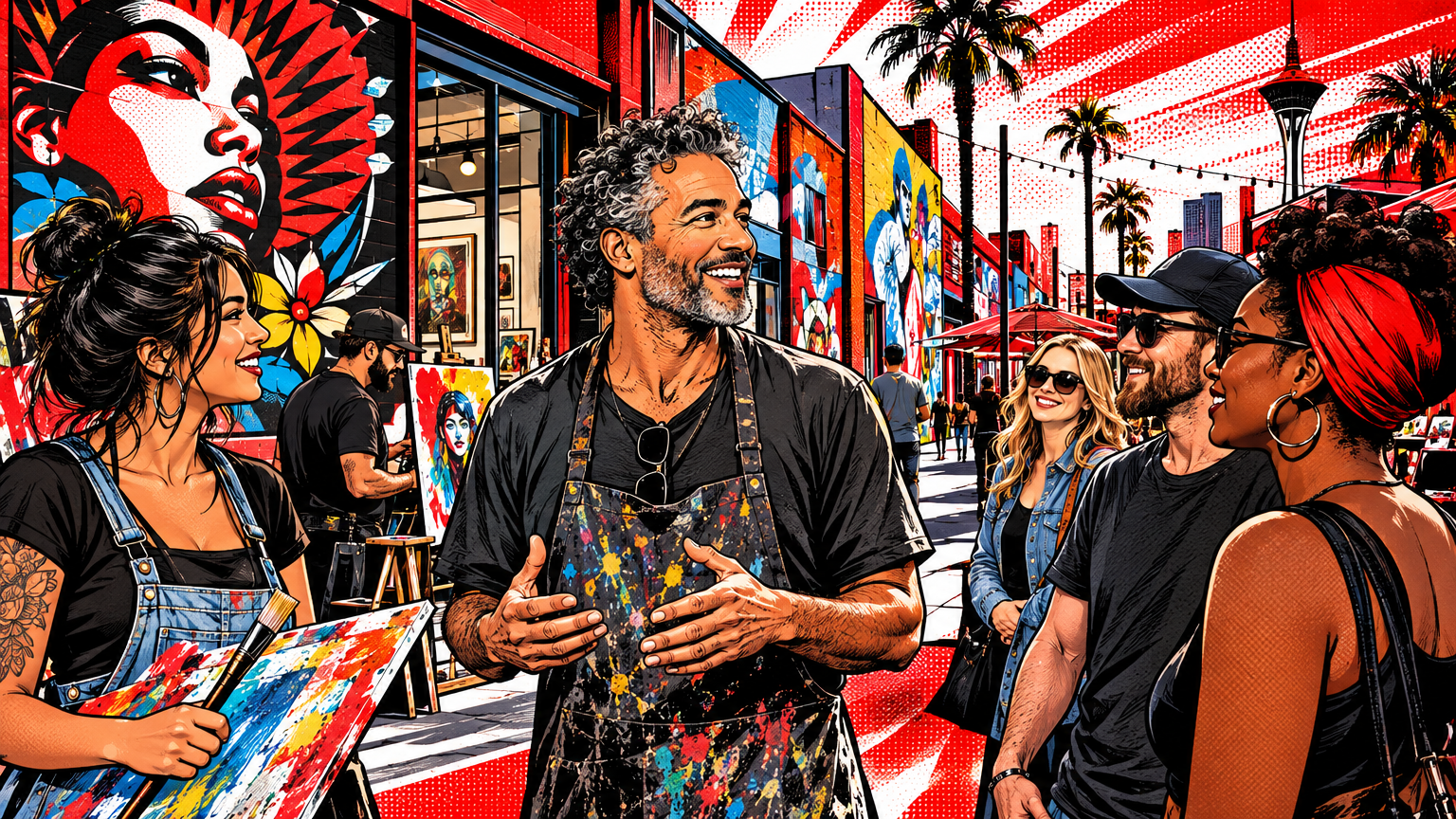
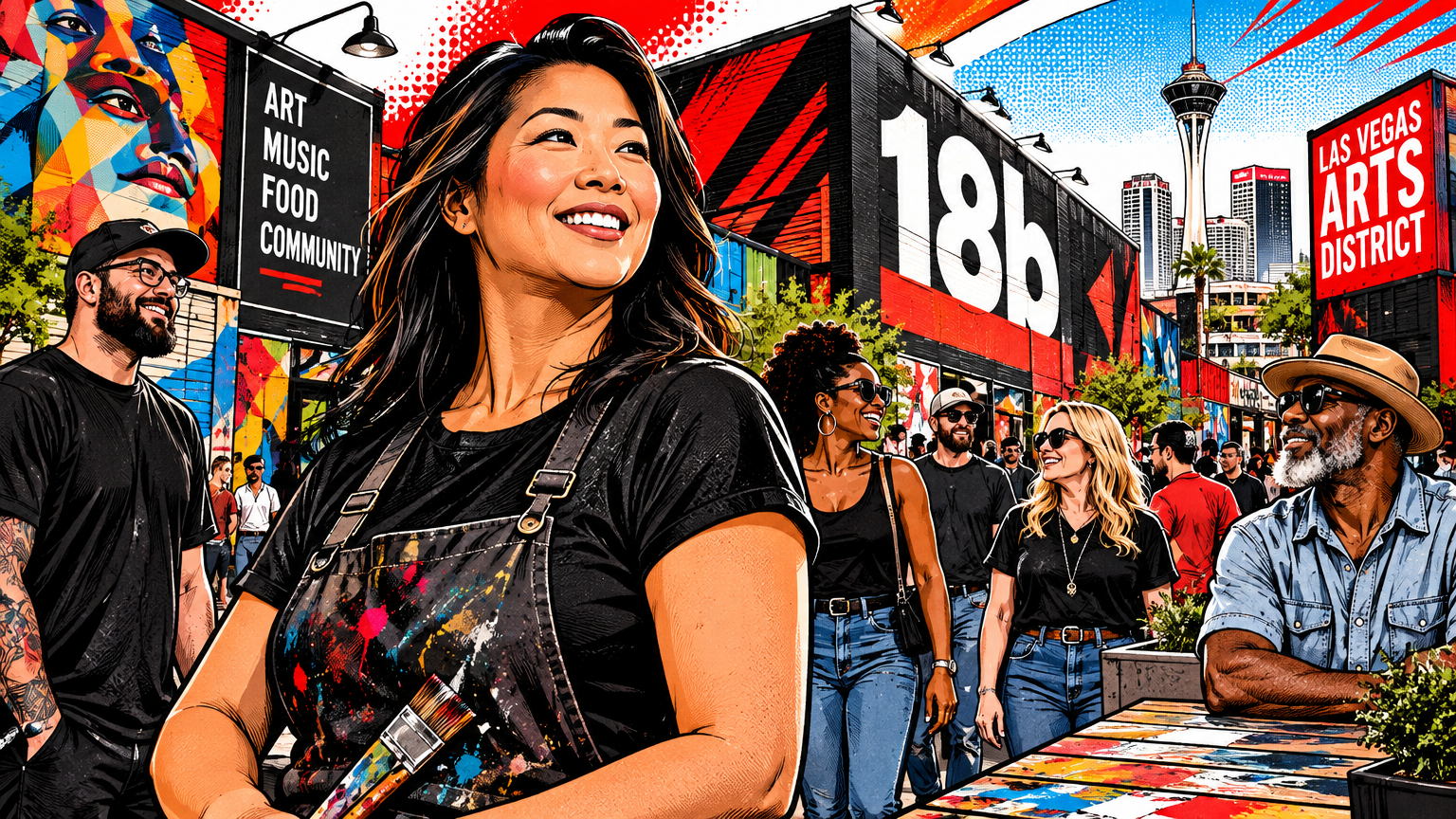
There are no slot machines here. No fountain show, no volcano, no tour buses at a valet stand. Instead there is a low warehouse with its roll-up door open, an artist carrying a canvas bigger than she is, a coffee shop filling with laptops and sketchbooks, a vintage dealer sweeping his sidewalk, a painter on a ladder in front of a fresh mural.
This is the Las Vegas Arts District, known to the people who built it as 18b. For nearly three decades it has been the city’s creative engine room. It grew out of old warehouses and stubborn belief, and survived recessions, ownership changes, and endless construction seasons. In October 2026 it absorbed the hardest blow in its history, and the festival that made it famous went quiet.
So the district stands at a crossroads, and the question hanging over Main Street is simple. As this neighborhood grows more popular and more valuable, can it keep the creative spirit that made people fall in love with it in the first place?
This is the story of how 18b happened, who built it, what it costs to keep it, and what might come next.
Arts District at a Glance
- What it is: The 18b Las Vegas Arts District, a city-recognized arts district created in 1998 as an 18-block zone to encourage art and artists.
- Why "18b": The name comes from the original 18 blocks. The district has grown to about 21 blocks, and its lived footprint is larger than its legal one.
- Official boundaries (City of Las Vegas): Roughly Hoover Avenue north, Commerce Street west, Fourth Street and South Las Vegas Boulevard east, and just past Colorado Avenue south.
- Defining streets: Main Street, Commerce Street, and Charleston Boulevard, anchored by The Arts Factory at Charleston and Main.
- Known for: Galleries and studios, the First Friday festival (currently paused), vintage shops, murals, independent restaurants, and Brewery Row.
- Getting there: About a mile south of the Fremont Street Experience and roughly a mile north of the STRAT. The free Downtown Loop shuttle serves the district, RTC buses run along Charleston and Las Vegas Boulevards, and a 500-space city parking garage opened at 1421 South Casino Center Boulevard in September 2026.
- First Friday status (verified October 29, 2026): Paused. The Foundation has suspended the monthly festival following the tragic events of October 2026. No return date has been announced.
1. What Exactly Is the Las Vegas Arts District?
Start with the name, because the name tells you how this place works.
In 1998, the City of Las Vegas set aside an 18-block area of downtown as a place where art and artists would be actively encouraged. Eighteen blocks. "18b" is that fact, shortened the way locals shorten everything. The name stuck so hard that decades later, businesses were fighting to be inside it. Josh Kellman, president of the Arts District board, told reporters: "Very quickly it changed. Businesses here were saying, 'Hey, I want to be in 18b.' No one wants to feel like they're outside the neighborhood."
The official boundaries, as the city defines them, run from Hoover Avenue in the north to just past Colorado Avenue in the south, Commerce Street to the west, and a border following Fourth Street up to Charleston, then South Las Vegas Boulevard back to Hoover. The district association describes it the same way.
But the real neighborhood is fuzzier and bigger than the legal one, stretching organically from Gass Avenue to Wyoming Avenue. Zoning changes had expanded the formal district to 21 blocks by 2009, when the 18b sign went up on Casino Center Boulevard. The name never updated. Nobody wanted it to.
Where it sits in the city
The district occupies a hinge point in downtown, south of the Fremont Street casino corridor, roughly halfway between Fremont East and the STRAT, with East Charleston Boulevard cutting through its center. Fremont Street is where downtown performs for visitors; the Arts District is where downtown lives with itself, close enough to the tourist machine to draw its energy, far enough away to develop its own gravity.
In 2005, Las Vegas Review-Journal readers voted it a Best of Las Vegas winner. By the mid-2010s, a wave of openings had pushed it into genuine prominence, and today it holds more than 100 businesses, according to the district association. Why it matters is simple. Las Vegas is often described as a city without a local culture, a place that imports everything and makes nothing. 18b is the standing rebuttal, built by hand around the idea that Las Vegas artists, shopkeepers, and neighbors come first. Whether that idea survives the neighborhood’s own success is the story ahead.
2. Before the Art: Warehouses, Carburetors, and Curio Shops
To understand why artists came here, understand what "here" was: working Las Vegas, commercial and industrial streets in the oldest part of the city, lined with warehouses and repair shops. The Arts Factory building tells the story: a commercial warehouse roughly half a century old, bowstring truss architecture, that spent its earlier life as an office supply warehouse near Charleston and Main. A few blocks away, the old Holsum bread factory turned out loaves long before anyone imagined it as loft space.
Downtown changed around these streets in the twentieth century's second half. Investment drifted south to the Strip, the old core aged, and buildings emptied or held on as used furniture stores and secondhand shops. When Nevada Public Radio looked back at the neighborhood in 2002, the year First Friday began, it described the area as "a mishmash of used furniture stores, curio shops, rebuilt carburetor shops and art galleries." The Arts District was not built on a blank slate. It grew inside a working neighborhood that already had texture, history, and people.
Why the artists came, and why it was not simple
The easy version says the rent was cheap, so the artists came. The documented version is less tidy. The buildings were a genuine draw: old warehouses offered big open floor plates, high ceilings, loading doors, and room to make a mess, and antique dealers already drew collectors of old, one-of-a-kind things. Artist Gem Jaxx, who arrived from California in 2006, remembered a rougher era plainly: "You couldn't park your car and not worry. You couldn't even walk the streets." That rawness kept the neighborhood off most investors' lists.
But cheap space was never the whole story, and sometimes it was not even true. Contemporary reporting from 2001 pointed to high rent rates and a widespread belief that downtown was crime-ridden as the two biggest obstacles working against the district idea. Progress was slow. Wes Isbutt estimated it would take four more art businesses for the area to truly flourish. That is the language of a long, uncertain build.
What the area did offer was a cluster effect, plus a city willing to experiment. When S2 Art opened next to The Arts Factory in 2001, co-owner Jack Solomon moved the company headquarters into the area with the help of a $100,000 City Council loan meant to spur development. In 2005, the old bread factory became Holsum Lofts, an early example of the adaptive reuse that would define the district.
3. The Creative Pioneers
Every neighborhood has a founding myth. 18b has something better: a founding cast, documented in real time, working out of storefronts you can still stand in front of.
Wes Isbutt and The Arts Factory
The central figure is Wes Isbutt, who now goes by Wes Myles. In 1997, a year before the city drew its map, he opened The Arts Factory at 107 East Charleston Boulevard, in that old bowstring-truss warehouse: one roof, many artists, studios and galleries side by side, the public invited in. In 1998 he partnered with the city on a street festival, the Gateway Music and Arts Experience, to prove the area could support a creative community. Mayor Oscar Goodman, elected in 1999, became a prominent supporter, and by 2000 and 2001 the City Council was debating making the district real, first as the Gateway Arts District. The Arts Factory remains the anchor nearly three decades later, housing more than 30 artists, galleries, and creative businesses, with the 18bin bar and restaurant inside, a weekly life drawing class, and Preview Thursday, the quieter gallery night collectors favor.
Cindy Funkhouser and the Funk House
Cindy Funkhouser ran the Funk House, an antique store that became an early art venue almost by instinct: she had been showing artists’ work in her shop for about five years before First Friday existed. The spark came from Portland, Oregon, where she experienced that city’s First Thursday art walk while visiting her son, and came home convinced Las Vegas could do the same. She took the idea to two friends and formed the nonprofit Whirlygig, Inc. to coordinate the event, serving as its president.
Julie Brewer and the Enigma Garden Café
Julie Brewer owned the Enigma Garden Café, remembered in a 2005 newspaper column as "an early beacon of art, poetry and good coffee," with Brewer herself a pioneer of downtown cool. The Enigma was the kind of place every art scene needs first, a café where poets and painters became a community before anyone called it one. Brewer was a co-conspirator in the First Friday idea, though Naomi Arin later recalled she was skeptical at first. The café was gone by 2005.
Naomi Arin and Dust Gallery
Naomi Arin brought a different seriousness. An attorney by training, with a background at the Institute of Contemporary Art in Boston, she opened Dust Gallery in 2003 to exhibit emerging contemporary artists who lived and worked in Las Vegas. The defining choice was deliberate: Dust would be a commercial gallery, not a nonprofit project space, because Arin wanted Las Vegas artists to make a living and stay, rather than leave for established art cities. She later ran Naomi Arin Contemporary Art and left law for art full time.
The Contemporary Arts Collective
The oldest root belongs to the Contemporary Arts Collective, founded in 1989 by artists, students, and instructors connected to UNLV’s fine arts department, nearly a decade before the district had a name. It gave artists exhibition space and built a serious program: lectures, workshops, international exhibitions, and a juried show that ran for a quarter century. Later the Las Vegas Contemporary Arts Center, it voted to dissolve in March 2014 after years of struggling for a permanent home and funding; its records now live at UNLV Special Collections. The CAC proves Las Vegas had an organized art community long before it had an arts district. 18b did not invent that community. It gave it an address. Across all these stories the pattern is the same: the informal activity came first, and the formal district identity followed it.
4. First Friday: The Festival That Built a Neighborhood, and the Night That Stopped It
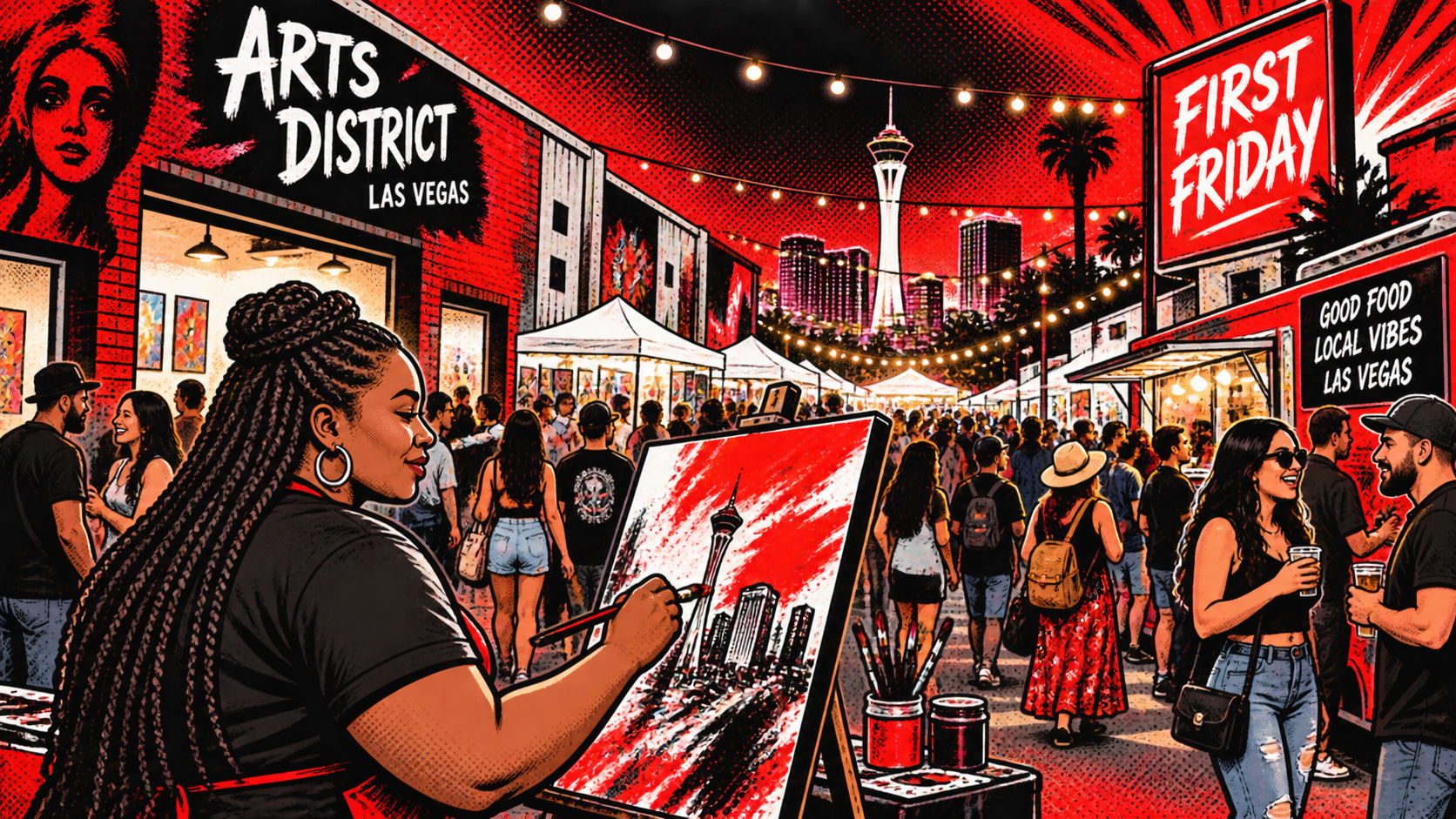
If The Arts Factory is the district’s living room, First Friday is its front porch.
October 2002
First Friday began in October 2002, organized by Whirlygig, Inc., the nonprofit Cindy Funkhouser formed with Julie Brewer and Naomi Arin in her corner. Borrowed from Portland’s art walk, the concept was simple: on the first Friday of each month, galleries, studios, and shops around Charleston and Casino Center would stay open late, hang new work, and invite the public to wander.
How many people came to the first one? Nobody knows. The most commonly repeated account puts the crowd at about 300. Artist and curator Brian "Paco" Alvarez, who was there and later got the First Friday logo tattooed on his body, told Nevada Public Radio: "It was a ragtag group of people, maybe 300 of us. There were no sidewalks, there was no lighting." But a recent district timeline reports that the foundation’s director estimates about 14 people showed up. Three hundred or fourteen: they cannot both be right, and no official count survives. What is not in dispute is that it was small and scrappy.
The institution grows
The growth after that is documented. In 2003 the city provided a $5,000 grant for First Friday billboards, and by the end of 2005 it was drawing 8,000 to 10,000 people a month; a 2007 travel report put attendance as high as 12,000. Then the Great Recession hit: in May 2009, Whirlygig paused the outdoor festival for the summer, with sponsorship down 40 percent and production costing upwards of $10,000 a month. Galleries and shops stayed open regardless.
In 2011 the festival changed hands. After a two-month hiatus, Whirlygig sold the First Friday trademark and assets to a group led by Zappos CEO Tony Hsieh, with Fred Mossler, Andrew Donner, and Joey Vanas. The first event under the new owners came that October, the ninth anniversary, and production grew to multiple stages and tens of thousands of attendees. Hsieh’s $350 million Downtown Project followed in 2012. It later passed to the nonprofit First Friday Foundation, went dark for about a year during the pandemic, and returned in April 2021 smaller and more neighborhood-focused.
By recent years, executive director Corey Fagan was describing crowds between 12,000 and 24,000, with roughly 100 local artists and sellers taking part, some making most of their rent from festival sales. Doug Rotondi, operations manager at 18bin inside The Arts Factory, put the stakes bluntly: "It’s our lifeline. I don’t think we could survive without First Friday because it gives people a reason to go downtown." Extra Super! BIG® has covered that heartbeat, from the festival’s place at the center of the district to the harder questions it faced as it grew.
Art or entertainment?
Woven through the growth is an argument never settled. The Hsieh era brought stages and scale, and some builders of the original scene asked whether the art had become the backdrop for a party. Wes Myles, the district’s own godfather, put it sharply in remarks quoted in a university history: "Are you trying to have a party or trying to have art? It’s a different conversation." The other side deserves its hearing: scale brought people who would never have entered a gallery, and some became collectors and neighbors. Owners who depend on festival nights experience the question not as philosophy but as payroll. Alvarez credited the festival’s endurance to ownership of a different kind: it lasted, he said, because "it was ours."
October 2026
On the night of Friday, October 2, 2026, during First Friday, a shooting near Charleston Boulevard and Main Street killed a 15-year-old. Local reports say three people were shot in total, and that a 17-year-old suspect was arrested and charged as an adult. A young person lost his life at an event built to celebrate his city’s creativity. It was a devastating tragedy for his family, and a wound for everyone who was there.
The Foundation’s response came within two weeks. In a statement on its homepage, it announced that "the production of the monthly First Friday event is pausing," so organizers can work with the city, law enforcement, and other partners "to reorganize and reimagine what the important future steps for First Friday can and should look like moving forward." The statement offered "deepest sympathies to the family of the young person who was killed and to everyone who was affected," and urged the public to keep supporting local artists directly.
As of this writing, verified on October 29, 2026 against the Foundation’s own website, the pause stands. Its events calendar is empty, and November’s First Friday will not take place as a street festival. Mayor Shelley Berkley called the pause a "very wise" response and said a return could come as early as December 2026 or possibly January 2027. That is a hope expressed by a mayor, not a scheduled date. No return date has been announced. The city says the Foundation, Metro, and the city share "a common goal around public safety," and that Las Vegas remains committed to the district’s artists, businesses, residents, and workers.
District businesses have organized in response, forming an Arts District Action Coalition whose first ideas include pairing at-risk youth with shopkeepers for mentorship and community service. Karina Carancho, who owns PLUR City on Commerce Street, voiced the economic fear underneath the grief: "First Friday is all about supporting local businesses so, unfortunately, it is the local small businesses out here that are going to be affected the most." The district is mourning a child and worrying about rent at the same time.
5. The Art Itself
Strip away the festivals and the brunch lines, and the reason this district exists is still the work on the walls. Its center remains The Arts Factory, where more than 30 artists, galleries, and creative businesses work under one warehouse roof: a painter next to a photographer, a sculptor sharing a wall with a printmaker. It runs a weekly life drawing class, the oldest kind of art infrastructure there is, and gives working artists something Las Vegas has historically been short on: a reliable place to be seen.
Around that anchor, the gallery scene has always mixed the formal and the makeshift. Dust Gallery set an early standard for serious contemporary programming, and the Contemporary Arts Collective carried the juried-show tradition for 25 years. Smaller spaces come and go in storefronts and side rooms, and that churn is not a failure of the model. It is the model. Independent galleries take risks institutions cannot: first shows for unknown painters, experimental work, photography, sculpture, and installation pieces that need a room more than a business plan.
The murals
The district’s most accessible gallery has no door at all. Walls across 18b carry murals that rotate as buildings change hands and artists get new commissions, so the outdoor collection is never finished and never the same twice. The best-known wall is the "Greetings from Las Vegas" mural at 1237 South Main Street, a postcard-style piece from the Greetings Tour project that has become the district’s unofficial photo backdrop. A "Love Wall" anchors 1 East Charleston Boulevard, and the blocks around Colorado Avenue and South Main Street hold a dense cluster of painted walls.
One point of orientation: the giant commissioned murals most people photograph downtown, many painted during the Life Is Beautiful festival era by artists like Shepard Fairey and D*Face, mostly stand north of here, around Fremont East. The Arts District's walls are more local and changeable, likelier the work of someone whose studio is around the corner, and the difference between a festival commission and a neighborhood wall is the difference this whole article is about.
Access, honestly stated
A note on access: The Arts Factory keeps regular hours and welcomes walk-ins, but many studios are working spaces first, and some galleries open limited hours or by appointment. Check before you go. Independent spaces are not retail operations, and the slight friction is the price of the real thing.
6. Main Street, Commerce Street, and the Character of 18b
Main Street is the showcase corridor, the spine where the district presents itself: The Arts Factory at its Charleston corner, restaurants and coffee shops in old storefronts, vintage dealers, the Greetings from Las Vegas mural watching over the sidewalk. Commerce Street, one block west, is the scrappier sibling, more workshops and bars, the street where a rave accessories shop like PLUR City feels exactly right. Charleston Boulevard is the crosstown artery that ties them together and cuts them apart.
The architecture is the argument made visible. Almost nothing here was built to be an arts district: a bowstring-truss warehouse became The Arts Factory, a bread factory became Holsum Lofts, mid-century storefronts became galleries and cocktail bars without losing their bones. This is adaptive reuse not as a design trend but as economic fact: sturdy, adaptable buildings whose tenants rewrote the interiors while keeping the faces.
The vintage heart
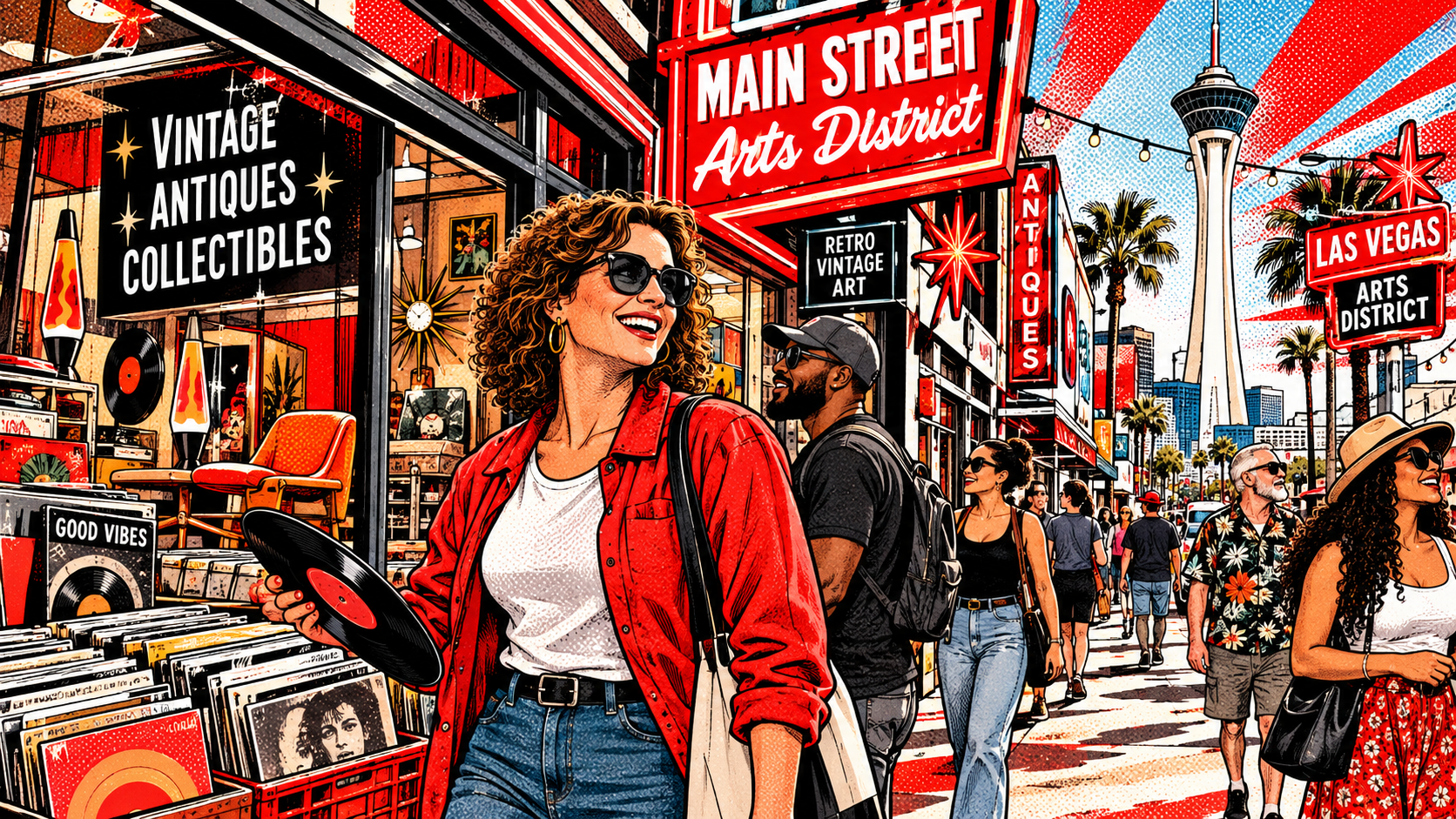
The antique and vintage scene predates the art scene and, in a real sense, parented it. Cindy Funkhouser was an antique dealer; the Funk House was an antique store that showed art. That DNA never left: Main Street still runs on treasure hunting, mid-century furniture, vintage clothing, and objects with previous lives, at shops like ReBAR, where the antique store and the dive bar occupy the same room and nearly everything is for sale. The vintage economy gave the district daytime foot traffic.
Walkable, in pockets
Is the district walkable? In pockets, genuinely yes: the blocks around Main and Charleston are a pleasure on foot, and mural hunting rewards walkers. But honesty beats boosterism. Charleston is wide and fast, some sidewalks are narrow or shadeless, and summer heat turns a stroll into an athletic event by noon. The right model is not a quaint village but a working downtown neighborhood with walkable nodes, connected by streets you cross with care. That rawness is part of why the place feels authentic, and why the city’s street investments matter so much here, and hurt so much while they are underway.
7. The Independents: Shops, Tables, and Counter Stools
A neighborhood is its businesses on an ordinary Tuesday. These are the Arts District’s, verified as operating in October 2026: Esther’s Kitchen, Good Pie, Makers & Finders Coffee, Main St. Provisions, Soulbelly BBQ, The Cornish Pasty Co., and Casa Don Juan on the food side; ReBAR, The Honeypot, and PLUR City for vintage and retail; Majestic Repertory Theatre for live performance; The English Hotel and 1228 Main on the hospitality corner.
Esther's Kitchen
Chef James Trees opened Esther’s Kitchen as a seasonal Italian restaurant, and it became the district’s proof that a Main Street address could compete with any dining room on the Strip. In 2024, Trees moved it into a space roughly three times larger at 1131 South Main Street: the flagship was not leaving the district to grow. It has since been named among the top brunch spots in the country for 2026.
Makers & Finders
Makers & Finders, at 1120 South Main Street, is a Latin-inspired coffee bar that treats hospitality as a craft: house-made syrups, empanadas and churro waffles, a lavender latte with a local following, and a room of murals and communal tables filled daily with remote workers and neighbors. Its founder built it as an "urban coffee bar serving Latin comfort food," and in practice it is the district’s second living room.
The Cornish Pasty Co.
The Cornish Pasty Co. serves the working-class British hand pie miners once carried underground. This year, though, owner John Bender has become one of the neighborhood’s most quoted owners for another reason: he told FOX5 in July 2026 that revenue was off about 20 percent since heavy construction equipment arrived, with barriers in front of his windows. The Pasty is still serving, and its year is the district’s central tension in one storefront: street work promising a better Main Street, and receipts that must survive until it is finished.
ReBAR
ReBAR is the district’s personality in a single business model: an antique shop that is also a dive bar, where the furniture, the décor, and half the inventory can be bought out from under your drink. It collapses the district’s founding move, art and objects inside a neighborhood room, into one business. Funkhouser hung paintings in an antique store and invented First Friday. ReBAR says the experiment worked.
Around these anchors: Good Pie’s Brooklyn-style slices at 1212 South Main; Main St. Provisions’ dining room; Soulbelly BBQ, Chef Bruce Kalman’s temple of smoke; Casa Don Juan’s old-school Mexican kitchen; The Honeypot’s crystals and décor, whose owner Jocelyn Poirier has stepped into leadership in the new Action Coalition; PLUR City’s rave gear on Commerce; Majestic Repertory Theatre’s immersive productions; coffee at 1228 Main by day and fine dining at night; and The English Hotel.
8. Brewery Row: When the Beer Arrived
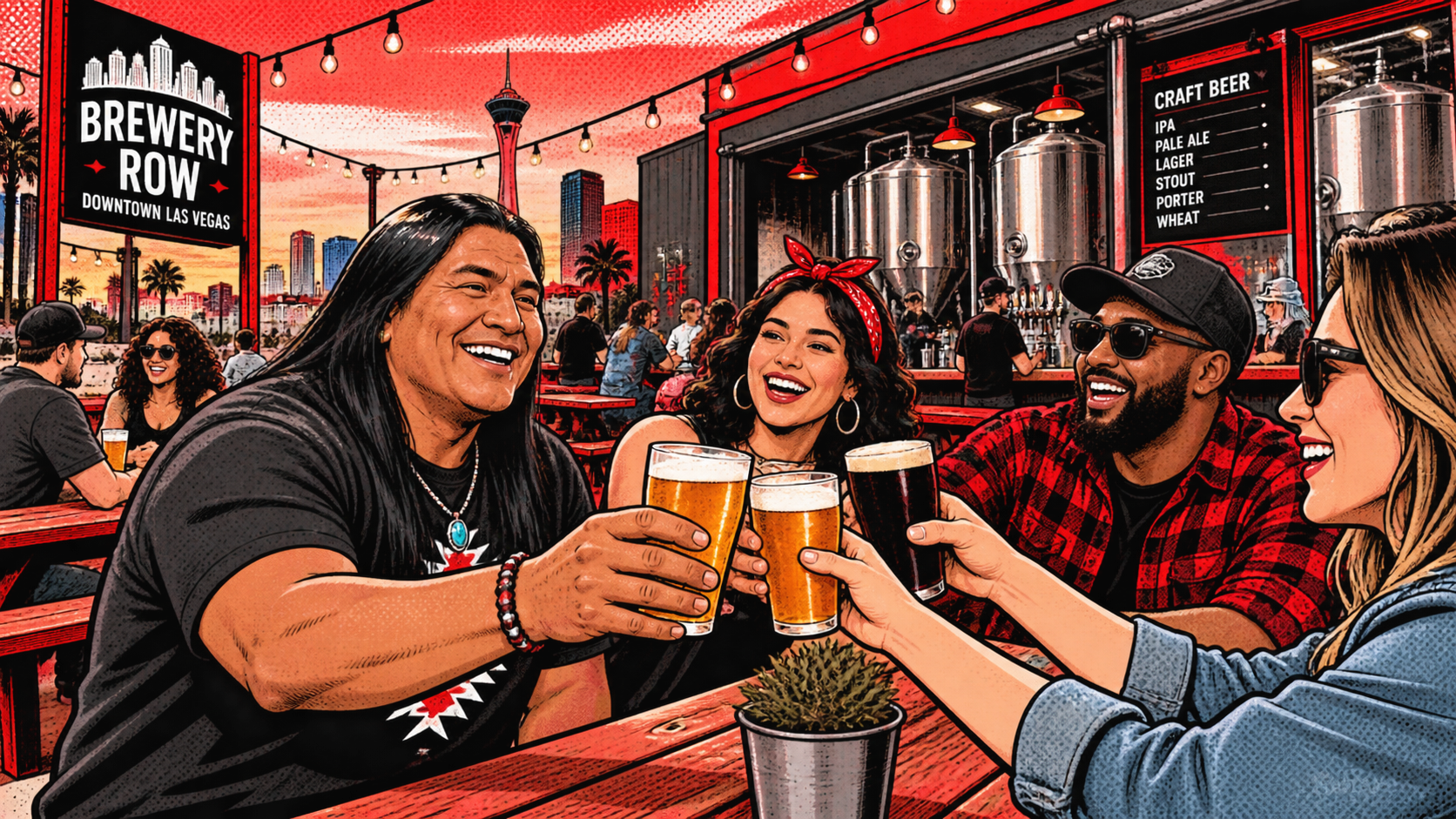
Craft beer came the way everything comes here: gradually, then with a city logo on it. The district’s first brewery, Hop Nuts Brewing, arrived in 2014. Brewers liked what artists had liked: adaptable industrial space, a downtown identity distinct from the Strip, and a festival delivering thousands of thirsty pedestrians. A cluster formed around Main Street. Able Baker Brewing built its identity on Atomic Age Nevada, its name and branding playing on the state’s nuclear test history. CraftHaus Brewery opened an Arts District taproom to join its Henderson roots, and its owners say they helped the city define what came next. Beer District Brewing set up at 914 South Main Street, and The Silver Stamp became the district’s serious beer bar.
The city makes it official
In 2021, the city decided to stop watching the cluster and start feeding it. The Brewery Row initiative, voted on in May 2021 and championed in Ward 3 by Councilwoman Olivia Diaz, formally recognized the corridor and attached incentives, most notably a temporary waiver of the city’s liquor license origination charge for qualifying new businesses, removing one of the steepest upfront costs of opening a brewery or bar in Nevada. Its goals were practical: highlight businesses serving Nevada-made products, bring traffic to the Arts District, and build the local brewing scene’s reputation. The City Council extended the waivers for another two years in July 2023. The official footprint runs from Bonneville Avenue to Oakey Boulevard and from Las Vegas Boulevard west to the railroad line, overlapping the district’s western side.
Brewery Row gave the district a second anchor identity beside its galleries, and a nighttime economy to complement the daytime one. It is not one-sided: nightlife brings noise, congestion, and visitors who treat the neighborhood as a venue rather than a community. And the beer economy is not immune to the district’s pressures.
Pressure, in a pint glass
In December 2025, HUDL Brewing poured its last beer at 1327 South Main Street and closed its taproom after five years. Co-owner Skip Norfolk told reporters revenue was down roughly 25 to 30 percent on the year, a needed kitchen expansion could not be financed, and softening tourism, including a near-disappearance of Canadian visitors, had squeezed the room. Its beers later returned through a production partnership with Neon Desert Brewing, a soft landing for the brand but not for the taproom. Even success stories here have thin margins.
Brewery Row today remains one of the district’s strongest draws: Able Baker, CraftHaus, Beer District, The Silver Stamp, and Nevada Brew Works are all pouring within a few blocks of the galleries. Our guide to the best breweries in the Las Vegas Arts District walks the row taproom by taproom. It is the rare bar crawl where you can also buy a painting.
9. It's a Neighborhood, Not Just a Destination
Festivals end. Rent is due on the first of the month, every month, and between the big nights the Arts District belongs to the people who live and work inside it.
That population is more varied than the nightlife coverage suggests: loft residents who chose downtown when downtown was a punchline; bakers, baristas, and line cooks on early shifts; artists in The Arts Factory studios on a Wednesday afternoon; and longtime residents of affordable buildings like L’Octaine Urban Apartments at Las Vegas Boulevard and Gass Avenue, where artist Brian "Paco" Alvarez, who attended the first First Friday in 2002, has lived for more than two decades. The man with the festival’s logo tattooed on him is also a working artist in income-restricted housing inside the district the festival made famous.
Everyday 18b runs on small rituals: coffee at Makers & Finders, a life drawing class at The Arts Factory, Preview Thursday’s quiet gallery night. The district’s identity, the thing residents defend, is not a brand deck. It is this accumulation of ordinary days, and the feeling that the neighborhood knows your name.
Belonging cuts in several directions. To the pioneers, it is earned in decades. To newer owners like Jocelyn Poirier of The Honeypot and Karina Carancho of PLUR City, who organized the district’s response to October’s tragedy, it is claimed by showing up when it is hard. To residents of the new towers, it may just be beginning. And to a visitor, the district feels open and browsable, but the welcome is extended by people whose home this is. A destination is a place you consume. A neighborhood is a place that lets you in.
10. The Price of Popularity
Success, in a neighborhood, is never free. Somebody always pays, and the argument is always about who. In 18b, the evidence is now substantial enough to examine piece by piece.
The building boom is real, and it is big
In 2026, two major apartment projects were completed in the district, bringing more than 600 new homes to a neighborhood that had no apartment towers a decade ago. Nashville-based Southern Land Co.’s Gemma, a 337-unit community at Third Street and California Avenue, began phased move-ins in the spring. A 311-unit complex at Commerce Street and Imperial Avenue, from Chicago-based Cedar Street Companies and Salt Lake City’s Bridge Investment Group, completed on a mid-2026 timeline. A Marcus & Millichap report projected valley-wide apartment completions of only about 3,400 units in 2026, a four-year low. Z Life Co.’s multi-tower Midtown project near Coolidge and First, roughly $300 million in investment, remains active, and the City Council this year approved a six-story apartment building at Seventh and Gass.
The squeeze, in the record
Against that boom, set the closures and the testimony. HUDL Brewing closed in December 2025 with revenue down 25 to 30 percent. Dig It! Coffee closed its shop at 1300 South Casino Center Boulevard in the spring of 2026, after about three years, owner Taylor Chaney citing more than a year of construction, road closures, and parking changes. Dig It! hired and trained adults with disabilities and had been named among the top coffee shops in the country by Yelp. El Sombrero, a Main Street fixture, closed as well. Berlin Bar shuttered. John Bender of The Cornish Pasty put the construction era into one number: revenue off about 20 percent.
Be careful, though: a list of closures is not a district-wide measurement, and some of 2026’s pain has valley-wide causes, including a soft tourism year. The measurable facts are these: hundreds of new market-rate apartments delivered in one year, major public investment in parking and streets with a long disruption tail, documented testimony about construction losses, and a city openly acknowledging that artists are being priced out. The boom and the squeeze are happening at the same time, on the same blocks.
City Hall, in both directions
The city is not a bystander here; it is a character with a long record of acting in both directions. It created the district in 1998, lent S2 Art $100,000 in 2001, funded First Friday billboards, and built the Brewery Row incentive in 2021. In September 2026 it opened a $25 million, 500-space parking garage at 1421 South Casino Center Boulevard, with $30 monthly passes for eligible residents and employees, and parking rules that made weekday mornings free while pushing paid hours into evenings. It also backed away from planned parking fee increases after owners objected.
Most telling is what the city is trying to build next: proposals are being requested for a 1.23-acre affordable housing development for artists beside the district, mixed-use, with gallery space on the ground floor and rents targeted to households at or below 80 percent of area median income. Redevelopment manager Tracy Reich stated the problem plainly: artists are "starting to be priced out a little bit," because "historically, artists go to where it’s the cheapest place to create. Then people find out how wonderful and fun it is, and then it slowly gentrifies and pushes artists out."
The BID fight, and the paradox
The sharpest current expression of that paradox is the proposed Business Improvement District, covering 18b and the Gateway district. Supporters see professional upkeep for a neighborhood that outgrew volunteer energy. Opponents have organized a petition, pointedly titled "Don’t Bid Us Out," arguing that the area reaches far beyond 18b, that only owners vote while tenants pay much of the cost passed through, that assessments can rise without a vote, and that the result would be a more polished, more expensive, less weird district. Paco Alvarez fears the assessment could push the out-of-state owner of L’Octaine, his affordable home of 21 years, to sell; reporting has put the property’s would-be annual BID cost at about $16,484. As of October 2026, the proposal remains contested and unresolved.
That is the price of popularity, stated without villains. The artists made the district desirable; desirability brought capital and crowds; crowds raised the costs of the very people who created the value. Every perspective holds a piece of the truth: the developer is right that housing near downtown jobs is good; the tenant is right that she did not agree to pay for her own displacement; the mayor is right that doing nothing also has a cost.
11. How to Experience It
Enough argument. You are going. Here is how to do the district well, starting with the festival question.
First, the First Friday question
As of October 29, 2026, First Friday is paused. The Foundation has suspended the monthly festival following the tragic events of October 2026, November’s festival will not take place, and no return date has been announced. Mayor Berkley has said a return could be possible in December 2026 or January 2027, but nothing is scheduled, so do not plan around a date that does not officially exist. Check the Foundation’s website before you go. The district’s galleries, shops, and restaurants remain open, and Preview Thursday and ordinary weekends still deliver most of what the festival amplified.
Getting there
The district sits about a mile south of the Fremont Street Experience and roughly a mile north of the STRAT, with Charleston Boulevard as its east-west spine. From the Strip, it is a short drive or rideshare north; from Fremont, walk or ride south on Main Street. The Downtown Loop, the city’s free shuttle, connects the district with downtown stops including Fremont Street and the Mob Museum, and RTC buses run along Charleston and Las Vegas Boulevards. Skipping the car entirely? Our guide to navigating Las Vegas without a car maps the routes.
Parking, solved better than it used to be
The biggest recent upgrade is the new city parking garage at 1421 South Casino Center Boulevard, opened September 29, 2026: five stories, 500 spaces, $3 per hour with a $15 daily maximum, and a mural on it, because of course there is. Street parking still exists. Under rules in effect since October 1, 2026, it is free from midnight to 1 p.m. Monday through Friday, paid from 1 p.m. to midnight on weekdays, and paid from 8 a.m. to midnight on weekends. We covered the garage opening and the new schedule in detail this fall.
Walking, heat, and honesty
Plan to walk, but plan like a local. The core around Main and Charleston is genuinely pleasant on foot; beyond it, sidewalks narrow, shade disappears, and Charleston demands respect at crossings. In summer, treat the district as a morning and evening neighborhood: arrive before 10 a.m. or after 6 p.m., and carry water. Most storefronts are ground-level and step-free, but accessibility varies by building. If a step-free entrance matters to your group, call ahead.
Three ways to spend your time
The 90-minute route. Start at The Arts Factory and give it a full half hour. Walk south on Main past the murals, stopping at the Greetings from Las Vegas wall at 1237 South Main for the photo. Coffee at Makers & Finders, then a slow pass through ReBAR, and try to leave without buying a chair.
The half-day route. Brunch at Esther’s Kitchen or coffee at Makers & Finders. Late morning in The Arts Factory and the galleries, then the mural blocks around Colorado and Main. Lunch at Good Pie or Casa Don Juan, an afternoon of vintage hunting, and an early tasting flight on Brewery Row.
The evening route. Dinner at Esther’s Kitchen, 1228 Main, or Main St. Provisions. A show at Majestic Repertory Theatre if the calendar aligns. Then walk Brewery Row slowly: a pour at Beer District Brewing, a nightcap at The Silver Stamp or a seasonal cocktail at Velveteen Rabbit, run by two sisters. End by walking Main Street once, end to end, under the signs.
Free, family-friendly, and the mistakes to skip
The best of the district is free: murals, architecture, and people-watching cost nothing. Families do well in the daytime, when the scene is coffee, murals, and treasure hunting; evenings on Brewery Row are adult territory. The common mistakes are easy to avoid once named. Do not come only for a festival night and call it the district. Do not assume every gallery keeps daily hours. Do not skip the side streets. Do not photograph studio work without asking. And do not use the district as a pre-game for somewhere else. Stay for dinner.
12. What's Next
Separate what is approved from what is proposed, because in this district that difference is where the honesty lives.
Built or underway: Gemma’s 337 units at Third and California are leasing, and the 311-unit Commerce and Imperial project has joined it, putting more than 600 new neighbors inside the district. Z Life Co.’s Midtown project, roughly $300 million near Coolidge and First, remains active. The parking garage is open.
Approved or in process: The city has approved a six-story apartment building at Seventh Street and Gass Avenue. The artist housing project beside the district is at the request-for-proposals stage, real but not yet designed, let alone built. Brewery Row’s license waivers, extended in 2023, remain alive.
Proposed and contested: The Business Improvement District remains a proposal with an organized opposition. The return of First Friday is not a project but a question: the Foundation, the city, and Metro are reviewing what a safer, reimagined festival looks like, with the mayor floating December or January and no date committed.
And the artists? Their future runs through every item above. If the artist housing gets built with its gallery ground floor, if parking economics stay humane, if the BID debate ends with tenant protections that have teeth, the next chapter can include the people who wrote the first one. If not, the buildings will still be full, and something essential will have quietly moved elsewhere, as in a hundred art districts before this one. The festival’s future and the artists’ future are the same question: whether 18b remains a place that produces culture, or graduates into one that merely hosts it. The pioneers were never supposed to win, either, and they built this.
13. Closing: The Story Still Being Written
Go back to that weekday morning corner, Main and Charleston, where we started. The artist is still carrying her canvas, the coffee shop still filling, the vintage dealer still sweeping a sidewalk in front of a building older than the Strip. Around them, cranes stand over new towers, and the festival that used to close these streets is quiet while its people figure out how to bring it back worthy of the name.
A warehouse clerk stocked office supplies where painters now argue about light. An antique dealer hung art in her shop and, with a café owner and a lawyer who opened a gallery, talked a city into believing its own artists were worth a monthly holiday. A generation of brewers, chefs, and shopkeepers built on their foundation, and a new generation of organizers now stands guard around the whole enterprise.
That is not a finished story, and this article will not pretend otherwise. The district was written by hand, in pencil, by people who kept showing up. It still is. The next chapter belongs to whoever shows up next, probably carrying something oversized through a roll-up door on an ordinary morning, while the rest of Las Vegas is still asleep.
18b Timeline: Key Milestones
- 1989: The Contemporary Arts Collective is founded by artists, students, and instructors from UNLV's fine arts community.
- 1997: Wes Isbutt opens The Arts Factory at 107 East Charleston Boulevard.
- 1998: The city designates the original 18 blocks; the "18b" name is born.
- 2001: S2 Art opens beside The Arts Factory with help from a $100,000 city loan.
- 2002: The area is renamed the Las Vegas Arts District. First Friday launches in October, organized by Whirlygig.
- 2003: Naomi Arin opens Dust Gallery. The city grants $5,000 for First Friday billboard promotion.
- 2005: The Holsum bread factory becomes Holsum Lofts. The district wins a Best of Las Vegas award. First Friday draws 8,000 to 10,000 monthly.
- 2009: The 18b sign rises on Casino Center Boulevard; the district has grown to 21 blocks. The recession forces a scaled-back festival summer.
- 2011: First Friday's assets are sold to a group led by Tony Hsieh.
- 2012: Hsieh launches the $350 million Downtown Project.
- 2014: Hop Nuts becomes the district's first brewery. The Contemporary Arts Collective dissolves after 25 years.
- 2021: The city launches the Brewery Row initiative. First Friday returns in April after its pandemic closure.
- 2024: Esther's Kitchen expands into a larger Main Street space.
- 2025: HUDL Brewing closes its Main Street taproom in December.
- 2026: More than 600 new apartment units are completed. The parking garage opens September 29. On October 2, a shooting at First Friday kills a 15-year-old; the Foundation pauses the festival.
14. Frequently Asked Questions
What is the Las Vegas Arts District?
A city-recognized arts district in downtown Las Vegas, known locally as 18b, centered on Main Street and Charleston Boulevard. It is home to galleries, studios, vintage shops, independent restaurants, and Brewery Row, and grew out of an artist-led movement that began in the late 1990s.
Where is it?
South of the Fremont Street casino corridor, roughly between Hoover Avenue and Wyoming Avenue, and between Commerce Street and Las Vegas Boulevard. The Arts Factory, at 107 East Charleston Boulevard, is its best-known landmark.
Why is it called 18b?
Because the City of Las Vegas designated 18 blocks as the arts district in 1998. The district has since grown to about 21 blocks, but the name stuck.
Is it worth visiting?
Yes, particularly if you want the Las Vegas locals built for themselves: working galleries, murals, vintage shopping, chef-driven restaurants, and craft breweries.
Is it free to explore?
Largely, yes. Walking the neighborhood, viewing murals, and browsing most galleries costs nothing. You will pay for food, drinks, shopping, and some performances.
What are the best things to do?
Tour The Arts Factory, walk the mural blocks around Main Street and Colorado Avenue, hunt vintage on Main Street, eat at an independent like Esther’s Kitchen, and finish on Brewery Row.
When is First Friday, and is it currently happening?
First Friday was traditionally held on the first Friday of each month. As of October 29, 2026, it is paused: the Foundation suspended the festival following the tragic events of October 2026, November’s event will not take place, and no return date has been announced. Check the Foundation’s website before planning around it.
Can you walk around it?
Yes, especially the core blocks around Main Street and Charleston Boulevard. The district is not uniformly pedestrian-friendly, though: some streets are wide and fast, shade is scarce, and summer heat demands planning.
Is it family-friendly?
During the day, yes: murals, galleries, coffee shops, and vintage stores suit families well. Evenings center on bars and breweries and are geared toward adults.
How is it different from Fremont Street?
Fremont Street is a casino entertainment corridor built for visitors. The Arts District is a working neighborhood built by local artists and small businesses, focused on galleries, shops, and restaurants rather than gaming.
Where do I park?
The city garage at 1421 South Casino Center Boulevard offers 500 spaces at $3 per hour with a $15 daily maximum. Metered street parking is also available; weekday mornings before 1 p.m. are free.
How much time should I spend?
Ninety minutes covers the highlights. Half a day lets you do the galleries, murals, lunch, and vintage shops properly. Stay through the evening for the full picture.
Research current through October 29, 2026.