Every other city buries its past. Las Vegas implodes its past on live television, then wonders what to do with the pieces.
For 30 years, one place has caught those pieces. The Neon Museum sits on 2.27 acres just north of downtown, and its Neon Boneyard holds more than 250 signs from the 1930s to today.
This fall, the Boneyard proved how fast Vegas history now moves. In ten days, the museum took in a sign barely three years old and sent out a skull that first hung over the Strip in 1993. Only in Vegas does history arrive this young, and only in Vegas is there a boneyard waiting to catch it.
A Sign Became History in Just Three Years
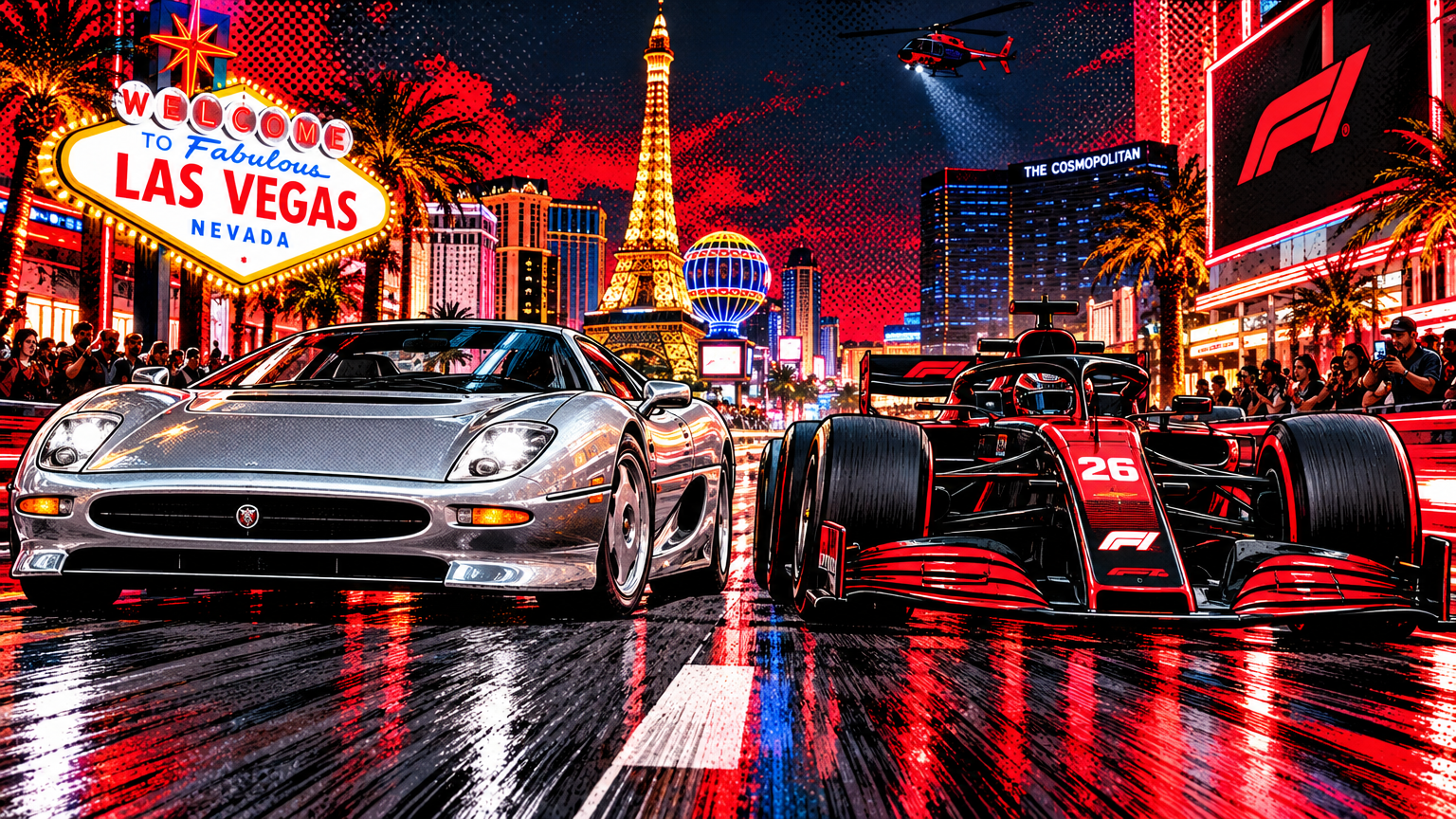
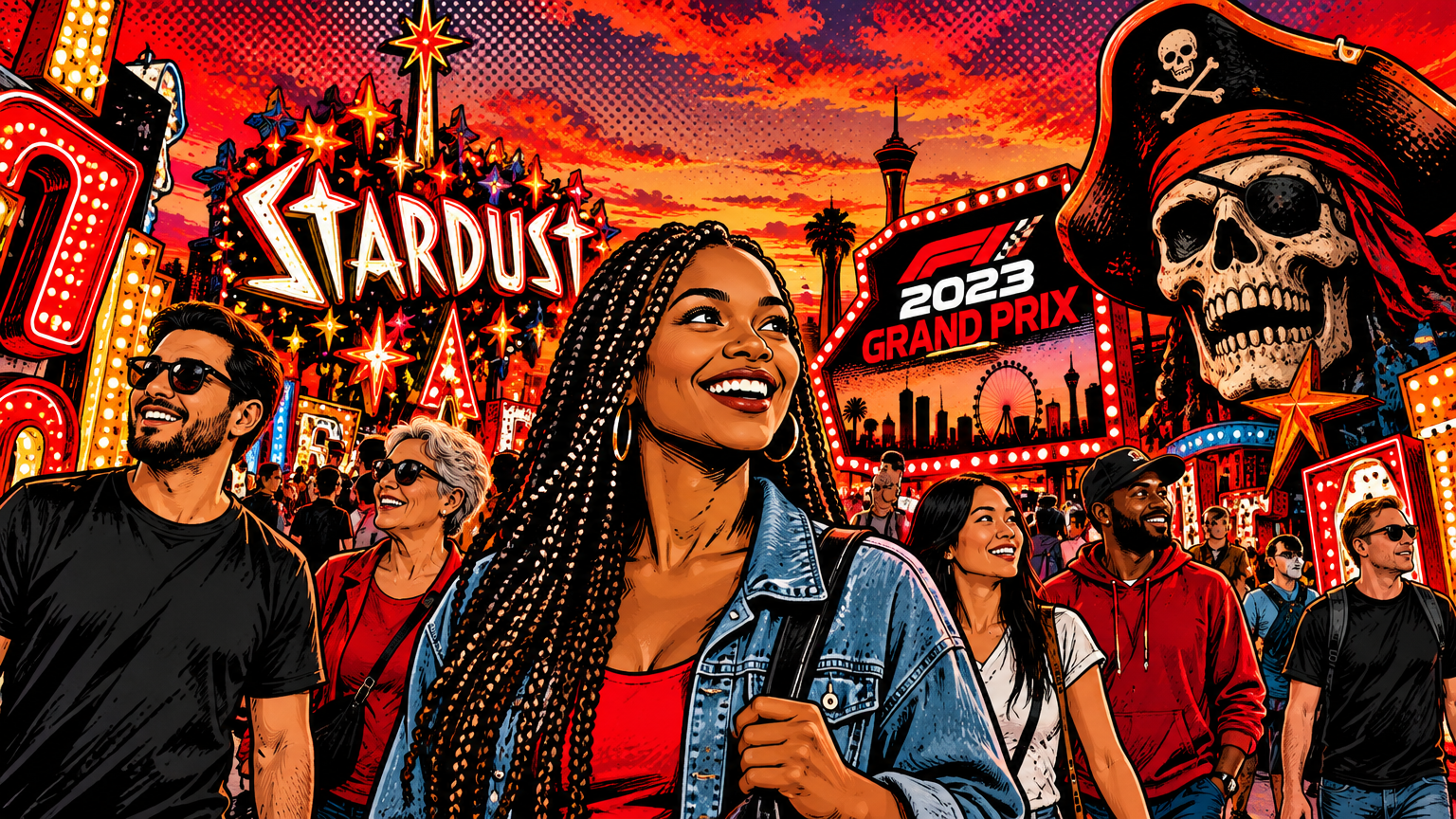
The newest old sign in Las Vegas is the FORMULA 1 HEINEKEN SILVER LAS VEGAS GRAND PRIX 2023 sign. It lit up for the inaugural Grand Prix in 2023, and it already lives in the Neon Boneyard, reilluminated and on display.
The sign measures about 5 feet tall by 9.5 feet wide. Heineken designed it, Kings Of Neon fabricated it in 2023, and its white, red and green LED Neon Flex lighting makes it the first of its kind in the museum collection. It first stood at Grand Prix Plaza at 4400 Koval Lane.
Two teammates came with it. An oversized racing shoe, the "shoey" exhibit, honors the celebration popularized by Australian driver Daniel Ricciardo, and Utah based WhiteClouds built it with 3D printing for the inaugural race. A model of the 2023 track layout now sits in the museum lobby.
The museum unveiled the sign on October 26 as the grand finale of Duck Duck Shed, its annual festival of Las Vegas history and design. Guests raised a Heineken toast, checked out a Formula 1 show car up close, and counted down to the 2026 Grand Prix, which runs November 19 to 21. Las Vegas Grand Prix, Inc. also contributed $25,000 to support the museum preservation work.
Museum CEO and Executive Director Aaron Berger put the speed of it plainly.
"Las Vegas is a city that is always changing and our collection grows with it. The Las Vegas Grand Prix represents a new chapter of the city's history: one that is shaped by innovation, global sports and Las Vegas' ability to continually reinvent itself. Preserving this sign from the inaugural race gives future generations a connection to the beginning of that story."
Austin Brown, Vice President of Marketing for Las Vegas Grand Prix, Inc., added: "Having these artifacts from the inaugural race preserved at The Neon Museum is a meaningful reminder of how far we've come in just four years."
Here is the part no other city can copy. Museums usually wait decades to call something historic. Vegas needed three years, because this city reinvents itself every single season.
Race fans can now study the first chapter of Grand Prix history before the fourth race even runs.
Then a Crane Came for the Pirate Skull
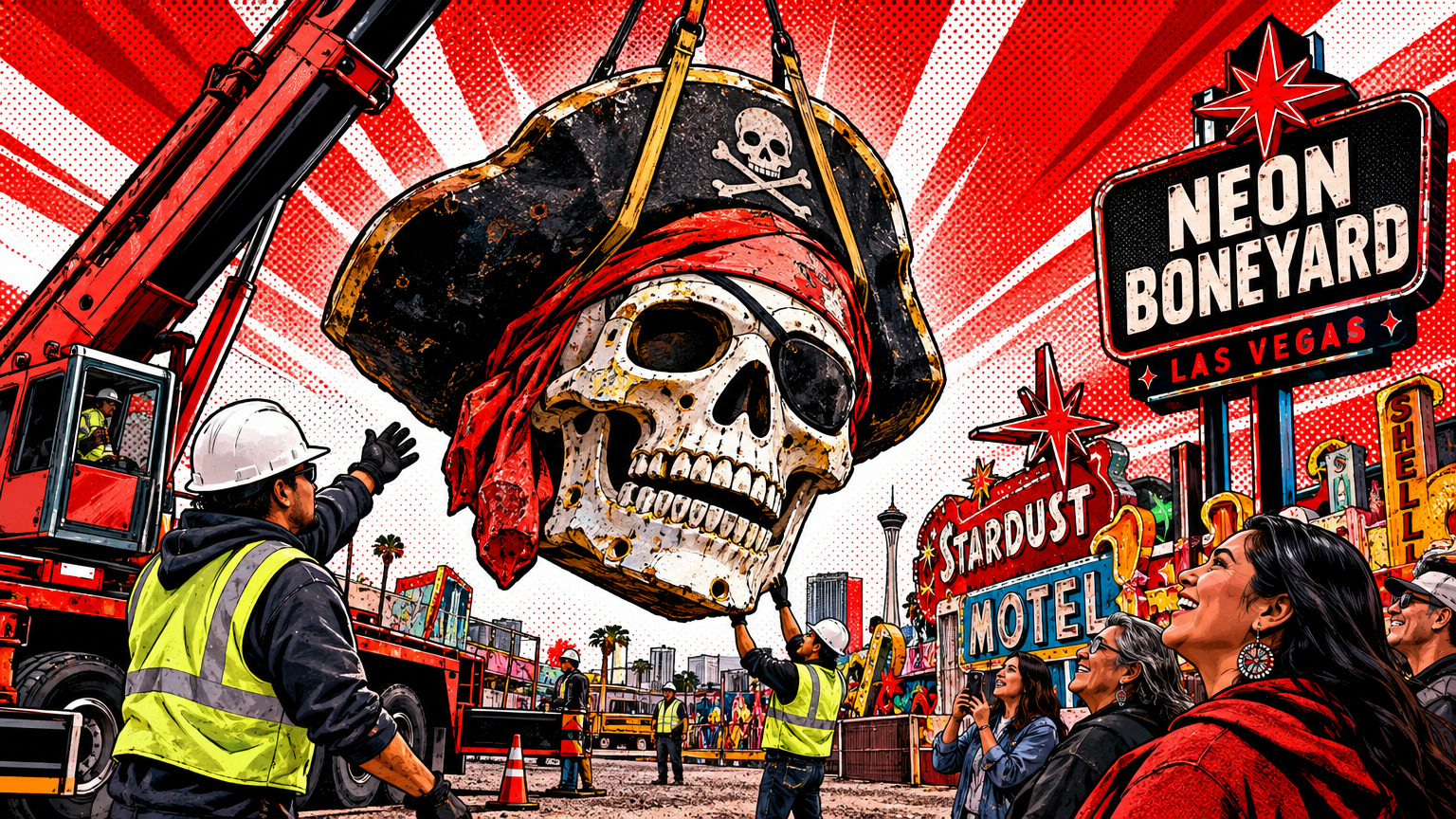
Ten days later, the traffic ran the other way. On November 5, the museum announced that a crane had lifted the Treasure Island pirate Skull out of the Boneyard and trucked it to YESCO for restoration. It will return, and the museum will announce the date later.
The Skull is a polychromatic molded fiberglass sculpture about 32 feet tall and 29 feet wide, built in three components: the skull, the earring and the bandana knot. It is the only survivor of two identical skulls mounted on both sides of the Treasure Island pylon sign when the property opened in 1993.
Its first exit was pure Vegas theater. After the property rebranded in 2003 and dropped the pirate theme, crews removed the sign on July 10, 2003, in a ceremony with pyrotechnics and fireworks. The Skull then moved to the Neon Museum, where the desert sun slowly faded its colors.
At YESCO, the work is hands on: fiberglass patching, stabilization and repainting to bring back the original colors. Think of it as a Strip marquee refurbishment, except the star is 32 feet tall and has been retired for two decades.
The lesson for visitors is simple. The Boneyard is not a parking lot for dead signs. It is a working hospital, and patients still check in and out.
The Sign Company That Lit Vegas Never Left
The skull went to exactly the right hospital. YESCO, the Young Electric Sign Company, has been building the glow of Las Vegas for more than 90 years.
Thomas Young founded the company in Ogden, Utah, in 1920 after borrowing $300 from his father. YESCO began servicing Las Vegas in 1932, and the Boulder Club was one of its first clients. In 1951, YESCO built Vegas Vic, the 40 foot tall cowboy who still waves over the Pioneer Club on Fremont Street.
YESCO also owns and maintains the most photographed sign on Earth. Betty Willis designed the Welcome to Fabulous Las Vegas sign in 1959 while working for Western Neon. YESCO acquired Western Neon in 1964 and has cared for the sign ever since.
The museum connection runs deeper than one restoration job. One fourth of the Neon Museum collection is on loan from the YESCO boneyard, the company storage yard that housed many of the city decommissioned signs for years.
So the full circle is real. The shop that lit the Strip stored the signs when the Strip threw them away. Now it restores the museum biggest pirate.

The Lobby Is an Artifact Too
The rescue mission started in 1996, when the Neon Museum was established as a nonprofit to collect and exhibit neon signs, the art form synonymous with Las Vegas. That same year, the Hacienda Horse and Rider sign became the first sign the project restored and installed as public art.
You enter through a rescued building. The Visitors Center fills the former La Concha Motel lobby, a shell shaped Googie landmark built in 1961 on Las Vegas Boulevard South, next to the Riviera. Acclaimed architect Paul Revere Williams designed it.
Williams was the first Black architect to join the American Institute of Architects, in 1923, and its first Black fellow, in 1957.
The lobby was saved from demolition in 2005 and moved in 2006. It opened as the Visitors Center on October 27, 2012, and the museum earned accreditation from the American Alliance of Museums in 2021, the highest national honor for museums in the United States.
The Boneyard by the numbers:
- 250 plus signs in the collection, spanning the 1930s to the present day
- 31 electrified signs glowing in the Boneyard, best viewed on a night tour
- 40 plus signs reanimated nightly in the Brilliant! Jackpot show in the North Gallery
- 17 restored signs installed as public art: 15 downtown, one in Summerlin and one in the Medical District
- 12,000 artifacts in the full collection, from signs and photos to costumes and souvenirs
- 2.27 acres of campus just north of downtown
Dead Signs, Lit Twice
The museum brings signs back two ways. One is elbow grease. The other is light itself.
The physical restoration line keeps growing. A Tropicana sign from 1978 was relit in early 2024, after the property closed on April 2. In May 2024, three Flamingo pieces, the 1976 roadside pylon and two feather plumes, merged into one installation 20 feet tall and 30 feet wide.
The 24 foot long Debbie sign from the Debbie Reynolds Hollywood Hotel and Casino glowed again in October 2024 for the first time in nearly three decades.
The last known Dunes entrance sign arrived in September 2025. The Mirage Lagoon sign, from the volcano show that defined a Strip era, arrived in June 2026. In early 2025, the museum even collected the Super Bowl LVIII sign, a design inspired by Betty Willis and her Welcome sign.
Then there is Brilliant! Jackpot. The show debuted February 1, 2018, in the North Gallery, created by experiential designer Craig Winslow.
Eight projectors throw 80,000 lumens while 24 speakers fill the room, and projection mapping re-electrifies more than 40 unrestored signs, traced bulb by bulb and tube by tube. A December 2021 update expanded the playlist to 54 songs.
The glow also spills back onto the street. In 2009, Las Vegas Boulevard between Sahara Avenue and Washington Avenue became one of only three urban streets in the country named a Federal Scenic Byway, and the museum restored signs stand along it as public art. History here does not stay behind a fence.
At 30, a Bigger Name and a Bigger Job
The museum turned 30 this year, and it is thinking bigger than neon. Its board expanded the mission in 2024, and Berger explained the move simply: "Our board, in 2024, very wisely expanded our mission statement."
The goal is to become the Museum of Las Vegas, preserving the stories, experiences and cultural history of the whole city: casinos and entertainment, restaurants and architecture, sports and the people who built it all. The F1 sign and the Super Bowl sign are early proof that the net now catches the present, not just the past.
The push has a practical reason. Only about 35 percent of the collection is on view, and the museum is exploring plans for a larger home. Demand keeps climbing: the museum welcomed 60,461 visitors in 2013, its first full year, and 219,488 in fiscal 2024, according to its annual report.
Even the festival name carries a footnote only Vegas could write. Duck Duck Shed, held October 23 to 26 in its fourth year, takes its name from Learning from Las Vegas, the influential 1972 book that taught architects to take signs seriously. Berger describes the city this way: "Las Vegas is a living cultural artifact."
How to See It Right
The Neon Museum stands at 770 Las Vegas Blvd N, Las Vegas, NV 89101. In November, the campus runs 3 p.m. to 11 p.m., with last admission at 10 p.m.
Daytime admission runs 3 p.m. to 5 p.m. and starts at $25. Evening admission runs 5 p.m. to 11 p.m. and starts at $35.
- Book the evening slot ahead. Advance reservations are recommended, especially at night, and popular times fill.
- Start inside the shell. Check in at the La Concha lobby and look up. You are standing inside a 1961 artifact before you see a single sign.
- Go after dark for the full effect. The 31 electrified signs are best viewed on a night tour, per the museum itself.
- Add one 45 minute extra. Pick a guided tour for the stories behind the signs, or Brilliant! Jackpot to watch dark signs blaze back to life.
- Hunt the new arrivals. Find the 2023 Grand Prix sign in the Boneyard, then the shoey exhibit and the 2023 track model in the lobby.
- Do not hunt the skull. The Treasure Island Skull is away at YESCO until the museum announces its return. Its empty space is part of the story now.
Las Vegas will keep building, keep closing and keep starting over. That is the show.
The Boneyard is where the show keeps its memory. Go stand in it after dark, and the old city lights up to meet you.