Long before a turkey ever hit a Las Vegas table, Southern Nevada already had a food story. It was written in pine nuts, mesquite pods, and small gardens beside desert water.
This is the Indigenous food history of the Mojave Desert. It belongs first to the Southern Paiute people, the Nuwuvi, whose name means the People.
The modern holiday table sits on a much older food landscape. Our Thanksgiving in Las Vegas 2026 BIG guide covers the feasts of today, and this piece looks underneath them, at the pantry that came first.
A Homeland, Not an Empty Desert
The Las Vegas Paiute Tribe, known as the Tudinu, is a federally recognized sovereign nation. On its official tribal website, the Tribe says its ancestors have inhabited Southern Nevada since at least 1100 A.D.
The Tribe is part of the greater Nuwu people. Its own site traces the nation from the original 10-acre colony to the Snow Mountain Reservation, now 3,850 acres.
Water shaped everything. The Springs Preserve history page notes that small streams and springs at its site gave life-sustaining water, and Indigenous peoples built gardens and small settlements near the springs and washes.
Pine Nuts From the High Country
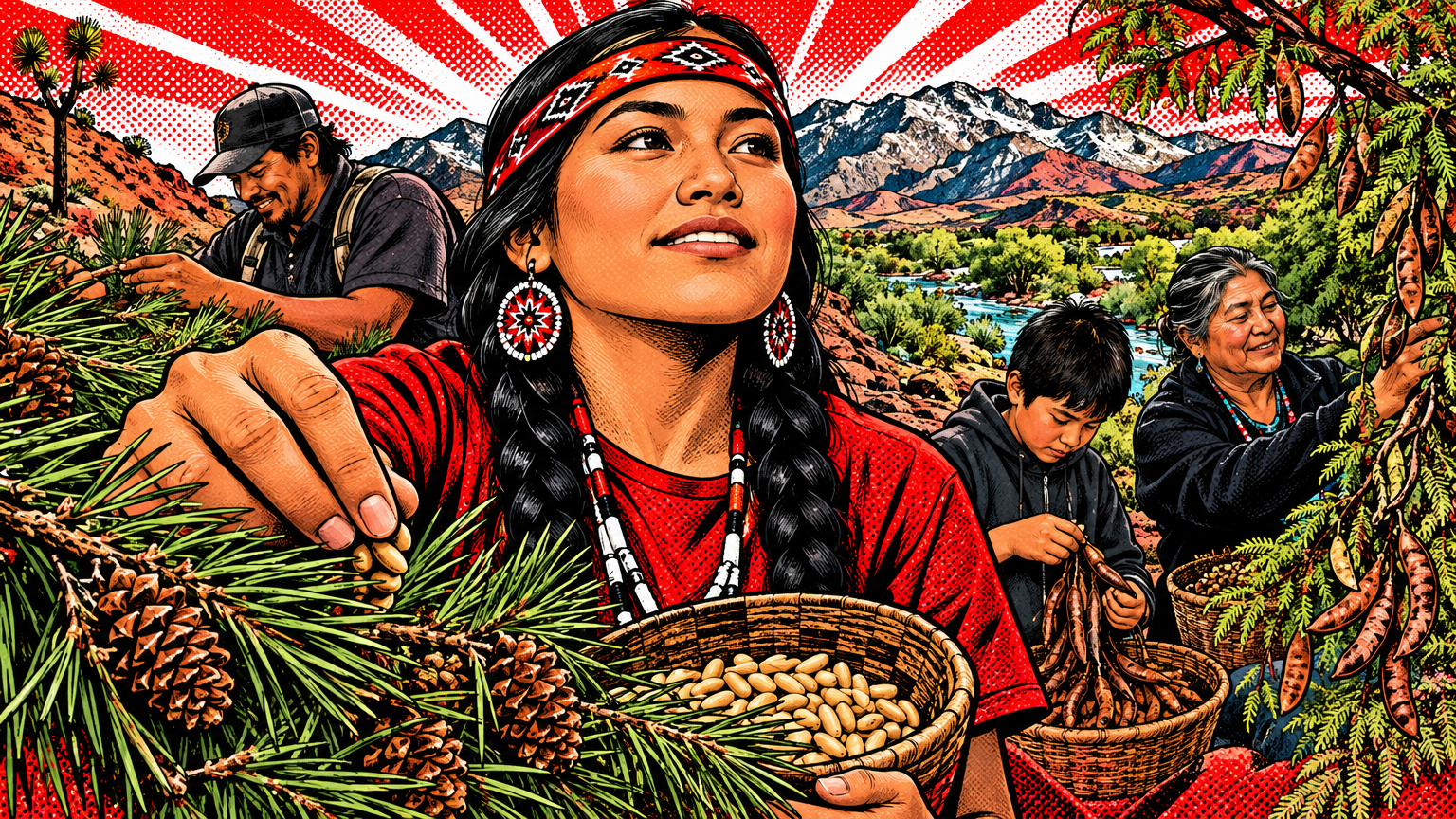
Fall was the season of plenty. A University of Nevada, Las Vegas course history of the Southern Paiute describes families moving to higher ground in fall to collect pinyon nuts.
That timing mattered. Families stored as much food as possible in fall to guard against winter and spring shortages, when stores ran low.
Pine nuts were built for that job. They are rich, portable, and storable, and a good harvest in the mountains could carry a family through the lean months.
The work was knowledge, not luck. Knowing which groves were producing, and when to go, was part of reading a desert that outsiders often called barren.
Mesquite, the Desert Staple
Down in the foothills and along the washes, the fall harvest turned to mesquite pods. The same UNLV history places mesquite gathering in those foothill locations.
Mesquite pods and seeds were ground together into flour. Historic accounts held by the Smithsonian describe that flour used as mush, or made into cakes.
A Bureau of Land Management guide made with tribal partners shows the tool kit plainly. Dried mesquite beans were ground into powder with a mano and metate, and the flour went into drinks and cakes.
Seeds got the same careful treatment. UNLV notes that collected seeds were winnowed and parched, then ground into flour for gruel or a type of bread.
Early ethnographers counted more than one hundred edible wild plants in Southern Paiute use. Mesquite and pine nuts sat at the center of a much wider desert pantry.


Gardens Along the Muddy and Virgin Rivers
Gathering was only half the system. Along the rivers, Southern Paiute families also farmed.
The Utah History Encyclopedia, published by the Utah Historical Society, says the largest Paiute population concentrations were along the Virgin and Muddy rivers. It describes limited irrigation agriculture along the banks of the Virgin, Santa Clara, and Muddy rivers.
The crops were practical and proven in hot country. The encyclopedia lists corn, squash, melons, gourds, and sunflowers, and, later, winter wheat.
That mix is the point. River gardens, spring gardens, mountain pine nuts, and foothill mesquite formed one connected food system, matched to elevation and water.
It was also fragile when newcomers arrived. The Springs Preserve history records that Euro-American livestock fouled springs and trampled crops, pushing Indigenous peoples away from water sources.
Where This Food History Stays Visible Today
Start at the springs themselves. The Springs Preserve history of the Las Vegas Springs states plainly that the area was occupied by Indigenous peoples for thousands of years.
The Preserve protects 180 acres around the original springs. Its official site calls the site the birthplace of Las Vegas and the original source of water for Native Americans living here thousands of years ago.
Go see it in person. Springs Preserve sits at 333 S Valley View Blvd, Las Vegas, NV 89107, with museums, gardens, and trails on the spring ground itself.
A newer garden there carries the story in its name. A 2026 American Alliance of Museums article describes Nuwu Pahsats, the People's Garden, at Springs Preserve, grown in collaboration with a Nuwuvi way of thinking about land, plants, and seasons.
The Tribe keeps its own history in its own voice, too. The Las Vegas Paiute Tribe site highlights protecting ancestral traditions, the Southern Paiute language, and a living connection to the land for future generations.
For more valley context, read our guide to Las Vegas Indigenous roots and Native American history. It pairs well with a walk at the springs.
So this Thanksgiving, look past the menu for a second. The oldest Las Vegas food tradition is not a prix fixe, it is a desert that fed its people for centuries, and still has plenty to teach.