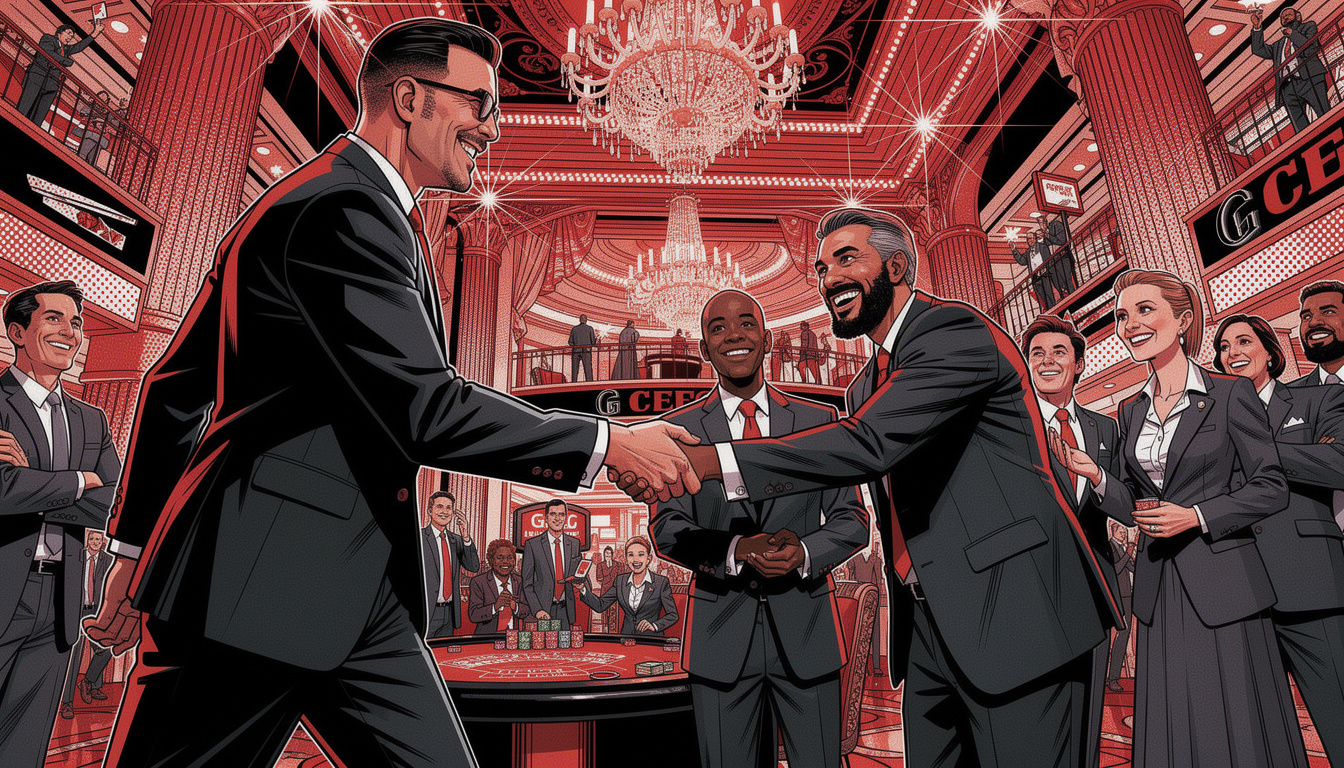
The Strip Just Got Personal Again
Las Vegas has always respected power.
Not quiet power.
Visible power.
The kind that shows up in hotel towers, casino floors, steakhouse booths, sportsbook screens, arena seats, private jets, and backroom deal conversations where the future of the city gets moved without asking the public for permission.
That is why Tilman Fertitta’s planned acquisition of Caesars Entertainment feels bigger than a standard casino transaction.
On paper, this is a $17.6 billion deal, including debt.
In reality, it feels like something deeper.
It feels like the return of the Vegas baron.
For years, the Strip has been run mostly by public companies, boards, earnings calls, analysts, compliance teams, institutional shareholders, and polished corporate language. The city still looked wild from the sidewalk, but behind the curtain, the business got cleaner, colder, and more structured.
Now Fertitta may be stepping into the middle of that machine with private control, a national restaurant empire, Golden Nugget casinos, the Houston Rockets, and a clear appetite for big moves.
That changes the mood.
Because when one man becomes the face of a major Strip power shift, the story stops feeling like a spreadsheet.
It starts feeling like Vegas again.
This Is Not Just Another Casino Buyer
Fertitta is not entering this story as a random billionaire with a checkbook.
He already understands hospitality.
He understands gaming.
He understands restaurants.
He understands sports.
He understands attention.
That combination matters in Las Vegas because the modern Strip is not really about gambling alone anymore. It is about building an ecosystem around the guest.
The guest books a room.
The guest eats dinner.
The guest watches a game.
The guest places a bet.
The guest joins a rewards program.
The guest sees a show.
The guest gets another offer.
The guest comes back.
That is the machine.
Caesars already has that machine at massive scale. Fertitta brings another machine with his own casinos, restaurants, and entertainment assets.
Put those two together, and the deal becomes about more than ownership.
It becomes about control.
Control of the guest before the trip.
Control of the guest during the trip.
Control of the guest after the trip.
That is where this story gets serious.
Vegas Was Built by Characters, Not Committees
Las Vegas has always had a strange relationship with big personalities.
The city says it wants order, but it was built by people who hated ordinary limits.
Operators.
Developers.
Gamblers.
Showmen.
Financiers.
Promoters.
Men and women who understood that Vegas does not run on modesty.
Vegas runs on belief.
Big belief.
Sometimes dangerous belief.
That is why the Fertitta deal feels emotionally different from a normal public-company merger. A public company can own the Strip, but it rarely becomes the Strip’s personality.
A private baron can.
That is the power and the risk.
A public company moves through layers. A private power player can move with speed, ego, instinct, and concentrated authority.
That can produce bold results.
It can also create hard consequences.
In Las Vegas, both are usually true.
The Caesars Name Still Carries Weight
Caesars is not just another casino brand.
It is one of the names people associate with Las Vegas itself.
Caesars Palace is not merely a resort. It is a symbol. It carries decades of Strip mythology, celebrity history, boxing history, luxury branding, and tourist memory.
When people think of old-school Vegas power, Caesars is already in the picture.
That is why this deal feels so large culturally.
Fertitta is not just buying casino assets.
He is buying into a legend.
He is buying one of the names that helped define the global idea of Las Vegas.
That does not mean he will tear it apart.
It means the stakes are higher.
When a company buys a weak brand, the question is how to fix it.
When a private billionaire buys a legendary brand, the question is whether he protects the mythology or bends it into something new.
That is what Las Vegas will be watching.
Public Caesars Was One Thing. Private Caesars Could Be Another.
A public Caesars has to explain itself to Wall Street.
A private Caesars under Fertitta could operate with a different rhythm.
That matters.
Public companies live under public pressure. Quarterly earnings. Analyst questions. Stock movement. Investor reaction. Public filings. Board caution. That environment does not prevent bold moves, but it slows the room down.
Private control can create more room to act.
Faster restaurant decisions.
Faster loyalty integration.
Faster cost reviews.
Faster asset sales.
Faster repositioning of properties.
Faster pressure on competitors.
Faster changes that tourists may not understand until they feel them in prices, packages, rewards, restaurant options, or service patterns.
That is why this deal feels like a power shift, not just a transaction.
The Strip may not look different the day after closing.
But the decision-making center could feel very different behind the scenes.
The Restaurant Empire Is the Quiet Weapon
The restaurant side of Fertitta’s empire may be one of the most important parts of this story.
Most people look at Caesars and think casinos.
Smart operators look at food and beverage.
They look at every dining room, every bar, every steakhouse, every quick-service concept, every convention dinner, every VIP room, every late-night receipt.
On the Strip, restaurants are not side businesses.
They are traffic engines.
They are margin engines.
They are status engines.
They are social-media engines.
Fertitta already owns a large restaurant empire. If Caesars joins that world, the possibilities become obvious.
More internal restaurant concepts.
More rewards tie-ins.
More dining packages.
More control over what guests eat, where they eat, and how that spending connects back to the larger hospitality system.
That could be powerful for Fertitta.
It could be threatening for independent operators trying to hold space inside casino properties.
That is how baron power works.
It does not only own the building.
It decides who gets to eat from the building.
The Real Prize Is the Customer Loop
The real prize is not a hotel tower.
It is not a casino floor.
It is not even Caesars Palace by itself.
The real prize is the customer loop.
A guest can be pulled in through a casino, a restaurant, a sportsbook, a rewards offer, a concert, a convention, a hotel package, or a regional gaming property.
Once inside, the company can move that guest across the system.
Dinner to hotel.
Hotel to casino.
Casino to rewards.
Rewards to sportsbook.
Sportsbook to next trip.
Next trip to another dinner.
That is how modern hospitality empires win.
They do not wait for customers.
They capture them, track them, reward them, segment them, and bring them back.
Caesars Rewards is already a serious weapon. Fertitta’s restaurant and casino ecosystem could make that weapon sharper.
That is not just business growth.
That is power over customer behavior.
The Baron Era Comes With Risk
There is a reason public companies became the standard.
They create structure.
They create disclosure.
They create accountability, even if imperfect.
When a major company goes private, the public can lose visibility.
That matters in Las Vegas because Caesars is not some small private resort. It is a massive employer, a major Strip operator, a tourism force, a vendor hub, a restaurant platform, and a major part of the local economy.
Private control may make Caesars more nimble.
It may also make the city more dependent on decisions made inside a tighter circle.
That is where the baron story gets complicated.
People love a strong operator when the results are exciting.
They worry when that same operator controls too much.
That tension is built into this deal.
Debt Is the Shadow Behind the Power
Power is one side of the deal.
Debt is the other.
The reported deal value includes about $11.9 billion in assumed debt. That matters because debt changes behavior.
Debt creates urgency.
Debt wants cash flow.
Debt wants efficiency.
Debt wants assets to perform.
That can force discipline.
It can also create pressure.
A debt-heavy private Caesars may look for more ways to produce revenue across rooms, dining, gaming, digital betting, events, and rewards. It may also review costs, vendor relationships, property strategy, and underperforming assets.
That is where workers, vendors, tourists, and local businesses should pay attention.
The question is not whether Fertitta understands the business.
He does.
The question is how hard the debt will push the business after the deal closes.
In Las Vegas, debt is never just a number.
It becomes pricing.
It becomes staffing.
It becomes asset sales.
It becomes vendor pressure.
It becomes strategy.
The Strip Could Get More Competitive
A private Fertitta-controlled Caesars could make the Strip sharper.
MGM would have to watch.
Wynn would have to watch.
Venetian would have to watch.
Fontainebleau would have to watch.
Every operator would want to know whether Caesars starts moving faster, pricing differently, upgrading experiences, changing restaurant strategy, or pulling customers deeper into a broader rewards system.
That could benefit visitors in some ways.
Competition can create better packages, stronger offers, sharper entertainment, and more polished service.
But competition among giants can also create a city built mainly for higher-spending customers.
That is where Las Vegas has to be honest.
A stronger Caesars may be good for the Strip.
But the Strip may still become more expensive for ordinary visitors.
Both things can happen at the same time.
Locals Should Not Treat This Like Distant Wall Street Drama
Locals should care about this deal.
Not because everyone gambles at Caesars.
Not because everyone stays on the Strip.
But because Caesars is part of the economic plumbing of Las Vegas.
Jobs.
Vendor contracts.
Restaurants.
Entertainment.
Tourism flow.
Convention business.
Local media attention.
Neighborhood spillover.
When a company that large changes control, the effects can move far outside the resort corridor.
A new owner may change dining strategy.
That can affect local restaurant operators.
A new owner may centralize purchasing.
That can affect local vendors.
A new owner may shift pricing.
That can affect where tourists spend.
A new owner may sell assets.
That can reshape competition.
So yes, this is a billionaire deal.
But it is also a local business story.
The Local Opportunity Is Hiding in Plain Sight
If the Strip becomes more corporate, more integrated, and more expensive, local businesses get a new opening.
Not an easy opening.
A real opening.
Tourists still want something that feels human.
They want the spot locals talk about.
They want the restaurant that does not feel copied from a national boardroom.
They want the bar with personality.
They want the neighborhood story.
They want the place that feels like Vegas, not just a casino brand.
That is where small businesses can win.
The bigger the giants get, the more valuable authenticity becomes.
If Fertitta’s Caesars becomes a stronger machine, local businesses need to become stronger brands.
They need visibility.
They need better offers.
They need sharper storytelling.
They need to be easy to find.
They need to make visitors feel like leaving the Strip is worth it.
That is the local counterpunch.
Why This Feels Bigger Than Business
This deal feels bigger than business because it touches the identity of Las Vegas.
Vegas is not just a market.
It is a mythology.
Every major ownership shift changes the story the city tells about itself.
Is Vegas becoming more corporate?
More private?
More expensive?
More powerful?
More centralized?
More polished?
Less accessible?
More efficient?
Less weird?
That is the real conversation under the financial terms.
Fertitta’s planned Caesars acquisition forces Las Vegas to look at what kind of city it is becoming.
A city of many competing voices.
Or a city where fewer giants control more of the experience.
A city where locals benefit from tourism.
Or a city where locals mainly serve a machine they do not control.
A city where big personalities build big things.
Or a city where big personalities own too much.
That is why the baron idea matters.
It is not nostalgia.
It is a warning and a promise at the same time.
The New Baron at the Gate
If the deal closes, Tilman Fertitta will not just own more casino assets.
He will become one of the most important private power figures in Las Vegas.
That does not automatically make him good or bad for the city.
It makes him impossible to ignore.
He could make Caesars sharper.
He could make the Strip more competitive.
He could connect restaurants, casinos, rewards, sports, and digital gaming into a powerful national machine.
He could also increase pressure on workers, vendors, independent operators, and middle-class visitors if the deal needs more cash than the old structure produced.
That is the tension.
Las Vegas loves bold moves.
But bold moves always have a bill.
The Fertitta-Caesars deal may bring back the Vegas baron.
Now the city has to find out whether that baron builds a stronger Strip or a tighter one.