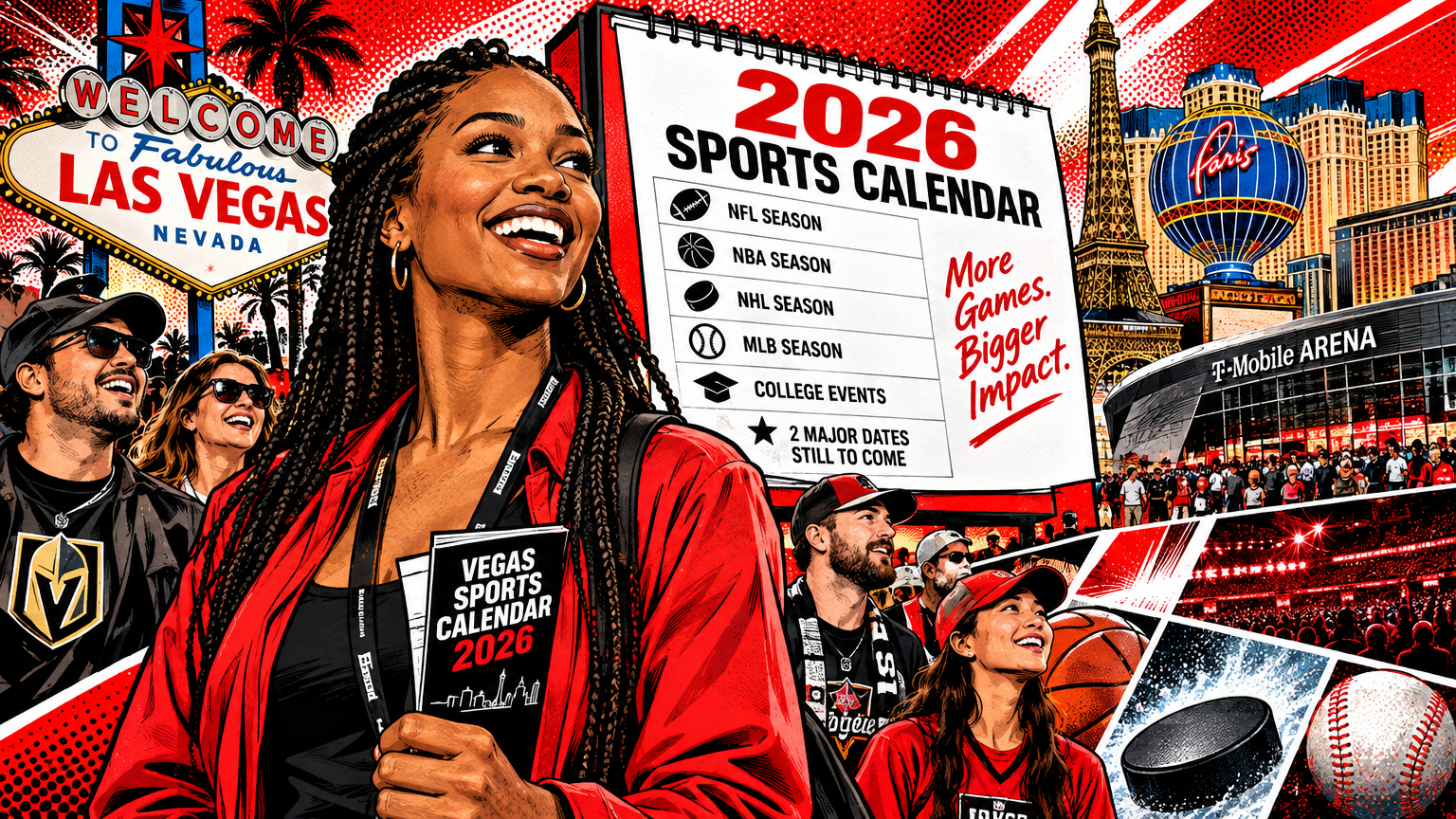
Las Vegas’ 2026 sports calendar is already bigger than two marquee weekends. WrestleMania 42 and the NBA Summer League have come and gone, the Raiders and Vegas Golden Knights are into their seasons, and two major events remain ahead: the Formula 1 Las Vegas Grand Prix, Nov. 19-21, and the Las Vegas Bowl on Dec. 31.
That’s the clearest read on the city’s big-game economy: not one championship weekend carrying the whole year, but a mix of stadium spectacles, recurring events and home-team schedules. The calendar offers plenty of chances to draw fans. It does not, on its own, reveal how much visitors spend or how broadly businesses benefit. That score takes more than a date list.
What remains on the 2026 calendar?
Formula 1 takes the Strip in November
The Formula 1 Las Vegas Grand Prix’s published schedule runs from Thursday, Nov. 19, through Saturday, Nov. 21. The race is set for Saturday night. Practice and qualifying are scheduled for Thursday and Friday, with F1 Academy sessions also listed across the weekend.
This is not a one-night stadium booking. The Grand Prix is a multi-day event built around a street circuit in the resort corridor. That means its footprint and operating demands differ from an event centered on Allegiant Stadium. The calendar establishes the dates and format; it does not settle what the weekend’s economic effect will be.
The Las Vegas Bowl closes the year
College football has its own late-year stadium date. The Las Vegas Bowl is scheduled for Dec. 31 at Allegiant Stadium. Putting the bowl after the Grand Prix gives sports fans another major event to plan around before the year ends. It also makes the calendar’s final stretch more than a single race weekend.
The University of Nevada, Las Vegas has additional football dates at Allegiant Stadium. Its published 2026 schedule lists games against Northern Illinois on Oct. 31 and Wyoming on Nov. 7. Those are useful reminders that the city’s sports business is not only about visiting events. College games and local team schedules contribute their own dates and audiences.
The year already had more than one big weekend
WrestleMania and Summer League are in the books
WrestleMania 42 took place at Allegiant Stadium on April 18 and 19. The two-night event gave the city a spring stadium spectacle, distinct from the November street-racing weekend. Both dates are now part of the year’s record, not future travel plans.
The NBA’s 2026 Summer League is another major fixture already held in Las Vegas. It brings a different kind of sports audience and calendar rhythm from a single championship event. The broader point is simple: the city’s sports lineup includes recurring events as well as one-off headliners.
Home seasons fill out the slate
The Raiders’ 2026 schedule is underway at Allegiant Stadium, and the team’s official schedule shows home games alongside its road dates. The Vegas Golden Knights’ 2026-27 season opened at T-Mobile Arena on Sept. 29. Meanwhile, the Las Vegas Aces’ 2026 schedule adds the WNBA team’s games to the year’s sports picture.
These seasons are not interchangeable with a major event weekend. They spread games across a longer stretch and serve both local fans and visitors who build trips around a particular matchup. The published schedules provide actual dates, but the calendar alone cannot tell us how many people travel for each game or what they spend while they are here.

A busy calendar is an opportunity, not an economic result
Las Vegas has an unusually varied sports lineup: professional teams, college football, basketball’s summer showcase, a two-night wrestling event, a street race and a bowl game. Each format gives the city a different kind of sports date to work with. Together, they make a stronger case for a year-round sports identity than a calendar focused on one annual tentpole.
But a packed schedule is not proof of a particular financial payoff. Attendance, hotel demand, visitor spending and the effects on businesses and people working near event sites are separate questions. The dates show when the city has a chance to draw fans. They do not answer how much economic activity those fans generate, or how evenly it is shared.
For fans, the next two dates to circle are Nov. 19-21 for the Grand Prix and Dec. 31 for the Las Vegas Bowl. For the city, the test is how those major events fit alongside team seasons and recurring fixtures. Vegas has more than a couple of big plays on its 2026 schedule. The final economic score is a different stat line.