Most cars in this series were built to be sold. This one was built to settle a score.
Ford tried to buy Ferrari. Enzo Ferrari walked away from the deal in 1963, and Henry Ford II answered the way rich men with factories answer things.
He built a car to beat Ferrari at the one race Ferrari owned. That car was the Ford GT40, and it won the 24 Hours of Le Mans four years in a row, from 1966 to 1969.
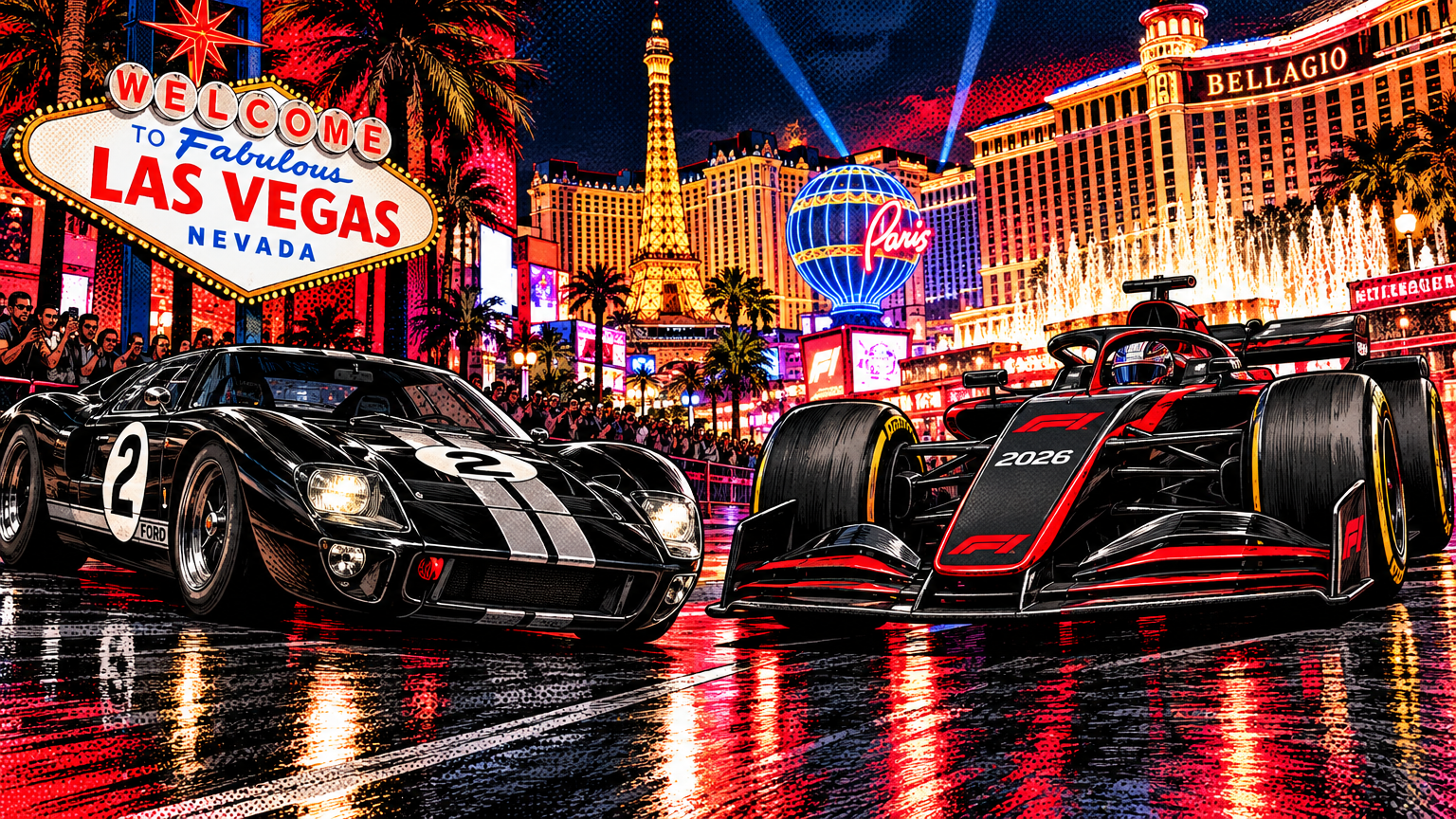
What happens if the Ford GT40 picks a fight with a Formula 1 car?
What happens is a very different kind of fight. The GT40 is not a road car with racing stickers, and it is not a supercar that went racing on weekends.
It is a purpose built endurance racer from the 1960s. That makes it the closest relative the Formula 1 car has faced in this whole series, and it still is not close enough.
Let us score it properly. Ford figures and the historical record first, claims labelled as claims, and no invented numbers anywhere.
First, Which GT40 Are We Talking About?
There is no single GT40, and pretending there is would cheat you. The name covers a family of racers built from 1964 to 1969, and the engines, gearboxes, and weights changed a lot along the way.
So we pin one car, the way this series always pins one car. Our challenger is the 1966 Ford GT40 Mk II, the big block car that finished first, second, and third at Le Mans in 1966.
The family around it, kept separate:
- The Mk II, our challenger: the 7.0 litre car of 1966, built around the Ford 427 V8. This is the scored car.
- The Mk I: the original car, first with a 4.7 litre V8, later with a 5.0 litre V8. In Gulf colours it won Le Mans in 1968 and 1969, after the big prototypes were ruled out.
- The Mk III: the road going version, built in tiny numbers with a detuned 289 V8 rated at 306 hp. A street car in a racer suit, not the challenger.
- The Mk IV: the all American redesign of 1967, same 427 engine in a new chassis and body. It won Le Mans in 1967 with Dan Gurney and A. J. Foyt.
The name itself is a lesson. GT stood for grand touring, and 40 was the height of the car in inches at the top of the windscreen, the minimum the rules allowed.
Picture that for a second. A modern Formula 1 car is low, but a GT40 driver sat in a car about as tall as a kitchen counter, with a huge V8 sitting inches behind his head.
Tall drivers paid for it. Dan Gurney was too tall to fit comfortably, so the team added a bump in the roof over his seat, and fans still call it the Gurney bubble.
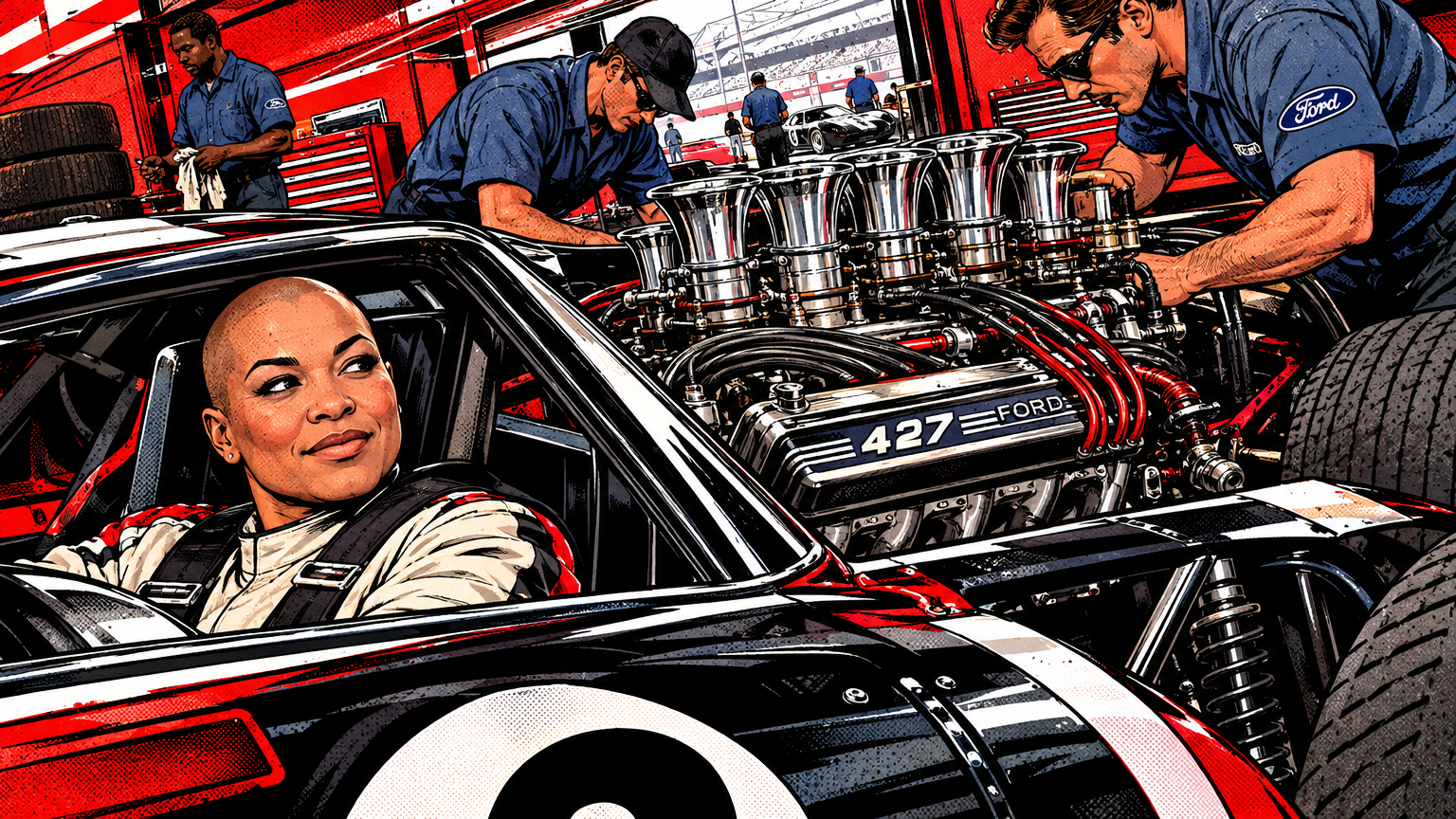
The scored engine is the heart of the story. It is a Ford FE series 427 cubic inch V8, 6,997 cc, a big block taken from the Galaxie line and proven in NASCAR racing.
In Mk II tune it made 485 bhp at 6,200 rpm and 475 lb-ft of torque, fed by a single Holley four barrel carburetor, with dry sump lubrication and aluminium heads to save weight. Those figures are the widely published specification for the winning car, chassis P/1046 included.
Here is the detail most people miss. Ford did not tune that engine to the edge, because the edge is where engines die at hour 19 of a 24 hour race.
A big, understressed American V8 could run hard all day and all night. That was the whole bet, and it is why the torque matters as much as the power: 475 lb-ft means the car pulled hard out of slow corners without needing to be revved to pieces.
The rest of the scored specification:
- Gearbox: a four speed manual built by Kar Kraft, Ford's own performance shop, made stronger because the earlier gearboxes had broken under the big engine.
- Layout: mid engine, rear wheel drive, with the engine behind the driver and ahead of the rear axle.
- Size: about 160 inches long, 70 inches wide, and 40.5 inches tall, on a 95 inch wheelbase.
- Weight: published figures vary by car and source, from about 2,200 lb to about 2,450 lb for the Mk II. We use about 2,450 lb as the working figure and say plainly that period weights wander.
- Top speed: about 205 mph in period trim, with a Mk II timed at 203 mph on the Mulsanne Straight at Le Mans in 1966.
- Total built: 105 GT40s in all forms from 1964 to 1969, per the commonly published production count.
One honest note before we score anything. Ford never published a road test style 0 to 60 mph time for the Mk II, because nobody road tested a Le Mans prototype the way magazines test a road car.
So this article prints no 0 to 60 figure for the GT40. If you see a precise one online, ask who timed it, where, and in which car, because those three answers change the number.
That honesty rule will matter in Round One. It also matters when you shop for any classic racer: a number with no test behind it is a story, not a fact.
The racing record, though, needs no stories. It is written in results, and the official 24 Hours of Le Mans history of the GT40 years tells it well.
- 1966, Mk II: first, second, and third at Le Mans. Bruce McLaren and Chris Amon took the win in the number 2 car, after Ken Miles and Denny Hulme were asked to slow for a staged photo finish and lost on a distance ruling.
- 1967, Mk IV: Gurney and Foyt won, in the only Le Mans overall win where the drivers, team, chassis, engine, and tyres were all American.
- 1968, Mk I: Pedro Rodriguez and Lucien Bianchi won in the Gulf car, chassis P/1075, after the rules pushed the 7.0 litre prototypes out.
- 1969, Mk I again: the same chassis, P/1075, won again with Jacky Ickx and Jackie Oliver, beating a Porsche 908 by seconds after 24 hours.
Read that list again, because it teaches you something real. The same actual car, not just the same model, won Le Mans twice, in 1968 and 1969.
Ferrari had won six straight Le Mans races from 1960 to 1965. Ford then won four straight, and the GT40 name did all four.
Meet the 2026 Formula 1 Car
Now meet the other corner. The 2026 Formula 1 car is also a purpose built racer, but it comes from a world with wind tunnels, simulators, and carbon fibre everything.
Its power unit is a 1.6 litre turbocharged V6 hybrid. The petrol engine is limited to about 400 kW, the MGU-K electric motor can add up to 350 kW, and Formula 1 describes the total package as more than 1,000 hp.
Minimum weight is 768 kg including the driver, which is about 1,693 lb. That is hundreds of pounds lighter than the GT40, with more than double the power.
It is rear wheel drive, built from carbon, and it carries active aerodynamics at the front and the rear. Its tyres are racing slicks made to work for a race stint, not for 24 hours.
Do the simple maths with us, because this is the number that decides almost every round. The GT40 Mk II makes about 485 hp for roughly 1,111 kg, which is about 437 hp per tonne.
The Formula 1 car makes more than 1,000 hp for 768 kg, which is more than 1,300 hp per tonne. Three times the power for every kilo it carries.
If you want the full picture of the weekend this fight is staged around, start with our Las Vegas Grand Prix hub. Then come back for the scoring.
Ford GT40 vs. F1: The Numbers
| Category | 1966 Ford GT40 Mk II | 2026 Formula 1 Car |
|---|---|---|
| Engine | 7.0L naturally aspirated Ford 427 V8 | 1.6L turbo V6 hybrid |
| Power | 485 bhp at 6,200 rpm | More than 1,000 hp (F1 description) |
| Torque | 475 lb-ft | No single published figure |
| Gearbox | 4 speed manual (Kar Kraft) | Sequential racing gearbox |
| Drive | Rear wheel drive | Rear wheel drive |
| Weight | About 2,450 lb (figures vary by car) | 768 kg minimum, about 1,693 lb, with driver |
| Power to weight | About 437 hp per tonne | More than 1,300 hp per tonne |
| 0 to 60 mph | No factory figure published | No universal official figure published |
| Top speed | About 205 mph; 203 mph timed on the Mulsanne in 1966 | 353.9 km/h trap, Gasly, 2026 Chinese GP qualifying |
| Height | 40.5 inches, the 40 in the name | Low, but built to aero rules, not a 40 inch rule |
| Signature win | Le Mans 1966, first, second, and third | Every Grand Prix on the calendar |
| Vegas valet factor | 10 out of 10, if the valet can fit in it | 0, it has no valet mode and no patience |
Two lines in that table deserve your attention. First, the GT40 is the rare challenger here that was never a road car at heart, so its numbers are racing numbers, not brochure numbers.
Second, it still loses the power to weight line by a factor of three. Sixty years of racing progress is a brutal thing to stand next to.
Round One: Acceleration
Round One is where we refuse to cheat. There is no factory 0 to 60 mph time for the Mk II, and this series does not invent one.
What we can compare honestly is what makes a car accelerate. Power to weight, traction, gearing, and how fast the driver can change gear.
The GT40 has strong torque and a simple job: a big V8, four gears, and a driver working a clutch and a lever. It was quick for 1966, quick enough to run with the best prototypes in the world.
The Formula 1 car has three times the power per tonne, a sequential gearbox that shifts in a blink, launch systems tuned by engineers, and rear tyres built for grip. It also has electric torque from the MGU-K filling gaps the petrol engine leaves.
Think of it this way. The GT40 accelerates like a very fast car. The Formula 1 car accelerates like it was fired.
Winner, Round One: Formula 1. Not because the GT40 is slow, but because no honest reading of power, weight, and gear change speed puts a 1966 car ahead here.
Round Two: Top Speed
Round Two is the GT40's best round, because top speed was its party trick. Le Mans in the 1960s had the long Mulsanne Straight, and the Mk II was built to eat it.
The period evidence is strong. A Mk II was timed at 203 mph on that straight in 1966, and about 205 mph is the commonly published maximum for the car.
Now the Formula 1 evidence, labelled by year the way this series always labels it. Pierre Gasly recorded 353.9 km/h, about 220 mph, in qualifying at the 2026 Chinese Grand Prix.
Go back a little and it gets worse for the Ford. Yuki Tsunoda hit 358.3 km/h, 222.6 mph, in 2025, and Alex Albon hit 368.9 km/h, 229.2 mph, in 2024, the highest trap figure through the first three Las Vegas editions and the series benchmark.
Fairness note, printed every time: a speed trap is not a top speed attempt. A Formula 1 car is geared and trimmed for a circuit, so its trap speed is what it did on the day, not the most it could ever do.
That note helps the GT40 in theory. In practice, even the lowest Formula 1 trap figure above sits about 15 mph clear of the Ford's best, and the highest sits about 24 mph clear.
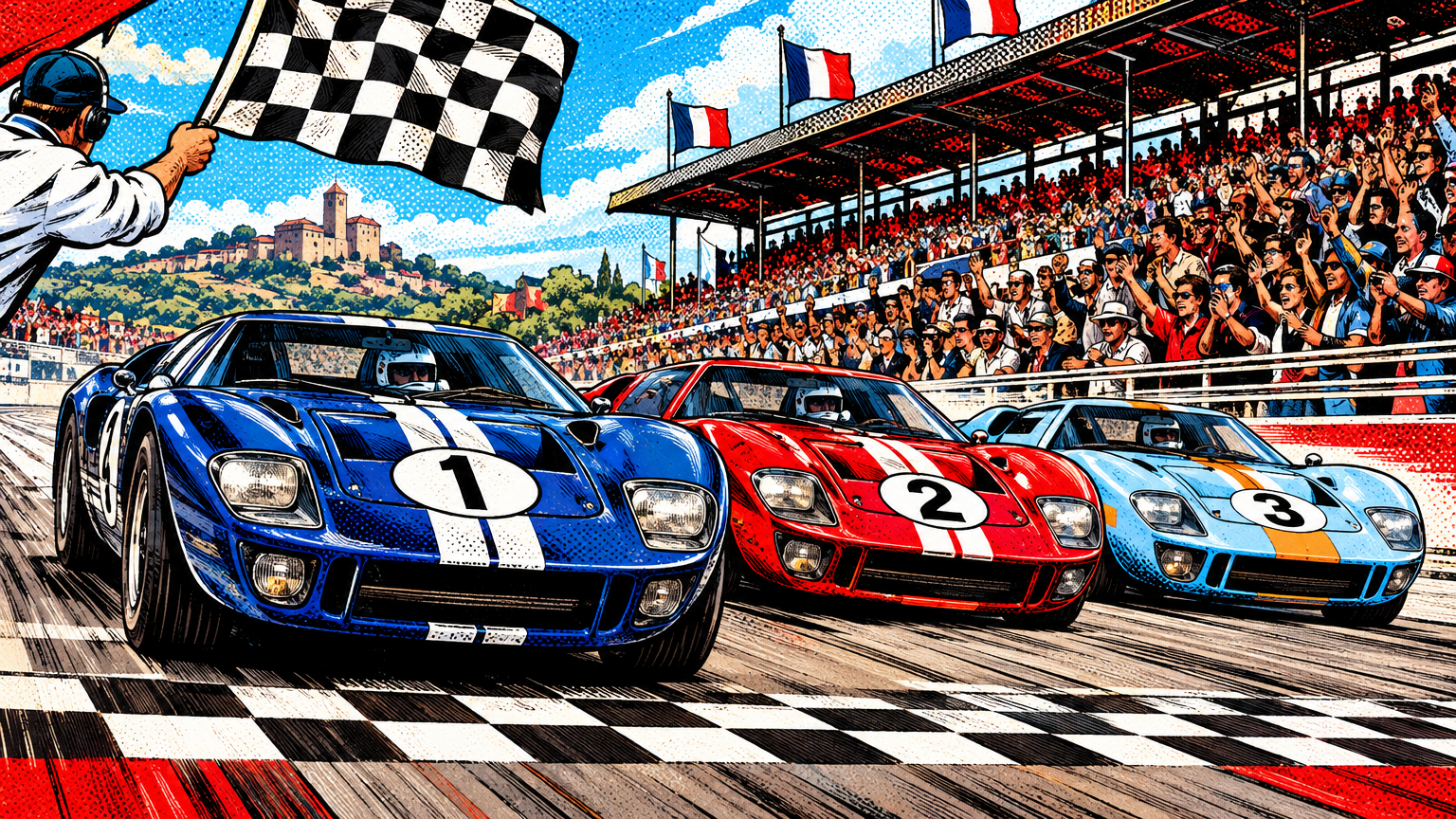
Winner, Round Two: Formula 1. The GT40 was the fastest thing at Le Mans in 1966, and it still gives this round a real fight, which almost no road car in this series can say.


Round Three: Now Add a Corner
Add a corner and the sixty year gap stops being polite. Cornering is where modern racing cars have changed the most.
The GT40 cornered on narrow tyres by modern standards, with no downforce package worth the name and suspension tuned for a long race on public roads in France. It was balanced, tough, and fast, and its drivers were heroes for holding it together at speed.
The Formula 1 car makes downforce with its floor, its wings, and its active aero. Downforce is invisible weight: it pushes the car into the road without adding mass, so the tyres can grip far beyond what the car's own weight allows.
That is the insight worth taking home. When a modern racer corners at speeds that look impossible, it is not magic and it is not just brave driving.
It is air doing the pushing. The GT40 had to make do with its own weight, about a tonne of it, and that is the whole gap in one sentence.
Use it the next time you watch any racing. Ask how much downforce the car makes, and you will understand its cornering better than any top speed figure can tell you.
Winner, Round Three: Formula 1. By the largest margin of the day.
Round Four: Braking
Braking is a heat problem dressed up as a stopping problem. Every stop turns speed into heat, and the car that sheds heat best can brake late, again and again.
The GT40 raced with disc brakes that were strong for their era, and brake wear still shaped its races. At Le Mans in 1966 the leading Ford lost time when the wrong brake rotors were fitted at a stop, a detail that helped change who won.
That story teaches the real lesson. In endurance racing, brakes are a system: discs, pads, cooling, spare parts, and the crew changing them right at 3 in the morning.
The Formula 1 car brakes with carbon discs, huge cooling, and a hybrid system that also slows the rear axle while harvesting energy. It brakes from over 200 mph for slow corners, lap after lap, at forces road car drivers never feel.
It also gets help the Ford never had. Energy recovery under braking puts charge back in the battery, so some of that speed turns into future acceleration instead of wasted heat.
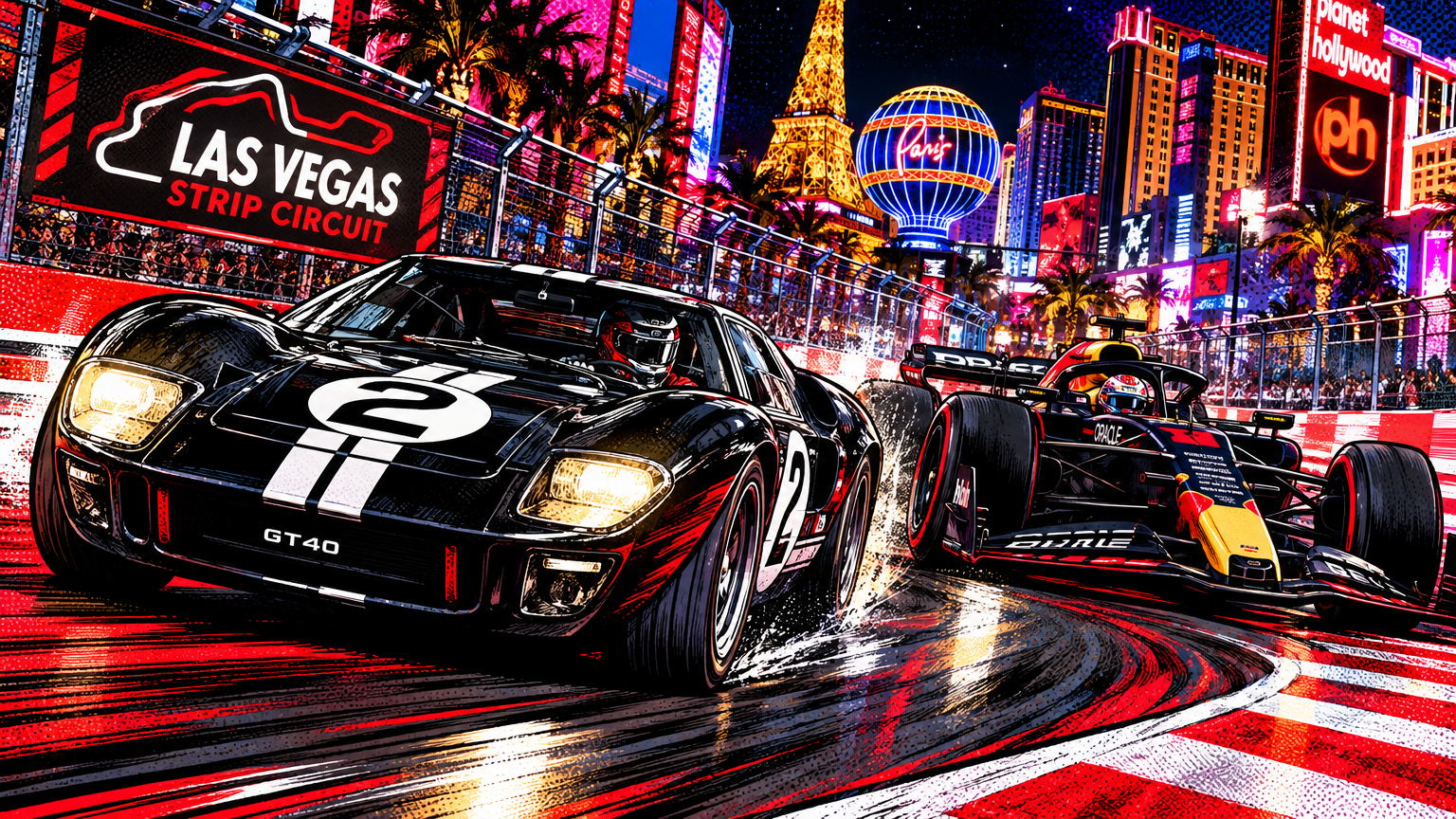
Winner, Round Four: Formula 1. The GT40's brakes were a Le Mans grade system for 1966, and they still belong to 1966.
So, Does the GT40 Win Anything?
Yes, and the list is not short. It just lives outside our four rounds.
- It wins the grudge. No other car in this series exists because a deal fell apart. The GT40 is what a corporate insult looks like when engineers answer it.
- It wins endurance. Our Formula 1 car races for about two hours. The GT40 was built to race for 24, through night, rain, and driver changes, and it won doing it four years straight.
- It wins repeat business. Chassis P/1075 won Le Mans in 1968 and again in 1969. Same car, two wins, a feat only a tiny handful of cars in history can claim.
- It wins simplicity you can use. A big engine working well inside its limits beat smaller, more stressed engines. That lesson still applies when you buy anything with a motor: headroom is reliability.
- It wins the room. Park a GT40 anywhere in Las Vegas and the crowd forms before the door opens, assuming the driver can get out of a 40 inch tall car with any dignity left.
It also wins a place in this series' family tree. Our Formula 1 vs. Ford F-150 Raptor R piece celebrated a modern Ford built to be tough on purpose, and the GT40 is where that Ford habit proved itself to the whole world.
And yesterday's challenger makes the opposite point nicely. If you missed it, read Formula 1 vs. Acura NSX Type S, where the smartest hybrid supercar took the same beating with computers instead of carburetors.
What Would Happen on the Las Vegas Strip Circuit?
Bring both cars to Las Vegas and the picture gets clearer, and a little cruel. The Las Vegas Strip Circuit is 6.201 km long, about 3.85 miles, with 17 turns and 50 laps in the Grand Prix.
Its signature is the long straight along the Strip, roughly 2 km of full throttle past the casinos. That straight is the one place the GT40 would feel at home, because it was built for exactly that kind of road.
For a few seconds, the big V8 would sing, the car would settle at speed, and 1966 would feel very close. Then the braking zone would arrive.
Seventeen turns means seventeen braking zones, seventeen traction zones, and endless chances for downforce to pay rent. The Formula 1 car would brake later, turn faster, and fire out with electric help, lap after lap.
The GT40 would also face a problem it never met at Le Mans. A tight street circuit rewards a nimble car, and a 1966 prototype on period tyres would be working hard just to keep its brakes and tyres alive for 50 laps.
None of this is a recorded race, and we invent no lap times for either car. It is an informed comparison, built from the verified circuit facts and the verified car facts above.
The honest summary is simple. On the Strip straight, the GT40 tells its story. Everywhere else, the Formula 1 car writes the lap.
The Final Call
Score it up. Round One to Formula 1, Round Two to Formula 1, Round Three to Formula 1, and Round Four to Formula 1.
That is a clean sweep, 4 to 0, and on paper it looks harsh. It should not feel harsh, because the GT40 is not being judged against its own era.
Against its own era, it was perfect. It beat Ferrari at Le Mans, then beat everyone else for three more years, with a NASCAR V8, a steel will, and a roof so low that tall drivers needed a bubble in it.
Against a 2026 Formula 1 car, no 1960s machine survives the maths. Three times the power per tonne, active aero, carbon brakes, and hybrid torque is not a gap, it is a different sport wearing similar clothes.
The Final Call: Formula 1 wins the fight.
Formula 1 may win the fight. But the GT40 still owns the best revenge story in racing, four Le Mans wins in a row, and a silhouette so low and so right that every supercar since has been chasing it.
There are plenty more cars waiting to pick a fight with Formula 1. Next up: Formula 1 vs. Ferrari 288 GTO: the turbo Ferrari built for a racing class that vanished, now facing the fastest racing machine on Earth.