Most modern supercars try to make speed feel easy. Computers shuffle the power, paddles fire the shifts, and the car quietly fixes your mistakes before you notice them.
The Porsche Carrera GT does the opposite. It hands you a Le Mans V10, a manual gearbox, a ceramic clutch with the manners of a light switch, and then wishes you luck.
It is widely called the last great analog supercar. It is also, on the right day with the right driver, still seriously fast.
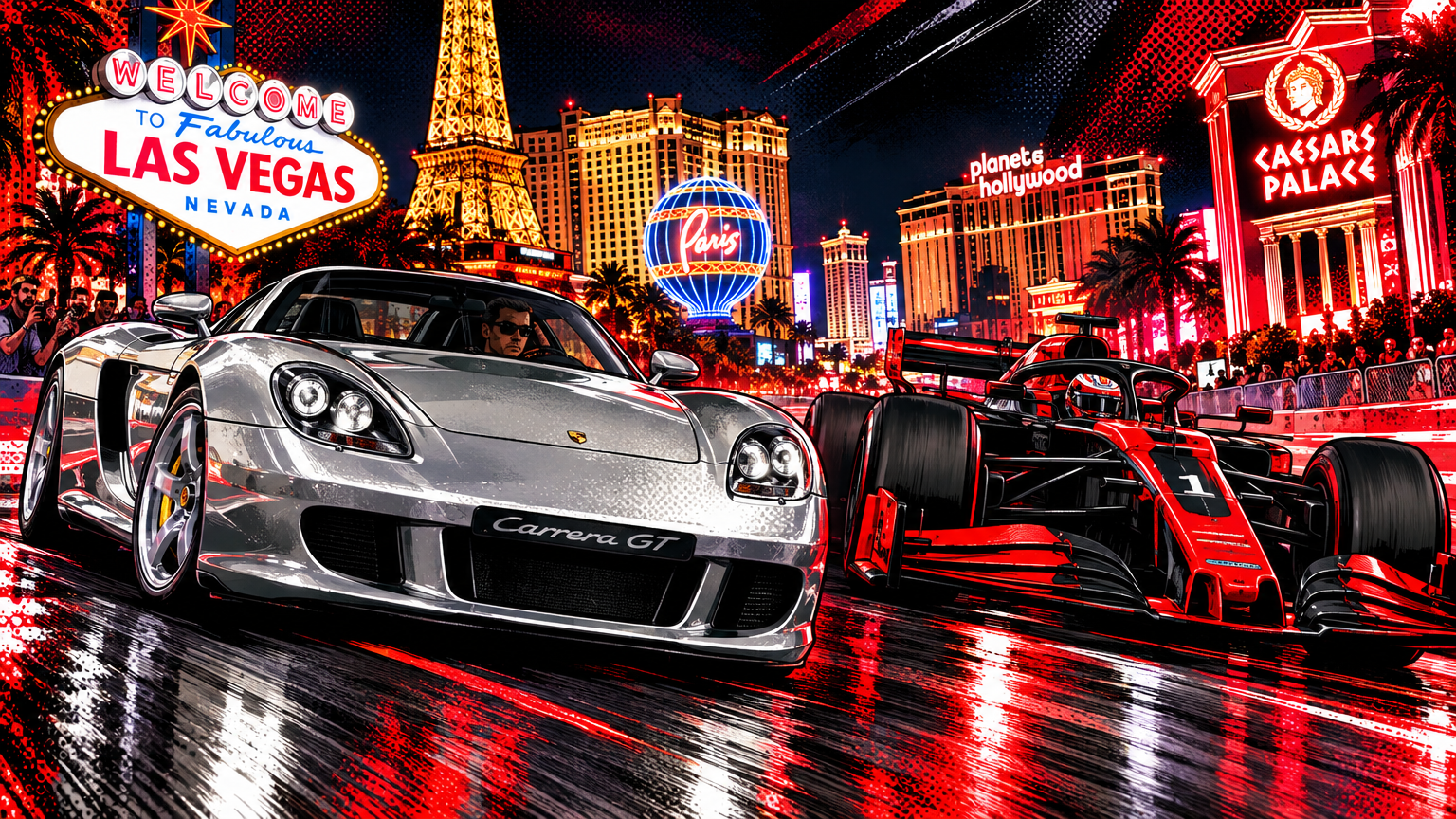
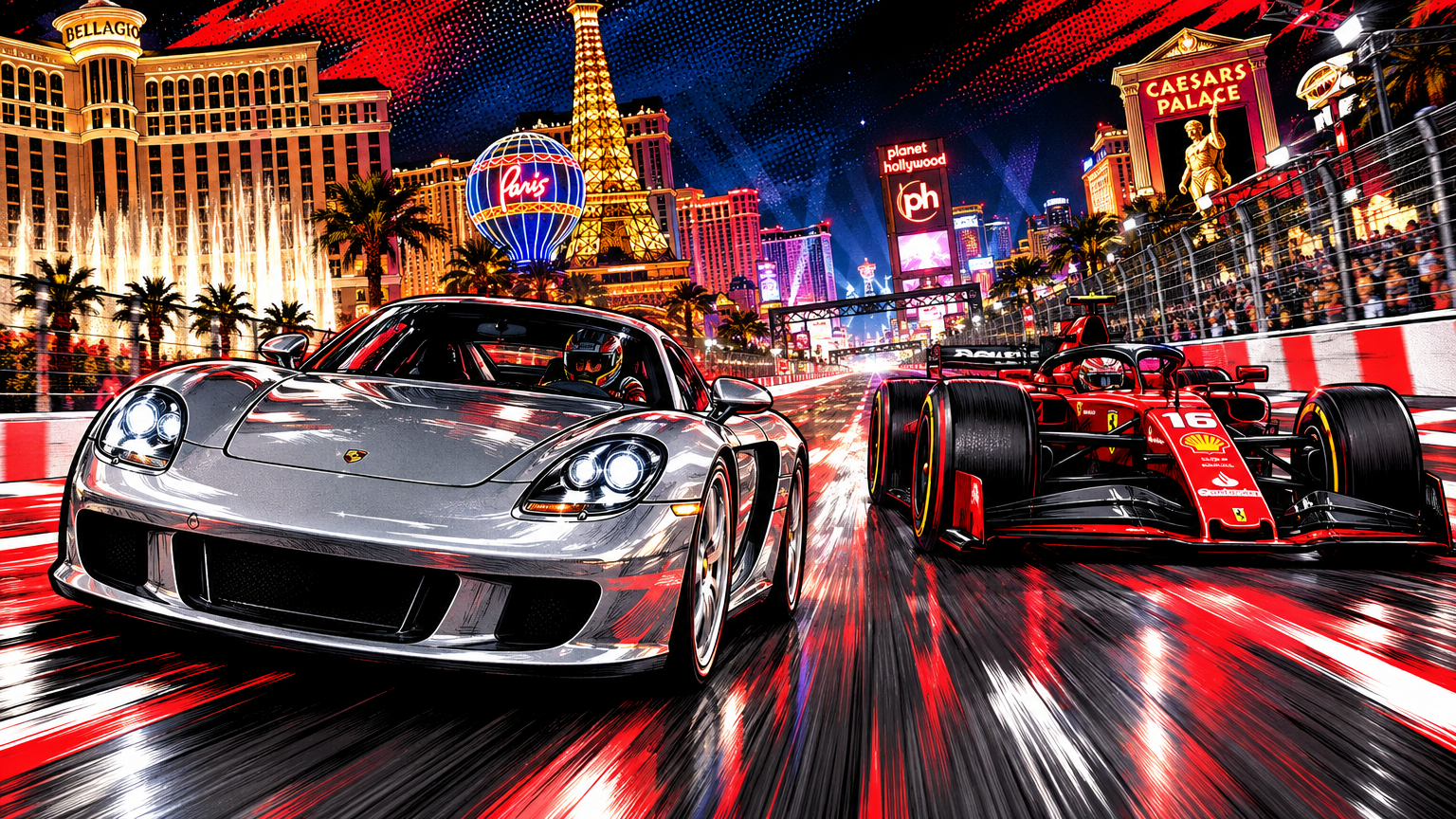
What happens if the Porsche Carrera GT picks a fight with a Formula 1 car?
What happens is the purest challenger this series has hosted meets the most computerized racing machine on Earth. One car wants your full attention. The other one demands it at 220 mph.
Let us score it properly. Porsche figures first, independent tests labelled as tests, and no invented numbers anywhere.
First, Which Carrera GT Are We Talking About?
There is only one production Carrera GT, and that simplifies things nicely. This is the standard road car built at Leipzig from 2003 to 2006.
The family around it, kept separate the way this series always keeps it:
- The production Carrera GT, our challenger: the 5.7 litre V10 road car sold to the public. This is the scored car.
- The 2000 Paris concept: the show car with the earlier 5.5 litre version of the engine. It started the story, but it is not the challenger.
- The stillborn Le Mans prototype programme: the racing project the V10 was created for, cancelled before it raced. History, not a scored car.
- The secret Formula 1 engine ancestor: Porsche built a V10 for a Formula 1 project in the early 1990s that never raced either. The bloodline is real, and it makes this matchup almost poetic.
Yes, you read that right. The Carrera GT exists because two racing programmes died, and Porsche refused to waste a great engine.
The full official history is laid out in this Porsche Newsroom history of the Carrera GT, and the scored figures below come from Porsche first.
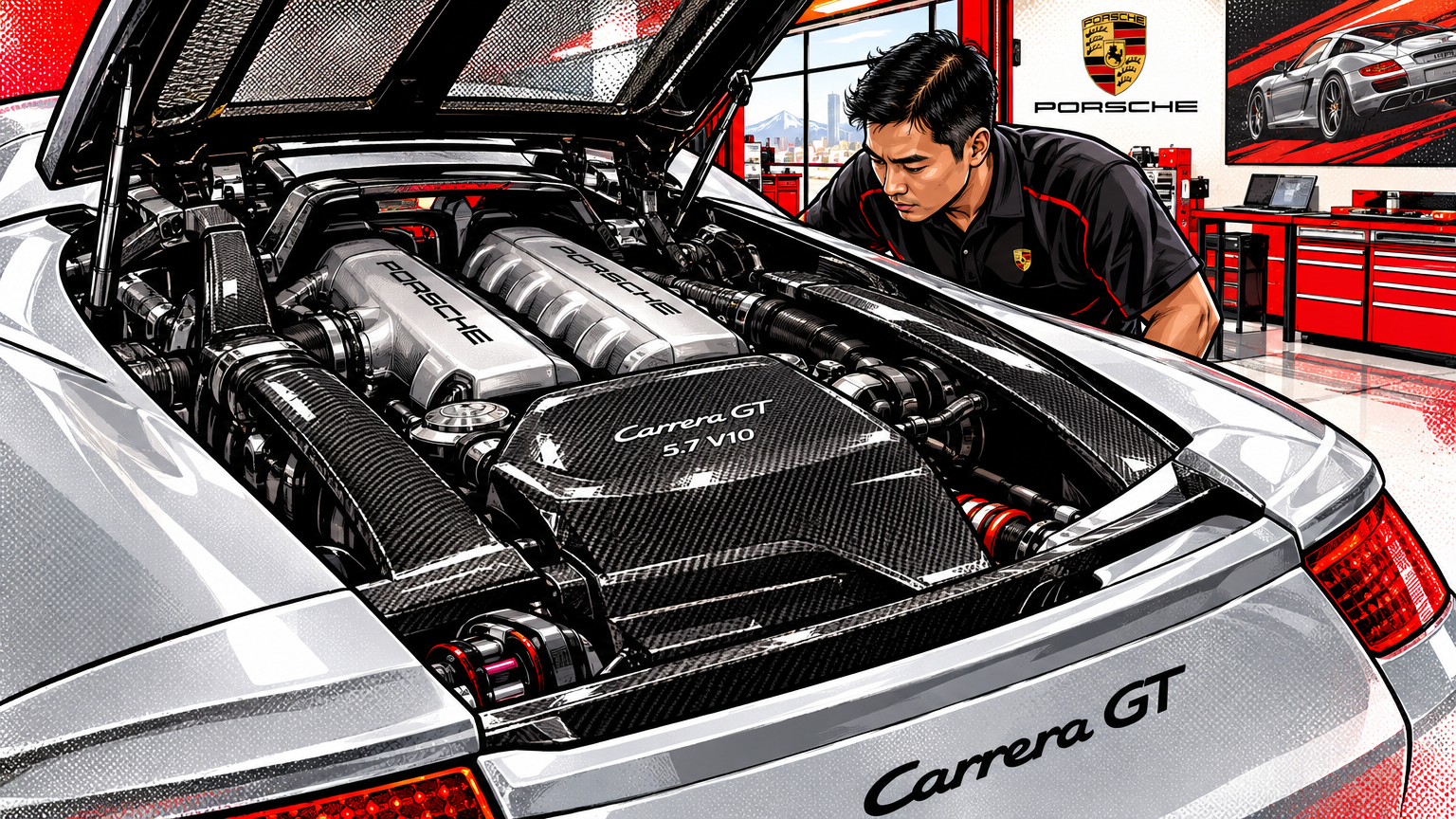
The engine is a 5,733 cc naturally aspirated V10 with a 68 degree cylinder angle, dry sump lubrication, titanium connecting rods, and a 12.0 to 1 compression ratio.
No turbochargers. No hybrid help. Just displacement, revs, and noise.
Porsche rates it at 450 kW, which is 612 PS, at 8,000 rpm. American SAE rating is 605 hp, and both numbers describe the same engine, so do not let a bar argument start over seven horsepower.
Maximum torque is 590 Nm, or 435 lb-ft, at 5,750 rpm. The redline sits at 8,400 rpm, and the engine has so little flywheel effect that the revs rise and fall almost instantly.
That last detail matters more than any spec on this page. Breathe on the throttle and the needle jumps. Lift off and it drops just as fast, which is glorious on a racetrack and humbling in a parking garage.
The gearbox is a six speed manual, transverse mounted, with a ceramic composite clutch that is famously small, light, and abrupt. There is no automatic mode, no paddle, and no launch control doing the thinking for you.
The structure underneath is just as serious. The Carrera GT was the first production car built around a complete carbon fibre reinforced plastic monocoque and engine subframe, and the bare tub weighs about 100 kg.
Suspension is pushrod activated double wishbones, borrowed straight from racing practice. The brakes are Porsche Ceramic Composite Brakes, 380 mm carbon ceramic discs, and the wheels are forged magnesium with centre locks.
Two details tell you everything about this car's personality. The gear knob is beechwood, a tribute to the wooden knob in the Porsche 917 race car, chosen partly because it stays cool to the touch.
And the driver aids stop early. You get anti lock brakes and traction control, but there is no electronic stability programme waiting to catch a slide. In the Carrera GT, the stability programme is you.
Porsche's headline figures: 0 to 100 km/h in 3.9 seconds, 0 to 200 km/h in 9.9 seconds, and a top speed of 330 km/h, or 205 mph. Kerb weight is 1,380 kg, and the car measures 4,613 mm long, 1,921 mm wide, and just 1,166 mm tall, on a 2,730 mm wheelbase.
Porsche built 1,270 cars in total, short of the 1,500 planned. The German price in 2003 was 452,690 euros, and American cars listed at roughly 440,000 dollars and up.
Today, good cars trade well past a million dollars. The analog era turned out to be a solid investment strategy.
Meet the 2026 Formula 1 Car
The other corner holds the 2026 Formula 1 car, built to a completely new set of regulations. It is smaller, lighter, and more electric than the cars before it.
Its power unit is a 1.6 litre turbocharged V6 hybrid. The combustion engine is limited to about 400 kW, the MGU-K electric motor contributes up to 350 kW, and Formula 1 describes the total package as more than 1,000 hp.
Minimum regulatory weight is 768 kg including the driver. That is 612 kg less than the Carrera GT, before you even talk about downforce.
The 2026 car also brings active aerodynamics at the front and rear, carbon construction throughout, and racing tires that exist for one job only. It carries no spare tire, no passenger seat, and no interest in your comfort.
For a sense of real world pace, the fastest 2026 speed trap evidence in this series is Pierre Gasly at 353.9 km/h, about 220 mph, in qualifying at the 2026 Chinese Grand Prix, from FIA data. Keep that number in your pocket for Round Two.
If you want the full picture of the weekend this fight is staged around, start with our Las Vegas Grand Prix hub. Then come back for the violence.
Porsche Carrera GT vs. F1: The Numbers
| Category | Porsche Carrera GT | 2026 Formula 1 Car |
|---|---|---|
| Engine | 5.7L naturally aspirated V10 | 1.6L turbo V6 hybrid |
| Power | 612 PS (605 hp SAE) at 8,000 rpm | More than 1,000 hp (F1 description) |
| Torque | 590 Nm (435 lb-ft) at 5,750 rpm | No single published figure |
| Gearbox | 6 speed manual, ceramic clutch | Sequential racing gearbox |
| Drive | Rear wheel drive | Rear wheel drive |
| Weight | 1,380 kg kerb | 768 kg minimum, including driver |
| 0 to 100 km/h | 3.9 sec (Porsche) | No universal official figure published |
| Top speed | 330 km/h (205 mph, Porsche) | 353.9 km/h trap, Gasly, 2026 China qualifying |
| Brakes | 380 mm carbon ceramic, PCCB | Carbon racing brakes |
| Built | 1,270 cars, 2003 to 2006 | Built for one season of racing |
| Price | 452,690 euros in 2003, seven figures today | Not for sale at any price |
| Vegas valet factor | 10 out of 10, if the valet can work the clutch | 0 out of 10, it cannot idle up a casino ramp politely |
Read the weight line twice, because it decides almost everything that follows. The Formula 1 car makes far more power and carries a little over half the Carrera GT's weight.
Power to weight makes it plain. The Carrera GT works out to about 443 PS per tonne, which is elite company even now.
The Formula 1 car sits above 1,300 hp per tonne. That is not a gap, that is a different sport.
And yet the Porsche has one number the F1 car can never match. One thousand two hundred and seventy owners got to take theirs home.
Round One: Acceleration
Porsche claims 3.9 seconds from 0 to 100 km/h, and the independent tests went quicker. Car and Driver, testing the car in June 2004, recorded 0 to 60 mph in 3.5 seconds.
The same test hit 100 mph in 6.8 seconds and ran the quarter mile in 11.2 seconds at 132 mph. For a manual gearbox car with no launch control, in 2004, those are absurd numbers.
They come with a technique warning, though. The ceramic clutch engages like a switch, the engine revs fall instantly, and stalling a Carrera GT in front of an audience is a rite of passage owners joke about and fear in equal measure.
Now the honest Formula 1 note this series always prints. There is no universal official 0 to 60 time for a Formula 1 car, because launch depends on tires, surface, gearing, and setup.
What is not in doubt is the physics. More than 1,300 hp per tonne, racing tires, and an electric motor filling every gap in the power curve will beat 443 PS per tonne and a human being working a clutch pedal.
The Carrera GT launches like a race car from a more honest era. The Formula 1 car launches like it was fired.
Winner: Formula 1. But the Porsche earns real respect here, because a skilled driver with three pedals got within sight of modern supercars that cheat with computers.
Round Two: Top Speed
This round is scored on verified numbers, the way this series has handled it since the Veyron took the round honestly. Claims sit in the corner. Receipts sit at the table.
The Carrera GT's receipt is a good one. Porsche rates the car at 330 km/h, 205 mph, and that figure made it one of the fastest production cars on Earth when it arrived.
The Formula 1 receipts are trap speeds, measured in qualifying trim on real circuits. Gasly recorded 353.9 km/h in 2026 trim in China.
The historical traps are higher still. Yuki Tsunoda hit 358.3 km/h, 222.6 mph, in Las Vegas in 2025, and Alex Albon reached 368.9 km/h, 229.2 mph, in 2024, the highest trap from the first three Las Vegas races.
Fairness note, printed every time: a speed trap is not a top speed attempt. A Formula 1 car in low drag trim on a long enough road would go faster still, and the Carrera GT's 330 km/h is a genuine road car maximum.
None of that changes the scoreboard. Every measured Formula 1 figure in this series sits above the Porsche's maximum.
Winner: Formula 1. The Carrera GT was the speed king of the road in 2004. The trap speeds say the crown moved.


Round Three: Now Add a Corner
Here is where the Carrera GT stops being a spec sheet and starts being a legend. The steering is unassisted, the chassis talks constantly, and period tests recorded around 0.99 g on the skidpad with far higher peaks on track.
Car and Driver recorded 1.10 g in slow corners and up to 1.19 g in faster sections during its 2004 test, helped by the rear wing that rises at speed and the flat underbody. For a road car on road tires, that is serious grip.
The handling lesson the Carrera GT teaches is about honesty. With no stability programme, the car rewards smooth hands and punishes greedy ones, and every input you make comes back as information.
Then the Formula 1 car corners, and the conversation ends. Active aero, huge downforce, slick racing tires, and a chassis that weighs 768 kg with a human inside generate cornering loads no road car can approach.
On the Las Vegas Strip Circuit, with 17 turns in 6.201 km, the gap would not be measured in seconds per corner. It would be measured in corners per lap the Porsche spends watching the F1 car disappear.
Winner: Formula 1. The Carrera GT might be the finest handling teacher ever sold to the public. The F1 car is the final exam.
Round Four: Braking
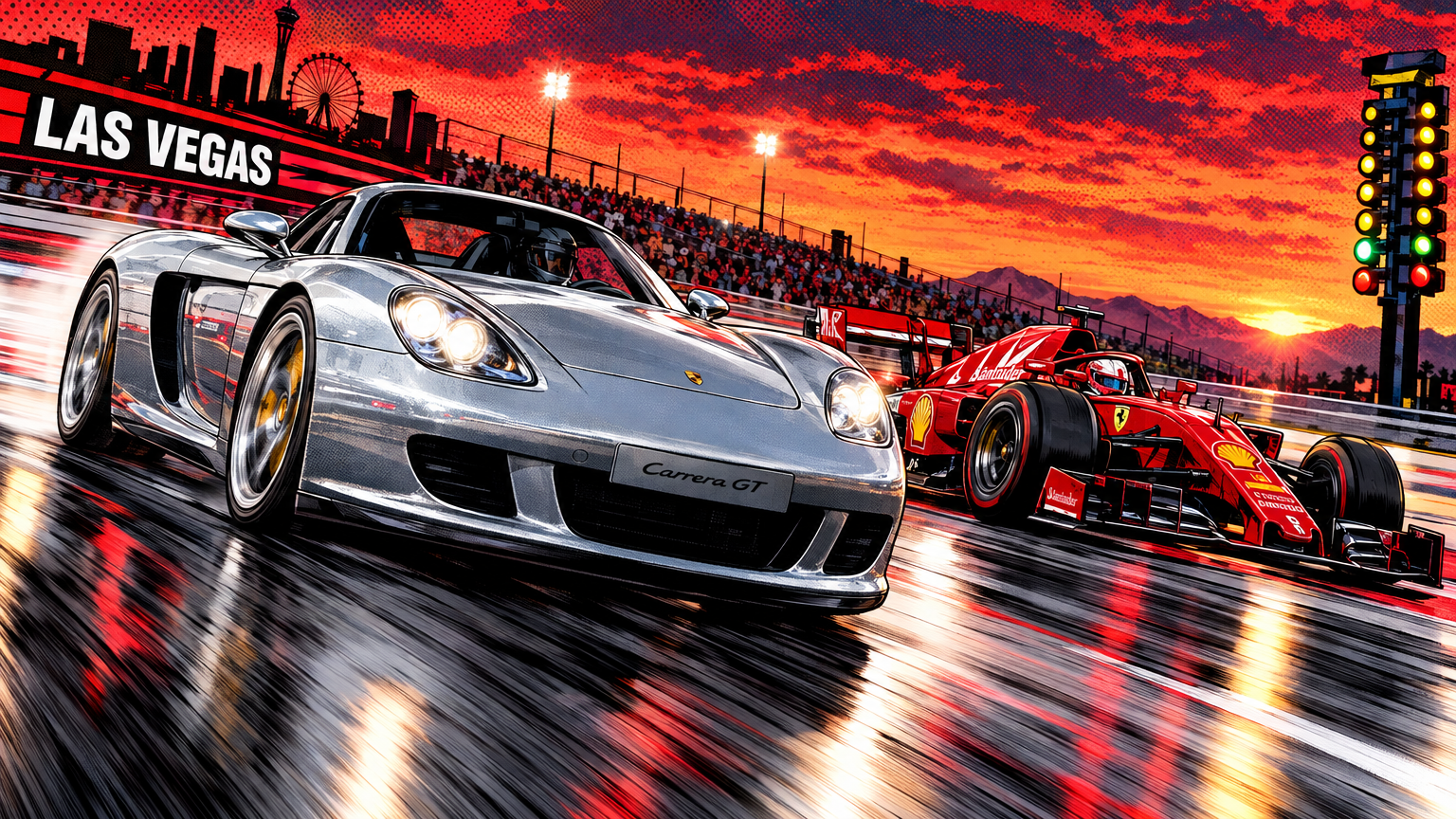
Braking is the Carrera GT's quiet party trick. Those 380 mm carbon ceramic discs were cutting edge in 2003, and they still deliver today.
Car and Driver stopped the car from 70 mph in 145 feet, six feet shorter than the Ferrari Enzo it tested in the same era. Other period tests recorded about 101 feet from 60 mph.
Here is the reader value twist most owners never hear about. In October 2024, Porsche and Michelin released a brand new Pilot Sport Cup 2 tire developed specifically for this twenty year old car.
Porsche says the new tire can shorten braking from 62 mph by up to 8 feet, and from 124 mph by up to 39 feet, compared with the previous tire. Same brakes, same car, shorter stops, purely from two decades of tire progress.
That is the most useful lesson in this whole article. Brakes stop the wheels. Tires stop the car, and old tires on a fast car are a false economy.
Even so, this round is not close. A Formula 1 car brakes with carbon discs, racing tires, and aerodynamic downforce pressing it into the road, shedding speed at rates that would feel like a crash in anything else.
Winner: Formula 1. Four rounds down, and the analog hero is scoreless. Now let us talk about why nobody who loves cars cares.
So, Does the Carrera GT Win Anything?
It wins the argument that matters to the people who actually buy these cars. Walk through what the Porsche offers that no Formula 1 car can:
- The sound: a naturally aspirated V10 at 8,400 rpm, widely ranked among the greatest engine notes ever put in a road car. No turbo muffling, no hybrid whine, just mechanical music.
- The involvement: three pedals, an open gate manual shift, unassisted steering, and no stability net. Every fast drive is earned.
- The story: an engine built for Formula 1, rebuilt for Le Mans, and finally given a life on the road because Porsche would not let it die.
- The ownership arc: roughly 440,000 dollars new, seven figures today, and Porsche still develops new tires for it twenty years on.
It also wins the lineage fight inside this very series. Go back and read our Formula 1 vs. Porsche 959 piece, and you can see the family line: the 959 taught supercars technology, and the Carrera GT taught them feel.
A Formula 1 car is faster in every measurable way. The Carrera GT is the one people dream about driving slowly, just to work the gearbox.
What Would Happen on the Las Vegas Strip Circuit?
The Las Vegas Strip Circuit runs 6.201 km, about 3.85 miles, with 17 turns and 50 laps on Grand Prix night. Its signature is the roughly 2 km straight along the Strip, one of the longest full throttle stretches in the sport.
Down that straight, the Carrera GT would stretch to serious speed and sound magnificent doing it. The Formula 1 car would arrive at the braking zone carrying trap speeds in the 350 km/h range, based on the measured figures in this series.
Through the corners, the story repeats every lap. The Porsche's 1,380 kg, road tires, and human shifts cannot live with 768 kg, active aero, and slicks.
No lap times are invented here, because none exist for this pairing. What exists is arithmetic: power to weight, weight, grip, and braking all point the same way, and they point that way by a lot.
The honest Vegas verdict is this. The Carrera GT would be the best sounding car on the Strip that night, and the crowd on the balconies would remember its lap long after faster cars blurred past.
The Final Call
Four rounds, four wins for Formula 1. Acceleration, top speed, cornering, and braking all go to the car built with one job and an entire factory behind it.
The Carrera GT never stood a chance on the scorecard, and it was never really about the scorecard. This is the car Porsche built from a dead racing programme, with a wooden gear knob, a clutch that bites, and an engine that sings like nothing before or since.
If you are shopping for one, use the insight that actually protects you:
- Measure the clutch: the ceramic clutch is expensive and its wear can be checked. Get the reading in writing before money moves.
- Date the tires: original era rubber on a 612 PS car with no stability control is a risk, not originality. The 2024 Cup 2 update exists for a reason.
- Verify the carbon: the monocoque is the car. Any accident history needs a specialist inspection, not a seller's reassurance.
- Budget for specialists: engine out work and Carrera GT specific parts require the right hands. Cheap maintenance is the most expensive kind on this car.
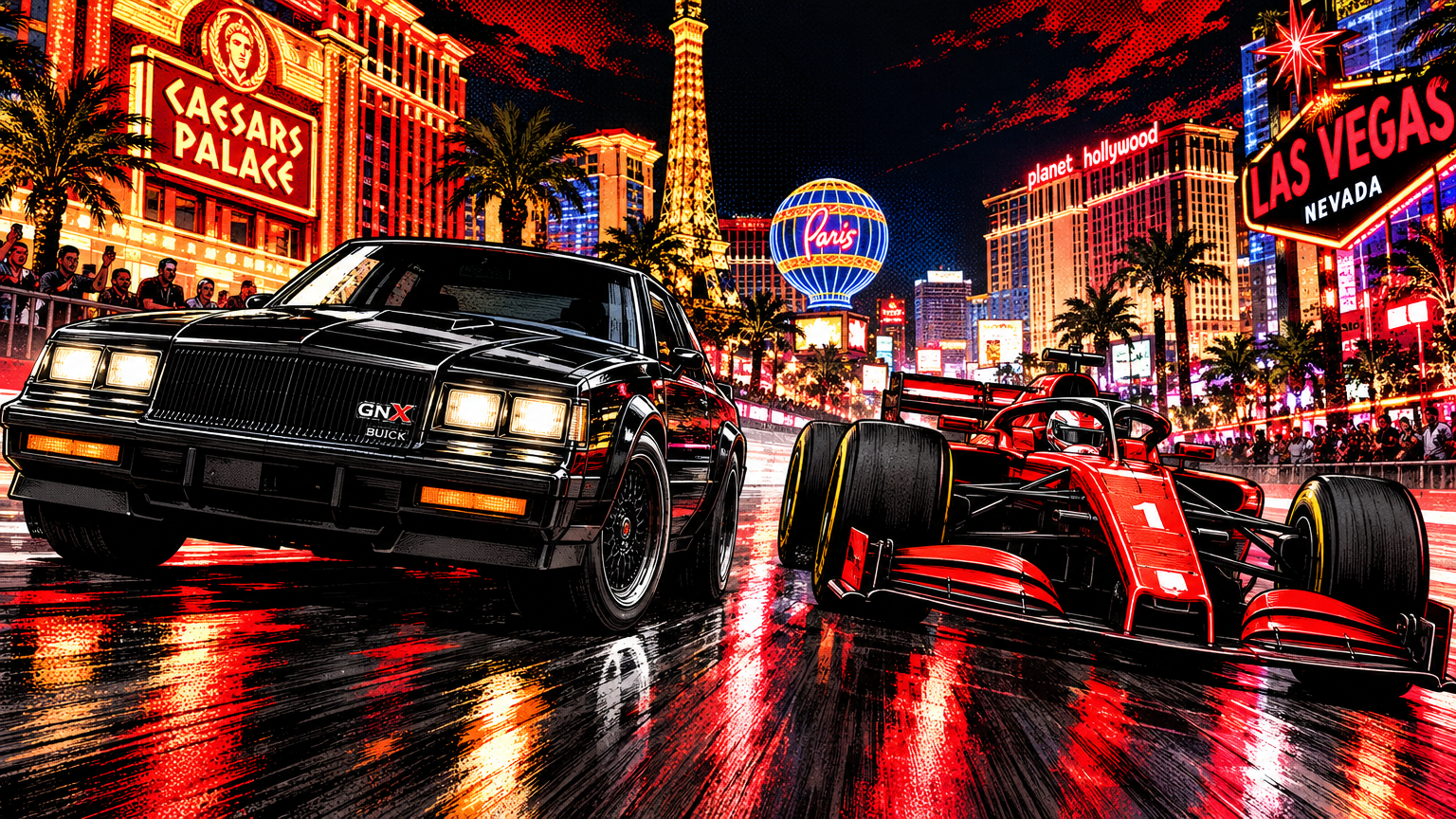
Yesterday's challenger makes today's point from the other end of the price ladder. If you missed it, read Formula 1 vs. Buick GNX, where a black 1987 Buick took the same beating and kept the same dignity.
Formula 1 may win the fight. But the Carrera GT still owns the drive home, the gear change, and the greatest soundtrack this series will ever hear.
There are plenty more cars waiting to pick a fight with Formula 1. Next up: Formula 1 vs. Acura NSX Type S: the hybrid supercar that brought a laptop to a knife fight, and might be smarter than it looks.