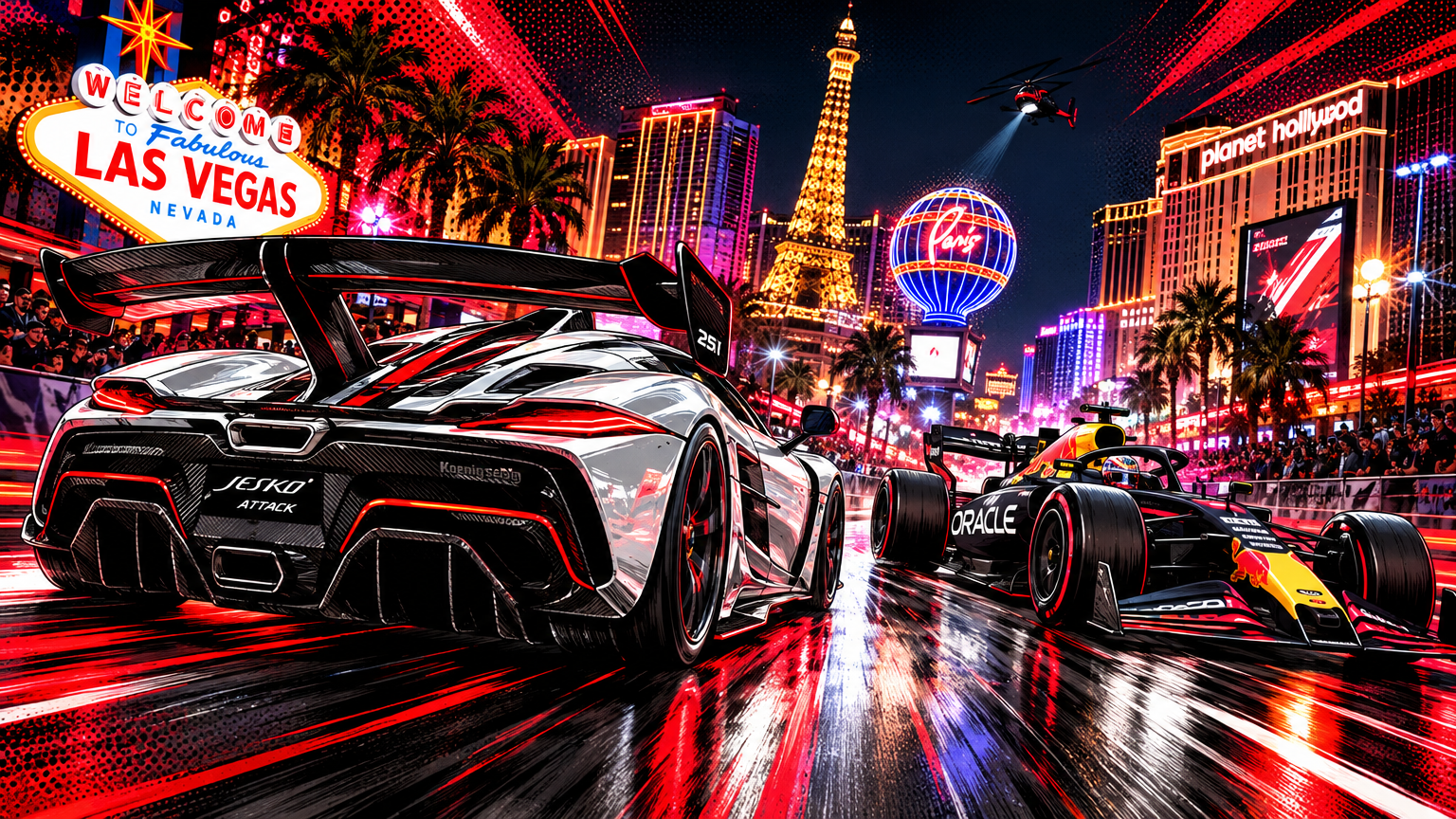
Every challenger so far has arrived with less power than the Formula 1 car, or barely the same. The Koenigsegg Jesko arrives with far more.
On the right fuel, this Swedish two seater makes 1,600 hp. That is not a typo, and it is not a hybrid trick.
It is a twin turbo V8, a very clever gearbox, and a small company in Angelholm that treats limits as suggestions.
What happens if the Koenigsegg Jesko picks a fight with a Formula 1 car?
What happens is the closest headline fight in this series so far. Then the weight math walks in and ruins the party, the way it always does.
Let us score it properly. Koenigsegg figures first, records labelled with the variant that set them, and simulations never dressed up as results.
First, Which Jesko Are We Talking About?
The Jesko was unveiled at the Geneva Motor Show in March 2019. It is named after Jesko von Koenigsegg, the father of company founder Christian von Koenigsegg.
Koenigsegg will build 125 Jeskos in total, split between two versions. Every car was sold, at a launch price reported at just under 3 million dollars before taxes and options.
The family, kept separate the way this series always keeps it:
- The Jesko Attack, our challenger: the high downforce, track focused version shown at Geneva. This is the scored car.
- The Jesko Absolut: the low drag sister car, built for straight line speed, with the big wing deleted and a long tail fitted. Its records are real, and they are labelled Absolut wherever they appear below.
- The Sadair's Spear: a later, lighter special built in a small run. Interesting, rare, and not scored.
- The Agera line: the Jesko's predecessor family. History, not the challenger.
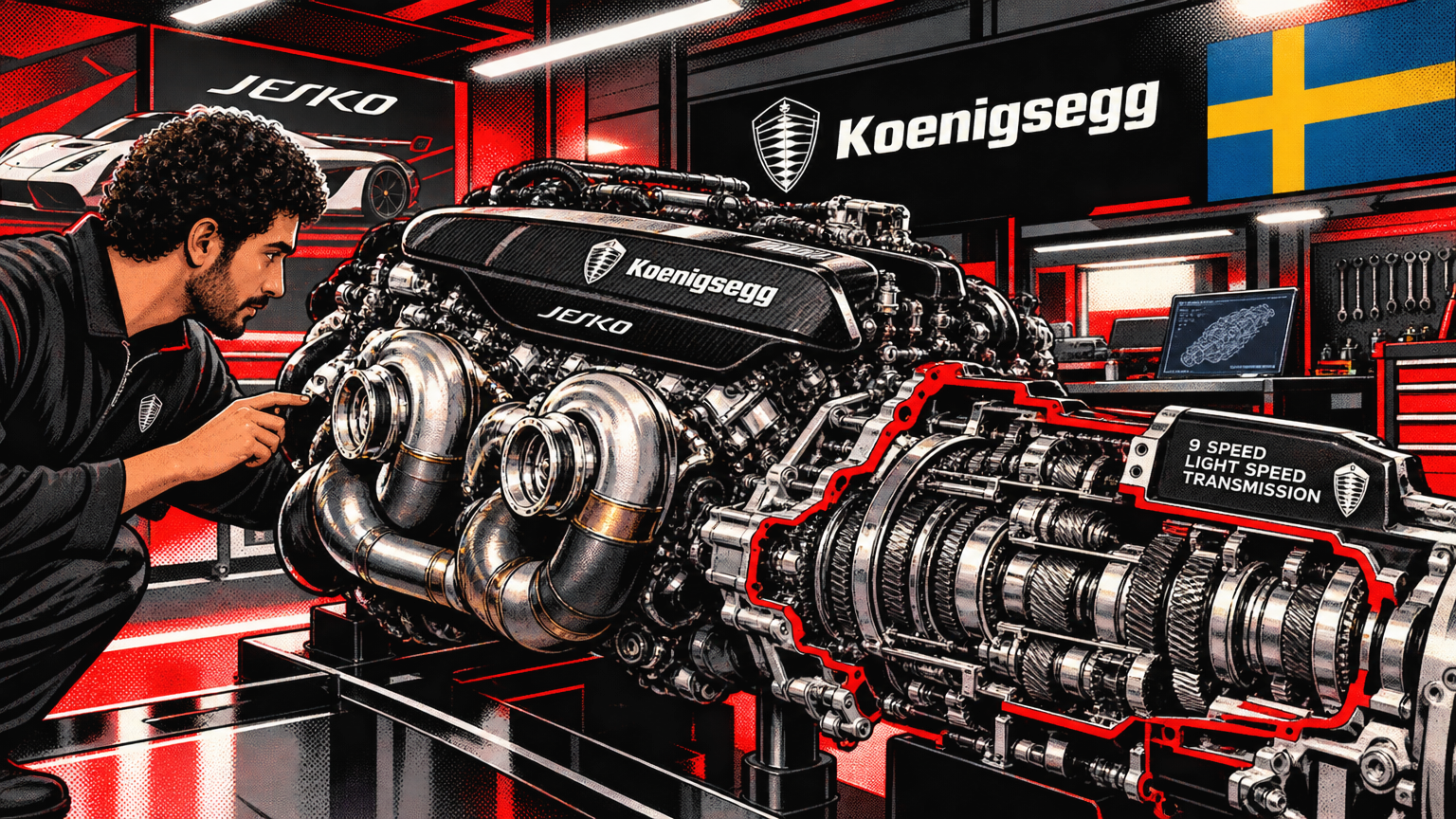
Now the scored car, Koenigsegg figures first, from the official Koenigsegg Jesko page. The engine is a 5.0 litre twin turbo aluminium V8 with a flat plane crankshaft.
It makes 1,280 hp at 7,800 rpm on standard gasoline. Fill it with E85 biofuel, where available, and Koenigsegg quotes 1,600 hp.
Torque tells the deeper story. There is 1,000 Nm on tap from 2,700 to 6,170 rpm, and maximum torque is 1,500 Nm at 5,100 rpm.
The redline sits at 8,500 rpm. Boost pressure is 1.7 bar on gasoline and 2.2 bar on E85, and the whole engine weighs just 189 kg.
Then comes the part engineers talk about in a different tone of voice. The nine speed Light Speed Transmission, designed and built in house by Koenigsegg, weighs just 90 kg.
Most gearboxes change one gear at a time, in order. The Light Speed Transmission uses several wet multi disc clutches, so it can jump directly between any two gears, skipping the ones in between.
Koenigsegg calls the brain behind that trick Ultimate Power on Demand. You ask for full power, and the box picks the right gear instantly instead of stepping down one ratio at a time.
Drive goes to the rear wheels only. There is no front motor, no hybrid battery, and no all wheel drive safety net.
The structure is a carbon fibre monocoque with aluminium honeycomb and integrated fuel tanks. Koenigsegg quotes torsional rigidity at 65,000 Nm per degree, which is a seriously stiff tub.
Size check: 4,626 mm long, 2,030 mm wide, 1,210 mm tall, on a 2,700 mm wheelbase. Dry weight is 1,320 kg, and kerb weight is 1,420 kg.
The aero is the Attack's whole personality. Koenigsegg quotes 700 kg of downforce at 250 km/h, 1,000 kg at 290 km/h, and a maximum of 1,400 kg.
Read that again slowly. At speed, the air presses this 1,420 kg car into the road with up to 1,400 kg of extra load, almost the car's own weight again.
Brakes are ventilated ceramic discs, 410 mm at the front with six piston calipers and 395 mm at the rear with four pistons. Tyres are Michelin Pilot Sport Cup 2, with the Cup 2 R as an option, 265/35 R20 front and 325/30 R21 rear.
Suspension is double wishbone all round with Triplex dampers front and rear. Those extra dampers fight squat under acceleration and dive under braking, which matters in a car this violent.
Now the records, and every one of them belongs to the Absolut, the low drag sister car. Same engine, same gearbox, different aero, and Koenigsegg is clear about which car did what.
On June 27, 2024, at an airfield in Orebro, Sweden, factory test driver Markus Lundh ran the Jesko Absolut from 0 to 400 km/h and back to a stop in 27.83 seconds. That was a world record for a homologated road car, verified with Racelogic timing gear.
Rimac took that crown away in 2025 with the electric Nevera R, at 25.79 seconds. So Koenigsegg went back to the same airfield with the same car.
On August 7, 2025, Lundh did it in 25.21 seconds. The run broke the record into pieces worth memorising: 0 to 400 km/h in 16.77 seconds, then braking from 400 km/h to a stop in 8.44 seconds.
The hardware had not changed at all. Koenigsegg credits new software for the Light Speed Transmission and engine management, called Absolut Overdrive, and says that software goes to customer cars too.
The Attack has a circuit receipt of its own. In August 2024, Lundh lapped Laguna Seca in 1:24.86, reported by Koenigsegg as the fastest lap there by a homologated production car at the time.
So the challenger is no dyno queen. It holds the hardest acceleration and braking record in the road car world, and its track version holds a Laguna Seca mark.
Meet the 2026 Formula 1 Car
The other corner holds the current Formula 1 machine, built to the 2026 regulations. You can follow the whole season build up at our Las Vegas Grand Prix hub.
The 2026 Formula 1 car uses a 1.6 litre turbocharged V6 hybrid. The petrol engine is limited to about 400 kW, and the MGU-K electric motor can add up to 350 kW.
Formula 1 describes the total package as more than 1,000 hp. Minimum regulatory weight is 768 kg, about 1,693 lb, including the driver.
The rest is the familiar Formula 1 recipe, turned up. Rear wheel drive, carbon construction, racing tyres, and active aerodynamics at the front and rear.
For speed evidence, this series uses measured traps, never invented top speeds. Pierre Gasly recorded 353.9 km/h, about 220 mph, in qualifying at the 2026 Chinese Grand Prix, per FIA data.
Put the two cars side by side and this fight gets interesting fast. The Jesko makes up to 1,600 hp and weighs 1,420 kg at the kerb, while the Formula 1 car makes more than 1,000 hp and weighs 768 kg with a human inside.
For company, look at the last challenger that matched Formula 1 on headline power, the Lamborghini Revuelto. The Jesko goes roughly 600 hp past it.
Koenigsegg Jesko vs. F1: The Numbers
| Category | Koenigsegg Jesko Attack | 2026 Formula 1 Car |
|---|---|---|
| Engine | 5.0L twin turbo V8, flat plane crank | 1.6L turbo V6 hybrid |
| Power | 1,280 hp on gasoline, 1,600 hp on E85, Koenigsegg | More than 1,000 hp, per Formula 1 |
| Torque | 1,500 Nm max at 5,100 rpm, Koenigsegg | Not published as one combined figure |
| Weight | 1,420 kg kerb (1,320 kg dry) | 768 kg minimum, including driver |
| Power to weight | About 1,127 hp per tonne on E85, kerb basis | More than 1,300 hp per tonne |
| Gearbox | 9 speed Light Speed Transmission, 90 kg | Sequential racing gearbox |
| Drive | Rear wheel drive | Rear wheel drive |
| Downforce | Up to 1,400 kg, Koenigsegg | Active aero, no single public figure |
| 0 to 400 to 0 km/h | 25.21 sec world record, Jesko Absolut, August 2025 | No equivalent published road car style test |
| Top speed | No verified run, simulation only for the Absolut | 353.9 km/h trap, Gasly, 2026 Chinese GP qualifying |
| Production | 125 cars, Attack and Absolut combined, sold out | Built for one racing season |
| Vegas valet factor | 10 out of 10, the valet will fight coworkers for this key | 0, there is no valet stand at a pit lane |
Three lessons hide inside that table, and they are worth more than the 1,600 hp headline.
- Fuel is a performance part. The same Jesko makes 1,280 hp on gasoline and 1,600 hp on E85. That 320 hp gap is bigger than the whole engine in most sports cars, and it comes from the fuel's cooling and knock resistance, not from new hardware.
- Power to weight still runs the show. Even on E85, the Jesko works out to about 1,127 hp per tonne on its kerb weight. The Formula 1 car clears 1,300 hp per tonne, so the car with less power still has more push for every kilo it carries.
- A simulation is not a result. Koenigsegg's computers suggest the Absolut could pass 330 mph in perfect conditions. No verified top speed run has happened, so this series scores the claim as a claim, never as a speed.


Round One: Acceleration
This is the round the Jesko was born for. The Absolut's verified record run reached 400 km/h in 16.77 seconds, on rear wheel drive, with no electric motor helping.
Think about what that asks of the tyres. Two rear tyres have to pour up to 1,600 hp into the road without turning it all into smoke, and the Absolut Overdrive software exists largely to manage that grip.
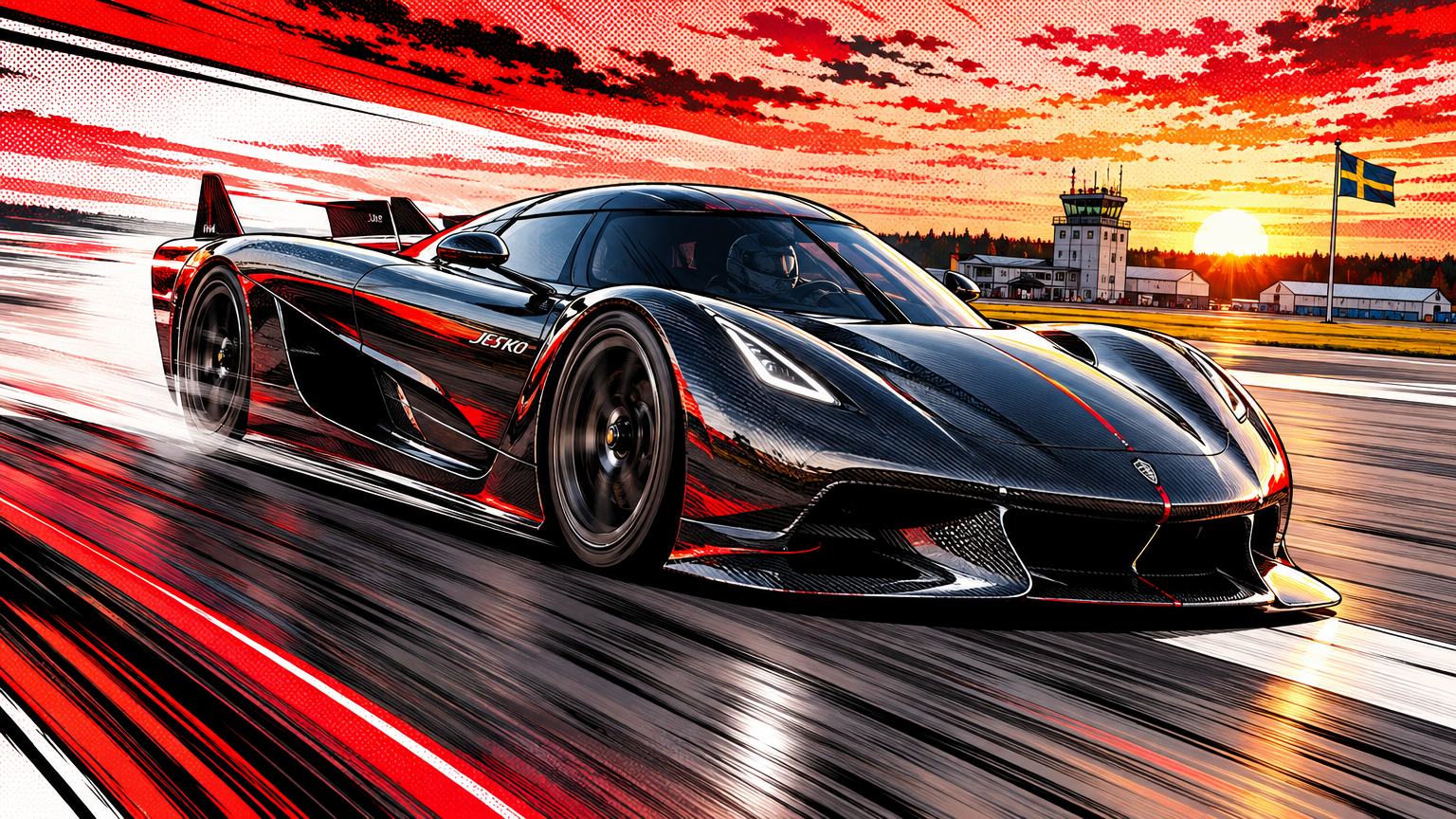
There is no universal official Formula 1 0 to 60 figure, and this series never invents one. The honest comparison is power to weight plus tyre.
The Jesko brings about 1,127 hp per tonne on E85 and road legal Cup tyres. The Formula 1 car brings more than 1,300 hp per tonne and warm racing slicks built for standing starts off a Grand Prix grid.
The Jesko is, by verified record, the hardest accelerating road car package on Earth across a full 0 to 400 to 0 run. Against this one opponent, on this one scoreboard, that still is not enough.
Winner: Formula 1. But file the lesson: if you ever compare fast cars, compare the full run, launch, top end, and stop together, the way the 0 to 400 to 0 test does.
Round Two: Top Speed
Here is where this series earns its keep, because the internet will happily sell you a Jesko top speed that nobody has ever measured.
Koenigsegg designed the Absolut to be the fastest car the company will ever make, with a drag coefficient of just 0.278. Company simulations point beyond 330 mph under ideal conditions.
A simulation is a prediction, not a run. As of this article, no Jesko, Attack or Absolut, has set a verified top speed record, and the scored Attack is the high downforce car, which trades straight line speed for cornering load by design.
Formula 1 brings receipts instead of predictions. Gasly trapped 353.9 km/h in 2026 qualifying trim, Yuki Tsunoda trapped 358.3 km/h here in Las Vegas in 2025, and Alex Albon trapped 368.9 km/h here in 2024.
Those are circuit figures, set in cornering trim on a street circuit, not top speed attempts on a runway. They are still measured, timed, and published by the FIA.
Winner: Formula 1, on verified numbers only. The day an Absolut makes a timed two way top speed run, this round gets rescored, and this series will happily rewrite it.
Round Three: Now Add a Corner
The Attack was built for exactly this round. Up to 1,400 kg of downforce, Triplex dampers at both ends, and a Laguna Seca lap that embarrassed pure race machinery on road tyres.
That downforce figure deserves respect. Pressing a car into the road with almost its own weight again is how a road car corners at speeds that feel wrong from the driver's seat.
The Formula 1 car plays the same game at a different scale. It weighs 652 kg less than the Jesko at the kerb, carries its mass lower, and runs racing tyres that work in a temperature window road tyres never reach.
Every corner asks the same question: how much mass are you asking the tyres to redirect? The Jesko asks that question about 1,420 kg, the Formula 1 car about 768 kg, driver included.
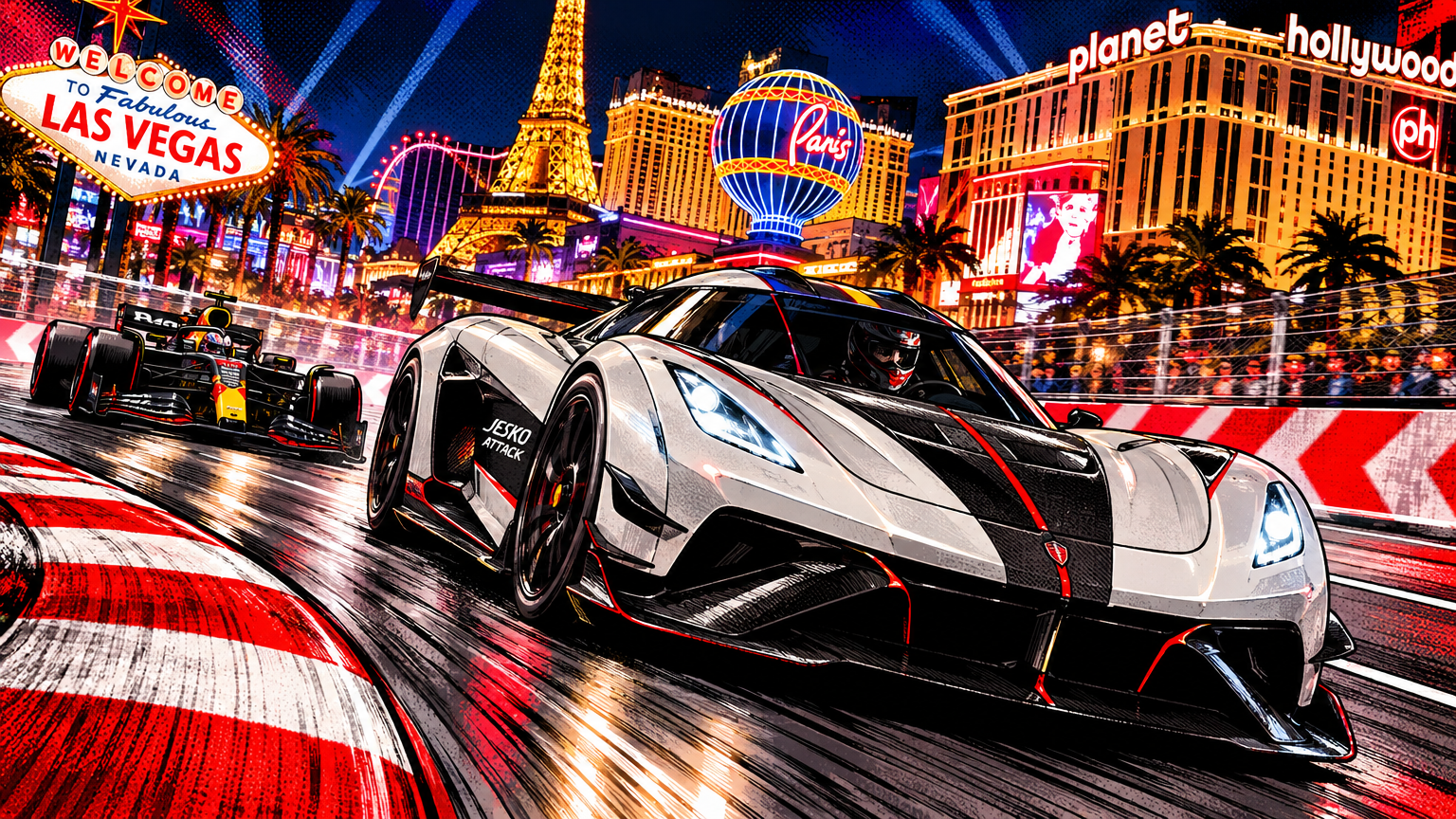
Winner: Formula 1. The usable insight: downforce is not free grip, it is rented grip that arrives with speed, so a high downforce road car feels most magical exactly where public roads never let you go.
Round Four: Braking
The Jesko's braking receipt is the second half of that record run. From 400 km/h, the Absolut stopped in 8.44 seconds, as part of the verified 25.21 second total.
Stopping from 400 km/h is an energy problem before it is a brake problem. The 410 mm front and 395 mm rear ceramic discs have to turn a huge amount of speed into heat, once, cleanly, with no fade and no drama.
The Attack runs those same brake sizes, with Sport ABS and bespoke Koenigsegg calipers. For a road car, this is as serious as braking hardware gets.
The Formula 1 car stops from lower peak speeds with far less mass to haul down. Less mass means less energy, less heat, and shorter stops, lap after lap, not just once.
Winner: Formula 1. Take this one to the street with you: a single heroic stop proves the brakes work, but repeated stops prove the system, and heat management is what separates the two.
So, Does the Jesko Win Anything?
It wins the headline, and it is not close. At 1,600 hp on E85, the Jesko makes about 600 hp more than the Formula 1 car's published total, with no hybrid system at all.
It wins the record book, too. The 0 to 400 to 0 world record belongs to its sister car, taken back from an all wheel drive electric rival by a rear wheel drive petrol car running smarter software.
- Most power here: 1,600 hp on E85 beats every challenger in this series, and the Formula 1 car itself.
- The gearbox lesson: the Light Speed Transmission shows that skipping gears entirely can beat shifting through them faster.
- The software lesson: the 2025 record came from code, not parts, and owners get the same update. Your car can get quicker after you buy it.
- The fuel lesson: E85 is worth 320 hp in this car. Fuel choice is a tuning decision, not just a pump decision.
It also wins the name game. A founder naming the flagship after his father, then building 125 of them in a small Swedish town, is a story no wind tunnel can generate.
And it wins on usability in the strangest way. It has Apple CarPlay, climate control, a removable hardtop, parking cameras, and 100 litres of luggage space split front and rear.
What Would Happen on the Las Vegas Strip Circuit?
The Las Vegas Strip Circuit runs 6.201 km, about 3.85 miles, with 17 turns and 50 laps on race night. Its roughly 2 km straight down the Strip is where this fight would look closest.
Out of the final corners, the Jesko's torque and that gear skipping transmission would keep it honest for a while. Past challengers in this series, like the Bentley Continental GT Speed, never got even that courtesy from the math.
Then the braking zones arrive, 17 of them per lap. Each one asks the Jesko to haul 1,420 kg down from speed, and each corner asks its road tyres to redirect that mass again.
The Formula 1 car would brake later, turn faster, and fire out on warm slicks. Over one lap the gap would be large, and over 50 laps the Jesko's tyres and brakes would be managing heat while the Formula 1 car was managing a race.
No lap time is invented here, because none exists. This is an informed comparison, not a recorded race, and the series never prints a number it cannot source.
What you can take from it is real. On a street circuit, repeated braking and turning beat peak power every single time, which is why race cars chase weight before they chase dyno sheets.
The Final Call
Four rounds, four wins for Formula 1. Acceleration, top speed on verified numbers, corners, and braking all go to the car built for nothing else.
And yet this is the challenger that came closest on the scoreboard that starts conversations. More power than the Formula 1 car, a world record in the family, and a gearbox the rest of the industry will study for years.
The Jesko does not need this fight to prove anything. It already proved it at Orebro, twice, the second time with nothing but new software and a drying runway.
Formula 1 may win the fight. But the Jesko still holds the record that road cars actually race each other for, and it does it with rear wheel drive, petrol, and a gearbox that skips gears like they never mattered.
There are plenty more cars waiting to pick a fight with Formula 1. Next up: Formula 1 vs. Buick GNX: the blacked out turbo Buick that embarrassed sports cars in the 1980s, and did it wearing a family coupe suit.