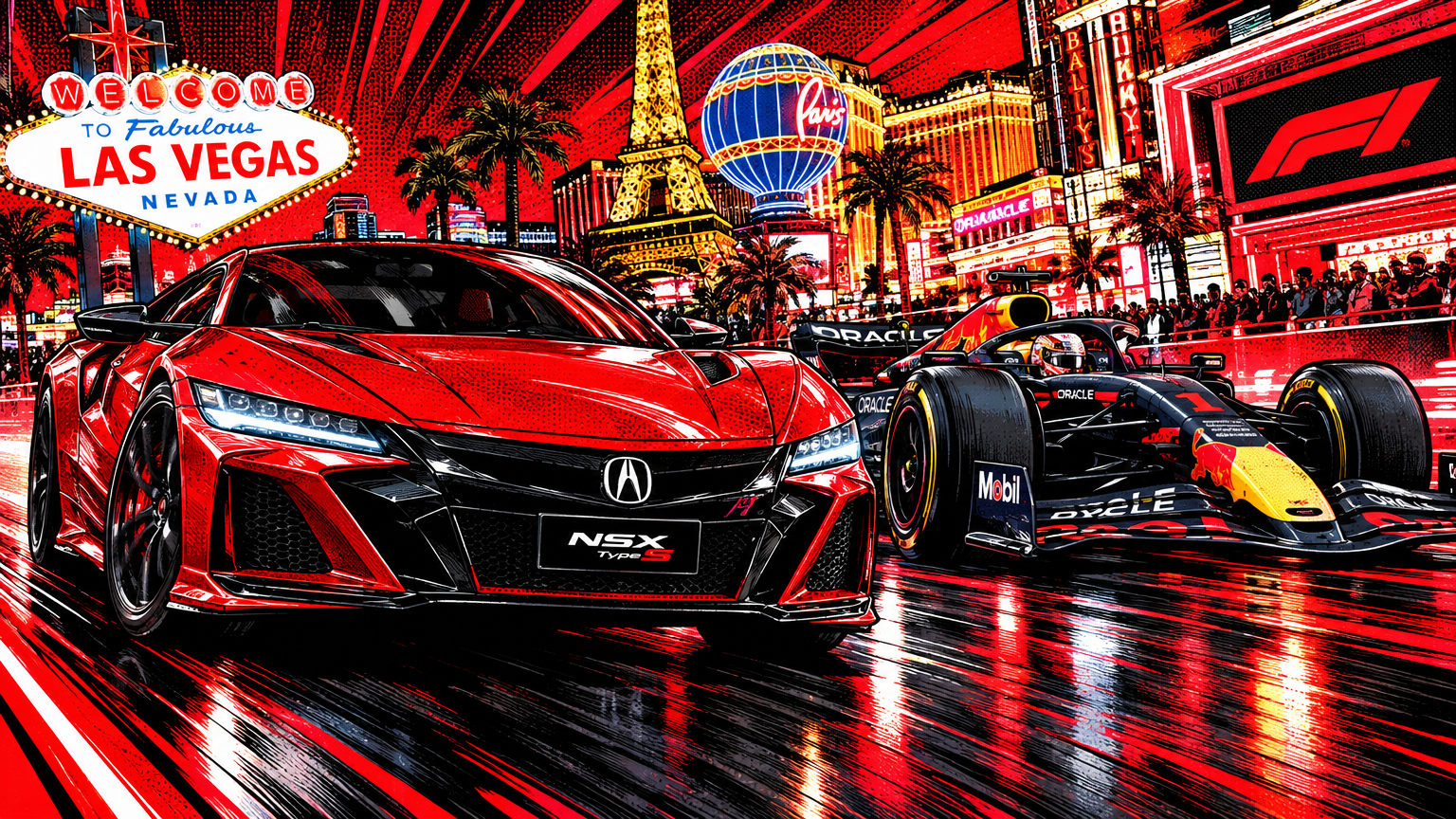
Most supercars pick one trick and shout about it. Big engine, big wing, big number, done.
The Acura NSX Type S picked a harder trick. It brought a twin turbo V6, three electric motors, a battery, and a computer that can push power to whichever wheel needs it most, all in the same car.
This is the final NSX, the 2022 send off for the whole nameplate. Acura built just 350 of them, and then it closed the book.
What happens if the Acura NSX Type S picks a fight with a Formula 1 car?
What happens is the smartest road car in this series meets the fastest racing machine on Earth. One was built to think its way around a corner. The other one just goes around it at speeds that bend your sense of fair.
Let us score it properly. Acura figures first, independent tests labelled as tests, and no invented numbers anywhere.
First, Which NSX Type S Are We Talking About?
There is exactly one NSX Type S, and that keeps this simple. This is the 2022 car, the only version of the NSX Acura sold that year, built for the final year of second generation production.
The family around it, kept separate the way this series always keeps it:
- The 2022 NSX Type S, our challenger: 600 hp, 350 built worldwide, 300 of them for United States customers. This is the scored car.
- The standard second generation NSX, 2017 to 2021: the same basic hybrid layout at 573 hp and 476 lb-ft. Close family, not the challenger.
- The first generation NSX, 1991 to 2005: the all aluminum original that Ayrton Senna helped tune. Legend status, completely different car.
- The NSX GT3 Evo race car: the competition car whose turbochargers the Type S borrowed. A donor, not a scored car.
Every Type S was hand built at the Performance Manufacturing Center in Marysville, Ohio. Its engine was hand assembled at the Anna Engine Plant, also in Ohio, which makes this Japanese icon about as American built as a supercar gets.
The full launch story is in the Acura Newsroom release for the NSX Type S, and the scored figures below come from Acura first.
The gasoline half of the team is a 3,493 cc twin turbocharged V6 with a 75 degree cylinder angle, dry sump lubrication, and a 7,500 rpm maximum. On its own it makes 520 hp at 6,500 to 6,850 rpm and 443 lb-ft at 2,300 to 6,000 rpm.
For the Type S, Acura fitted the turbochargers from the GT3 Evo race car and raised peak boost from 15.2 to 16.1 psi. New fuel injectors flow 25 percent more, and new intercoolers shed 15 percent more heat.
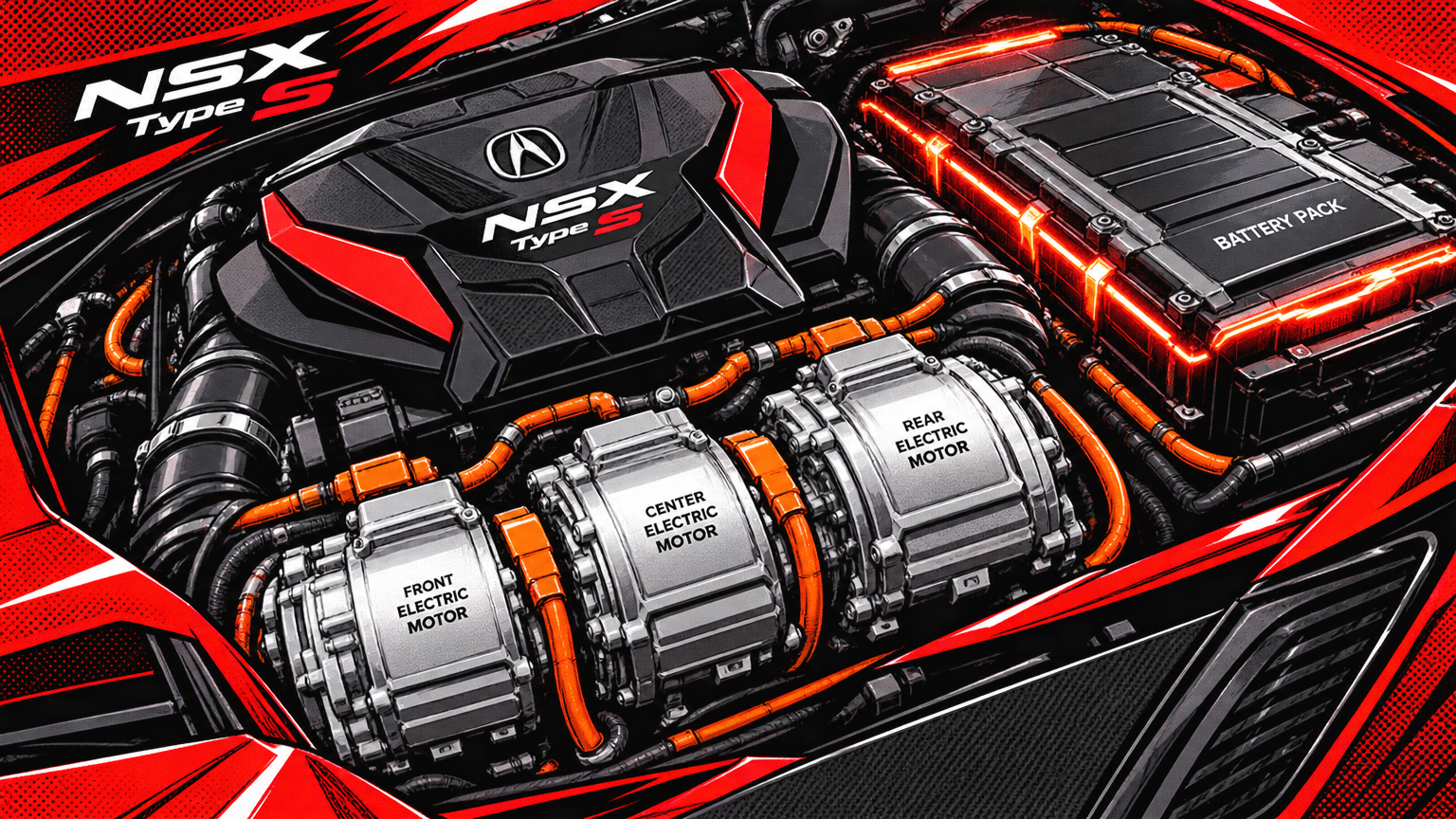
The electric half is where it gets clever. A direct drive motor sits between the engine and the gearbox at the rear, rated at 47 hp, and two more motors drive the front wheels, one per wheel, at 36 hp each.
Acura also lowered the front motor gearing by 20 percent, from 8.050 to 1 to 10.382 to 1, for a harder launch. Usable battery capacity rose 20 percent and battery output rose 10 percent.
Add it all up and the combined system output is 600 hp and 492 lb-ft of torque. That is 27 hp and 16 lb-ft more than the 2021 car, and it makes the Type S the most powerful road going Acura ever built.
Power routes through a nine speed dual clutch transmission that Acura retuned for the Type S. Upshifts in Sport and Sport Plus engage up to 50 percent faster, and a new Rapid Downshift mode picks the lowest usable gear when you hold the downshift paddle for 0.6 seconds.
The drive system is the famous Sport Hybrid Super Handling All-Wheel Drive. Because the front wheels have their own motors, the car can add power to the outside front wheel mid corner and literally help pull the nose around.
That is torque vectoring, and it is the single smartest idea on this car. Most cars slow a wheel down to turn. The NSX speeds one up.
The chassis is an aluminum intensive multi material space frame with a carbon fibre floor panel and a standard carbon fibre roof. Weight distribution is 42 percent front and 58 percent rear.
The car measures 4,534 mm long on a 2,629 mm wheelbase and stands just 1,214 mm tall. Acura's specification sheet lists curb weight at 1,790 kg without options, and the Car and Driver test car weighed 3,898 lb.
New forged split five spoke wheels widen the track by 0.4 inches at the front and 0.8 inches at the rear. The bespoke Pirelli P Zero tires, marked H0 for Honda spec, are 245/35ZR19 up front and 305/30ZR20 at the back, and Acura credits the package with about 6 percent more lateral grip.
Brakes are Brembo, six piston at the front and four piston at the rear. The optional Lightweight Package swaps in carbon ceramic brakes, adds a carbon engine cover and carbon interior trim, and cuts about 57.8 lb for 13,000 dollars on top of the 169,500 dollar base price.
Acura figures: 0 to 60 mph in under 3.0 seconds and a top speed of 191 mph, which is 307 km/h. Acura also says the Type S laps the Suzuka Circuit in Japan two seconds faster than the 2021 NSX.
Finishing touches tell the farewell story. A numbered plaque sits on the engine cover, a big carbon rear diffuser copies the GT3 Evo race car, and the new Gotham Gray matte paint was limited to just 70 of the 350 cars.
Meet the 2026 Formula 1 Car
The other corner holds the 2026 Formula 1 car, built to a completely new set of regulations. It is smaller, lighter, and more electric than the cars before it.
Its power unit is a 1.6 litre turbocharged V6 hybrid. The combustion engine is limited to about 400 kW, the MGU-K electric motor contributes up to 350 kW, and Formula 1 describes the total package as more than 1,000 hp.
Here is the family resemblance nobody expected in this matchup. The NSX Type S is also a turbo V6 hybrid with electric motors doing real performance work, so for once the challenger speaks the same language as the Formula 1 car.
It just speaks it much more quietly. The Acura makes 600 hp and carries about 1,790 kg. The Formula 1 car makes more than 1,000 hp at a minimum regulatory weight of 768 kg including the driver.
The 2026 car also brings active aerodynamics at the front and rear, carbon construction throughout, and racing tires that exist for one job only. It has no Quiet mode, no heated seats, and no interest in your commute.
For a sense of real world pace, the fastest 2026 speed trap evidence in this series is Pierre Gasly at 353.9 km/h, about 220 mph, in qualifying at the 2026 Chinese Grand Prix, from FIA data. Keep that number in your pocket for Round Two.
If you want the full picture of the weekend this fight is staged around, start with our Las Vegas Grand Prix hub. Then come back for the scoring.
Acura NSX Type S vs. F1: The Numbers
| Category | Acura NSX Type S | 2026 Formula 1 Car |
|---|---|---|
| Engine | 3.5L twin turbo V6 plus 3 electric motors | 1.6L turbo V6 hybrid |
| Power | 600 hp combined (520 hp from the V6) | More than 1,000 hp (F1 description) |
| Torque | 492 lb-ft combined | No single published figure |
| Gearbox | 9 speed dual clutch | Sequential racing gearbox |
| Drive | All wheel drive, torque vectoring | Rear wheel drive |
| Weight | 1,790 kg listed, 3,898 lb as tested | 768 kg minimum, including driver |
| 0 to 60 mph | Under 3.0 sec (Acura), 2.9 sec (Car and Driver test) | No universal official figure published |
| Top speed | 191 mph (307 km/h, Acura) | 353.9 km/h trap, Gasly, 2026 China qualifying |
| Brakes | Brembo, carbon ceramic with Lightweight Package | Carbon racing brakes |
| Built | 350 cars, 2022 only | Built for one season of racing |
| Price | 169,500 dollars new, 182,500 with Lightweight Package | Not for sale at any price |
| Vegas valet factor | 9 out of 10, it has a Quiet mode for the casino ramp | 0 out of 10, it has no quiet anything |
Read the weight line twice, because it decides almost everything that follows. The Formula 1 car makes about two thirds more power and carries well under half the weight.
Power to weight makes it plain. Using the Car and Driver test weight, the NSX Type S works out to about 339 hp per tonne, which is strong supercar territory.
The Formula 1 car sits above 1,300 hp per tonne. That is not a gap, that is a different sport.
And yet the Acura owns one line in this table outright. It is the only car here that can run silently on electric power through a hotel lobby at 2 a.m., and in Las Vegas that is a genuine feature.
Round One: Acceleration
Acura promises 0 to 60 mph in under 3.0 seconds, and the independent test matched the promise. Car and Driver recorded 2.9 seconds to 60 mph, 6.7 seconds to 100 mph, and the quarter mile in 11.0 seconds at 126 mph.
MotorTrend, testing a different car on a different day, recorded 3.1 seconds to 60 mph and 11.2 seconds at 124.1 mph for the quarter. Two honest tests, two slightly different answers, and that spread is exactly why this series labels its sources.
The launch itself is the hybrid party trick. Electric motors make maximum torque the instant they turn, the front motors drag the car forward while the rears push, and there is no turbo lag to wait for and no clutch to abuse.
Now the honest Formula 1 note this series always prints. There is no universal official 0 to 60 time for a Formula 1 car, because launch depends on tires, surface, gearing, and setup.
What is not in doubt is the physics. More than 1,300 hp per tonne, racing tires, and an electric motor filling every gap in the power curve will beat 339 hp per tonne, however cleverly those horses are deployed.
The NSX launches like a computer solved the problem. The Formula 1 car launches like the problem never existed.
Winner: Formula 1. But the Acura earns real respect here, because sub three seconds with a warranty and a Quiet mode is engineering most brands still cannot copy.
Round Two: Top Speed
This round is scored on verified numbers, the way this series has handled it since the Veyron took the round honestly. Claims sit in the corner. Receipts sit at the table.
The Acura receipt is a clean one. Acura rates the Type S at 191 mph, 307 km/h, the same top speed as the standard car, and no independent run in our sources beats it.
The Formula 1 receipts are trap speeds, measured in qualifying trim on real circuits. Gasly recorded 353.9 km/h in 2026 trim in China, which is about 220 mph.
The historical traps are higher still. Yuki Tsunoda hit 358.3 km/h, 222.6 mph, in Las Vegas in 2025, and Alex Albon reached 368.9 km/h, 229.2 mph, in 2024, the highest trap from the first three Las Vegas races.
Fairness note, printed every time: a speed trap is not a top speed attempt. A Formula 1 car in low drag trim on a long enough road would go faster still, and the NSX figure is a genuine road car maximum.
None of that changes the scoreboard. Every measured Formula 1 figure in this series sits well above the Acura maximum.
Winner: Formula 1. The Type S is a 191 mph car, which is flying. The trap speeds say Formula 1 cruises past that number with a corner coming.


Round Three: Now Add a Corner
This is the round the NSX was born for. Torque vectoring is not a brochure phrase on this car, it is the whole handling strategy.
Here is how it works in plain terms:
- Turn in: the inside front motor can drag while the outside front motor pushes, creating a yaw moment that rotates the car toward the apex.
- Mid corner: the system balances power across all four tires, using grip the rear wheels alone could never reach.
- Exit: the front motors add torque as you unwind the wheel, pulling the car straight and firing it down the next straight.
The test numbers back the theory. Car and Driver recorded 0.99 g on its 300 ft skidpad, while MotorTrend recorded 1.03 g and a 23.2 second figure eight lap, quicker than the Porsche 911 GTS it tested alongside.
Acura's own receipt is the Suzuka claim: two seconds a lap faster than the 2021 car, from the wider track, the new tires, the retuned dampers, and the extra power working together.
Then the Formula 1 car corners, and the conversation ends. Active aero, huge downforce, slick racing tires, and a chassis that weighs 768 kg with a human inside generate cornering loads no road car can approach.
On the Las Vegas Strip Circuit, with 17 turns in 6.201 km, the Acura would be the thinking driver's hero. The Formula 1 car would still be gone.
Winner: Formula 1. The NSX might be the smartest cornering road car of its era. The F1 car is what smart was trying to become.
Round Four: Braking
Braking is where the two test crews disagreed, and the disagreement itself is the lesson. Car and Driver stopped its test car from 70 mph in 155 ft and from 100 mph in 304 ft, on the carbon ceramic brakes.
MotorTrend stopped its car from 60 mph in 103 ft. Different speeds, different surfaces, different tires and different days, so the numbers are not rivals. They are reminders that a braking figure only means anything with its test attached.
The hardware is serious either way. The Lightweight Package carbon ceramics measure about 15.0 inches at the front and 14.2 inches at the rear in the Car and Driver test, clamped by Brembo calipers with six pistons up front.
There is also a hybrid bonus most spec sheets skip. The electric motors can slow the car with regenerative braking before the friction brakes even get busy, which saves the pads in street driving and helps stability on the way into a corner.
Even so, this round is not close. A Formula 1 car brakes with carbon discs, racing tires, and aerodynamic downforce pressing it into the road, shedding speed at rates that would feel like a crash in anything else.
Winner: Formula 1. Four rounds down, and the smartest challenger in the series is scoreless. Now let us talk about why that score misses the point.
So, Does the NSX Type S Win Anything?
It wins the everyday argument, and it wins it by a mile. Walk through what the Acura offers that no Formula 1 car can:
- Two personalities: Quiet mode for the neighborhood, Track mode for the canyon, and three settings in between, all from one dial.
- All weather traction: two front motors and all wheel drive mean the 600 hp works in the rain, not just on a perfect test day.
- The farewell math: 350 cars, a numbered plaque, and the last gasoline NSX ever built in Ohio. Rarity is baked in, not marketed in.
- The bloodline: the original NSX embarrassed Ferrari in 1991 by being fast and reliable at once, and Senna himself helped tune its chassis. The Type S is that idea, finished.
It also wins the hybrid lineage fight inside this very series. Go back and read our Formula 1 vs. Mercedes-AMG ONE piece, and you will see the same bet placed at ten times the price: electric motors are not the enemy of speed, they are the delivery system for it.
A Formula 1 car is faster in every measurable way. The NSX Type S is the one you can drive to dinner afterward, in the rain, without a crew.
What Would Happen on the Las Vegas Strip Circuit?
The Las Vegas Strip Circuit runs 6.201 km, about 3.85 miles, with 17 turns and 50 laps on Grand Prix night. Its signature is the roughly 2 km straight along the Strip, one of the longest full throttle stretches in the sport.
Down that straight, the Acura would top out at its 191 mph maximum and hold it bravely. The Formula 1 car would arrive at the braking zone carrying trap speeds in the 350 km/h range, based on the measured figures in this series.
Through the corners, the story repeats every lap. Torque vectoring can spend the grip the Acura has, but it cannot invent grip, and 1,790 kg on road tires cannot live with 768 kg, active aero, and slicks.
No lap times are invented here, because none exist for this pairing. What exists is arithmetic: power to weight, weight, grip, and braking all point the same way, and they point that way by a lot.
The honest Vegas verdict is this. The NSX Type S would be the most interesting car on the Strip that night for anyone who loves clever engineering, and its silent electric creep past the valet stand would start more conversations than any lap time.
The Final Call
Four rounds, four wins for Formula 1. Acceleration, top speed, cornering, and braking all go to the car built with one job and an entire factory behind it.
The NSX Type S never stood a chance on the scorecard, and it was never really about the scorecard. This is the car Acura built to close a 30 year story: a turbo hybrid with a race car brain, finished by hand in Ohio, in a run of just 350.
If you are shopping for one, use the insight that actually protects you:
- Verify the number: every Type S carries a numbered plaque on the engine cover. Match it to the paperwork, because 350 cars means clones and stories will follow the money.
- Ask about the package: the Lightweight Package adds the carbon ceramic brakes and cuts about 57.8 lb. It cost 13,000 dollars new and changes both the spec and the value.
- Check the hybrid health: the battery and the three motors are the car. A specialist inspection with hybrid system checks is not optional on a car this complex.
- Date the tires: the bespoke H0 Pirelli P Zero was developed for this car. Old or mismatched rubber throws away the grip the whole chassis was tuned around.
Yesterday's challenger makes today's point from the analog end of the world. If you missed it, read Formula 1 vs. Porsche Carrera GT, where a manual gearbox V10 took the same beating with the same dignity.
Formula 1 may win the fight. But the NSX Type S still owns the smartest drive home in this entire series, rain or shine, loud or silent, your call.
There are plenty more cars waiting to pick a fight with Formula 1. Next up: Formula 1 vs. Ford GT40: the 1960s Le Mans legend that beat Ferrari at its own game now comes for the modern king.