Primm’s Shutdown Is Bigger Than a Layoff
A Business Closure Became a Human Emergency
A closure is one kind of problem.
A job loss tied to housing, transportation, and an isolated desert economy is something much larger.
That’s what makes Primm different. This isn’t just a story about a major property going dark at the Nevada-California border. It’s a story about hundreds of workers being forced to solve income, rent, distance, transportation, and survival at almost the same time.
The headline number is 344 workers.
That number matters. It’s large enough to signal real economic damage. But it doesn’t capture the full crisis. In a remote place like Primm, a lost job doesn’t sit by itself. It can affect where a worker sleeps, how that worker gets to the next job, whether that next job is even reachable, and whether the worker can stay in Southern Nevada at all.
That’s the company-town problem.
Primm was built around a narrow economic engine. The town’s jobs, housing, daily services, and commercial activity have been deeply tied to the same operating ecosystem. When that ecosystem starts breaking, workers don’t just lose a paycheck. They lose the structure that made the paycheck possible.
That’s why this shutdown has to be understood as more than a labor story.
It’s a business story.
It’s a housing story.
It’s a transportation story.
It’s a warning about what happens when a remote town depends too heavily on one dominant employer and one aging economic model.
The Layoff Number Is Only the Beginning
344 Jobs Is the Clearest Number, Not the Whole Story
The reported 344 job losses give the public a clean figure to understand.
But clean figures can hide messy reality.
A layoff number tells readers how many jobs are directly affected. It doesn’t show how many rent payments depend on those jobs. It doesn’t show how many families are connected to those paychecks. It doesn’t show how many workers live close to the property because distance makes any other setup difficult.
In Las Vegas, a worker losing a hospitality job may still have options across a larger metro economy. That doesn’t make the loss easy. But the city has more employers, more housing choices, more roads, more services, and more ways to recover.
Primm doesn’t have that kind of cushion.
A job loss in Primm can quickly become a chain reaction:
Income disappears.
Housing becomes unstable.
Transportation becomes harder.
Job searches become more complicated.
Families may be forced to move before a new local plan is in place.
That’s why the number is only the start.
The Structure Behind the Number Matters More
The deeper issue is the structure behind the layoff.
Primm’s economy has been concentrated around a small set of major properties and roadside operations. Workers didn’t just serve a business. They helped keep a remote town functioning. When that business shrinks or exits, the people attached to it become the most exposed part of the system.
Operators can make business decisions.
Landowners can negotiate.
Potential buyers can wait.
Public agencies can respond.
Workers have to live through the timeline in real time.
That’s the imbalance at the center of the Primm worker crisis.
A layoff in Primm doesn’t just remove income. It can remove the worker’s entire local support system.
Primm Was Built Like a Company Town
One Economic Engine Carried Too Much Weight
Primm has long carried the structure of a company town.
That doesn’t mean it looks like an old mining camp with one factory whistle and one main street. It means the local economy has been heavily tied to one dominant commercial engine. The jobs, nearby housing, retail activity, fuel stops, food options, and daily rhythm of the area have all depended on the same narrow base of demand.
That can work while the anchor is strong.
It becomes dangerous when the anchor fails.
A company-town model creates efficiency when business is healthy. Workers live close to the job. Employers keep a nearby labor pool. The local economy runs around predictable shifts, customers, operations, and payroll. The system can look stable because the parts are connected.
But those same connections become liabilities during a shutdown.
If the job disappears and the housing is tied to the same ecosystem, workers don’t get a clean transition. If the local services are tied to the same customer traffic, daily life gets harder. If transportation options are limited, the next job may exist on paper but not in practice.
That’s the risk Primm is showing now.
Why Concentration Creates Risk
Economic concentration can hide weakness.
A town can look functional because one major operator keeps the lights on, the payroll moving, the rooms open, the food service running, and the parking lots active. From the highway, that can look like stability.
But stability built on one engine is fragile.
When that engine slows down, the entire place feels it.
When it stops, the town has to answer a brutal question: what else is there?
For Primm workers, that question isn’t theoretical. It’s immediate. If the local employment base contracts sharply, workers can’t simply walk down the street to another employer with the same pay, same schedule, same housing access, and same transportation reality.
That’s what separates Primm from a normal layoff story.
The worker crisis isn’t separate from the town’s business model. It’s proof of how dependent the town became on that model.
A company town works until the company stops needing the town.
The 48-Hour Housing Pressure Is the Crisis Multiplier
Job Loss and Housing Loss Are Different Together
Job loss is serious.
Housing loss is serious.
Together, they create a different level of crisis.
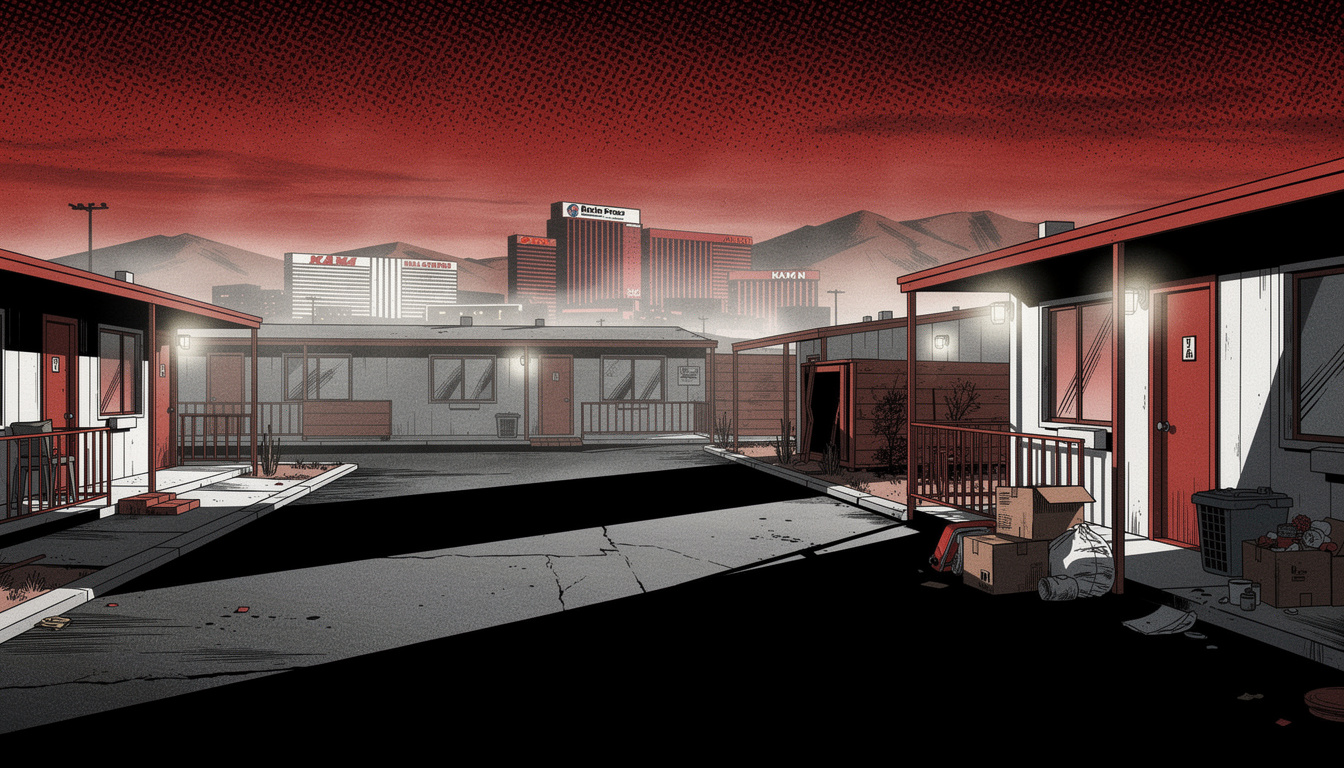
Primm’s worker situation becomes much more severe because many employees are facing housing pressure right after the shutdown timeline. A short move-out window can turn a difficult transition into an emergency. It forces workers to make major life decisions before they’ve had time to stabilize income, locate new housing, secure transportation, or understand whether another operator may step in.
That’s the crisis multiplier.
A worker who loses a job can search for another job.
A worker who loses a job and housing at the same time has to solve everything at once.
That’s not a normal employment transition. That’s displacement pressure.
Housing Was Part of the Employment System
In remote markets, workforce housing isn’t just a benefit.
It’s infrastructure.
It helps the employer staff the operation. It helps workers stay close enough to work. It reduces the distance problem. It keeps a labor pool attached to a difficult location.
But when housing is tied too closely to the same collapsing economic structure, it can become a pressure point.
Housing is leverage. When it’s connected to the same system as employment, workers have less room to negotiate with reality. They can’t simply wait out the market. They can’t easily absorb a gap between jobs. They may not have time to find a place in Las Vegas, figure out transportation, move belongings, and start over.
That’s why the housing timeline matters so much.
The crisis isn’t just that workers may lose paychecks. It’s that some may lose the address that made the paycheck possible.
Geography Makes Recovery Harder
Primm Isn’t Las Vegas
Geography is one of the most important parts of this story.
Primm is close enough to Las Vegas to be tied to its economy, but far enough away that recovery isn’t simple for workers. Distance changes everything. It changes the cost of finding a job. It changes the value of a job offer. It changes whether a worker can reliably commute.
A job 40 miles away may sound reachable to someone with a reliable car, stable fuel money, and a flexible schedule.
For a displaced worker without those things, that job may not be real.
That’s the difference between opportunity and theory.
Las Vegas may have hospitality jobs. The broader region may have restaurants, hotels, warehouses, retail jobs, and service work. But none of that fully solves the problem if workers can’t reach those jobs from Primm or can’t afford to move quickly into the metro area.
Distance Turns Opportunity Into Theory
Transportation is often treated like a side issue.
In Primm, it’s central.
Workers need more than job openings. They need routes, vehicles, gas money, timing, child care solutions, and housing close enough to make the job sustainable. Without those pieces, the job market can look stronger from the outside than it feels to the worker living through the crisis.
That’s why remote labor shocks are so damaging.
The labor market doesn’t operate only on wages. It operates on access.
If workers can’t get to the job, the job doesn’t solve the crisis.
If workers can’t keep housing near the job, the job doesn’t solve the crisis.
If workers are forced to leave before a transition plan develops, the next operator may inherit empty buildings and a missing workforce.
In workforce economics, distance is a cost.
In Primm, distance may be the cost that breaks the transition.
Workers Have the Least Leverage
Everyone Else Can Wait Longer
The Primm shutdown creates a clear power map.
Some parties can wait.
Workers can’t.
Operators can exit the market or reduce exposure. Landowners can negotiate with potential partners. Regulators can push for continuity. Buyers can wait for better terms. Public agencies can assess the damage. Investors can watch the pricing of distressed assets.
Workers don’t have that luxury.
Rent doesn’t wait.
Food doesn’t wait.
Gas doesn’t wait.
Family needs don’t wait.
A new job search doesn’t wait.
That’s why the workers have the least leverage in the entire structure. They’re being hit first and fastest, even though they had the least control over the decisions that created the crisis.
The Timeline Problem
Institutions operate on legal, financial, and negotiation timelines.
Workers operate on daily survival timelines.
That difference matters. A buyer can spend weeks reviewing assets. A landowner can wait for the right partner. A regulator can monitor the process. A public agency can coordinate support.
A worker facing job loss and housing pressure has to make decisions immediately.
That’s the cruelest part of the company-town model. The system can take years to weaken, but workers are often asked to adjust in days.
I see that as the central imbalance in Primm.
The people with the least control are being asked to absorb the fastest consequences.
The Shutdown Could Push Costs Onto the Public
Private Decisions Can Become Public Costs
A shutdown may begin as a balance-sheet decision.
The aftermath can become a public infrastructure problem.
That’s especially true in remote areas. When a private local economy fails, public agencies often inherit the damage. Workers may need housing support. Families may need emergency services. Displaced employees may need job placement, transportation help, or social-service support. Public safety still has to cover the corridor whether the commercial tax base is strong or weak.
That’s the public burden inside the Primm story.
The private market can decide a property no longer works. But the workers, roads, housing needs, safety needs, and regional impact don’t disappear just because the business case weakened.
Someone still has to deal with the aftermath.
The Corridor Still Needs Services
Primm’s location makes the public angle even more important.
The I-15 corridor doesn’t stop mattering because a local employer pulls back. Drivers still pass through. Truckers still need services. Emergency responders still need access. Travelers still break down, get sick, need fuel, or need help along the route.
If Primm loses too much daily commercial function, the region doesn’t just lose jobs. It loses part of the support system for a major travel corridor.
That can shift pressure to Clark County, workforce agencies, housing services, public safety resources, and nearby communities. The cost of failure doesn’t stay neatly inside the property line.
That’s why the worker crisis and the public-services issue are linked.
When a remote company-town structure breaks, the private loss can become a public responsibility.
A New Operator Would Still Need the Workers
Labor Is Part of the Asset Base
Any realistic future for Primm still needs workers.
That sounds obvious, but it’s easy to forget during redevelopment talk. People focus on land. Buildings. Highway visibility. Fuel demand. Future airport proximity. Travel-center possibilities. Logistics. Limited gaming. Restaurant concepts. Parking. Infrastructure.
All of that matters.
But none of it operates without labor.
A travel center needs workers. A food operation needs workers. A fuel station needs workers. A scaled-down gaming model needs workers. A logistics hub needs workers. A hotel reuse strategy needs workers. An airport-support future would need workers too.
If the current workforce is displaced too quickly, the next operator may have to rebuild a labor base from scratch.
That raises costs.
It slows reopening.
It weakens continuity.
It makes the comeback harder.
Housing Stability Could Become a Redevelopment Asset
Worker housing may become one of Primm’s most important redevelopment assets.
Not because it’s glamorous.
Because it’s practical.
A remote corridor business needs nearby labor. If housing remains available, stable, and connected to a realistic employment plan, Primm has a better chance of restarting some kind of commercial function. If workers scatter, the next plan gets harder to execute.
A building can sit empty.
A workforce can’t.
Once workers leave, bringing operations back gets more expensive. Recruiting gets harder. Training gets harder. Staffing gets harder. Service quality gets harder. The whole restart becomes less efficient.
That’s why future operators shouldn’t view labor as separate from real estate.
Labor is part of the asset base.
The Company-Town Lesson
Efficiency Can Become Dependency
Primm’s worker crisis is a warning about remote single-industry towns.
The structure can look efficient while things are working. A dominant employer creates jobs. Housing supports the workforce. Services form around the traffic. The town’s identity becomes tied to the anchor. The model feels stable because everything points in one direction.
Then the direction changes.
That’s when efficiency becomes dependency.
The problem isn’t that company-town structures never work. The problem is that they carry hidden risk. When one employer, one industry, or one customer pattern carries too much weight, the people living inside that system are exposed if the anchor weakens.
Primm shows that clearly.
The business model didn’t just support the town. It shaped the worker reality. When the model broke, the workers felt it first.
The Next Primm Needs More Than One Engine
The next Primm can’t be another one-anchor town.
That would only rebuild the same fragility in a different form.
A stronger future would need a wider base. Not one massive model carrying everything, but several practical engines supporting the corridor. Travel services. Food. Fuel. Truck parking. Logistics. Limited gaming where it makes sense. Worker housing. Construction support. Airport-adjacent activity if that long-term project moves forward.
The goal shouldn’t be to recreate the old dependency.
The goal should be to reduce it.
A town built around multiple practical uses has a better chance of absorbing shocks. A town built around one dominant engine may look strong until that engine fails.
That’s the company-town lesson Primm is teaching now.
Primm’s Workers Are the First Test of the Town’s Future
The Buildings Aren’t the Only Assets That Matter
Primm’s future won’t be judged only by whether buildings reopen.
It’ll be judged by whether the people who kept the town functioning are protected, retained, or pushed out before the next version of the town can form.
That’s the immediate test.
The buildings may define the skyline, but the workers define whether anything can actually operate again. If the next plan ignores that, it won’t matter how strong the land position looks on paper. Primm can’t run on acreage alone. It can’t reopen on highway visibility alone. It can’t build a future only with old structures and new investor decks.
It needs people.
It needs housing stability.
It needs transportation reality.
It needs a labor plan.
A Comeback Gets Harder If the Workforce Leaves
The worker crisis is not separate from Primm’s redevelopment story.
It is the first stage of it.
If workers are displaced now, any future operator will face a harder restart. If housing gets destabilized, the labor base gets thinner. If transportation problems aren’t solved, job openings won’t translate into recovery. If the human cost is treated like a side issue, Primm’s next chapter starts with a weaker foundation.
That’s the business truth beneath the human pain.
Primm’s old model put too much weight on one economic engine. The shutdown is exposing that weakness. Now the town’s future depends on whether the next plan learns from it.
Primm’s buildings may be what people see from the highway.
But its workers are what made the place function.
If Primm’s next chapter starts by losing the people who made the last one work, the comeback gets harder before it even begins.