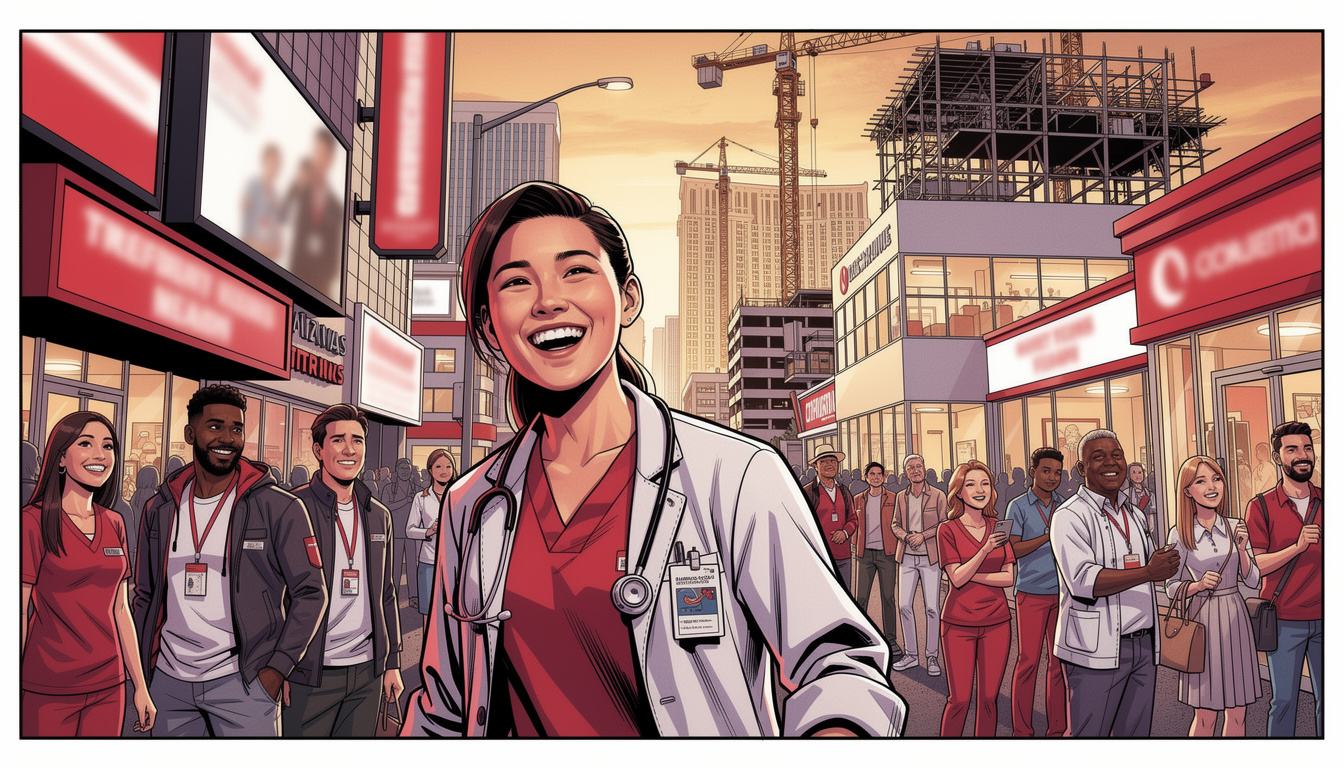
The Money Trail Leads to Healthcare
Las Vegas healthcare expansion starts with one hard number: 2.4 million. The U.S. Census Bureau estimates that Clark County had 2,407,226 residents in July 2025, up from 1,951,269 at the 2010 census. That is an increase of nearly 456,000 people, roughly 23 percent, before counting the tourists and business travelers who also use local medical services.
That population creates recurring demand. More primary care visits. More diagnostic work. More surgeries. More specialty treatment. More space for physicians, laboratories, rehabilitation providers, pharmacies, and administrative teams. Healthcare businesses are not chasing a temporary Vegas spike. They are positioning around a larger patient base that requires service every day of the year.
The market is also aging. Census data show that 17 percent of Clark County residents are 65 or older. That matters because older populations generally use more healthcare services, particularly cardiology, orthopedics, oncology, imaging, and chronic-disease management. For operators and investors, the combination of population growth and age-driven demand creates leverage. It supports expansion across hospitals, neighborhood clinics, medical offices, and outpatient facilities.
The central play is straightforward. Las Vegas has more residents, persistent workforce shortages, and a healthcare system that must add capacity. Capital follows pressure. In this valley, the pressure is building.
Why Outpatient Growth Has the Advantage
The most visible expansion is not limited to major hospital campuses. Healthcare is moving closer to where patients live. Primary care offices, urgent care centers, imaging operations, specialty practices, and ambulatory facilities can be distributed across the valley rather than concentrated in one institutional district.
That model fits Las Vegas. The region is geographically spread out, and its growth corridors extend through Summerlin, Henderson, the southwest valley, and North Las Vegas. A neighborhood clinic gives a healthcare system another point of contact with patients while reducing the need for routine care to flow through a hospital.
University Medical Center, Southern Nevada's public hospital, has been extending its ambulatory network. UMC planning materials show that an expanded Southern Highlands clinic opened in March 2025, while another clinic on Nellis Boulevard was moving through the construction process. That is a more precise signal than talk of an unconfirmed new hospital tower. The strategy is distributed access, with clinical capacity placed closer to growing neighborhoods.
Medical Office Space Is Sending a Mixed but Useful Signal
Follow the real estate numbers and the picture gets sharper. According to Colliers' fourth-quarter 2025 Las Vegas medical office report, the market ended the year with 9.4 percent vacancy and a weighted average asking rent of $2.92 per square foot per month on a full-service gross basis. Quarterly net absorption was positive at 24,420 square feet, although full-year absorption remained negative after a large Class B property was vacated earlier in the year.
That is not a blank-check boom. It is a selective market. Well-located, purpose-built clinical space has an advantage, while older or poorly configured buildings face more friction. Medical tenants need plumbing, power, patient circulation, accessibility, parking, and layouts that conventional offices were not designed to provide. Converting ordinary office or retail space can work, but the economics depend on the specialty and the cost of improvements.
Colliers also reported stronger owner-user and investment sales activity in 2025 than in the preceding several years. That matters. Physicians and healthcare groups buying their own buildings are making long-duration commitments to the valley. Investors returning to the sector are making a separate bet on lease demand and asset durability. Both groups are reading the same market signal, but disciplined site selection still decides who wins.
The Workforce Pipeline Is Becoming an Economic Asset
Buildings do not deliver care. People do. Las Vegas can finance clinics and approve medical space, but expansion ultimately depends on physicians, nurses, technicians, pharmacists, therapists, and support personnel.
This is where higher education becomes part of the business case. The Kirk Kerkorian School of Medicine at UNLV continues to produce graduating classes after its charter class completed medical school in 2021. The strategic value goes beyond the degree. Medical education supports residency programs, faculty practices, research, and long-term relationships with local hospitals. Keeping more medical trainees in Southern Nevada remains the bigger prize.
Roseman University College of Medicine added another major piece in February 2025 when it received preliminary accreditation for its MD program. The school announced plans to recruit a charter class of 60 students at its Summerlin campus. Roseman already trains pharmacists, nurses, and other healthcare professionals, but an accredited medical program raises the institution's position in the regional talent market.
The location matters. Roseman's medical school is in Summerlin, not Henderson, even though the university has a significant Henderson campus. That puts a new physician-training operation near one of the valley's strongest residential and medical-service markets.
Education does not solve a workforce shortage overnight. Medical training takes years, and graduates can leave Nevada for residency or practice. Still, every local class expands the recruiting pool, strengthens clinical partnerships, and gives health systems a better shot at retaining talent. That is infrastructure, just like roads and utilities, except the asset walks into the operating room.
Economic Diversification Strengthens the Case
Healthcare also serves a broader Las Vegas objective: building an economy with more recurring local demand and less dependence on visitor volume. Tourism remains the city's economic engine, but the pandemic exposed the risk of leaning too heavily on one sector. Healthcare offers a different revenue profile. Patients need care through recessions, convention cycles, and changes in casino traffic.
The Las Vegas Global Economic Alliance identifies healthcare and biotechnology as target industries for Southern Nevada. That designation reflects the sector's role in diversification, research, workforce development, and business recruitment. It does not guarantee incentives or automatic project approvals, but it tells operators that regional economic-development leaders want more investment in the field.
The employment mix is another advantage. Healthcare expansion creates clinical jobs, but it also supports construction, facilities management, billing, information technology, compliance, logistics, and professional services. Those positions broaden the valley's business base and generate demand for housing, retail, and education.
What Comes Next for Las Vegas
The outlook is strong, but the winners will be selective. Population growth supports demand. An aging market deepens it. New medical education capacity improves the talent pipeline. Outpatient delivery gives systems a scalable way to enter growing neighborhoods. Medical real estate provides the physical platform.
The constraints are just as real. Labor remains difficult to recruit. Specialized build-outs are expensive. Reimbursement pressure can squeeze operators. A medical office market with 9.4 percent vacancy does not support every project at every price. Expansion plans still need financing, licenses, permits, payer contracts, and qualified staff.
That tension is exactly why the Las Vegas healthcare market is becoming more sophisticated. Easy money is not the story. Strategic positioning is. Operators that control the right sites, build durable referral networks, and secure talent will take market share. Developers that understand clinical requirements will capture better tenants. Schools that connect graduates to local residencies and employers will become central economic players.
Las Vegas built its reputation on hospitality, speed, and scale. Healthcare is now applying those same strengths to a business with year-round demand and a much longer runway. Follow the population. Follow the workforce. Follow the real estate. The capital is already taking its position, and that position will help define the next version of Las Vegas.