Halloween used to be one night.
Buy a costume. Buy candy. Hand it out. Go home.
That is not the business model anymore.
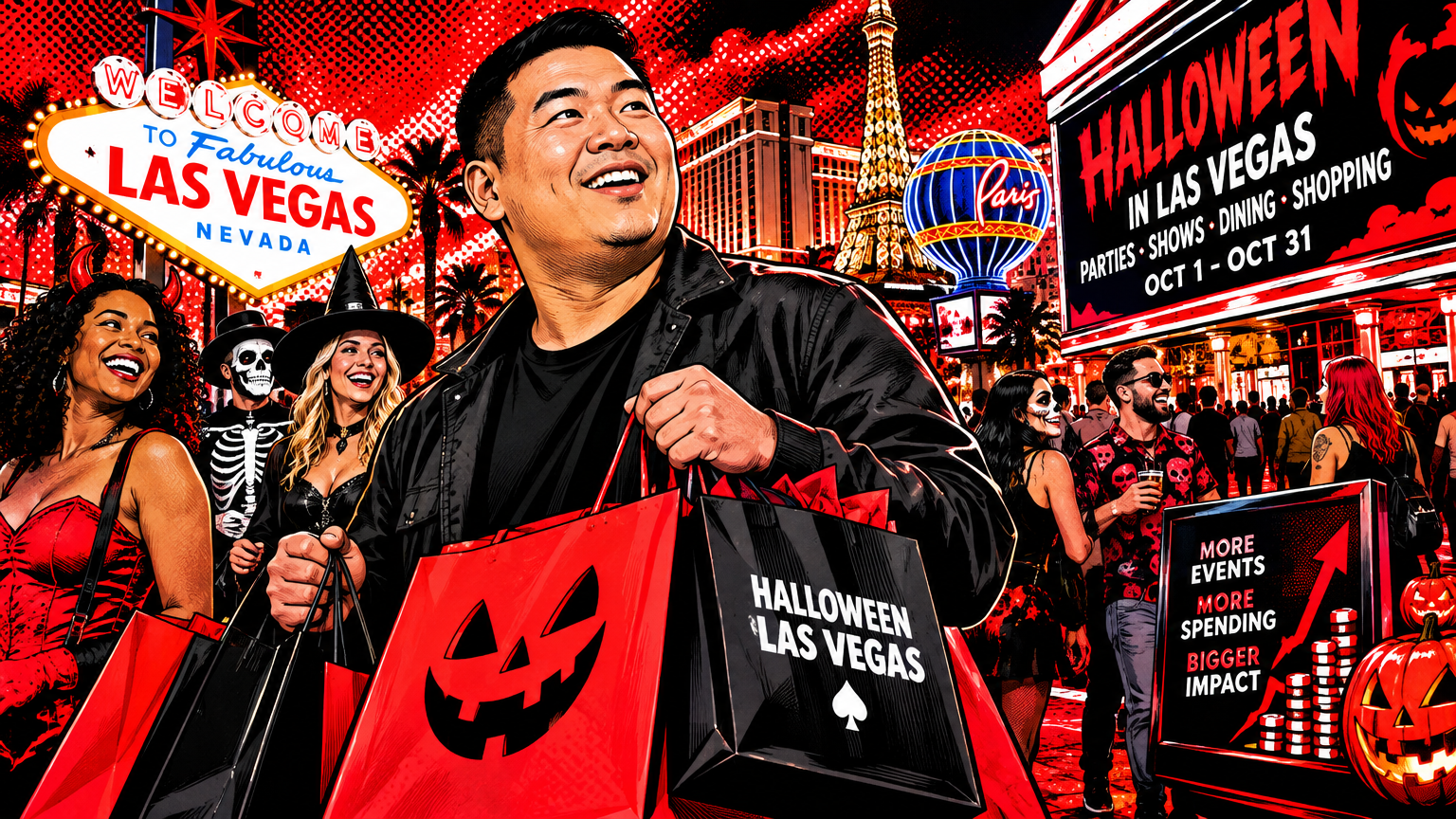
In Las Vegas, Halloween has become a month-long commercial season built around hotel rooms, haunted attractions, cocktails, restaurants, costumes, rides, nightlife, retail, transportation and premium experiences.
The costume might get somebody out the door.
The real money starts moving after that.
And the numbers are much bigger than most people realize.
Halloween Is Now a $13.5 Billion American Business
Start with the national market.
The National Retail Federation expects Americans to spend $13.5 billion on Halloween in 2026.
That comes after a record $13.1 billion in 2025.
The average consumer celebrating Halloween expects to spend $115.14 this year.
And the money isn't concentrated in one category.
| 2026 Halloween Spending Category | Expected U.S. Spending |
|---|---|
| Costumes | $4.4 billion |
| Decorations | $4.3 billion |
| Candy | $4.1 billion |
| Greeting cards | $800 million |
Seventy-four percent of consumers plan to celebrate Halloween.
Half plan to wear a costume.
Forty-two percent plan to decorate their home or yard.
Forty-two percent plan to carve pumpkins.
And here is the number that matters when you are trying to understand why Halloween suddenly seems to arrive before summer is completely gone:
Forty-nine percent of Halloween shoppers started shopping in September or earlier.
The market moved backward on the calendar.
Businesses followed.
That is how one night became a season.
Las Vegas Adds an Entire Second Economy to Halloween
Those national numbers are impressive.
They also miss the most important part of the Las Vegas story.
The National Retail Federation is measuring Halloween consumer purchases such as costumes, candy and decorations.
It is not calculating what somebody spends because Halloween gave them a reason to come to Las Vegas.
That is a different wallet.
A Las Vegas Halloween customer can spend money on:
- Airfare
- Hotel rooms
- Resort spending
- Rideshare
- Parking
- Dinner
- Drinks
- Haunted attractions
- Nightclubs
- Special events
- Retail
- Late-night food
- Gaming
The Halloween purchase may be the costume.
The Halloween economy is everything that happens because the person puts it on.
There is no credible published figure isolating the total economic impact of Halloween on Las Vegas.
So we are not going to invent one.
We do not need to.
The surrounding numbers already show the size of the machine Halloween plugs into.
October Already Sits on Top of a Massive Las Vegas Economy
Look at October 2025.
According to Las Vegas tourism data, the city welcomed 3,409,100 visitors that month.
Convention attendance reached 603,600.
Hotel occupancy averaged 83.7%.
The average daily room rate was $203.88.
Las Vegas sold roughly 3,895,800 occupied room nights during the month.
Meanwhile, Clark County casinos won approximately $1.17 billion from gamblers in October, while the Las Vegas Strip alone generated about $748.9 million in gaming win.
Average daily vehicle traffic at the California-Nevada border reached 43,194 vehicles.
That matters because Southern California remains one of Las Vegas' most important feeder markets.
Halloween is not being asked to build an economy from zero.
It arrives in a city that already moves millions of visitors and more than a billion dollars in monthly gaming revenue.
The opportunity is simpler.
Give those people another reason to spend.
Almost $800 Million in Implied October Hotel Revenue
Here is where the scale becomes easier to see.
Las Vegas reported approximately 3.896 million occupied room nights in October 2025 at an average daily room rate of $203.88.
Multiply those two reported metrics and you get roughly $794.3 million.
That is not an official Las Vegas hotel-revenue figure. It is a simple Extra Super! BIG® calculation based on reported occupied room nights and average daily rate.
But it gives us a useful sense of scale.
Nearly eight hundred million dollars of implied room spending flowed through the destination in one October.
Now add restaurants.
Add bars.
Add attractions.
Add shopping.
Add rideshare.
Add gambling.
Add nightlife.
That is the commercial platform Halloween gets to stand on.
Halloween Falls on Saturday in 2026
The calendar handed Las Vegas an unusually clean opportunity this year.
Halloween is Saturday, Oct. 31.
That matters.
Las Vegas is already a weekend-driven destination.
For all of 2025, citywide weekend hotel occupancy averaged 88.8%, according to the Las Vegas Convention and Visitors Authority.
Midweek occupancy averaged 76.6%.
A Saturday Halloween removes one of the biggest barriers to holiday travel.
Most customers do not need to leave work early on Oct. 31.
They do not need to decide whether to stay out late on a Tuesday.
They have Friday night, Halloween Saturday and Sunday morning sitting together naturally.
For hotels, bars, restaurants, clubs and attractions, that gives the holiday room to become a full weekend product.
The Real Vegas Trick Is Selling the Same Customer More Than Once
This is where Las Vegas has an advantage almost no normal Halloween market can match.
A haunted house in another city may sell one ticket.
Las Vegas can sell an entire sequence.
A visitor checks into a hotel.
That visitor orders lunch.
They take a rideshare to an attraction.
They buy a ticket.
They upgrade the ticket.
They buy a drink.
They buy dinner.
They go to a party.
They buy another drink.
They stop for food after midnight.
They return to the resort.
Maybe they gamble.
Maybe they shop the next morning.
One Halloween decision created transactions across multiple businesses.
That is the real model.
Halloween is the traffic generator.
Las Vegas monetizes the trip.
From Free to $1,935: The Halloween Pricing Ladder
One of the clearest signs that Halloween has matured as a business is the range of prices consumers can now choose from around Las Vegas.
There is no single Halloween customer.
Operators are building products for families, casual visitors, horror fanatics, nightlife customers and premium buyers.
| Halloween Experience | 2026 Price Structure | Business Model |
|---|---|---|
| Vegas Pumpkin Patch | Free admission and parking | Bring people in free, then monetize rides, games and food. |
| Halloween Town | $5 admission | Low entry barrier, followed by paid rides and games. |
| HallOVeen at Opportunity Village | $24 admission | Bundled family attraction with a clear admission price. |
| Freakling Bros. Horror Shows | $50-$60 Freak Pass | Core haunted-house package with higher peak-night pricing. |
| Freakling Bros. All Night Pass | $120 | Premium access for customers who want more. |
| Freakling Bros. Season Pass | $320 | Turn one customer into a repeat customer all season. |
| Universal Horror Unleashed Fraidy Cat | From $19 | Monetize visitors who want atmosphere without the haunted houses. |
| Universal Horror Unleashed One-Time Access | From $59 | Standard admission with one visit to each house. |
| Universal Horror Unleashed Unlimited Access | From $89 | Upsell the customer from access to repeat access. |
| ScAREA15 General Admission | $46.82 | Entry to the core Halloween event. |
| ScAREA15 Attractions Bundle | $92.60 | Combine admission with additional attractions and arcade value. |
| ScAREA15 GA+ | $125.30 | Sell convenience and better viewing. |
| ScAREA15 Standard Table Package | $1,935 | Turn Halloween into a premium hospitality product for up to six guests. |
Look at that range.
Free.
Five dollars.
Nineteen dollars.
Fifty dollars.
One hundred twenty dollars.
Three hundred twenty dollars.
Nearly two thousand dollars.
Same holiday.
Completely different customers.
That is what a mature market looks like.
Free Admission Is Not the Same as Free
Vegas Pumpkin Patch offers one of the cleanest examples.
Admission is free.
Parking is free.
The hay maze, kids activity center, photo opportunities and Halloween-night trick-or-treating are free.
Then the paid economy begins.
Rides cost money.
Games cost money.
Food costs money.
That is not a flaw in the model.
That is the model.
Free admission removes friction.
A family can walk onto the property without first doing a four-person ticket calculation.
Once inside, the customer decides where to spend.
Maybe the kids want rides.
Maybe somebody buys funnel cake.
Maybe everybody plays games.
The business trades a front-door admission charge for a larger pool of potential transactions.
It is customer acquisition disguised as a pumpkin patch.
Fear Has an Upsell Button
Freakling Bros. takes another approach.
The basic Freak Pass runs $50 on certain nights and $60 during higher-demand periods.
An All Night Pass costs $120.
A season pass costs $320.
The core product is fear.
The upsells are access, frequency and convenience.
Universal Horror Unleashed does the same thing from another angle.
A customer who wants the environment but does not want to enter the haunted houses can buy a Fraidy Cat ticket starting at $19.
One trip through each haunted house starts at $59.
Unlimited house access starts at $89.
One venue.
Three levels of courage.
Three levels of revenue.
This is basic price segmentation, but Halloween makes it unusually natural.
The customer does not feel like they are buying a spreadsheet tier.
They are deciding how much fear they want.
AREA15 Shows How High the Ceiling Can Go
Then there is the nightlife side.
At ScAREA15: Strange Circus, early general admission is currently listed at $46.82.
A package combining admission with additional attractions costs $92.60.
GA+ with expedited entry and VIP viewing is $125.30.
Then the pricing jumps.
A standard table package for up to six guests is listed at $1,935, including a $700 beverage spend.
That is the same Halloween night being sold at radically different economic levels.
The general-admission customer is buying access.
The GA+ customer is buying convenience and position.
The table customer is buying territory.
That is classic Las Vegas.
Once demand exists, create layers above it.
The Best Halloween Businesses Do Not Sell One Product
This is the lesson operators should study.
A strong seasonal business can have:
- A low-friction entry product
- A standard paid product
- A premium upgrade
- Food and beverage
- Merchandise
- Repeat-visit products
- VIP access
- Group packages
The customer chooses the level.
The operator captures more than one type of buyer.
Halloween makes this particularly effective because the holiday attracts families at noon, horror fans after dark and nightlife customers at midnight.
Those are not the same markets.
Vegas can monetize all of them.
Halloween Also Turns Empty Retail Space Into Revenue
Halloween has another business trick that rarely gets discussed.
It can temporarily revive commercial real estate.
Spirit Halloween says it has opened more than 1,550 seasonal stores across North America for 2026.
The company announced plans to hire more than 52,000 seasonal employees for the season.
That model is built around temporary occupancy.
A large storefront becomes vacant.
A seasonal retailer moves in.
For a few months, dead square footage becomes productive again.
Rent gets paid.
Workers get hired.
Inventory moves.
Customers return to a building that might otherwise sit dark.
Then the operation disappears after Halloween.
It is one of the most efficient examples of pop-up retail at national scale.
And it works because Halloween demand is intense, predictable and temporary.
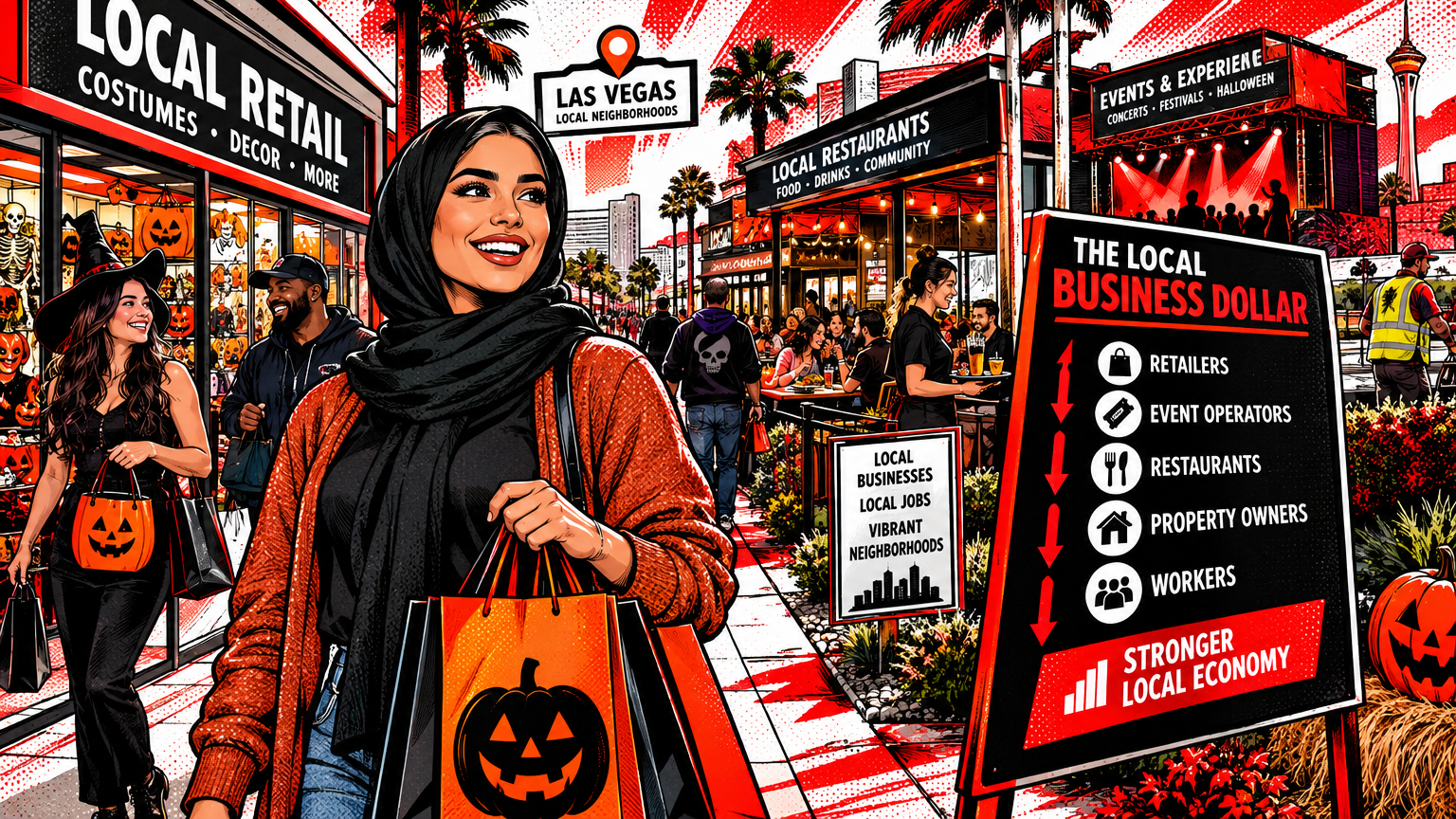
Small Businesses Are Getting a Bigger Piece of Halloween
There is another number Las Vegas business owners should pay attention to.
According to the National Retail Federation, 13% of consumers plan to make Halloween purchases at local and small businesses in 2026.
A decade ago, that figure was 7%.
It has nearly doubled.
That matters in Las Vegas because Halloween spending does not belong only to casinos and giant attractions.
There are opportunities for:
- Local restaurants
- Bars
- Bakeries
- Coffee shops
- Candy shops
- Costume designers
- Makeup artists
- Hair stylists
- Photographers
- DJs
- Event producers
- Decorators
- Florists
- Party rental companies
- Food trucks
- Tattoo shops
- Neighborhood retailers
A neighborhood bakery does not need to compete with Universal Horror Unleashed.
It needs a Halloween product people want to buy.
A bar does not need to build a haunted house.
It can create a cocktail menu and a reason to visit twice.
A photographer does not need a million-dollar attraction.
They need a set, a booking calendar and customers in costume.
The opportunity gets much larger when businesses stop thinking of Halloween as Oct. 31.
The Money Starts Moving Before October
This may be the most important business shift of all.
Almost half of Halloween shoppers began shopping in September or earlier this year.
That changes when businesses need to act.
If your first Halloween promotion appears Oct. 27, you are late.
The customer may already have the costume.
The party may already be booked.
The attraction tickets may already be purchased.
The weekend plan may already exist.
Seasonal businesses are not competing only for money.
They are competing for a place on the calendar.
That sale can happen weeks before the customer actually shows up.
Artificial Intelligence Is Entering the Halloween Sales Funnel
The discovery process is changing too.
Forty-seven percent of consumers surveyed by the National Retail Federation said they are using artificial intelligence tools to help with Halloween shopping in 2026.
Thirty-four percent are using them to brainstorm ideas.
Thirty-two percent are using them for recommendations or product research.
That changes how businesses need to think about being discovered.
A customer may no longer search only:
"Halloween bar Las Vegas."
They may ask:
"Where should my girlfriend and I go for a spooky date in Las Vegas that isn't a nightclub?"
Or:
"What Halloween attractions in Las Vegas are good for teenagers?"
Or:
"Build me a Halloween night in Vegas for under $200."
The businesses with clear prices, hours, descriptions, structured pages and useful information have a better chance of appearing in those answers.
Halloween now has an AI discovery layer sitting between the customer and the cash register.
Las Vegas Has More Than $50 Billion of Annual Visitor Spending to Fight Over
Zoom out even farther.
Las Vegas welcomed about 38.5 million visitors in 2025, according to the Las Vegas Convention and Visitors Authority.
Those visitors generated approximately $50.8 billion in direct visitor spending.
The total economic impact of Southern Nevada tourism was estimated at $80.9 billion.
That is the bigger prize.
Halloween does not have to create new spending categories from scratch.
It can redirect part of the money visitors were already prepared to spend.
The hotel was going to sell rooms.
Now it can sell a Halloween weekend.
The bar was going to sell drinks.
Now it can sell a themed experience.
The restaurant was going to serve dinner.
Now it can create a seasonal menu.
The attraction was going to sell admission.
Now it can create a limited-time reason to return.
That is how a holiday becomes an economic multiplier without needing to own every transaction.
Why Halloween Matters Even More in 2026
Las Vegas enters this October in an interesting position.
Through August 2026, overall visitation was roughly flat compared with the same period a year earlier.
August itself was softer, with about 3 million visitors and a year-over-year decline of 4.3%.
Convention attendance, however, was up 10.5% through the first eight months of the year.
Gaming revenue has also remained resilient even as some visitor metrics have softened.
That creates a clear incentive.
Las Vegas needs reasons for people to come.
More importantly, it needs reasons for people who are already here to spend.
Halloween can do both.
A Saturday Halloween gives operators a strong event date.
A month-long season gives them much more.
The Hidden Winners Are Everywhere Around the Main Event
When people think about Halloween revenue, they naturally think about whoever sold the ticket.
That is only the center of the circle.
Look outside it.
A haunted attraction needs employees.
It may need security.
It buys supplies.
It buys advertising.
It may hire performers.
It may use food vendors.
Customers need transportation.
Customers eat before or after.
Customers buy costumes somewhere else.
Customers may stay overnight.
Customers may visit another attraction while they are here.
This is why the total value of Halloween to Las Vegas is difficult to isolate.
The spending leaks into everything.
That is also why the opportunity is so large.
There Are Winners and There Are Missed Opportunities
The businesses positioned to win Halloween tend to do a few things well.
They start early.
They make the offer easy to understand.
They create more than one price point.
They give customers something worth photographing or sharing.
They create urgency with limited dates.
They sell food, drinks, upgrades or repeat visits around the core product.
They make it easy to find accurate information online.
They give customers a reason to bring somebody else.
The missed opportunity looks different.
A generic orange cocktail added Oct. 30.
A costume contest nobody hears about.
A social media post with no price, no time and no clear offer.
A business waiting for Halloween night instead of selling Halloween season.
The market is too developed for that now.
The Bigger Business Shift Is From Products to Experiences
The $13.5 billion national Halloween market is still driven by physical things.
Candy.
Costumes.
Decorations.
But Las Vegas has the infrastructure to move the holiday beyond products.
Here, fear can be an attraction.
A cocktail can be theater.
A pumpkin patch can become a carnival.
A nightclub can become a costume spectacle.
A vacant store can become a temporary retail operation.
A normal weekend can become a travel reason.
That is where Las Vegas is strongest.
The city knows how to turn an idea into something people can enter, photograph, drink, eat, share and upgrade.
Halloween Does Not Need to Be Huge for Every Business
This point matters for small operators.
You do not need to build a massive event.
You need a profitable reason for the right customer to choose you.
A bakery can sell a limited Halloween box.
A neighborhood bar can run one strong seasonal menu for four weeks.
A photographer can build a Halloween portrait package.
A restaurant can create one themed night.
A salon can sell Halloween makeup appointments.
A coffee shop can launch three drinks and a photo wall.
A tattoo shop can run a flash event.
A local retailer can bundle costumes, decorations or gifts.
The opportunity is not about copying the Strip.
It is about catching part of the traffic the holiday creates.
The Business of Halloween Is Time
At its core, the biggest change is not costumes.
It is not haunted houses.
It is not giant skeletons in front yards.
It is time.
Halloween used to occupy a night.
Retailers pushed it into September.
Attractions stretched it across October.
Bars created month-long pop-ups.
Families turned it into weekend outings.
Nightlife turned it into multi-night events.
Tourism turned it into a trip.
Every additional day creates another chance to sell.
That is how the economics changed.
Las Vegas Does Not Sell Halloween Once
That is the final point.
Las Vegas does not need one giant Halloween transaction.
It sells the room.
Then the meal.
Then the ride.
Then the attraction.
Then the upgrade.
Then the drink.
Then the party.
Then the late-night food.
Then another night in the hotel.
The costume gets the customer out of the room.
The business model begins after that.
Halloween may still end at midnight on Oct. 31.
The money machine starts weeks earlier.