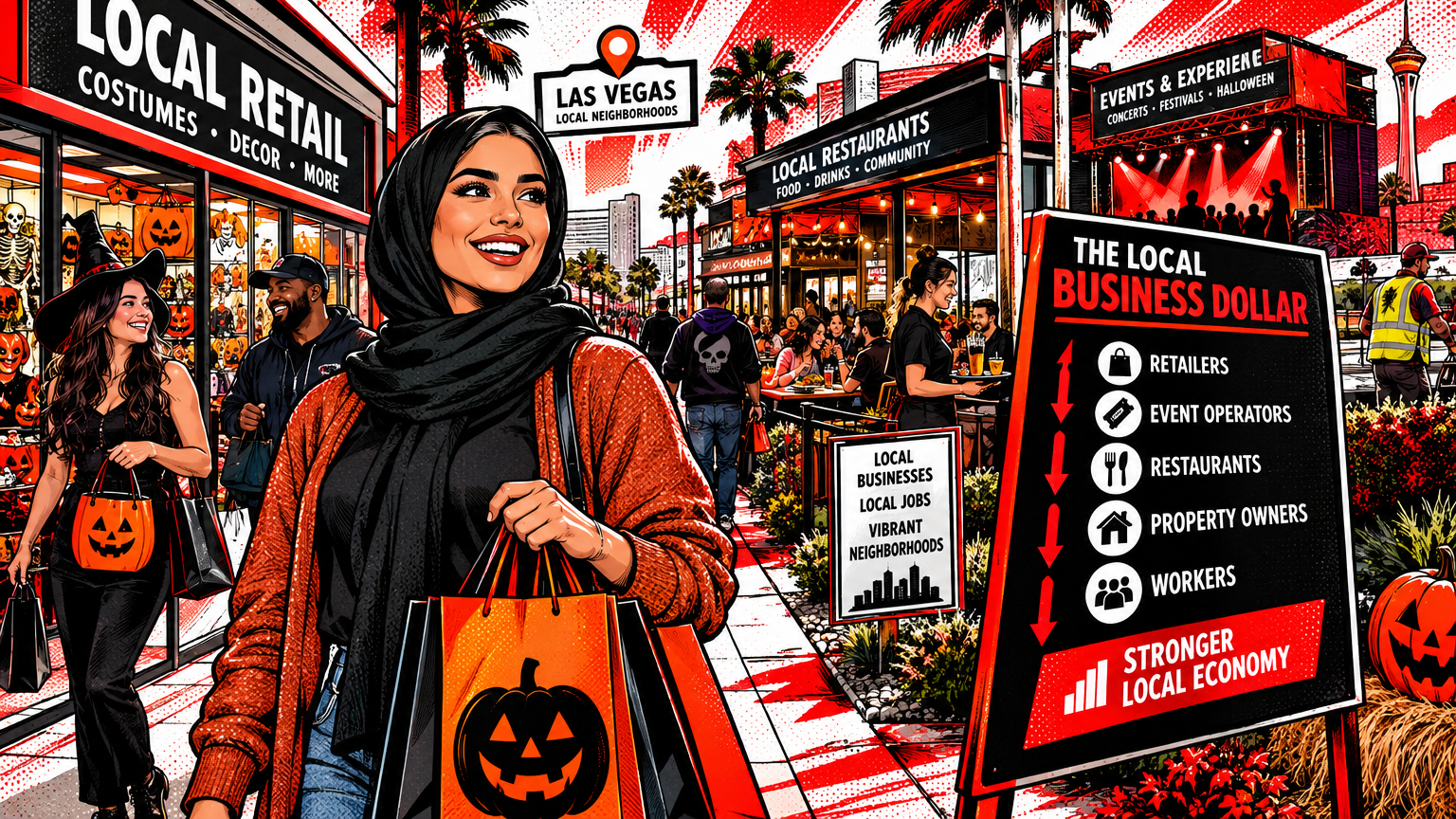
The money question is not how big Halloween looks on a busy weekend. It is how much of each sale stays in the Las Vegas Valley after the customer leaves. Retailers, event operators, restaurants, property owners and workers can all benefit, but a ticket sold or costume purchased does not tell you who ultimately keeps the revenue.
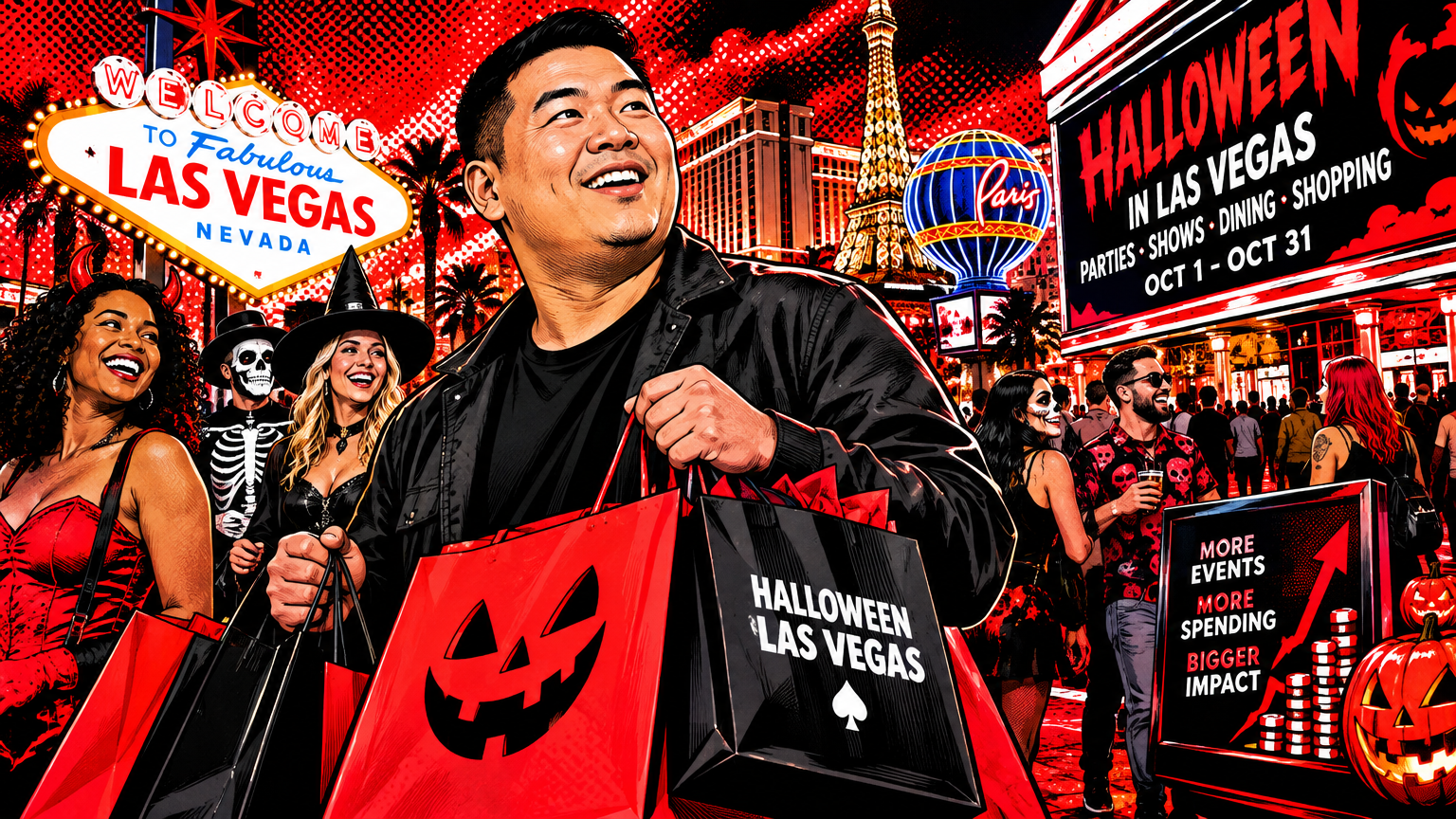
There is no published Las Vegas Halloween spending total in the local tourism indicators reviewed here. National numbers show the holiday has serious retail scale: the National Retail Federation’s 2026 consumer survey projects $13.5 billion in U.S. Halloween spending. That is a national estimate, not a Las Vegas figure, and it does not measure how much money stays with local businesses.
That distinction matters. A valley business can ring up a strong seasonal sale while much of the value flows to outside suppliers, national owners, property costs or service platforms. The local play is to convert Halloween demand into local payroll, nearby purchasing and customers who return after the decorations come down.
Where the Halloween dollar enters the market
Halloween spending reaches the local economy through several channels. Customers buy costumes, candy, decorations and party supplies. They pay for events and food. Businesses hire workers, stock inventory and promote seasonal offerings. Each transaction starts a chain of payments, and each link has a different local footprint.
Retail puts the sale in plain sight
Costumes, candy and decorations are the clearest Halloween purchases. The national survey points to the scale of those categories: NRF estimates U.S. spending in 2026 at $4.4 billion for costumes, $4.3 billion for decorations and $4.1 billion for candy. These figures describe the country as a whole, not Southern Nevada. They do show why the holiday matters to retailers competing for a concentrated run of seasonal demand.
Local and small businesses have a place in that market, but not a guaranteed win. NRF reports that 13% of consumers plan to make Halloween purchases at local or small businesses nationally. Discount stores and specialty costume stores remain more common shopping destinations in the same survey. The practical takeaway for Las Vegas operators is direct: a local address alone does not capture spending. Selection, price, convenience and the ability to reach the customer still decide the sale.
Inventory is the margin test. A store that buys too heavily can be left marking down seasonal goods after demand fades. A store that under-orders misses sales during the short peak. Payroll, rent, shipping, payment processing and unsold stock all sit between revenue and profit. The register total is not the owner’s take-home number.
Events can create more than one transaction
Haunted attractions, neighborhood celebrations and seasonal pop-ups can sell admission and add spending on food, merchandise, parking or vendor space. They can also put nearby restaurants and shops in front of customers who may not have planned to visit them. That second transaction is where a crowd gains leverage for a commercial district.
Turnout alone does not establish local impact. The outcome depends on who operates the event, who controls the venue, where supplies come from and how revenue is divided among payroll, rent, fees and other costs. A customer who buys a ticket and then eats at a nearby independent restaurant creates a wider local chain than a visitor whose spending ends at the gate. That is a business-model distinction, not a claim that one event or operator necessarily produces a particular amount of local benefit.
Who keeps the money after the sale?
Revenue does not remain intact with the business that collects it. It pays for goods, labor, occupancy, utilities, insurance, marketing and transaction services before any profit is calculated. Some costs support workers and suppliers in the valley. Others may flow to companies or owners elsewhere. Without business-level data on ownership and purchasing, there is no credible way to assign a precise local-retention percentage to Halloween sales.
Workers and suppliers are part of the return
Seasonal activity can generate shifts in retail, food service, event setup, security, cleaning and customer service. Those wages put money into household budgets. But the number of shifts, pay and duration vary by employer. A short burst of hiring is not the same as a stable job, and a busy event does not reveal how much labor income it produced.
Purchasing choices also shape the return. An event or shop that hires local contractors, buys from nearby vendors and uses valley-based services keeps more transactions close to home than one relying almost entirely on outside suppliers. The distinction is practical. Local sourcing can support other businesses, but it still has to meet the operator’s cost, quality and timing requirements.
Ownership matters, but it is not the whole scorecard. A locally owned retailer can purchase most of its inventory from outside Nevada. A national chain can employ local residents and pay local operating costs. A franchise can combine local ownership with payments to a parent company. The sharper questions are who receives the revenue, who gets paid, where the goods and services are sourced, and whether the customer comes back.
Landlords and nearby businesses have a different stake
Property owners can benefit when an event or seasonal promotion draws visitors to a shopping center or commercial district. More traffic can help tenants find customers and give a landlord a stronger leasing story. But foot traffic is an input, not a profit report. Tenants still need sales sufficient to cover their fixed costs, and event-related parking, cleanup or congestion can create operating burdens that somebody has to manage.
Restaurants may gain when customers pair an outing with dinner or drinks. Proximity helps, but so do service capacity, access and timing. If a business cannot handle a rush, neighborhood activity does not automatically become its revenue. The operator has to capture the customer in the moment and deliver a reason to return.
How seasonal traffic becomes durable value
The strongest operators treat Halloween as customer acquisition, not a one-night windfall. An event can introduce visitors to a district and give them a reason to return. A retailer can build relationships with shoppers who also need gifts, party supplies or home goods through the year. A restaurant can turn a seasonal first visit into a repeat customer. Those are strategic opportunities, not guaranteed outcomes.
The local data has limits. The Las Vegas Convention and Visitors Authority’s published research tracks broad tourism indicators and visitor profiles. That is valuable context for the regional economy, but it does not isolate Halloween spending outside the Strip or tell readers how much of a specific Halloween dollar stays local. National consumer intentions cannot fill that local measurement gap.
For businesses, the next move is to measure what can be controlled: event attendance that becomes nearby purchases, repeat visits, inventory sell-through, labor costs and local vendor spending. For customers, spending at a locally owned business can support local operators, but ownership alone does not prove where every dollar goes. The full chain is the better test.
Halloween outside the Strip is not a simple contest between the resort corridor and neighborhood businesses. It is a distributed market, with retailers, restaurants, event operators, landlords, workers and suppliers competing for pieces of seasonal demand. The businesses that manage costs, build direct customer relationships and connect visitors to more than one local transaction are best positioned to turn a seasonal spike into lasting value. That is the money move for a stronger Las Vegas business base.