Prizm Outlets Shows Primm’s Collapse in Retail Form
An Empty Mall Tells a Different Kind of Story
A closed casino floor can tell one kind of story.
An empty outlet mall tells another.
Prizm Outlets shows what happens after the main attraction stops pulling hard enough and the businesses around it lose the traffic they were built to catch. The mall is not just a quiet retail center at the California-Nevada border. It is physical evidence of Primm’s larger economic unraveling.
The old Primm was built as a stopover machine. Travelers could gamble, eat, sleep, shop, fuel up, and keep moving. The whole system depended on gravity. The resort properties pulled people off Interstate 15. Once they stopped, other businesses had a chance to capture spending.
Prizm Outlets was part of that ecosystem.
It was not supposed to survive alone in the desert.
That is the point.
The mall’s decline shows that Primm’s crisis was never limited to gaming. It moved into retail, real estate, tourism, roadside services, and the wider I-15 border economy. When the anchor weakens, the satellites feel it. Prizm Outlets is what that looks like when the lights go dim, and the storefronts stop meaning what they used to mean.
I look at Prizm as more than a dead mall.
It is stranded capital sitting beside a corridor that no longer converts the way it used to.
A Dead Mall Tells a Different Story
Empty Retail Is Stranded Infrastructure
A closed resort property shows failure at the anchor level.
A dead mall shows the second wave.
That second wave is where Prizm Outlets matters. Retail does not collapse in isolation when it is built around a larger destination system. It depends on traffic, but not just any traffic. It needs shoppers. It needs people willing to stop, park, walk in, browse, compare prices, carry bags, and spend time.
Passing vehicles are not enough.
That is the Prizm problem.
The mall sits near one of the most recognizable travel corridors in the West, but visibility did not save it. A full highway cannot fill an empty mall by itself. The cars have to become customers. The customers have to become shoppers. The shoppers have to spend enough to justify the space.
When that conversion breaks, the square footage becomes heavy.
Vacant retail space is not neutral. It still carries costs. It still needs security, maintenance, insurance, utilities, repairs, cleaning, and some kind of redevelopment plan. Empty storefronts also carry psychological cost. They tell travelers, tenants, investors, and nearby operators that the place has lost motion.
That is why Prizm Outlets is important.
It did not just lose stores.
It lost the commercial gravity that made the stores make sense.
The Mall Makes the Numbers Visible
Primm’s decline can be explained through revenue, traffic, operating costs, and customer behavior.
But a dead mall makes it visible.
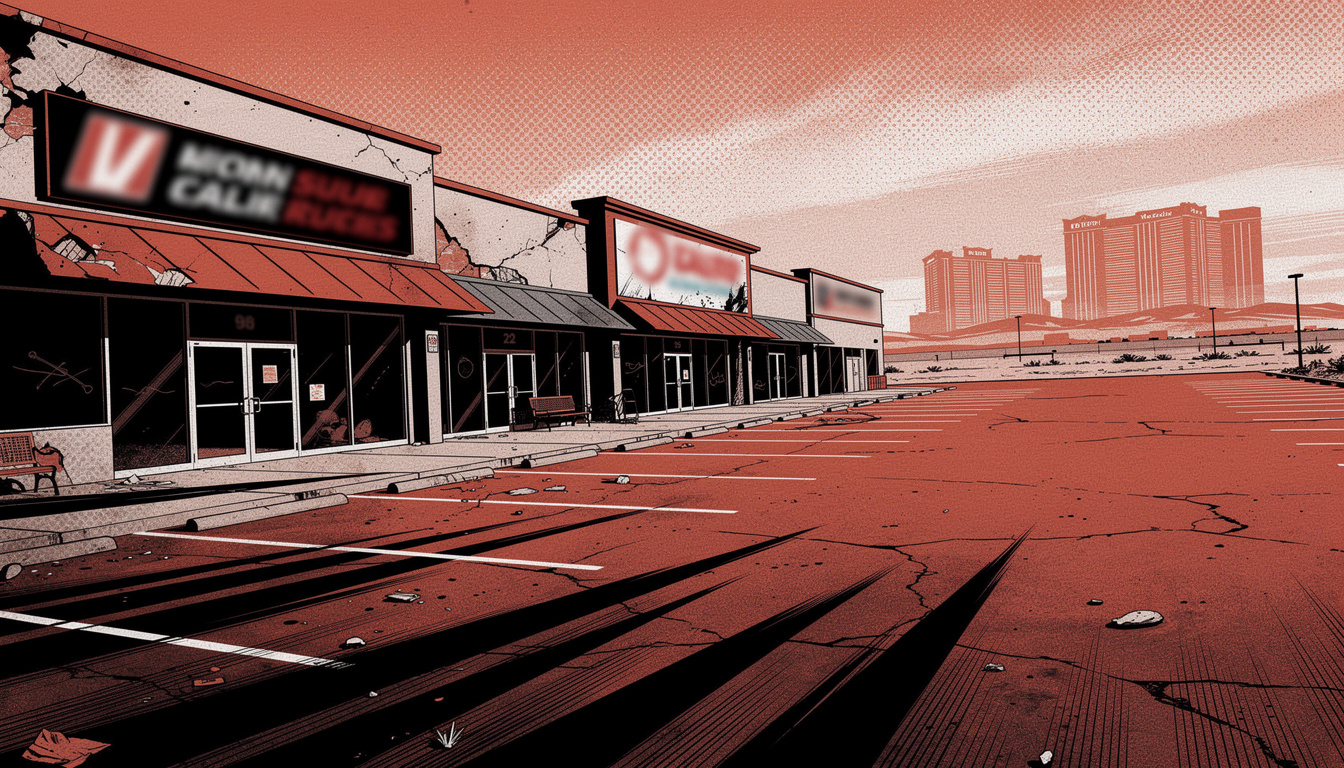
Empty parking lots. Dark windows. Long corridors. Faded signs. Retail spaces that once needed brands, shoppers, and foot traffic now sitting in silence. That is a different kind of evidence. It shows the market’s decision in physical form.
The mall becomes a balance sheet people can walk through.
That is why Prizm is not just background scenery in the Primm story. It is one of the clearest signs that the old system failed beyond the gaming floor.
Prizm Was Built for a Stronger Primm
The Mall Needed the Town to Work
Prizm Outlets was built for a stronger version of Primm.
That matters.
It was not a bad idea in the old Primm. It became a bad fit when the old Primm stopped functioning. Outlet retail made more sense when the town had more energy, stronger hotel traffic, more roadside confidence, and a larger base of travelers willing to stop before reaching Las Vegas.
The mall did not need to create every visit by itself.
It needed the larger Primm machine to work.
That machine included resort properties, hotel rooms, food options, gaming, roadside visibility, and the feeling that Primm was a real stop, not just a place to pass. Shopping made sense inside that cluster. A traveler could stop for one reason and spend for another.
That was the model.
A family could stop for food and walk into the outlets.
A traveler could book a room and shop before leaving.
A visitor could come for gaming and buy something on the side.
A road-trip stop could become a shopping stop.
That only works when the exit feels alive.
Prizm Depended on a Cluster, Not Isolation
Outlet malls work best when they are connected to a stronger customer ecosystem.
That can be a major city. A tourist district. A resort area. A strong suburban retail zone. A destination shopping corridor. Or a travel stop with enough constant activity to support retail.
Prizm had the border-town version of that idea.
It depended on Primm being active enough to generate spillover. The mall was not meant to sit as a lonely retail island in the desert. It was meant to be one more reason to stop inside a larger commercial cluster.
Once the cluster weakened, the mall’s own weakness became exposed.
That is the lesson.
Retail that depends on an anchor has to worry about the anchor first.
Outlet Shopping Changed Too
Prizm Got Hit From Both Sides
Prizm’s decline was not only about Primm.
Retail changed, too.
That is where the story gets sharper. The mall was not just fighting a weaker border-town economy. It was also fighting a changing shopping market. Online retail kept growing. Shoppers became more selective. Stronger outlet options closer to Las Vegas gave visitors and locals better choices. Tourists did not have to stop 40 miles outside the city to shop when more convenient options existed closer to their hotel, home, or route.
Prizm got hit from both sides.
The Primm stopover economy weakened.
The outlet-shopping model changed.
That combination is hard to survive.
A remote outlet mall needs a strong reason to exist. It needs pricing power, brand draw, tenant strength, convenience, and enough traffic that behaves like actual shoppers. If one of those factors weakens, the property can struggle. If several weaken at once, the model starts breaking.
That is what happened here.
Retail Did Not Stand Still
Retail did not stand still while Primm weakened.
That is the part investors and operators have to respect. A property can make sense when it opens and become mismatched years later. The market changes around it. The customer changes. Competition improves. Online shopping reshapes expectations. The old traffic pattern loses value.
Prizm was built for one era and left to fight in another.
That is not unique to Primm. Dead malls across the country tell a similar story. But Prizm’s location makes the case more extreme. It was not sitting in the middle of a dense metro area where a new tenant mix could easily chase nearby residents. It was tied to a border corridor and a weakened stopover town.
That makes repositioning harder.
It also makes the business lesson clearer.
A mall cannot survive on old assumptions if the customer no longer behaves the same way.
Traffic Without Shoppers Is Not Retail Demand
A Full Highway Cannot Fill an Empty Mall by Itself
I-15 still matters.
That does not mean Prizm had enough retail demand.
This is the same conversion problem that sits underneath the larger Primm story. Traffic is only useful when it converts into the behavior a business needs. For a gas station, conversion may only require a driver to stop for fuel. For a fast-food restaurant, it may require a quick meal. For a mall, the bar is higher.
Retail needs time.
It needs browsing.
It needs intent.
It needs enough stores to make the stop worthwhile.
It needs the customer to believe that getting out of the car is worth it.
That is a harder conversion in a corridor where travelers are increasingly focused on speed and utility. A driver passing Primm may still need fuel, coffee, food, or a restroom. That does not mean the driver wants to walk through an outlet mall.
Prizm needed shoppers.
The corridor was increasingly producing passersby.
Retail Demand Begins When a Driver Becomes a Shopper
A vehicle is not a shopper.
A traveler is not automatically a customer.
A parking lot is not revenue unless people get out and spend.
That sounds basic, but it is the whole story. Prizm had visibility, but visibility did not create enough buyer behavior. It had location, but location did not overcome the weakening Primm ecosystem. It had square footage, but square footage becomes a liability when it cannot attract tenants and customers.
Retail demand begins when a driver becomes a shopper.
Prizm could no longer make that conversion often enough.
Anchor Gravity Was the Real Problem
When the Anchor Weakens, the Satellites Feel It
Prizm did not fail alone.
It failed after the ecosystem around it stopped producing enough customer gravity.
That is the real estate lesson. Retail centers near major attractions often depend on the health of those attractions. The stores may have separate leases, brands, signs, and doors, but the demand is connected. If the anchors pull less traffic, the smaller businesses become exposed.
Primm’s resort properties, hotel guests, events, food stops, and road-trip energy all helped create potential shoppers.
As those anchors weakened, the mall lost support.
That is why Prizm Outlets is so important to understanding Primm. It shows that the town was not a group of separate businesses that happened to sit near each other. It was an interconnected commercial system. When the main engine lost strength, the surrounding pieces started losing theirs too.
The mall is the retail version of that failure.
The Satellites Need the Center to Hold
A satellite business can survive without the anchor only if it has its own strong demand.
The Lotto Store had a clear reason for customers to come. A fuel stop can have a clear reason. A strong travel center can have a clear reason. But outlet retail in a remote corridor has a harder job if the surrounding activity is declining.
Prizm needed the center to hold.
The center did not hold.
That is why its collapse matters beyond retail. It warns every future operator in Primm that the next model must create real customer behavior, not just occupy old space. The corridor does not reward square footage by itself. It rewards use.
Sanithrift Shows the Survival Version of Prizm
Survival Retail Is Not the Same as Revival
Sanithrift represents the survival version of Prizm.
That is not the same as revival.
A thrift model can fit distressed retail differently than traditional outlet brands. Value-driven customers may be more intentional. The store does not need the same polished outlet environment to make sense. It can operate with a different cost structure, different customer expectations, and a different relationship to the property.
That matters because it shows there may still be some use inside the asset.
But it also proves the old model is gone.
One active tenant does not mean the outlet mall has returned. It means one practical use has found a way to survive inside a much larger failed retail environment. That is a very different story.
The Surviving Model Is Smaller and More Practical
The surviving version of Prizm is smaller, more practical, and less dependent on the old outlet fantasy.
That is important.
Sanithrift may show that the asset is not worthless. It may show that value-driven retail can still function in a limited way. It may show that certain customers will still come for a specific reason.
But it does not restore the old mall.
It reveals the next challenge: Can the rest of the property find uses that fit current demand, or will the old retail footprint keep sitting larger than the market around it?
That is now the core question.
Sanithrift may prove there is still some use in the asset.
It also proves the original category has broken.
The Mall Is a Real Estate Problem Now
The Use Has to Change With the Market
Prizm is no longer only a shopping-center story.
It is a land, structure, security, maintenance, and reuse problem.
That is what happens when retail demand falls too far. The question shifts from leasing to repositioning. A property owner can keep trying to fill empty spaces with the same kind of tenants, but if the market no longer supports the old model, the strategy has to change.
Large vacant retail buildings are expensive to hold.
Empty corridors need protection.
Parking lots need purpose.
Utilities need decisions.
Roofs, systems, pavement, signage, and common areas all become part of the cost burden.
That is why the mall’s future may not be shopping.
It may be storage, logistics, events, services, workforce support, training space, discount retail, staging, or partial redevelopment. The use has to change with the market.
From Leasing Problem to Repositioning Problem
A leasing problem asks: How do we fill these spaces?
A repositioning problem asks: What should this asset be now?
Prizm is in the second category.
That makes the future more difficult, but also more interesting. The property may not need another attempt at a traditional outlet comeback. It may need a practical role in a changing corridor. That could mean smaller uses, mixed uses, industrial support, public-private functions, workforce services, or a phased approach that activates only the portions that make economic sense.
That is less glamorous than a full retail revival.
It is also more realistic.
When a retail asset loses its customer base, the question shifts from leasing to repositioning.
What Could Prizm Become Next?
The Best Future May Not Look Like a Mall
Prizm’s best future may not look like a mall.
That is the most important redevelopment point.
A full traditional outlet revival is unlikely without a much stronger traffic engine. The old conditions that supported the property are not the same. Primm’s resort gravity has weakened. Shopping behavior has changed. Travelers are moving differently. The corridor is asking for practical uses, not old retail nostalgia.
That does not mean the property has no future.
It means the future has to be priced correctly.
Possible uses could include:
Storage
Logistics support
Discount retail
Indoor market concepts
Food hall or roadside dining
Workforce services
Training space
Events
Equipment staging
Travel-center support
Construction-support uses
Partial redevelopment
None of these are automatic. Every use would need capital, operations, demand, access, safety, and a realistic plan.
But they are more honest than pretending the old outlet model is ready to come back as it was.
Prizm Has to Stop Defending the Old Category
Prizm’s future depends on whether ownership can stop defending the old category and start pricing the next use.
That is the hard part.
Real estate owners often hold onto what a property used to be because the old identity is easier to understand. A mall is a mall. Stores go in it. Shoppers come. Rent gets paid. That is the old logic.
But when the market breaks that logic, the asset has to be rethought.
Prizm may be more valuable if it stops trying to be what it was. The property may need partial activation instead of full revival. It may need lower-intensity uses. It may need storage and services instead of national outlet brands. It may need to support the corridor instead of trying to entertain the corridor.
That is a different future.
It may be the only one that fits.
Prizm Is the Warning Sign for Primm’s Future
Empty Space Gets More Expensive Over Time
Prizm is what delay looks like in real estate form.
That is the warning.
Vacancy becomes harder to reverse the longer it lasts. Physical conditions decline. Tenants stop seeing opportunity. Customers stop forming habits. Security concerns grow. Maintenance costs pile up. Public perception gets worse. The property becomes known for emptiness, and that identity can be hard to shake.
Empty space gets more expensive over time.
Not always in obvious ways.
Sometimes the cost is physical.
Sometimes it is financial.
Sometimes it is psychological.
Prizm carries all three.
The Mall Warns Against Waiting Too Long
Prizm shows what can happen if Primm waits too long to reposition other assets.
Casinos, housing, retail, fuel, food, and services are connected. If the town goes dark, more pieces could follow the mall’s path. That is why keeping daily activity alive matters. A property can survive distress if it still has function. It becomes much harder if it becomes part of a larger vacancy narrative.
That is the lesson for the corridor.
The longer Primm waits to match its assets to real demand, the more expensive the reset becomes.
The mall is not just an example of failure.
It is a warning about timing.
The Mall Did Not Just Lose Stores. It Lost Purpose.
Prizm Needs a Reason to Exist in the Next Primm
Prizm Outlets matters because it shows Primm’s collapse in physical form.
The mall was built for a version of the town that still had commercial gravity. It needed resort traffic, stopover behavior, shoppers, outlet demand, and a broader ecosystem strong enough to support it.
That version of Primm is fading.
The mall cannot be revived by memory. It cannot be saved by pretending that passing traffic is enough. It cannot rely on the old idea that travelers will stop because they used to stop.
It needs a new reason to exist.
That reason may not be retail in the traditional sense. It may be practical reuse, partial activation, logistics support, workforce services, discount retail, travel-center support, or something tied to the future airport-adjacent corridor. Whatever the use becomes, it has to match the market Primm is becoming, not the one Primm used to be.
The Property Still Has to Earn Its Future
Prizm Outlets does not need another version of the past.
It needs a role in the future.
That is the real business challenge. The asset may still have land, structure, access, parking, and visibility. Those pieces matter. But they do not automatically create value. They have to be connected to a use that makes sense now.
The old mall lost stores.
Then it lost shoppers.
Then it lost purpose.
The next chapter has to reverse that order. First, define the purpose. Then find the users. Then rebuild the customer behavior around something the corridor actually needs.
Prizm Outlets does not need another version of the past.
It needs a reason to exist in the Primm that is coming next.