The Money Is Chasing More Than Tourists
Las Vegas remains one of the biggest food-and-beverage stages in the country, but the investment thesis has changed. The latest operators are not placing a single bet on weekend tourists. They are building concepts that can reach resort guests, convention traffic, locals, and online audiences from the same market.
The numbers explain the position. The Las Vegas Convention and Visitors Authority reports 38.5 million visitors and $50.8 billion in direct visitor spending over its latest measured period. The destination also carries roughly 150,300 hotel rooms. That is a deep customer pool before the first local walks through the door.
There is pressure in the market, too. The authority's latest data show trailing 12-month visitation below the prior-year period. That matters. A massive addressable market does not guarantee easy revenue. Restaurants still face labor, food, occupancy, marketing, and delivery costs. The operators making the strongest moves are pairing recognizable brands with controlled formats and built-in traffic.
Follow the money and three strategies come into focus. Food halls are aggregating proven concepts. Celebrity-backed fast casual is extending intellectual property into smaller footprints. International restaurant groups are using the Strip as a global launchpad. The valley is attracting all three plays at once.
Food Halls Are Becoming Real Estate Infrastructure
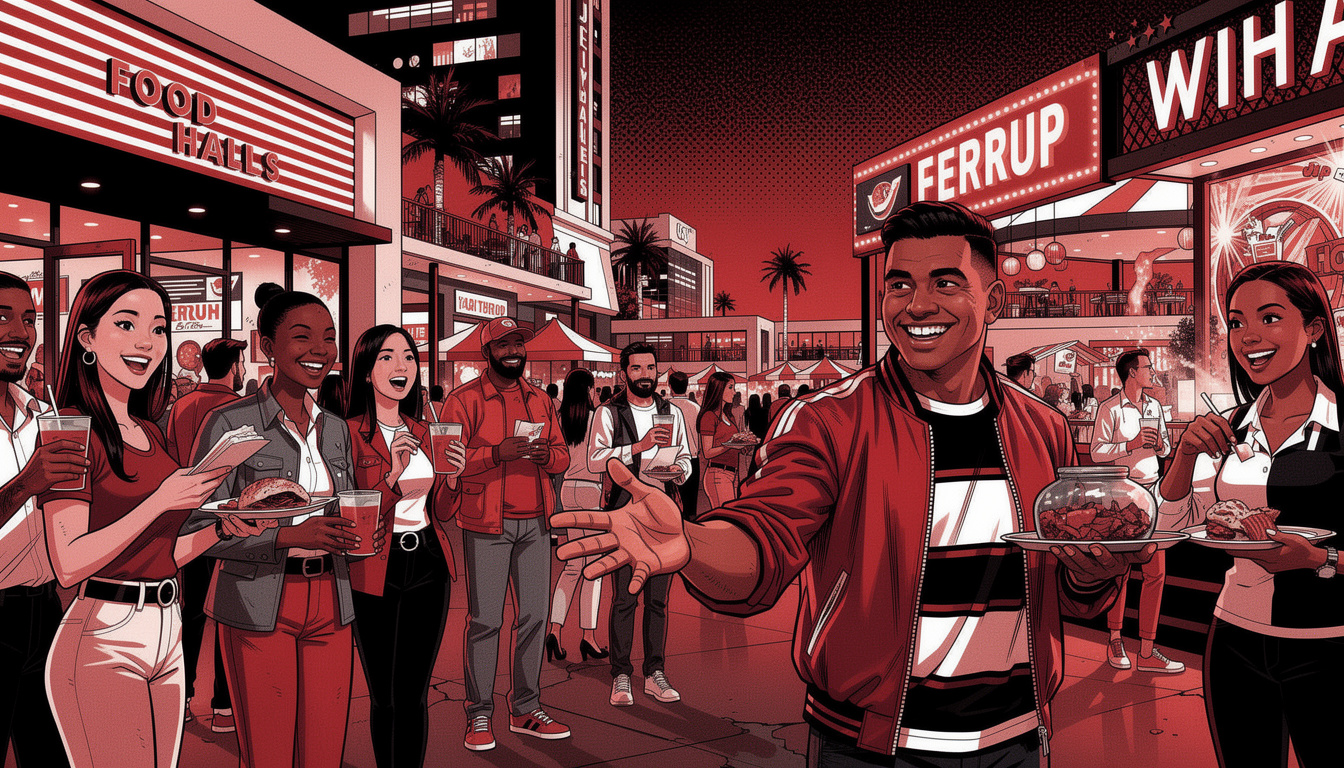
A strong food hall is no longer a dressed-up food court. It is a traffic engine. Resorts and mixed-use developers can concentrate multiple brands in one destination, give customers more choice, and activate space throughout the day. Operators gain access to an audience they would have spent heavily to assemble on their own.
Via Via Packages Proven Demand
Via Via Food Hall at The Venetian Resort Las Vegas shows how the Strip version of the model works. Its lineup imports recognized operators from major food cities, including All'Antico Vinaio, Howlin' Ray's, Scarr's Pizza, B.S. Taqueria, Turkey and the Wolf, and Close Company.
That roster is the business plan. The Venetian is not asking customers to take a chance on one untested concept. It is assembling brands with existing followings and placing them inside a resort with hotel guests, gamblers, convention attendees, and pedestrians already moving through the property.
The leverage runs both ways. The resort gains a fresh quick-service destination with broad appeal. The restaurants gain a Las Vegas presence without independently creating a full-scale destination restaurant. The hall spreads demand across sandwiches, pizza, fried chicken, tacos, cocktails, and other categories. That reduces dependence on a single menu and gives groups an easy reason to stay together.
STIX ASIA Extends the Model Off the Strip
The next major signal sits in southwest Las Vegas. STIX ASIA at UnCommons is listed as coming in 2026, with plans for an 18,000-square-foot venue and 12 dining stalls. The location matters as much as the menu. UnCommons combines offices, apartments, restaurants, and gathering space in one mixed-use development.
This is food as an anchor, not an accessory. A large dining hall can help a development create evening and weekend traffic beyond the office schedule. It also gives residents and workers another reason to remain on the property. For the food operators, the surrounding development supplies a customer base before outside marketing enters the equation.
Execution remains the test. A food hall with 12 stalls carries operational complexity, and an announced opening is not the same as a completed one. Tenant quality, consistency, parking, repeat local business, and opening discipline will determine whether the square footage becomes an asset or overhead. The strategic logic is clear. UnCommons is using food to strengthen the entire real estate ecosystem.
Fast Casual Is Monetizing Brand Power
Celebrity dining once meant a large dining room, a high average check, and a marquee chef's name over the entrance. The newer play compresses the brand into a faster, more repeatable format.
Chicken Guy! at Harrah's Las Vegas opened in April 2025 inside Fulton Street Food Hall. Caesars identified it as Guy Fieri's second Chicken Guy! location on the Strip and his fourth restaurant with Caesars Entertainment's Las Vegas resorts.
That is brand extension with controlled risk. The concept enters an existing food hall rather than carrying the full burden of a stand-alone destination. Harrah's adds a recognizable chef brand to its quick-service mix. Chicken Guy! gains another Strip distribution point. Fieri's name lowers the customer-acquisition hurdle because millions of visitors already understand the proposition before seeing the menu.
The same efficiency shows up at BLVD Las Vegas, where the current directory lists How Ya Dough'n? alongside In-N-Out Burger and the project's retail tenants. The pizza concept gains visibility inside a high-profile Strip development rather than relying solely on neighborhood discovery. BLVD gains another reason for shoppers to extend their visit. In commercial real estate, dwell time has value.
International Groups Are Using Vegas as a Launchpad
The premium end of the market is making a different bet. Instead of shrinking the format, international operators are using Las Vegas to establish a major United States position.
Gymkhana at ARIA Resort & Casino opened in December 2025 as the first U.S. location for the London restaurant. JKS Restaurants partnered with MGM Resorts International on the project. The original Gymkhana holds two Michelin stars in London, giving the Las Vegas operation immediate global positioning.
This is not a low-cost market-entry strategy. It is a prestige play. ARIA provides the luxury-resort platform, customer flow, and operating infrastructure. JKS supplies a restaurant brand with international recognition. Each party brings an asset the other would have to spend heavily to replicate.
Las Vegas gives imported brands unusual reach. A successful restaurant here serves domestic leisure travelers, international guests, convention groups, casino customers, and local diners. That mix turns one location into a global showroom. The value extends beyond nightly covers. A strong Las Vegas operation can support future partnerships, brand licensing, and expansion conversations elsewhere.
What Separates the Winners From the Openings
Vegas never has a shortage of restaurant announcements. Staying power is the harder metric. The businesses with the best runway share several advantages:
- Built-in traffic: Resorts and mixed-use developments deliver customers before an operator begins its own marketing campaign.
- Recognizable positioning: A proven chef, celebrated restaurant, or established regional concept reduces the work required to explain the brand.
- Format discipline: Food halls and fast-casual counters can concentrate production and seating while serving more than one customer occasion.
- Multiple demand channels: Tourist traffic matters, but local repeat business, conventions, offices, and nearby residents provide balance.
The risks are equally direct. High-profile real estate comes with high expectations. Imported brands still need local relevance. Food halls must prevent uneven stall quality from weakening the whole destination. Fast-casual concepts must protect speed and value while labor and ingredient costs remain under pressure.
The ghost-kitchen boom once promised a shortcut around those constraints. Delivery-only kitchens still serve a purpose, but the current visible capital is favoring places that also strengthen a resort, shopping center, or mixed-use property. Physical presence is back in the deal, provided the space produces traffic and brand value.
The Outlook for the Valley
The next phase of Las Vegas dining investment will be won through alignment. The right operator needs the right landlord, the right audience, and the right footprint. A famous name without operating discipline burns cash. A beautiful development without compelling food loses dwell time. A food hall without repeat customers becomes expensive scenery.
Via Via, Chicken Guy!, Gymkhana, How Ya Dough'n?, and the planned STIX ASIA development represent different price points and operating models. Their common strategy is distribution. Each business is attaching itself to a larger traffic system, whether that system is a Strip resort, a retail project, or a mixed-use district.
That is the real market signal. Las Vegas is not simply collecting new restaurants. It is becoming a platform where hospitality groups, developers, and global food brands can share infrastructure and multiply exposure. The operators that understand that leverage will own the next chapter. Vegas will supply the stage. The disciplined money will decide who stays on it.