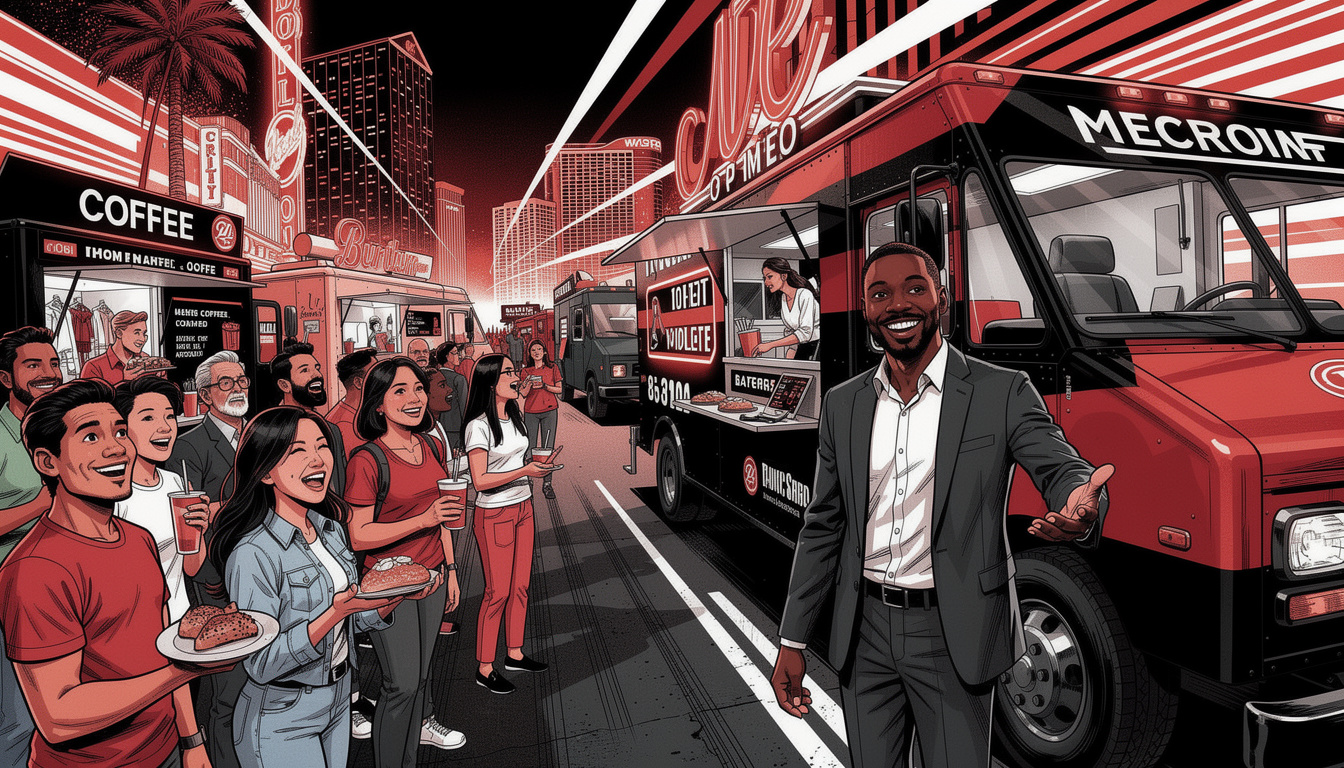
The mobile business proposition starts with overhead
In Las Vegas, location is leverage. It is also one of the biggest line items on the balance sheet. Mobile businesses attack that cost directly by replacing a conventional storefront with a truck, trailer or specially equipped vehicle.
That does not make the model cheap or easy. It makes the cost structure different. A mobile operator still faces vehicle acquisition, equipment, insurance, fuel, maintenance, licensing, inspections, storage and, for food vendors, commissary expenses. What the operator avoids is a long commercial lease, a large tenant-improvement package and the obligation to keep one address productive every day of the year.
That flexibility fits Las Vegas. The market runs on shifting concentrations of demand, from conventions and sports crowds to neighborhood festivals, corporate lunches and private events. The Las Vegas Convention and Visitors Authority research dashboard displays headline figures of roughly 38.5 million visitors and 6 million convention attendees. That is a deep customer pool, but it does not sit in one place. Mobile operators are built to pursue it.
The central business play is straightforward. Reduce fixed exposure. Book locations or events with known traffic. Move when the economics change. In a city where demand can surge around one venue and disappear a few blocks away, mobility has real strategic value.
What is driving the Las Vegas mobile economy?
The strongest evidence of this shift appears in food vending, where local governments maintain formal licensing systems and the city of Las Vegas offers designated operating opportunities. Mobile personal-care businesses also have a defined state licensing path. Retail vans and other vehicle-based concepts exist as a business format, but they do not share one uniform regulatory category or a reliable public count.
Events turn mobility into a revenue tool
Las Vegas delivers recurring waves of concentrated demand. Conventions, festivals, civic events and private bookings give mobile businesses a chance to sell against a specific crowd rather than wait for customers to find a permanent address.
The Arts District provides a clean local example. First Friday Las Vegas promotes local artists, small businesses and food trucks as part of its monthly event. The city also lists Food Truck Thursdays at Las Vegas Civic Center and a downtown mobile food truck lottery that allocates a designated parking space on selected dates.
Those programs matter because legal access is part of the asset. A truck can move, but it cannot simply park anywhere and begin trading. Profitable mobility depends on permission from property owners, event organizers or the government agency controlling the location. The operator who secures a dependable calendar of approved sites has a business. The operator who only owns a truck has equipment.
Lower fixed costs create room to test concepts
A mobile format gives entrepreneurs a way to test menus, pricing and neighborhood demand without committing to a full buildout. That creates runway. A concept can work corporate lunches during the week, attend an Arts District event on Friday and take a private booking on Saturday.
The model also produces faster market feedback. Weak products become obvious. Strong products can earn repeat bookings, build a social following or establish enough demand to support catering, packaged goods or a permanent location. Mobility becomes an entry strategy rather than the final destination.
Still, broad startup-cost and revenue averages should be treated with caution. A basic vending vehicle and a custom commercial kitchen are entirely different investments. Event commissions, food costs, staffing and repairs also change the margin. There is no credible public dataset showing a standard Las Vegas mobile-business profit margin.
Licensing has become clearer, not frictionless
The regulatory structure is more developed than the mythology suggests. According to the city of Las Vegas mobile food vending guidance, a food truck or trailer operating inside city limits needs a Southern Nevada Health District permit, a commissary agreement, liability insurance, vehicle registration and city fire inspection. The city lists an initial business-license fee of $100 plus a one-time $50 processing fee, followed by renewals calculated from six-month revenue.
The city also created a sidewalk-vending license category in 2024. That category applies to food and nonalcoholic beverages sold from conveyances such as pushcarts or stands. It does not authorize merchandise sales. Sidewalk vending and food-truck operations are related forms of mobile commerce, but they are not interchangeable.
Jurisdiction is the first gate. An address branded as Las Vegas can fall inside the city or in unincorporated Clark County, and the rules depend on the controlling authority. The Clark County mobile food vendor application packet directs applicants to confirm jurisdiction and land use before applying. It also calls for state registration, tax registration, a commissary location, a health permit, vehicle documents and insurance.
That is not deregulation. It is a defined compliance path. Serious operators can price it, schedule it and build it into the launch plan.
Food leads, while services broaden the model
Food trucks have the clearest operating ecosystem
Food trucks remain the most visible mobile-business segment because the format connects naturally with festivals, civic programs, breweries, office clusters and private functions. Public agencies have also built specific rules around food safety, fire protection and waste handling.
The economics depend heavily on utilization. A truck sitting idle still carries insurance, storage and equipment costs. A truck with recurring lunch stops, event bookings and catering work can spread those costs across several revenue channels. Follow the money and the decisive metric is not miles driven. It is the percentage of available service periods attached to productive locations.
Brand building is another advantage. The vehicle functions as kitchen, storefront and billboard. Social media can direct customers to the next stop, while event appearances introduce the concept to new audiences. The strongest operators turn movement into distribution rather than confusion.
Personal care shows how other trades can go mobile
Mobile service businesses use the same core strategy: bring the service to the customer and reduce dependence on a permanent public-facing location. Nevada has an established framework for certain personal-care operations. The Nevada State Board of Cosmetology publishes requirements for mobile and in-home salons and lists a two-year mobile-establishment license at $200.
That framework does not eliminate professional licensing, sanitation standards or local business requirements. It confirms that mobility can be a recognized operating model rather than an informal workaround. The best opportunities sit where customers place a premium on convenience, including private residences, workplaces, productions and scheduled group appointments.
The strategic outlook for Las Vegas
Mobile businesses are not positioned to replace fixed retail across Las Vegas. Casinos, resorts, restaurants and neighborhood centers still win through permanence, capacity and controlled customer experience. The mobile model wins on flexibility, targeted access and lower exposure to long lease obligations.
For commercial property owners, the signal is not that storefront demand disappears. The signal is that smaller operators have more ways to reach the market before signing a lease. Landlords and developers can respond with event-ready lots, utility connections, short-term activations and structured pop-up programs. Mobility can feed real estate when a proven operator graduates into a permanent space.
For entrepreneurs, the discipline is clear. Confirm jurisdiction before buying equipment. Build the permit timeline into the capitalization plan. Secure approved locations and recurring bookings. Track revenue by stop, event and service period. A mobile business lives on routing, utilization and access.
Las Vegas supplies the demand engine. It does not guarantee the deal. Operators who control compliance, location rights and a dependable calendar can turn a vehicle into a scalable platform. That is the real rise of mobile business in this city, and it gives Vegas another way to convert movement into money.