ACT I: The Parking Lot
At night, it almost makes too much sense.
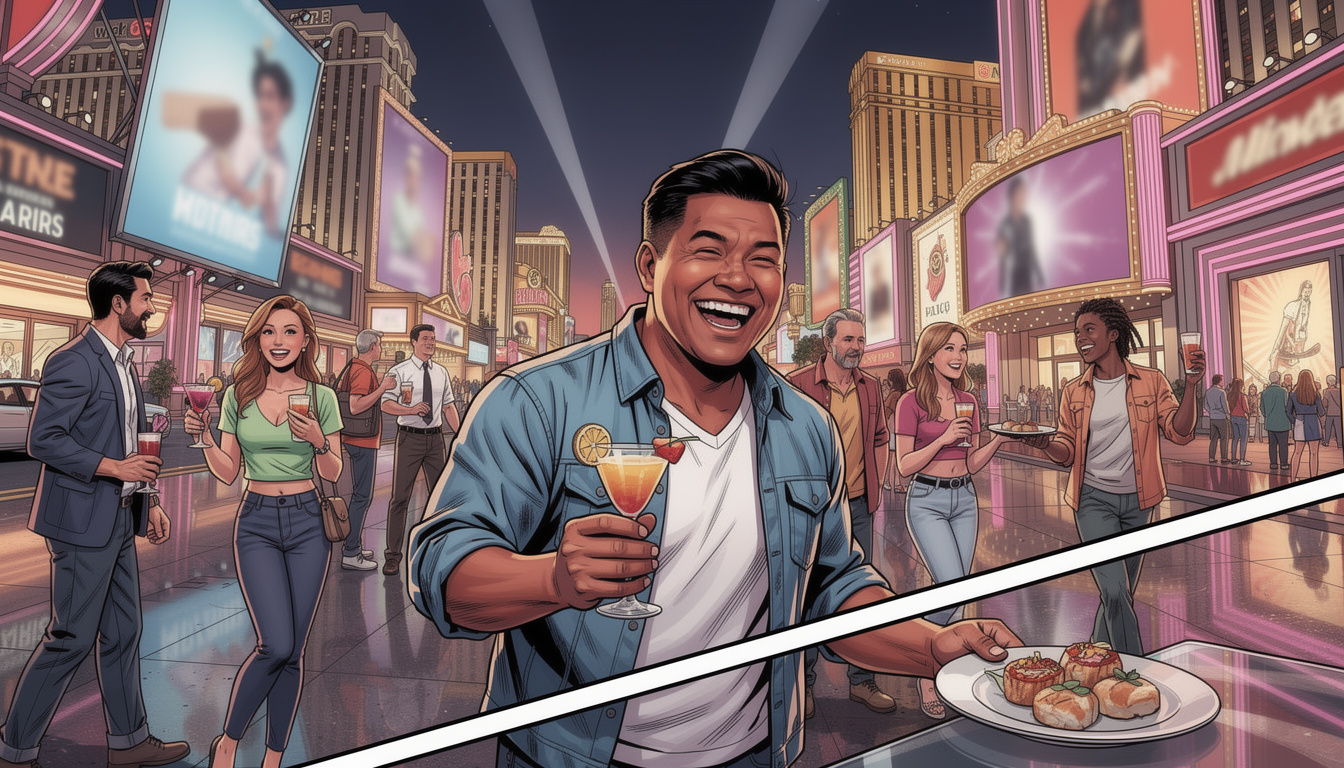
A Formula 1 car fires down Las Vegas Boulevard at more than 200 miles per hour. Casino towers flash past. The Bellagio glows. Caesars Palace sits just beyond the barriers. The Sphere looks like somebody dropped a small electronic planet into the middle of the city.
The Strip, normally packed with taxis, buses, rental cars, limousines, pedestrians making questionable footwear decisions, and at least one guy dressed like Spider-Man, is now part of a Formula 1 racetrack.
Of course it is.
This is Las Vegas.
But Formula 1 did not always get this version of Vegas.
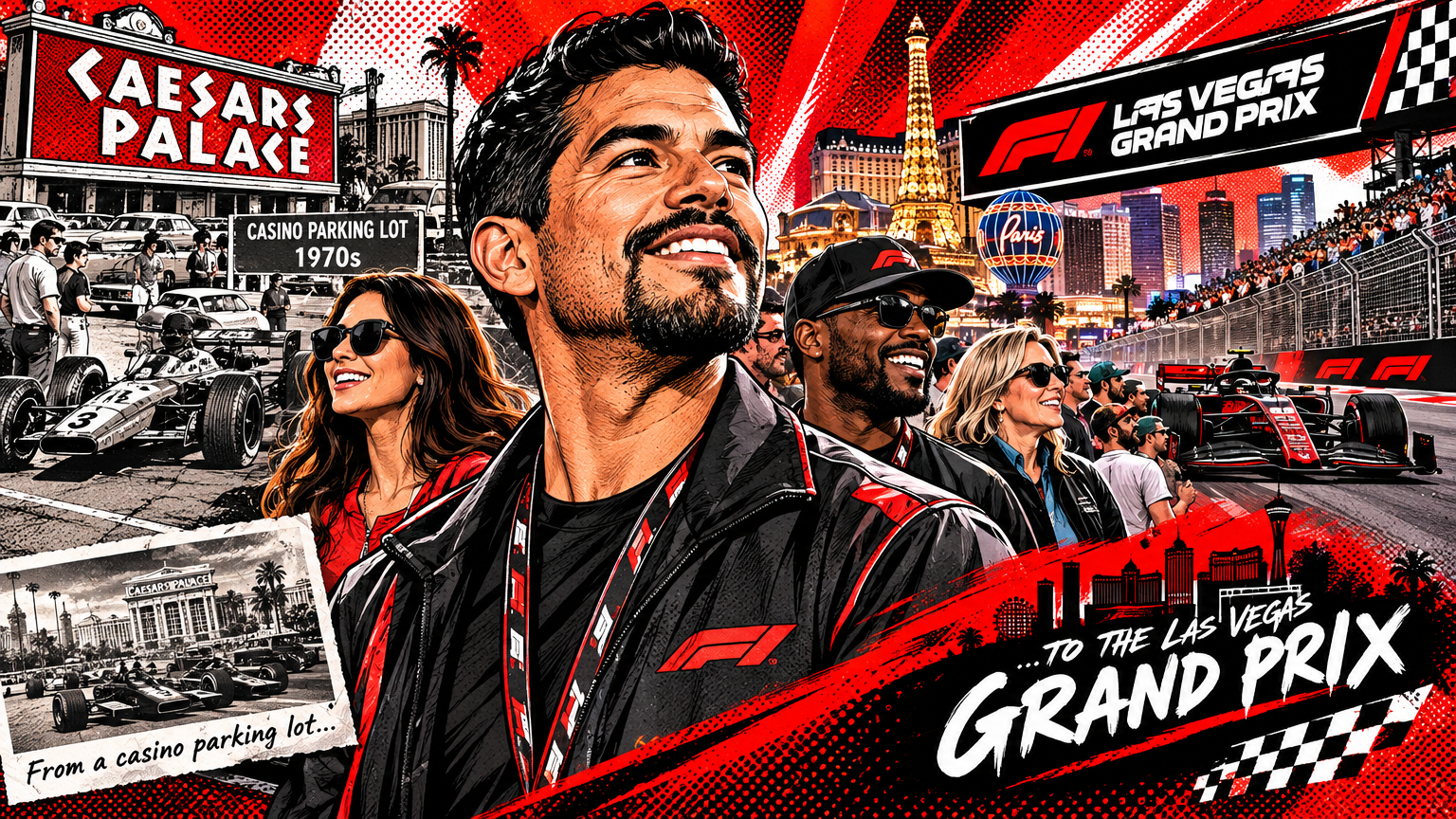
The first time the world's most glamorous racing series came here, it didn't get the Strip.
It got a parking lot.
And somehow, that parking lot would decide a world championship.
Vegas Had a Better Idea. Bureaucracy Had Other Plans.
Go back to 1981.
Formula 1 needed an American finale. Watkins Glen, the longtime home of the United States Grand Prix in upstate New York, had fallen into financial trouble. Bernie Ecclestone, already becoming the dominant commercial force in Formula 1, wanted another American destination.
Las Vegas had one very obvious thing going for it.
It was Las Vegas.
Caesars Palace executive Bill Weinberger saw the opportunity. Formula 1 brought international celebrities, wealthy fans, corporate money and the kind of people Caesars hoped might watch a race for a few hours and then spend considerably more time downstairs at the tables.
The dream was Monaco in the desert.
The original ambition was bigger than the race history usually remembers. The idea was to put Formula 1 on Las Vegas Boulevard.
Sound familiar?
More than four decades before modern Formula 1 cars would blast down the Strip under casino lights, organizers were already looking at Las Vegas Boulevard and imagining race cars on it.
There was just one problem.
Actually doing it.
Closing major public roads required approvals, coordination, and time. The clock was running. The Strip plan became impractical.
Caesars still wanted the race.
Formula 1 still needed somewhere to put it.
So the organizers looked behind the casino.
There was space back there.
Sort of.
Formula 1's first Las Vegas problem was simple: How do you fit a world-class racetrack behind a casino?
The solution has become part of Vegas racing folklore.
Weinberger and Ecclestone sat down at a Caesars Palace coffee shop and tried to figure out how to squeeze a Formula 1 circuit onto the property. Weinberger later recalled tracing a rough shape around his hand on a placemat as the two men worked through the problem.
Too many turns.
Not enough room.
Lose a few fingers.
Keep drawing.
Eventually, they had something.
Not Monaco.
Not Monza.
Not Watkins Glen.
Vegas.
Or at least the version of Vegas that could be built in a hurry.
Forty-Five Days to Build a Grand Prix
The circuit that emerged was roughly 2.3 miles long, with 14 turns and a counterclockwise layout. It occupied Caesars property between the Strip and Interstate 15, including parking areas and adjoining land that had to be transformed into something capable of handling Formula 1 machinery.
Calling it "just a parking lot" misses part of the story.
Calling it a great racetrack would miss another part.
Crews had to create a purpose-prepared racing surface, install barriers, assemble temporary pits and grandstands, and turn a patch of casino property into the final stop of the Formula 1 World Championship.
They had about 45 days.
Today, the modern Las Vegas Grand Prix requires months of preparation, complex traffic plans, temporary bridges, barriers, lighting, grandstands, security zones, and an enormous permanent paddock complex.
In 1981, Vegas was basically saying: Give us six weeks.
The finished circuit looked like somebody had challenged a racetrack designer to avoid straight lines whenever possible.
Turn.
Turn.
Another turn.
More concrete.
Another left.
Keep going.
The course was flat and visually sparse. The concrete barriers were low. The surrounding landscape offered drivers few of the reference points they normally used to judge braking and positioning.
And then there was the direction.
Counterclockwise.
That mattered because the drivers' bodies had spent an entire season being punished mostly in the opposite direction. Now, for the championship finale, they were going to spend 75 laps repeatedly loading muscles that weren't accustomed to this particular beating.
In the Nevada heat.
Behind a casino.
For the world championship.
Perfectly normal stuff.
The Glamour Capital Meets the Least Glamorous Racetrack
The name sounded spectacular.
Caesars Palace Grand Prix.
You can practically hear the champagne corks.
Then you looked at the track.
Drivers found a flat, tight circuit surrounded by concrete and desert dust. John Watson later remembered the difficulty of driving without the buildings, trees, and elevation changes racers normally use as visual markers. Mario Andretti criticized the lack of flow and thought the layout was better suited to go-karts than Formula 1 cars.
The irony was immediate.
Formula 1 had come to one of the most visually outrageous cities in America and somehow found one of its least visually outrageous pieces of land.
The casinos were right there.
The neon was right there.
The Strip was right there.
And Formula 1 was going around in circles behind Caesars.
Jump forward four decades, and the difference is almost comical.
Modern Formula 1 would make sure the television cameras couldn't possibly miss Las Vegas. The casinos would become the scenery. The Strip would become a straightaway. The city's architecture would become part of the broadcast.
In 1981, the Caesars Palace Grand Prix had the opposite problem.
The race was in Las Vegas without really looking like Las Vegas.
But none of that mattered once the championship math entered the picture.
Because Formula 1 had accidentally created something fascinating.
A world championship showdown in a casino parking lot.
The Championship Comes Down to Vegas
Carlos Reutemann arrived in Las Vegas leading Nelson Piquet by a single point.
One point.
After a season traveling across continents, racing some of the most famous circuits on Earth, the championship was going to be settled on a track that had barely existed long enough for the asphalt to feel permanent.
Reutemann put his Williams on pole.
His teammate Alan Jones lined up beside him.
Piquet started fourth.
Everything was set.
Then the race started and Reutemann's afternoon began to fall apart.
Jones went forward.
Reutemann went backward.
Piquet didn't need to win. He needed enough points to get past Reutemann in the championship.
That sounds simple when you're reading the result decades later.
It wasn't.
The physical demands of the circuit were tearing into Piquet.
The relentless counterclockwise corners punished him. The heat made it worse. His body was failing faster than his car.
And he had to keep driving.
Think about that scene for a second.
Outside the barriers, Caesars Palace is doing what Caesars Palace does. People are gambling. Drinks are moving. Money is changing hands.
Inside the barriers, Nelson Piquet is fighting to stay in a Formula 1 car long enough to become world champion.
Vegas had found its race after all.
Not the glamorous one Caesars imagined.
A brutal one.
Alan Jones dominated at the front.
Piquet dragged himself to fifth.
Reutemann finished behind him and outside the points.
That was enough.
Nelson Piquet became Formula 1 world champion by a single point.
He had arrived in Las Vegas chasing a title.
He left with one.
His body had just about had enough of the place.
Formula 1 had traveled the world and somehow decided its championship behind Caesars Palace.
It should have been the perfect ending.
For Formula 1, it was spectacular drama.
For Caesars, there was a more important question.
Where was everybody?
The High Rollers Didn't Come
The entire business theory behind the Caesars Palace Grand Prix was wonderfully Vegas.
Bring Formula 1 fans to town.
Put them in hotel rooms.
Feed them.
Entertain them.
Then introduce them to the casino floor.
Caesars looked at Monaco and saw wealthy international racing fans spending freely. Why couldn't Las Vegas get a piece of that?
There was only one flaw.
The expected flood of Formula 1 high rollers didn't materialize.
Attendance was disappointing. The event reportedly lost Caesars millions. Other resorts weren't necessarily eager to rally behind what looked like a Caesars Palace production rather than a Las Vegas production.
That distinction would turn out to be enormous.
Four decades later, the modern Grand Prix would require cooperation across the resort corridor. Caesars. MGM. Wynn. Venetian. Tourism officials. Government agencies. Formula 1. Transportation planners. Contractors. Businesses. Thousands of workers.
The first version was largely built around one casino.
The second would eventually require an entire city.
But nobody knew that yet.
In 1981, Caesars had already spent the money and built the track.
There was only one logical thing to do.
Try again.
1982: Same Parking Lot, Another World Championship
Formula 1 came back the next year.
Same Caesars Palace.
Same basic circuit.
Same desert.
And, unbelievably, another world championship was on the line.
In 1982, Michele Alboreto put his Tyrrell into the fight from third on the grid and ultimately won the race. Keke Rosberg finished fifth in his Williams.
Fifth place doesn't sound particularly historic.
It was.
Rosberg became world champion.
For the second consecutive year, Formula 1 had come to Las Vegas and crowned its champion on this strange patch of asphalt beside Caesars Palace.
Two races.
Two championship finales.
Two world champions crowned.
And still, the event couldn't make itself matter enough to survive.
That's the strange part.
The Caesars Palace Grand Prix wasn't meaningless.
It was incredibly important to Formula 1.
It just wasn't important enough to Las Vegas.
Vegas Walks Away
The easy version of this story says Formula 1 left because everyone hated the racetrack.
The real version is better.
Yes, drivers complained.
Yes, the circuit was awkward.
Yes, the heat was punishing.
But Formula 1 can survive complaints.
What it can't easily survive is bad business.
The crowds weren't big enough. The financial return wasn't strong enough. The international gamblers Caesars hoped Formula 1 would deliver weren't arriving in sufficient numbers. And the race never fully became a citywide Las Vegas event.
Chris Pook, who helped organize the Caesars races and had already built the successful Long Beach Grand Prix, would later point toward one of the central problems: a race like this needed the city behind it.
Vegas wasn't.
Not yet.
After 1982, Formula 1 disappeared from Las Vegas.
Other racing briefly continued at Caesars, but the Formula 1 experiment was finished.
The temporary circuit eventually vanished beneath a changing Las Vegas.
The city built.
The Strip expanded.
Casinos came down.
New ones went up.
Formula 1 moved on.
And for decades, the Caesars Palace Grand Prix became one of those wonderfully weird pieces of Las Vegas history that sounds increasingly fictional every time you explain it to someone.
Yes, Formula 1 raced here before.
Yes, it was behind Caesars Palace.
Yes, it was basically a purpose-built circuit carved through casino parking property.
Yes, they decided the world championship there.
Twice.
Then they left.
The Parking Lot Wasn't the Failure. It Was the First Draft.
Now jump forward again.
Nighttime.
Las Vegas Boulevard.
A Formula 1 car rockets past Caesars Palace.
That's the image that ties the two eras together.
In 1981, Formula 1 couldn't get onto the Strip, so it built a racetrack behind the casino.
More than four decades later, Formula 1 would come back and put the Strip inside the racetrack.
The first race tried to borrow Vegas glamour while staying mostly hidden from the city around it.
The second would make hiding impossible.
It would close roads.
Buy land.
Build a permanent home.
Move traffic.
Disrupt businesses.
Challenge workers.
Sell some of the most expensive tickets in racing.
Turn casino resorts into trackside scenery.
And force Formula 1 itself to put an enormous amount of money on the table.
But that version of the Las Vegas Grand Prix couldn't have happened in 1981.
Formula 1 wasn't ready.
Las Vegas wasn't ready.
America wasn't ready.
So the parking lot disappeared.
And the strangest part of the story began.
Because Formula 1 wasn't going to stay away forever.
It just needed Las Vegas to get bigger.
And Formula 1 was about to get much, much bigger too.
ACT II: The Forty-Year Comeback
For a while, the easiest way to understand Formula 1's relationship with Las Vegas was to look at what wasn't happening.
No race.
No Formula 1 cars.
No grandstands.
No champagne.
No screaming engines bouncing off casino towers.
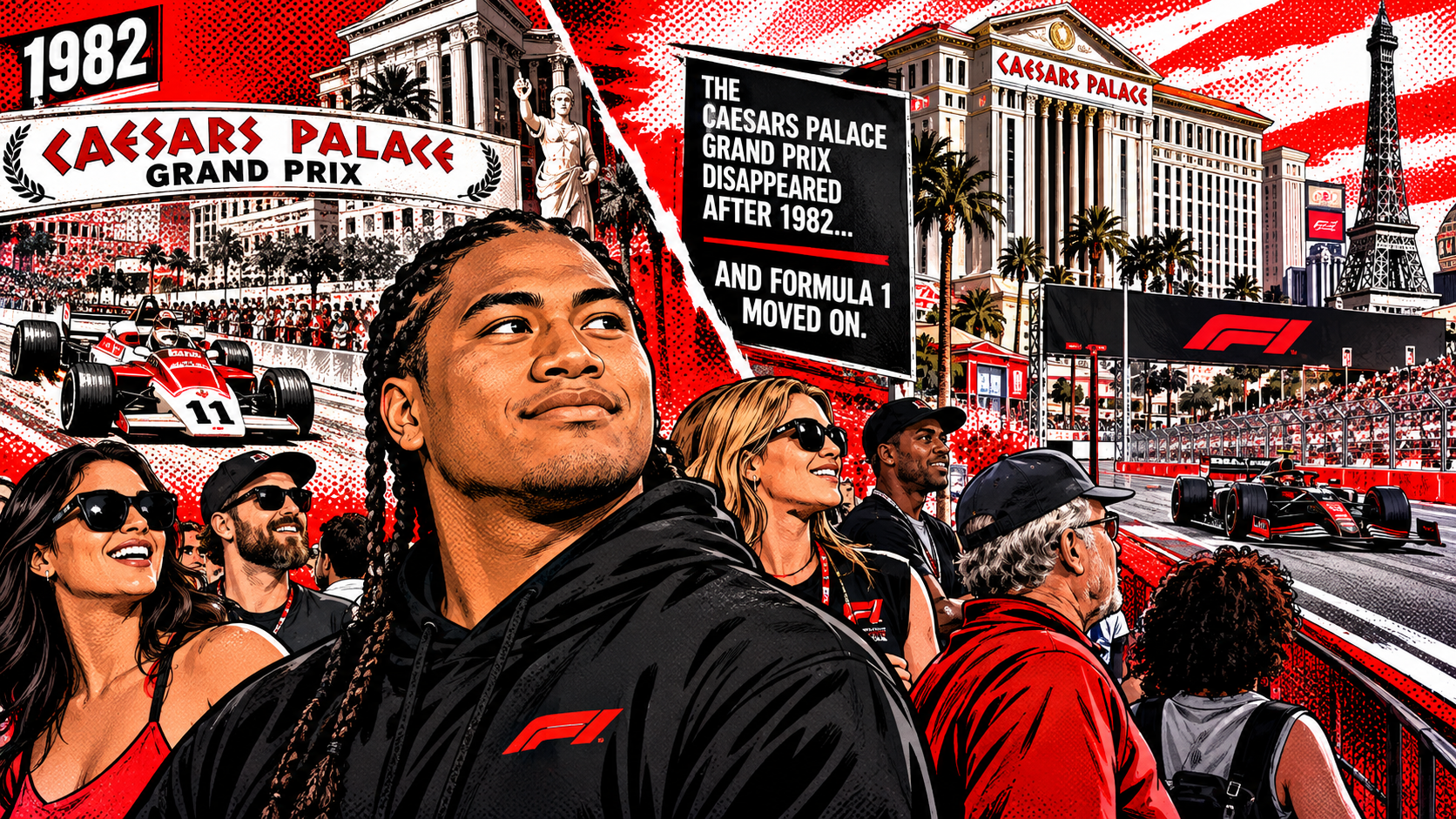
The Caesars Palace Grand Prix disappeared after 1982, and Formula 1 moved on.
So did Las Vegas.
That sounds like the end of the story.
It wasn't.
It was the beginning of a very long intermission.
Formula 1 Had an America Problem
The Caesars experiment wasn't Formula 1's only complicated American relationship.
For decades, Formula 1 kept trying to figure out the United States.
It wanted the market.
It wanted the television audience.
It wanted American sponsors.
It wanted American fans.
What it couldn't seem to find was a formula that stuck.
Races appeared.
Races disappeared.
Detroit.
Dallas.
Phoenix.
Indianapolis.
Different cities. Different circuits. Different ideas.
Same basic problem.
Formula 1 was one of the biggest sports properties on Earth, but in the United States it could still feel like something happening very far away.
Las Vegas knew that feeling.
It had already tried Formula 1.
Twice.
The city had watched two world championships get decided behind Caesars Palace and then watched the entire thing disappear.
For years, there was little reason to believe the third try would be different.
Then two things started changing at roughly the same time.
Formula 1 began figuring out America.
And Las Vegas began figuring out sports.
Meanwhile, Las Vegas Was Becoming a Sports City
There was a time when putting a major professional sports franchise in Las Vegas was treated like a dangerous idea.
Too much gambling.
Too transient.
Too weird.
Too Vegas.
Then Vegas started collecting major sports properties anyway.
The Golden Knights arrived.
The Raiders arrived.
Boxing was already part of the city's DNA.
UFC had deep roots here.
Major events kept getting bigger.
Stadiums and arenas changed the physical city. Sports changed the calendar. Tourism officials increasingly saw major sporting events as another reason to fill hotel rooms, restaurants, casinos, and convention spaces.
Las Vegas wasn't merely a place where sports happened occasionally.
Sports were becoming part of what Las Vegas sold.
That distinction mattered.
Remember what went wrong in 1981.
Caesars Palace had tried to bring Formula 1 fans to one casino.
The modern Las Vegas sports strategy was much bigger.
Bring the event to the city.
Bring the fans to the hotels.
Bring the sponsors to the resorts.
Bring the television cameras to the Strip.
Then give everybody a reason to spend money while they're here.
It was basically the 1981 idea after four decades of Vegas-level upgrades.
Formula 1 Was Changing Too
In 2017, Liberty Media completed its takeover of Formula 1.
That corporate change would eventually matter enormously to Las Vegas.
Formula 1 had always been a global sport, but its new American ownership saw something sitting right in front of it.
The United States was enormous.
And Formula 1 was nowhere near as enormous here as it could be.
That meant opportunity.
The sport began pushing harder into the American market.
The United States Grand Prix in Austin had already given Formula 1 a durable American foothold. Then came another ingredient nobody in the Caesars Palace parking lot could have imagined.
Netflix.
Formula 1: Drive to Survive arrived in 2019 and introduced a new American audience to the drivers, teams, rivalries, crashes, politics, and personalities of Formula 1.
People who couldn't explain the difference between a Ferrari and a Red Bull suddenly had opinions about team principals.
Formula 1 started showing up in conversations it hadn't been part of before.
American television audiences grew.
Younger fans arrived.
Sponsors noticed.
Promoters noticed.
Formula 1 noticed.
But it would be too simple to say Netflix brought Formula 1 back to Las Vegas.
The pieces were already moving.
Liberty wanted American growth.
Austin had demonstrated that Americans would show up.
Miami was becoming another major piece of Formula 1's U.S. strategy.
Television numbers were climbing.
Las Vegas was transforming into a serious sports destination.
Drive to Survive didn't create all of that.
It poured gasoline on it.
Formula 1 had spent decades trying to make America care. Suddenly America was paying attention.
And once Formula 1 started looking seriously at the United States again, there was one city almost impossible to ignore.
The city where it had already failed.
Vegas Never Completely Let the Idea Die
Here's where the forty-year-gap version of the story gets misleading.
Formula 1 didn't race in Las Vegas between 1982 and 2023.
That doesn't mean nobody spent those years thinking about it.
The idea kept resurfacing.
One of the most notable revival attempts came in the 2010s.
Developer Farid Shidfar worked on a proposal to bring Formula 1 back to Las Vegas, complete with concepts for a street circuit.
This wasn't a couple of guys at a bar saying, "You know what would be cool?"
There were plans.
There were discussions.
There was government interest.
There was an attempt to solve the same problem that had defeated the original Caesars organizers.
How do you put Formula 1 into Las Vegas without breaking Las Vegas?
Think about what a race here requires.
The roads aren't decorative.
They're how hundreds of thousands of workers, tourists, taxis, buses, delivery trucks and emergency vehicles move through one of the busiest tourism corridors in America.
Closing Las Vegas Boulevard sounds incredible when you're drawing a circuit.
It sounds slightly different when you're responsible for getting thousands of casino employees to work.
That was the central Vegas puzzle.
Everybody could see the television shot.
The hard part was everything outside the television shot.
The earlier revival efforts never produced a Formula 1 race.
But they demonstrated something important.
The Caesars Palace Grand Prix had not killed the idea.
Vegas was still thinking about Formula 1.
It was waiting for the right version.
Then Miami Changed the Math
For decades, the idea of multiple Formula 1 races in the United States would have sounded optimistic.
Then Formula 1 started building exactly that.
Austin remained on the calendar.
Miami joined in 2022.
And instead of treating Miami as enough, Formula 1 kept looking.
That tells you almost everything about how much the American market had changed.
In the old world, Formula 1 struggled to keep one successful American Grand Prix alive.
In the new world, it could seriously consider three.
But a third race couldn't just be Austin again.
It needed its own identity.
Austin had a permanent circuit.
Miami had a destination-event atmosphere.
Las Vegas had something neither could duplicate.
Las Vegas.
The city itself was the asset.
That sounds obvious now.
It wasn't obvious in 1981.
Back then, organizers tried to construct a racetrack near the attraction.
The new generation started asking a more dangerous question.
What if the attraction was the racetrack?
Look at the Strip
Imagine the sales pitch.
Start at night.
Obviously.
Put Formula 1 cars under the lights.
Send them past Caesars Palace.
Past Bellagio.
Past the Venetian.
Past Wynn.
Put the city's hotels, signs, towers and attractions directly into the broadcast.
Don't build Vegas scenery around a racetrack.
Use the real thing.
Now imagine those images being broadcast around the world.
Every lap becomes a tourism commercial.
Every helicopter shot becomes an advertisement.
Every onboard camera tells the audience exactly where the race is.
Nobody watches a car flying down Las Vegas Boulevard and asks what city they're looking at.
That's an extraordinary advantage in sports.
It's also an extraordinary advantage in tourism marketing.
And by the early 2020s, Formula 1 and Las Vegas had finally grown into versions of themselves capable of understanding what the other side could offer.
Formula 1 wanted American attention.
Las Vegas wanted global events.
Formula 1 wanted premium hospitality.
Las Vegas had spent decades perfecting premium hospitality.
Formula 1 wanted sponsors.
Las Vegas was covered in enormous corporate resorts.
Formula 1 wanted spectacle.
Vegas practically considered spectacle a municipal utility.
And both of them wanted money.
Lots of it.
Somewhere Behind Closed Doors, the Crazy Idea Became a Serious One
The modern Las Vegas Grand Prix doesn't have one clean creation myth.
There isn't a single verified moment where one person walked into a room, slapped a track map on the table, and invented the race.
The comeback emerged from overlapping ambitions.
Formula 1 and Liberty Media wanted deeper American expansion.
Las Vegas tourism leaders wanted major international events.
Resort companies had obvious reasons to care about a weekend capable of bringing affluent visitors into their hotels, restaurants, casinos, and hospitality suites.
Government officials controlled the public roads Formula 1 needed.
Everybody had something the other side couldn't do without.
That made the modern race fundamentally different from Caesars Palace.
In 1981, Caesars could build a track on Caesars property and hope everybody came.
In the 2020s, Formula 1 couldn't simply show up with some concrete barriers and ask Las Vegas Boulevard to move.
This time the casinos had to talk to Formula 1.
Formula 1 had to talk to tourism officials.
Tourism officials had to work with government.
Government had to think about roads.
Transportation officials had to think about buses.
Resorts had to think about employees.
Everybody had to think about tourists.
And eventually somebody had to explain how Formula 1 cars were going to travel down the Strip at more than 200 miles per hour without turning the rest of Las Vegas into a parking lot.
Ironically, the parking lot had followed them into the future.
It was just going to be much larger this time.
The Old Vegas Mistake Was Becoming the New Vegas Strategy
Remember Bill Weinberger's original bet.
Bring Formula 1 fans to Las Vegas.
Get them into Caesars.
Get them gambling.
Get them spending.
The idea failed in 1981 partly because the audience wasn't big enough and the event wasn't broad enough.
Forty years later, the same basic concept looked completely different.
Now Formula 1 had a growing American fan base.
Now Las Vegas had major-league sports infrastructure.
Now the Strip's resort companies understood citywide mega-events.
Now global television exposure could be packaged alongside luxury hospitality, concerts, sponsorships, restaurants, casinos, and premium hotel inventory.
The original idea hadn't necessarily been stupid.
It might have been early.
Very early.
The Caesars Palace Grand Prix tried to bring Formula 1 fans into Las Vegas. The modern Grand Prix would turn Las Vegas itself into something Formula 1 could sell.
By 2021, the conversations were getting serious.
Formula 1 executives were talking.
Las Vegas tourism officials were talking.
Resort companies were involved.
Government officials were involved.
The idea that had once sounded like Vegas fantasy was moving toward something much more dangerous.
A contract.
Forty Years Later, Caesars Was Still There
This is the image worth holding onto.
Caesars Palace survived both versions of the story.
In 1981, Formula 1 raced behind it.
In the modern plan, Formula 1 would race past it.
The physical distance between those two ideas wasn't very large.
The conceptual distance was enormous.
One race was squeezed onto available casino property because organizers couldn't get the Strip.
The other would be built around getting the Strip.
That meant the problem Formula 1 couldn't solve in 1981 was about to become the centerpiece of the entire event.
Las Vegas Boulevard.
Closing it.
Resurfacing it.
Lighting it.
Fencing it.
Building grandstands around it.
Moving workers around it.
Keeping casinos operating beside it.
And convincing some of the most powerful companies in Las Vegas that all of this madness was worth doing.
Then came March 2022.
The rumors stopped being rumors.
Formula 1 was coming back.
Not to a parking lot.
Not to a racetrack somewhere outside the resort corridor.
Not to some safe little patch of desert where nobody would be inconvenienced.
It was coming directly into the heart of Las Vegas.
And this time Formula 1 wasn't merely asking the city to host a race.
Formula 1 was preparing to bet on the race itself.
ACT III: The Deal
Formula 1 had figured out that it wanted Las Vegas.
Las Vegas had figured out that it wanted Formula 1.
That was the easy part.
Now they had to figure out how to actually do it.
Because drawing a racetrack over Las Vegas Boulevard on a map is fun.
Closing Las Vegas Boulevard is something else entirely.
This wasn't an empty stretch of Nevada highway.
This was the Strip.
Billions of dollars in resorts.
Thousands of hotel rooms.
Restaurants.
Casinos.
Nightclubs.
Delivery trucks.
Taxis.
Buses.
Tourists.
Workers.
And a city that does not particularly enjoy turning the money machine off.
Formula 1 wasn't asking Las Vegas to build a racetrack somewhere.
It was asking Las Vegas to temporarily turn one of the most valuable tourism corridors in the world into one.
That required more than a promoter.
It required a coalition.
And it required something Formula 1 had never risked here before.
A serious piece of its own money.
So Who Actually Brought Formula 1 Back?
Las Vegas loves a creation story.
Somebody had the idea.
Somebody made the call.
Somebody walked into a room and said, "We're doing this."
The modern Las Vegas Grand Prix is messier than that.
There is no clean, universally accepted story in which one person can point at the Strip and claim the whole thing.
Instead, the race emerged from a collection of people and organizations whose interests suddenly lined up.
At Formula 1 and Liberty Media, Greg Maffei and Stefano Domenicali were central figures in the sport's American expansion.
In Las Vegas, tourism leaders including Steve Hill were working from the other direction, trying to bring more enormous global events into the city.
Resort companies controlled the hotels, hospitality inventory, restaurants, casinos, and enormous pieces of property lining the proposed circuit.
Clark County controlled critical public infrastructure.
Transportation agencies had to keep people moving.
Police and emergency services had to keep the resort corridor functioning.
Formula 1 needed all of them.
And all of them had different reasons to care.
Formula 1 wanted America.
Tourism officials wanted visitors.
Casinos wanted customers.
Hotels wanted rooms filled.
Sponsors wanted attention.
Television wanted pictures nobody could get anywhere else.
Las Vegas wanted another global event.
Everybody could see the money.
The harder question was who would accept the risk.
The modern Las Vegas Grand Prix wasn't created by one person. It happened because Formula 1, tourism leaders, resorts and government all had something the others needed.
That alone separated the new race from the old one.
Caesars Palace had tried to make Formula 1 work largely as a Caesars Palace event.
This time, one casino couldn't do it.
Formula 1 needed Las Vegas.
Not a parking lot in Las Vegas.
Las Vegas.
The Strip Was the Whole Point
There were easier ways to build a Formula 1 race in Southern Nevada.
Find open land.
Build a permanent circuit.
Put parking around it.
Run some shuttle buses.
Done.
That wasn't the idea.
If Formula 1 was coming back to Las Vegas after more than 40 years, it wasn't coming back quietly.
The Strip was not an obstacle to work around.
The Strip was the product.
The modern circuit would run through the resort corridor using Las Vegas Boulevard, Sands Avenue, Koval Lane and Harmon Avenue.
Roughly 3.85 miles.
Seventeen turns.
A long blast down Las Vegas Boulevard with Formula 1 cars reaching speeds above 200 miles per hour.
At night.
Under the lights.
Past some of the most recognizable resorts on Earth.
This time nobody watching television would wonder where Formula 1 had put the racetrack.
Bellagio would tell them.
Caesars Palace would tell them.
The Venetian would tell them.
Wynn would tell them.
The entire skyline would tell them.
Every lap could advertise Las Vegas without cutting to a commercial.
That was the genius of it.
It was also the problem.
Because those postcard images were full of real businesses operating on real streets.
Formula 1 wanted the world's most spectacular urban backdrop.
Las Vegas still had to get people to work on Monday morning.
March 2022: It's Official
In March 2022, Formula 1 finally announced what had once sounded ridiculous.
The Las Vegas Grand Prix was coming.
The first race would take place in November 2023.
And the announcement made clear that this wasn't going to be a cautious return.
Formula 1 was putting the race at night.
It was putting the circuit through the resort corridor.
It was putting cars on Las Vegas Boulevard.
And it was putting the race on Saturday night.
That last part mattered.
Formula 1 traditionally races on Sundays.
Las Vegas wasn't interested in tradition for tradition's sake.
Saturday night was Vegas.
It was nightlife.
It was television.
It was spectacle.
It was a Grand Prix designed to look less like another stop on the Formula 1 calendar and more like a global event that happened to include a race.
Forty years earlier, drivers complained that the Caesars Palace circuit didn't look or feel like Las Vegas.
Nobody was going to make that complaint this time.
Then Formula 1 Did Something Different
Normally, Formula 1 travels into a market where somebody else is promoting the Grand Prix.
A local promoter takes on much of the event risk, pays for the privilege of hosting Formula 1, and tries to make the numbers work through tickets, hospitality, sponsorship and other revenue.
Las Vegas was different.
Formula 1 and its parent company weren't merely arriving, collecting a fee, and leaving town.
They were taking a direct role in promoting the event.
That changed the bet.
If Las Vegas worked, Formula 1 could participate much more directly in the upside.
Tickets.
Hospitality.
Sponsorship.
Premium experiences.
Entertainment.
Brand value.
American growth.
But direct control came with direct exposure.
If construction costs exploded, Formula 1 couldn't simply point at a promoter.
If ticket demand disappointed, Formula 1 would feel it.
If the event became a logistical nightmare, Formula 1's name was on the nightmare.
If Las Vegas hated the disruption, Formula 1 couldn't pack up on Sunday and pretend it belonged to somebody else.
This time Formula 1 was putting its chips on the table too.
In 1981, Caesars Palace gambled on Formula 1. In 2023, Formula 1 was gambling on Las Vegas.
And then the gamble got literal.
Formula 1 went shopping for land.
Formula 1 Buys a Piece of Las Vegas
For the first Caesars Palace Grand Prix, Formula 1 needed temporary space.
Build the circuit.
Run the race.
Take it apart.
Leave.
The modern version went in the opposite direction.
Formula 1's parent company spent roughly $240 million acquiring approximately 39 acres near Harmon Avenue and Koval Lane.
That is not a temporary commitment.
That's real estate.
Las Vegas real estate.
Formula 1 wasn't merely renting a weekend in the city anymore.
It owned a piece of it.
The site would become the operational heart of the Las Vegas Grand Prix, with a permanent paddock building overlooking the starting grid and pit lane.
Teams would operate there.
Cars would start there.
VIPs would gather there.
Television cameras would repeatedly show it to the world.
And when race weekend ended, the building wouldn't disappear.
That was the point.
Formula 1 was building permanence into a street race.
That sounds like a contradiction.
In Vegas, it sounds like a business model.
The Most Expensive Part of the Racetrack Wasn't the Racetrack
The land purchase changed the scale of the project immediately.
This wasn't just about asphalt and barriers anymore.
Formula 1 needed a permanent home capable of supporting the operational and hospitality demands of a modern Grand Prix.
It needed garages.
Team space.
Broadcast infrastructure.
Hospitality.
Race control functions.
Corporate areas.
Premium viewing.
And it needed the entire thing ready for a race that already had a date.
That ticking clock is important.
Formula 1 announced the event in March 2022.
The inaugural race was scheduled for November 2023.
That gave organizers roughly a year and a half to do something Las Vegas had never done before.
Build a permanent Formula 1 headquarters.
Construct the event infrastructure.
Prepare miles of public roadway.
Coordinate with resorts.
Sell tickets.
Sell sponsorships.
Build hospitality.
Create transportation plans.
Install safety systems.
And somehow keep the Strip functioning while they did it.
The 1981 organizers had faced their own ridiculous deadline.
About 45 days to create a racetrack behind Caesars Palace.
Four decades later, the scale was almost unrecognizable.
But the Vegas instinct hadn't changed.
Announce something enormous.
Set a date.
Then figure out how the hell to build it.
Everybody Wanted Something
At this point, the Las Vegas Grand Prix becomes less like a sports story and more like a giant table covered in poker chips.
Everybody had money somewhere on the felt.
Formula 1 wanted a signature American event.
Liberty Media wanted growth.
Resorts wanted high-spending guests.
Tourism officials wanted international exposure and visitor spending.
Sponsors wanted the Strip.
Fans wanted access.
Government agencies wanted the event to function without breaking the transportation system.
Workers wanted to get to their jobs.
Small businesses wanted customers to still be able to reach them.
Those interests could coexist.
Sometimes.
But not always.
That tension would become one of the defining stories of the modern Grand Prix.
The television version of Formula 1 in Las Vegas was simple.
Race cars.
Neon.
Casinos.
Champagne.
The street-level version was about to be much more complicated.
Road closures.
Construction.
Traffic.
Fences.
Blocked views.
Pedestrian bridges.
Delivery schedules.
Commutes.
Businesses wondering where their customers went.
Workers wondering how they were supposed to get home.
And Formula 1 discovering that building a racetrack through Las Vegas was much easier to sell in a rendering than to live beside for months.
The $240 Million Difference
There is a beautiful symmetry between 1981 and 2023.
The first time Formula 1 came to Las Vegas, a casino owned the land and Formula 1 was the attraction.
The second time, Formula 1 bought the land.
That's the entire transformation in one sentence.
Formula 1 wasn't hoping Caesars could make the economics work anymore.
Formula 1 was trying to make the economics work itself.
It wasn't squeezing a temporary circuit onto somebody else's property.
It was building its own headquarters.
It wasn't hiding behind the Strip.
It was taking over part of it.
The ambition was staggering.
So was the exposure.
Because buying the land was one thing.
Building the paddock was one thing.
Signing the agreements was one thing.
Making the announcement was one thing.
None of those things answered the question Las Vegas was about to spend months asking.
How exactly do you turn the Strip into a Formula 1 racetrack?
The answer was about to involve asphalt, concrete, cranes, barriers, bridges, fences, road crews, construction workers, casino employees, furious drivers,
and one of the most aggressive event buildouts Las Vegas had ever attempted.
The deal was done.
Now they had to build the impossible.
ACT IV: Building the Impossible
There is a big difference between announcing that Formula 1 cars will race down Las Vegas Boulevard and actually putting Formula 1 cars on Las Vegas Boulevard.
The announcement takes a stage.
The second part takes over your city.
Because the Strip was not a racetrack.
It was a street.
A very busy street.
It had bumps.
Manholes.
Utility covers.
Traffic signals.
Crosswalks.
Turn lanes.
Bus stops.
Driveways.
Pedestrians.
Taxis.
Delivery trucks.
And several hundred thousand people who were going to continue using the surrounding resort corridor while Formula 1 attempted to turn it into a place where racing cars could travel above 200 miles per hour.
The glamorous part was coming.
First came the cones.
How Do You Turn the Strip Into a Racetrack?
The short answer:
You rebuild it.
A Formula 1 street circuit cannot simply be drawn onto ordinary pavement and declared ready.
The surface matters.
The barriers matter.
The drainage matters.
The fencing matters.
The lighting matters.
The openings in the road matter.
Every place a car might leave the racing line matters.
Every piece of infrastructure underneath that car matters too.
And suddenly Las Vegas had a very unusual construction project on its hands.
Not building a racetrack next to a city.
Building a racetrack out of the city.
Sections of the course needed specialized paving work. Safety barriers and debris fencing had to be installed. Grandstands had to rise. Temporary structures had to appear. Pedestrian movement had to be reconsidered. Lighting had to be powerful enough for racing and television. Utility access had to coexist with a circuit designed for cars generating enormous aerodynamic forces.
Then, when the race wasn't happening, much of this still had to function as Las Vegas.
That's the part the glamorous renderings don't show.
The Strip could not simply close for several months while Formula 1 built itself a playground.
Hotels still had guests.
Restaurants still needed food.
Casinos still needed employees.
People still had flights to catch.
Shows still had curtains going up.
Money still had to move.
Las Vegas was trying to perform open-heart surgery on its tourism corridor without stopping the heartbeat.
The challenge wasn't building a Formula 1 circuit. It was building one while Las Vegas kept being Las Vegas.
The City Becomes a Construction Zone
For the people watching from somewhere else, the Las Vegas Grand Prix began in November 2023.
For people living and working around the Strip, it started much earlier.
They got the construction version.
Lane restrictions.
Road work.
Detours.
Changing traffic patterns.
Temporary closures.
More cones.
Then more cones protecting the other cones.
Las Vegas is already a city where telling someone, "It's only two miles away," can be an act of deception.
Formula 1 added another layer.
A familiar commute could change.
A normal turn could disappear.
A delivery route could become a puzzle.
A trip across the resort corridor could take considerably longer than expected.
And the people absorbing those changes weren't necessarily people holding Grand Prix tickets.
They were bartenders.
Dealers.
Housekeepers.
Servers.
Security guards.
Drivers.
Retail workers.
Restaurant employees.
Small-business owners.
The people who make the Strip work while everyone else is having fun on it.
This is where the Formula 1 story splits in two.
There was the Las Vegas Grand Prix being built for television.
And there was the Las Vegas Grand Prix being experienced at street level.
Those were not always the same event.
Forty Years Earlier, They Had a Parking Lot
Now braid the story backward.
1981.
Caesars Palace.
Organizers had a giant advantage the modern race did not.
They were building largely on casino property.
They could carve out their strange little circuit behind Caesars without rebuilding the central transportation system of the Strip.
It wasn't elegant.
But it was contained.
Forty-two years later, Formula 1 had finally gotten what the original organizers wanted.
Las Vegas Boulevard.
And now everyone was discovering why getting Las Vegas Boulevard had been so difficult in the first place.
The parking lot had looked like a compromise.
Suddenly it also looked convenient.
Formula 1 Was Building Two Things at Once
While crews transformed public roads into a temporary circuit, another project was rising near Harmon Avenue and Koval Lane.
The permanent paddock complex.
This was the physical proof that Formula 1 wasn't treating Las Vegas like a traveling carnival.
It was planting a flag.
The building would serve as the operational center of race weekend, with the pit lane and starting grid directly outside.
Teams needed garages.
Officials needed working space.
Media needed infrastructure.
Guests needed hospitality.
Formula 1 needed a command center.
And unlike the grandstands and barriers appearing around the circuit, this wasn't supposed to disappear when the race ended.
That made the modern Las Vegas project fundamentally different from the 1981 experiment.
The Caesars Palace Grand Prix left almost nothing permanent behind.
The new race was changing the physical city.
Formula 1 had bought the land.
Now it was building on it.
The temporary race had acquired a permanent address.
Then the Grandstands Started Appearing
Race circuits need spectators.
Spectators need somewhere to sit.
That sounds straightforward until your racetrack runs through a place already packed with buildings.
So temporary grandstands began appearing around the circuit.
Hospitality structures followed.
Viewing areas took shape.
Bridges and temporary pedestrian systems became part of the enormous movement plan.
Fencing rose along portions of the route.
Las Vegas started looking less like a city preparing for a race and more like a city being wrapped around one.
That was fantastic if you were Formula 1.
It was more complicated if your business happened to be behind the wrapping.
The Billion-Dollar View Problem
In Las Vegas, a view can be worth money.
A lot of money.
Now put a Formula 1 racetrack outside the window.
Suddenly restaurants, bars, hotel rooms, patios and businesses along the course had something extraordinarily valuable sitting right in front of them.
A free view of one of the most expensive sporting events in town.
That created an obvious tension.
Formula 1 was selling access.
Some businesses already had access simply because of where they were located.
As race infrastructure went up, disputes and public frustration grew over sightlines, fencing and how much of the circuit people could see without holding an official ticket or hospitality package.
Nowhere did the collision between Formula 1 and Las Vegas symbolism become more visible than at Bellagio.
Trees along the sidewalk in front of the fountains were removed as the area was transformed for Grand Prix infrastructure, including premium viewing.
The reaction was immediate.
Because these weren't random trees behind an industrial park.
This was Bellagio.
The fountains.
One of the most photographed pieces of the Strip.
Formula 1 had come to Las Vegas because the city was beautiful on television.
Now Las Vegas was rearranging pieces of itself so Formula 1 could televise it.
That contradiction was hard to miss.
Formula 1 wanted the Strip because it already looked spectacular. Then it had to rebuild parts of the Strip so the spectacle could happen.
Not Everybody Was Selling $10,000 Hospitality
The Grand Prix economy was being built from the top down.
Luxury suites.
Premium hospitality.
Casino packages.
High-end dining.
Corporate entertainment.
Hotel rooms.
Sponsorships.
VIP experiences.
There was serious money moving through the event.
But Las Vegas is not made entirely of giant casino companies.
Between the resorts and behind the Strip are restaurants, convenience stores, service companies, bars, retailers and independent businesses that live or die on ordinary customers being able to reach them.
For some of those businesses, Grand Prix construction did not feel like an economic boom.
It felt like somebody had put a maze between them and their customers.
Some business owners publicly complained about lost traffic and declining sales during the prolonged construction period.
Others questioned why they were absorbing disruption for an event whose most obvious financial benefits seemed concentrated among Formula 1, major resorts and premium hospitality operators.
That created a question much bigger than racing.
Who gets the upside when Las Vegas lands a mega-event?
And who gets the inconvenience?
The answers were not always the same people.
The Casino Worker Test
Imagine you work on the Strip.
You do not have a Grand Prix ticket.
You are not staying in a luxury suite.
You are not drinking champagne above Turn 1.
You are trying to clock in.
That is an entirely different way to experience Formula 1.
For months, transportation planning became one of the most important pieces of the event.
Workers needed routes into the resort corridor.
Buses needed somewhere to go.
Pedestrians needed ways across streets that were becoming pieces of a restricted race circuit.
Taxis and rideshare drivers needed pickup and drop-off plans.
Hotels needed supplies.
Restaurants needed deliveries.
Emergency vehicles needed access no matter what Formula 1 was doing.
The race cars were the easy part.
There were only 20 of those.
The hard part was everybody else.
And Then There Were the Tickets
Formula 1 wasn't building an ordinary sporting event.
It was building a premium Las Vegas event.
That distinction showed up quickly in the pricing.
Grandstand seats, multi-day packages, and hospitality experiences reached deep into luxury-event territory.
The most elaborate packages could cost thousands of dollars per person.
Add flights.
Add hotel rooms.
Add food.
Add drinks.
Add Vegas.
A weekend at the Las Vegas Grand Prix could become a very expensive weekend very quickly.
This created another uncomfortable question.
Who was this race actually for?
The international traveler?
The corporate client?
The casino high roller?
The American Formula 1 fan?
The Las Vegas local?
Some combination of all of them?
That question echoed all the way back to Caesars Palace.
In 1981, Caesars wanted wealthy international racing fans to come gamble.
In 2023, Formula 1 and the resorts were again building an event around visitors willing to spend heavily.
The difference was scale.
The parking-lot version had hoped the high rollers would arrive.
The Strip version was being designed around them.
Vegas Starts Pushing Back
The closer race week got, the harder it became to separate excitement from exhaustion.
Yes, Formula 1 was bringing an enormous international event to Las Vegas.
Yes, the television images promised to be ridiculous.
Yes, the economic opportunity could be substantial.
But locals had also spent months watching construction consume pieces of the resort corridor.
Workers had dealt with detours.
Businesses had complained.
Drivers had sat in traffic.
Familiar sidewalks and roads had changed.
The initial novelty of seeing Formula 1 construction equipment around town had a shelf life.
Eventually, a cone is just a cone.
And Las Vegas had a lot of cones.
The mood mattered because Formula 1 wasn't only trying to run a race.
It was trying to establish a relationship with the city.
A one-year event can survive resentment.
A long-term event has to live with the neighbors.
Formula 1 had spent hundreds of millions of dollars planting itself in Las Vegas.
Now it had to prove that Las Vegas wanted it planted there.
The Great Vegas Contradiction
Las Vegas specializes in making enormous things look effortless.
You walk into a resort and see the finished product.
The marble is polished.
The fountains dance.
The lights work.
The steak arrives.
The show starts on time.
You are not supposed to think about the loading dock.
Formula 1 exposed the loading dock.
For months.
The public got to watch the city transform piece by piece.
They saw the road work.
They saw the fencing.
They saw the grandstands.
They saw the traffic.
They saw what it actually takes to manufacture spectacle.
And that's what the Las Vegas Grand Prix really was.
Manufactured spectacle on an enormous scale.
Not fake.
Manufactured.
Built deliberately by thousands of people so that, for a few hours on Saturday night, it could look completely natural that Formula 1 cars were flying past Bellagio.
That illusion required months of very visible reality.
Finally, the Track Appeared
As race week arrived, the construction project began turning into something recognizable.
A Formula 1 circuit.
The barriers were there.
The fencing was there.
The grandstands were there.
The paddock was there.
The lights were there.
The teams arrived.
The cars arrived.
The world's media arrived.
And suddenly all those months of traffic cones had a reason.
Las Vegas Boulevard looked extraordinary.
The same street where tourists normally crawled through traffic was about to become one of the fastest sections of the Formula 1 calendar.
Caesars Palace was no longer hiding the race behind itself.
It was part of the scenery.
Bellagio was part of the scenery.
The Venetian was part of the scenery.
The Sphere, which hadn't even existed when the race was announced, looked almost purpose-built for the occasion.
The city had become the circuit.
Formula 1 had done it.
Or at least it looked like it had.
There was one thing left to do.
Put Formula 1 cars on the track.
Nine Minutes
Think again about 1981.
Forty-five days to build a racetrack.
Drivers hated parts of it.
The heat was brutal.
The business case disappointed.
But the race happened.
Now think about 2023.
More than a year of planning.
Hundreds of millions of dollars committed.
Public roads rebuilt.
A permanent paddock constructed.
Grandstands erected.
Traffic rerouted.
Businesses disrupted.
Tickets sold.
Corporate guests flown in.
The world's cameras pointed at Las Vegas.
Formula 1 had spent months trying to make sure every detail was ready.
Then the first practice session began.
Carlos Sainz accelerated down the circuit in his Ferrari.
Underneath him was the street Formula 1 had spent all that time transforming.
Above him was the Las Vegas spectacle Formula 1 had spent all that money selling.
And below him was a piece of street infrastructure that was about to turn the entire weekend upside down.
About nine minutes into Formula 1's long-awaited return to Las Vegas, Sainz hit it.
The Ferrari was damaged.
The session stopped.
And the most expensive new spectacle in American motorsports suddenly had a very serious problem.
After 41 years away, Formula 1 had finally returned to Las Vegas.
It lasted nine minutes.
ACT V: The Weekend Everything Could Have Collapsed
For months, Las Vegas had been warned about Formula 1.
The traffic.
The construction.
The prices.
The fences.
The road closures.
The businesses losing customers.
The workers fighting their way to the Strip.
Formula 1 had an answer to all of it.
Wait until you see the race.
Then Thursday night arrived.
The lights came on.
The cameras went live.
The cars left the garages.
The world finally got its first look at Formula 1 racing through Las Vegas.
And less than 10 minutes later, a piece of the street tried to eat a Ferrari.
The Ferrari Meets Las Vegas Boulevard
Carlos Sainz was driving through the new Las Vegas Strip Circuit during the opening practice session when his Ferrari struck a water valve cover assembly in the racing surface.
Not tapped it.
Not grazed it.
Hit it hard enough to badly damage the car.
The Ferrari stopped.
Red flags came out.
Practice stopped.
Then came the sentence nobody involved with this half-billion-dollar-scale spectacle wanted to hear.
The problem wasn't just the Ferrari.
It was the track.
Officials determined that the concrete frame around the cover had failed.
That meant they couldn't simply remove Sainz's car, sweep the road and send everybody back out.
Every similar cover around the circuit suddenly became a question.
And Formula 1 cars are very good at finding weaknesses.
They produce tremendous aerodynamic forces against the pavement underneath them.
Anything embedded in that pavement needs to stay embedded.
This one hadn't.
Esteban Ocon's Alpine was damaged too.
The opening practice session was canceled.
Formula 1 had spent more than a year preparing Las Vegas Boulevard for racing.
The first real session lasted only a handful of minutes.
Somewhere, the ghost of the Caesars Palace parking lot was probably feeling pretty good about itself.
Formula 1 had spent decades trying to get onto the Strip. Once it finally got there, the Strip fought back.
Now Check Everything
The incident instantly changed the night.
Crews had to inspect the circuit.
Similar covers had to be secured.
The track had to be made safe before Formula 1 could send cars back onto it.
The second practice session slipped later.
Then later.
Then very, very Vegas late.
Midnight passed.
One o'clock passed.
Fans waited.
Teams waited.
Crews worked.
And the Strip sat underneath enough temporary lighting to make sunrise seem unnecessary.
Eventually, Formula 1 prepared to run an extended 90-minute second practice session.
There was another problem.
The people who had paid to watch it couldn't stay.
Thanks for Coming. Please Leave.
At roughly 1:30 in the morning, spectators were told the fan areas were closing.
The issue wasn't that Formula 1 no longer planned to practice.
It did.
The issue was that the event had slipped so far beyond its planned schedule that staffing, transportation, security and hospitality operations were reaching their limits.
The fans had waited through the delay.
Now they were being sent home before the cars returned.
Second practice finally began around 2:30 in the morning.
The Ferraris came back.
The Red Bulls came back.
The Mercedes came back.
Everybody came back.
Except the crowd.
Formula 1 finally had cars flying through Las Vegas in the middle of the night.
And many of the grandstands were empty.
It was one of those moments so perfectly backward that only Las Vegas could make it look cinematic.
Formula 1 had spent months selling access to the spectacle.
Then it produced the spectacle after sending the customers away.
Here is $200. Please, Buy a Shirt.
Now Formula 1 had a customer-service problem.
Fans with Thursday-only tickets had essentially purchased a few minutes of Formula 1 action followed by several hours of waiting.
Organizers offered affected single-day ticket holders a $200 credit for official Las Vegas Grand Prix merchandise.
Not $200 cash.
Not automatically a ticket refund.
Merchandise.
Imagine buying a ticket to a Formula 1 event.
You watch a few minutes.
A Ferrari hits part of the road.
The race cars disappear.
You wait until after one in the morning.
You are told to leave.
Then the cars come back after you're gone.
And your consolation prize is essentially:
Would you like a very expensive Formula 1 shirt?
Fans were not universally amused.
Legal action followed from ticketholders.
And the story racing around the world was no longer about how beautiful the Strip looked.
It was about the cover in the road.
The empty grandstands.
The angry fans.
The damaged Ferrari.
The merchandise voucher.
The comeback Formula 1 had waited more than four decades to stage was turning into exactly the kind of Vegas embarrassment it had hoped to bury.
And Somehow Carlos Sainz Got Penalized
If the story wasn't strange enough already, it got stranger.
Sainz had done nothing wrong.
He drove over a piece of the circuit.
The circuit failed.
His Ferrari suffered major damage.
Ferrari had to replace components.
And because one of those replacements pushed Sainz beyond his season allocation under Formula 1's regulations, he received a 10-place grid penalty.
Ferrari asked for relief.
The stewards acknowledged the unusual circumstances.
But the regulations didn't give them the authority to simply erase the penalty.
So let's review.
Las Vegas broke the Ferrari.
Ferrari fixed the Ferrari.
Formula 1 penalized the Ferrari for being fixed.
Welcome to Formula 1.
The track damaged Carlos Sainz's Ferrari. Fixing the damage helped earn him a 10-place grid penalty. Even Las Vegas couldn't invent that plot twist.
It was funny if you weren't Carlos Sainz.
He certainly wasn't laughing.
Neither was Ferrari.
And the penalty would become even more painful when qualifying arrived.
Then Ferrari Went Fast
This is where the weekend began doing something unexpected.
It started becoming good.
Really good.
Once the track problems were addressed, the circuit itself began producing something Formula 1 desperately needed.
Speed.
Slipstreams.
Braking battles.
Passing opportunities.
And Ferraris that absolutely loved Las Vegas.
Charles Leclerc took pole position.
Sainz qualified second fastest.
For a moment, Ferrari had locked out the front row of the Las Vegas Grand Prix.
Then Sainz's penalty kicked in.
He dropped to 12th on the starting grid.
Max Verstappen moved onto the front row beside Leclerc.
The setup was almost too perfect.
Ferrari had the pole.
Red Bull had the world champion.
Sainz had a reason to be furious.
Formula 1 had a reason to be nervous.
And Las Vegas finally had a race.
One Race Left to Save the Weekend
By Saturday night, the Las Vegas Grand Prix had already generated enough drama for an entire season.
The city had endured months of construction.
Businesses had complained.
Workers had fought traffic.
Fans had questioned ticket prices.
A track cover had destroyed the opening practice session.
Spectators had been removed before the second one.
A Ferrari had been damaged.
The driver of that Ferrari had been penalized.
Formula 1 had been mocked.
And Max Verstappen, the reigning world champion, had spent part of the buildup publicly criticizing how heavily the event emphasized show over sport.
There was now one very obvious way to change the conversation.
Put on a great race.
No pressure.
Saturday Night on Las Vegas Boulevard
At 10 p.m. local time, the lights went out.
Not the casino lights.
Those never go out.
The starting lights.
Verstappen attacked Leclerc immediately.
The two went into Turn 1 together.
Both ran wide.
Verstappen came out ahead.
The stewards decided he'd forced Leclerc off the circuit and handed Verstappen a five-second penalty.
So the first modern Las Vegas Grand Prix was barely underway and already the world champion had a penalty.
Good.
At this point, normal would have been disappointing.
Then Leclerc came back.
He hunted Verstappen.
Closed the gap.
Passed him.
Ferrari was leading the Las Vegas Grand Prix.
For all the months of arguments about spectacle, hospitality and money, something much simpler was happening underneath the neon.
Two very fast cars were racing each other.
And it was excellent.
The Strip Finally Does Its Job
This was what Formula 1 had been gambling on.
The long straights gave drivers opportunities to attack.
The cold conditions complicated tire management.
The braking zones created passing chances.
Safety cars compressed the field.
Strategies changed.
Positions changed.
The lead changed.
And every time the cars blasted down Las Vegas Boulevard, the television shot looked completely absurd.
In the best possible way.
Formula 1 cars screaming past casino towers at night.
Exactly what had been promised.
Exactly what couldn't happen in 1981.
Exactly what had required all those months of disruption to create.
For the first time all weekend, Formula 1 didn't need to explain the Las Vegas Grand Prix.
You could just watch it.
Verstappen Comes Back
Verstappen served his penalty.
That didn't end his night.
He came charging back through the fight.
Sergio Pérez worked himself into contention too.
Leclerc kept fighting.
At different points, all three were part of the battle at the front.
For a race that had been accused of caring too much about entertainment, the racing was producing plenty of entertainment without any help.
Eventually Verstappen got back to the lead.
This time he kept it.
Behind him, the fight wasn't over.
Pérez held second.
Leclerc wanted it back.
And Las Vegas still had one more reveal left.
One Last Move
Final lap.
Verstappen was heading toward victory.
Pérez was second.
Leclerc was third.
The obvious thing for Leclerc to do was take the podium.
Bank the points.
Bring the Ferrari home.
He chose the other option.
Going into the Turn 14 braking zone, Leclerc attacked Pérez.
Late.
Hard.
Inside.
The Ferrari went through.
Second place.
On the final lap.
In Las Vegas.
There it was.
The viral moment Formula 1 had spent hundreds of millions of dollars trying to manufacture.
Except this one wasn't manufactured.
It was racing.
After months of manufactured spectacle, the best moment of the weekend was beautifully simple: one driver braking later than another.
Verstappen won.
Leclerc finished second.
Pérez finished third.
Oscar Piastri set the fastest lap.
And the inaugural modern Las Vegas Grand Prix had somehow gone from potential disaster to one of the season's most entertaining races.
The Parking Lot and the Strip Finally Meet
Now pull the camera back 42 years.
1981.
Alan Jones wins behind Caesars Palace.
Nelson Piquet survives the heat and becomes world champion.
1982.
Michele Alboreto wins.
Keke Rosberg becomes world champion.
Then Formula 1 disappears.
2023.
Max Verstappen wins with Caesars Palace sitting beside the circuit.
The same casino that once put Formula 1 behind itself now watches Formula 1 blast past its front door.
That is the entire Las Vegas Formula 1 story in one image.
The parking lot wasn't erased.
It was completed.
The dream the original organizers couldn't pull off had finally happened.
Formula 1 was on the Strip.
And the Strip looked spectacular.
But a great race could solve only one problem.
It proved the circuit could produce good racing.
It did not prove the business worked.
It did not erase the construction.
It did not restore lost sales for businesses that had suffered during the build.
It did not tell Las Vegas whether all the traffic, money, and disruption had been worth it.
And it definitely did not tell Formula 1 whether its enormous bet had paid off.
Those answers wouldn't be found on the podium.
They would be found in hotel rooms.
Casino floors.
Tax receipts.
Visitor spending.
Corporate accounts.
Small-business ledgers.
Liberty Media's financial statements.
And the one place Las Vegas has always understood better than almost anywhere else.
The numbers.
The race was over.
Now it was time to count the money.
ACT VI: Did the Bet Work?
Sunday morning is when Las Vegas tells the truth.
The lights are still on.
The carpets are still loud.
The casinos are still open.
But somewhere behind all that spectacle, somebody is counting.
Rooms sold.
Tables played.
Meals served.
Drinks poured.
Tickets scanned.
Taxes collected.
Payroll paid.
Money won.
Money lost.
Vegas always gets to the numbers eventually.
And after the inaugural Las Vegas Grand Prix, there was one number everybody wanted.
Was it worth it?
The Race Was Great. The Math Was Harder.
If the only question was whether Formula 1 could put on a spectacular race in Las Vegas, Saturday night had answered it.
Yes.
Absolutely.
The television pictures were ridiculous.
The racing delivered.
The Strip looked like it had been designed by somebody playing a Formula 1 video game with an unlimited budget.
But that wasn't the real test.
Formula 1 had not spent all that money just to make a cool television show.
Las Vegas had not tolerated months of construction just to create a nice helicopter shot.
The resorts weren't involved because they thought race cars were neat.
This was business.
Big business.
And business has an annoying habit of eventually asking for receipts.
The Billion-Dollar Headline
After the inaugural race, enormous economic-impact numbers began circulating.
The headline figure was close to $1.5 billion in total economic impact for Southern Nevada.
That's a spectacular number.
It is also a number that needs a giant asterisk wearing a tiny Formula 1 helmet.
Because "economic impact" does not mean "profit."
It does not mean Formula 1 made $1.5 billion.
It does not mean Las Vegas government collected $1.5 billion.
It does not mean local businesses split $1.5 billion and everybody went home happy.
Economic-impact studies attempt to measure spending moving through an economy and the additional activity connected to that spending.
Visitors spend money at hotels.
Hotels pay employees.
Employees spend money elsewhere.
Formula 1 hires contractors.
Contractors buy materials.
Race operations create additional spending.
Construction creates additional spending.
All of that can become part of the larger number.
Which means the giant number tells us something important.
The Grand Prix moved a tremendous amount of money through Las Vegas.
It does not tell us that everybody benefited equally.
A giant economic-impact number can tell you how big the pie was. It cannot tell you who got a slice.
The Visitors Were Different
This was one of the central ideas behind the Grand Prix from the beginning.
Formula 1 wasn't just supposed to bring more people.
It was supposed to bring valuable people.
Visitors willing to stay multiple nights.
Visitors willing to eat at expensive restaurants.
Visitors willing to buy premium tickets.
Visitors willing to gamble.
Visitors willing to spend thousands of dollars over a weekend.
In other words:
The high rollers Bill Weinberger wanted in 1981.
There they were.
Four decades late.
The original Caesars Palace Grand Prix had been built around the belief that Formula 1 could attract affluent international customers to Las Vegas.
The problem was that not enough of them showed up.
The modern race arrived in a completely different Formula 1 economy.
The sport had a larger American audience.
Global sponsors wanted access.
Corporate hospitality had become a massive business.
Casinos could build race packages around rooms, restaurants, parties and premium experiences.
The same basic idea that struggled behind Caesars Palace suddenly made a lot more sense on the Strip.
But there was another side of the ledger.
Ask the Business Behind the Bridge
Drive a few blocks away from the champagne and the economics could look very different.
Some small businesses near the circuit said the prolonged construction and traffic changes cost them heavily.
Customers couldn't figure out how to reach them.
Normal routes disappeared.
Temporary infrastructure changed traffic flow.
Months of preparation for a three-day event created a strange economic contradiction.
Las Vegas could be making more money overall while an individual Las Vegas business was making less.
Both things could be true.
That's why the question "Was Formula 1 good for Las Vegas?" is almost too simple to be useful.
Which Las Vegas?
The resort company selling premium rooms?
The restaurant buried behind construction?
The bartender collecting tips from wealthy race fans?
The employee spending extra time getting to work?
The taxi driver?
The contractor?
The souvenir shop?
The county?
The state?
Formula 1?
Those aren't the same balance sheets.
And one giant economic-impact number cannot merge them into one.
Vegas Had Seen This Movie Before
Go back to Caesars Palace.
1981.
1982.
The racing mattered.
The championships mattered.
The spectacle mattered.
But eventually Caesars looked at the economics.
The race disappeared.
That history made the modern version more interesting.
Formula 1 already knew what failure in Las Vegas looked like.
A race can be exciting and still die.
A race can decide a world championship and still die.
A race can put famous drivers in front of a famous casino and still die.
History doesn't care how cool the poster looked.
The modern Las Vegas Grand Prix needed something the Caesars race never achieved.
It needed to become repeatable.
Year one proved Formula 1 could build it.
Year two would test whether Formula 1 had learned how to live with it.
Year Two: Please, Fewer Cones
The second Las Vegas Grand Prix faced a completely different challenge.
Nobody needed convincing that Formula 1 could race on the Strip anymore.
They needed convincing that Formula 1 could do it without spending most of the year making everybody miserable.
The first year required major road preparation.
Infrastructure had to be built from scratch.
The permanent paddock had to be constructed.
The entire city was learning the process while doing it.
Year two had an advantage.
The racetrack already existed underneath the traffic.
The paddock already existed.
Formula 1 already knew where the barriers went.
Las Vegas already knew where the pain points were.
Organizers could concentrate on making the setup faster, the transportation plans smarter and the relationship with locals less hostile.
That didn't magically erase every problem.
Some businesses near the circuit continued to argue that the race cost them money.
Traffic remained traffic.
Temporary infrastructure remained temporary infrastructure.
But the central challenge had changed.
In 2023, Formula 1 had to invent the Las Vegas Grand Prix.
In 2024, it had to operate it.
Those are very different jobs.
Then Something Funny Happened
The second race started feeling less impossible.
That's what repetition does.
The first time somebody tells you Formula 1 is closing Las Vegas Boulevard, you wonder whether the city has lost its mind.
The second time, you wonder what the traffic plan is.
The event returned in November 2024.
More than 300,000 attendees were recorded across the weekend.
George Russell won for Mercedes.
Lewis Hamilton finished second.
And Max Verstappen finished fifth, which was enough to secure his fourth consecutive Formula 1 world championship.
There was a lovely historical echo buried in that.
1981.
Las Vegas crowns Nelson Piquet.
1982.
Las Vegas crowns Keke Rosberg.
2024.
Las Vegas crowns another world champion.
Different circuit.
Different era.
Same city somehow ending up in the championship story.
Maybe Vegas really does like deciding things.
The Second-Year Number Was Smaller. That Wasn't the Whole Story.
The reported regional economic impact for 2024 came in below the giant first-year figure.
That sounds bad until you remember what was buried inside year one.
Formula 1 had bought land.
It had built a permanent complex.
It had spent heavily preparing the circuit.
Those enormous startup investments helped inflate the economic activity surrounding the inaugural event.
You do not buy the same 39 acres every November.
You do not build the same paddock every November.
You do not create the entire racetrack from scratch every November.
A mature event should look different from its construction year.
That made the second race a cleaner test of something more important.
Could the recurring event itself keep bringing people to Las Vegas and getting them to spend?
The answer mattered far more than whether year two could recreate a one-time construction boom.
But Formula 1's Own Books Tell a More Complicated Story
This is where anyone hoping for a neat answer gets disappointed.
Formula 1 publicly reports its broader financial performance.
It has acknowledged revenue from Las Vegas ticketing, sponsorship, and hospitality.
It has also acknowledged the substantial costs of promoting and delivering the event.
What it does not hand the public is one beautifully simple line reading: "LAS VEGAS GRAND PRIX PROFIT: $________"
Too bad.
That would make this much easier.
Instead, the Las Vegas economics are spread across different categories.
Ticketing.
Sponsorship.
Hospitality.
Event costs.
Property.
Operations.
Long-term assets.
And then there are benefits that don't fit neatly into a single race-week profit calculation.
American television growth.
Sponsor exposure.
Brand value.
Corporate hospitality.
A permanent Las Vegas property.
A year-round Formula 1 presence.
Formula 1 did not simply buy a race.
It bought optionality.
The Paddock Refused to Go Away
Remember the old Caesars circuit.
When the racing stopped, the racetrack eventually disappeared.
The modern paddock did the opposite.
It stayed.
That gigantic investment near Harmon and Koval had always hinted at something larger than one weekend a year.
Eventually, that strategy became visible.
Grand Prix Plaza turned the permanent Formula 1 property into a year-round attraction, using the complex for racing experiences, interactive Formula 1 entertainment and events outside Grand Prix weekend.
That matters because suddenly the building has another job.
It isn't sitting empty for 51 weeks waiting for race cars.
Formula 1 can use the property.
Rent parts of it.
Entertain people in it.
Activate sponsors there.
Keep the brand visible in Las Vegas even when there isn't a Grand Prix happening outside.
Formula 1 came to Vegas as a sporting event.
Then it became a landlord.
Then it became an attraction operator.
That is a very Las Vegas career path.
The first Las Vegas Grand Prix left behind memories. The modern Las Vegas Grand Prix left behind real estate.
Year Three: The Weird Thing Becomes Normal
By 2025, Formula 1 wasn't returning to Las Vegas.
It was coming back to Las Vegas.
There is a difference.
Returning sounds historic.
Coming back sounds scheduled.
The third modern Las Vegas Grand Prix drew another enormous weekend crowd.
The event sold out.
Max Verstappen won again.
And the strangest sign of success wasn't necessarily anything that happened on the racetrack.
It was how unsurprising the whole thing had become.
Of course Formula 1 races down the Strip.
Of course there is a giant Formula 1 building at Harmon and Koval.
Of course barriers start appearing as race season approaches.
Of course Las Vegas hosts another globally televised sporting event.
That normalization would have sounded insane in 1983.
It would have sounded ambitious in 2013.
By the middle of the 2020s, it was on the calendar.
So Did Formula 1's Vegas Gamble Pay Off?
There are several answers.
That is inconvenient.
It is also the truth.
Start with Formula 1.
It gained a marquee American race.
It gained ticketing revenue.
It gained sponsorship inventory.
It gained hospitality inventory.
It gained a permanent Las Vegas property.
It gained a year-round attraction.
It gained one of the most recognizable television backdrops in motorsports.
It also accepted substantial costs and direct promotional risk.
Now look at the resorts.
They gained a global event capable of bringing affluent visitors into hotels, restaurants, casinos and premium experiences during race week.
Now tourism officials.
They gained worldwide exposure and another mega-event attached directly to the Las Vegas brand.
Now government.
The event generated tax revenue and economic activity while also requiring significant planning, transportation coordination and public resources.
Now local businesses.
Some benefited from visitors.
Some said they were hammered by disruption.
Now workers.
Some made money from the event.
Some spent months dealing with the consequences of building it.
There is no honest way to compress all of those experiences into one word.
Success.
Failure.
Worth it.
Not worth it.
Vegas is more complicated than that.
The Better Question
Maybe the question isn't whether the Grand Prix paid for itself immediately.
Maybe the question is what Formula 1 believed it was buying.
If this were simply a three-day race, the investment would look enormous.
If it were a long-term American growth platform, the calculation changes.
If it were a global hospitality showcase, the calculation changes.
If it were a permanent Formula 1 foothold in one of the world's biggest entertainment destinations, the calculation changes again.
That's why the land matters.
That's why the paddock matters.
That's why Grand Prix Plaza matters.
That's why direct promotion matters.
Formula 1 wasn't betting only on ticket sales.
It was betting that Las Vegas could become part of Formula 1's identity.
And Las Vegas was betting that Formula 1 could become another piece of its transformation into a global sports capital.
Those are longer bets.
Las Vegas understands those too.
The House Isn't the Only One Gambling Anymore
There is something almost perfect about Formula 1's relationship with Las Vegas.
In 1981, Caesars Palace was the gambler.
The casino put up the money.
The casino provided the property.
The casino hoped Formula 1 would deliver customers.
The bet didn't work well enough.
Formula 1 left.
In the modern era, the roles flipped.
Formula 1 bought the property.
Formula 1 built the permanent facility.
Formula 1 helped promote the race.
Formula 1 accepted the risk.
Formula 1 hoped Las Vegas would deliver the customers.
The casino city had finally convinced Formula 1 to gamble.
And the size of that bet changed more than one race.
Because once Formula 1 discovered it could own the property, control more of the event, build permanent hospitality and turn a Grand Prix into a broader entertainment platform, Las Vegas stopped looking like an experiment.
It started looking like an idea.
An idea other races could study.
An idea sponsors could understand.
An idea Formula 1 could build around.
And an idea that pushed the sport further away from simply staging races.
Las Vegas had spent decades turning gambling into resorts, resorts into entertainment districts and entertainment districts into global sports stages.
Now Formula 1 was learning the same trick.
The race wasn't just the product anymore.
The entire weekend was the product.
The hospitality was the product.
The city was the product.
The spectacle was the product.
The real estate was part of the product.
And that may turn out to be the most important thing Las Vegas gave Formula 1.
Not a racetrack.
A different way to think about what a Grand Prix could be.
ACT VII: From the Parking Lot to the Strip
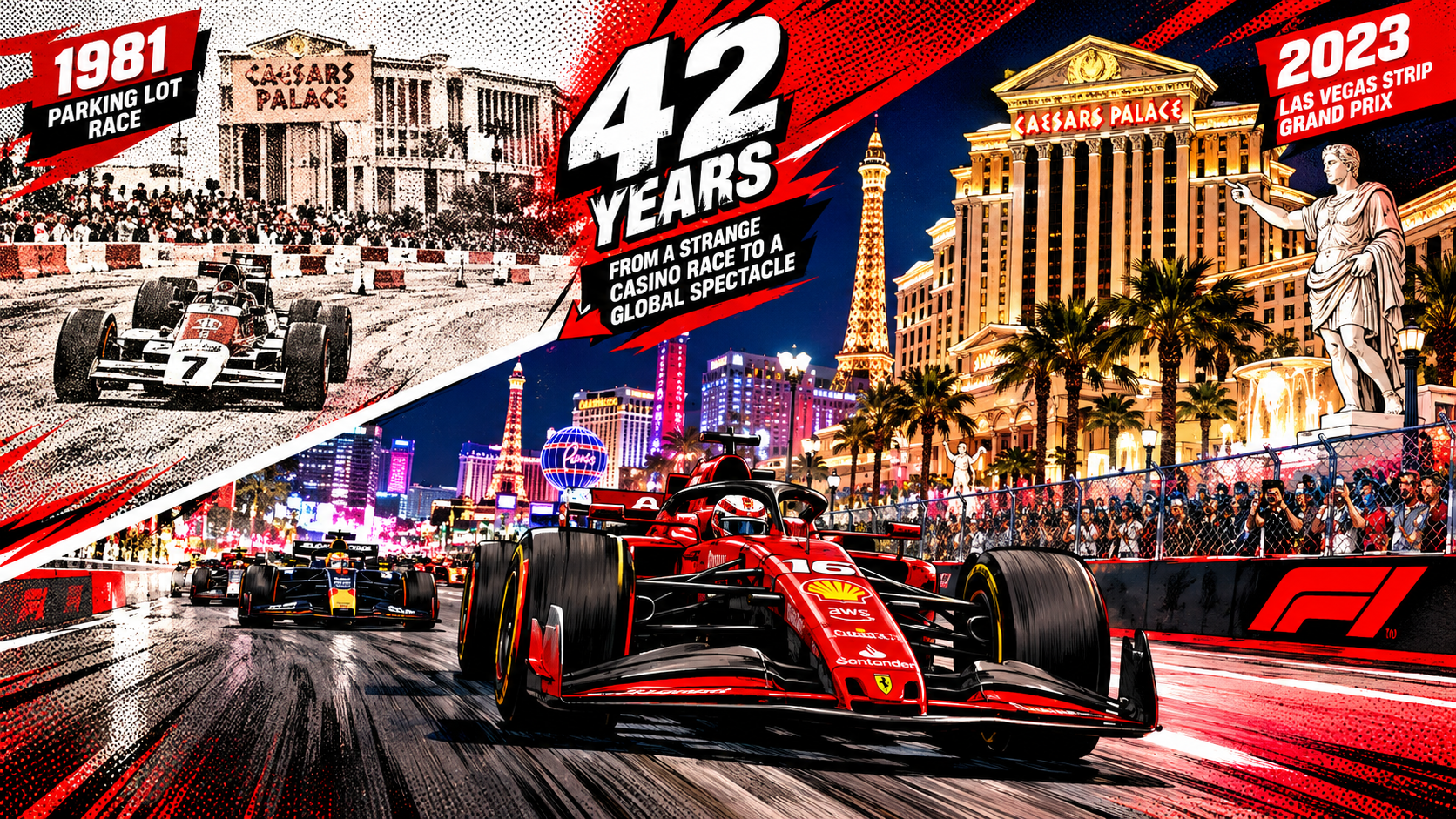
Forty-two years.
That's how long it took Formula 1 to travel a few hundred yards.
In 1981, the cars raced behind Caesars Palace.
In 2023, they raced past it.
Geographically, Formula 1 hadn't gone very far.
Everything else had changed.
Go Back to the Parking Lot One More Time
Imagine standing behind Caesars Palace in October 1981.
There is no Sphere.
No Bellagio.
No Allegiant Stadium.
No Formula 1 paddock building at Harmon and Koval.
No giant American Formula 1 audience following every team principal argument on television and social media.
There is just a strange new racetrack built on casino property.
Fourteen turns.
Concrete barriers.
Desert heat.
Formula 1 cars.
And one very Vegas business plan.
Bring wealthy people to town.
Give them something spectacular to watch.
Then give them a thousand other ways to spend money.
That idea sounds familiar now.
Because Las Vegas never really abandoned it.
It perfected it.
The First Race Was Too Small for Vegas
That sounds ridiculous.
Formula 1 is not small.
But the first Las Vegas version was.
Not the cars.
Not the championship.
The idea.
The Caesars Palace Grand Prix was essentially a major international sporting event wrapped around one resort's ambitions.
Caesars had the property.
Caesars had the financial incentive.
Caesars wanted the gamblers.
Caesars took the bet.
What it didn't have was the entire Strip participating in the same vision.
That turned out to matter.
The modern Grand Prix went in the opposite direction.
It was too large for any one casino to contain.
It required resorts.
Tourism officials.
Government agencies.
Transportation planners.
Police.
Contractors.
Thousands of workers.
Small businesses.
Formula 1 itself.
The race couldn't simply happen at a casino.
It had to happen to Las Vegas.
The Caesars Palace Grand Prix was a race at a casino. The Las Vegas Grand Prix turned the resort corridor into the event.
Las Vegas Changed What Formula 1 Was Selling
For most of Formula 1 history, the basic product has been obvious.
The race.
Twenty cars.
A circuit.
A winner.
Las Vegas pushed the idea further.
Here, the race could never be the only product.
The location was too valuable.
The hotels were too valuable.
The views were too valuable.
The hospitality was too valuable.
The entertainment possibilities were too valuable.
The global television exposure was too valuable.
So Formula 1 didn't simply sell seats overlooking a racetrack.
It sold Las Vegas with Formula 1 running through it.
Race tickets.
Luxury hospitality.
Corporate experiences.
Casino packages.
Parties.
Concerts.
Sponsorships.
Premium viewing.
Year-round experiences at its permanent property.
All attached to one weekend when the Strip becomes something it was never designed to be.
A racetrack.
Las Vegas didn't invent Formula 1 hospitality.
It didn't invent sponsorship.
It didn't invent street racing.
What Vegas did was put all of those things inside the same giant neon blender.
Then Formula 1 put its own money behind it.
Formula 1 Became the Casino
This may be the best way to understand the entire story.
In 1981, Formula 1 was the attraction.
Caesars Palace was the house.
Caesars provided the property.
Caesars spent the money.
Caesars hoped the customers would arrive.
Caesars hoped those customers would spend.
Caesars took the risk.
Forty-two years later, Formula 1 started acting a lot more like the house.
Its parent company bought the land.
It built the permanent facility.
It took a direct promotional role.
It sold the tickets.
It sold the hospitality.
It sold sponsorship.
It controlled enormous pieces of the experience.
And it accepted enormous pieces of the risk.
Formula 1 didn't merely return to Las Vegas.
It learned something from Las Vegas.
If you want more of the upside, own more of the experience.
Of course, Las Vegas teaches the second half of that lesson too.
If you own more of the experience, you own more of the downside.
The drain-cover disaster belonged to Formula 1.
The angry fans belonged to Formula 1.
The construction criticism followed Formula 1.
The ticket questions followed Formula 1.
But when the cars finally flew down the Strip under the lights, that belonged to Formula 1 too.
Big risk.
Big reward.
Very Vegas.
The City Wasn't a Backdrop Anymore
This is where the two Las Vegas races become almost perfect opposites.
The 1981 circuit tried to create a racetrack inside Las Vegas.
The modern circuit tried to create a racetrack out of Las Vegas.
That difference is everything.
At Caesars Palace, the city mostly sat outside the circuit.
On the modern course, the city is the circuit.
Las Vegas Boulevard is not scenery.
It's a straightaway.
Koval Lane is not somewhere behind the casinos.
It's part of the lap.
Harmon is not simply a route toward the Strip.
It's part of Formula 1.
Buildings become landmarks for television viewers.
Hotels become hospitality partners.
Restaurants become viewing locations.
Roads become sporting infrastructure.
Las Vegas doesn't sit behind the race.
Las Vegas is inside it.
That Came With a Price
It would be easy to end the story here.
Formula 1 came back.
The race was spectacular.
The Strip looked incredible.
Everybody lived happily ever after.
That isn't the story.
The real story is messier.
The modern Grand Prix demonstrated what Las Vegas can do when enormous companies, tourism leaders and government agencies align behind an event.
It also demonstrated what happens when an enormous event collides with the people already using the city.
Workers still needed to get to work.
Businesses still needed customers.
Residents still needed roads.
Drivers still needed routes through the resort corridor.
Formula 1's dream did not erase any of that.
It ran directly through it.
That tension may be the most Las Vegas part of the entire Grand Prix.
This city has always sold spectacle.
But spectacle has a loading dock.
Somebody builds it.
Somebody works it.
Somebody pays for it.
Somebody profits from it.
And sometimes somebody discovers a concrete barrier where the entrance to their business used to be.
The Las Vegas Grand Prix made all of that unusually visible.
Look at Caesars Palace
There it is again.
Caesars Palace.
The building that ties the whole thing together.
In 1981, Alan Jones raced behind it.
Nelson Piquet became world champion behind it.
In 1982, Michele Alboreto won behind it.
Keke Rosberg became world champion behind it.
Then Formula 1 vanished.
Decades passed.
The city around Caesars changed almost beyond recognition.
Then Formula 1 returned.
And instead of hiding the race behind Caesars Palace, it sent the cars straight past it.
That is not just a better television angle.
It is the story.
In 1981, Formula 1 raced behind Caesars Palace. Forty-two years later, it raced past the front door.
The Crazy Part Is That the Original Idea Wasn't Completely Wrong
Bill Weinberger wanted Formula 1 because he thought it could bring valuable customers to Las Vegas.
He wanted international visitors.
He wanted wealthy fans.
He wanted attention.
He wanted gambling.
He wanted spending.
That was 1981.
The first attempt failed to become sustainable.
But the fundamental idea survived.
Modern Las Vegas still wants major events because major events bring visitors.
Resorts still want those visitors spending money.
Formula 1 still wants premium customers.
Sponsors still want attention.
Television still wants spectacle.
The ingredients didn't disappear.
They got bigger.
Las Vegas got bigger.
Formula 1 got bigger.
The American audience got bigger.
The resorts got bigger.
The hospitality business got bigger.
The television opportunity got bigger.
The financial risk got bigger.
The disruption got bigger.
The entire bet got bigger.
Which, if we're being fair, is exactly what Las Vegas tends to do with ideas.
From a Placemat to Las Vegas Boulevard
There may be no better symbol of the transformation than the two maps.
The first circuit was born from the problem of not being able to use the city.
Organizers looked at the available Caesars property and tried to figure out how to squeeze a Grand Prix into it.
A rough racetrack took shape.
Decades later, the modern organizers faced the opposite challenge.
They looked at the city and asked how much of it they could put inside the Grand Prix.
The answer was ambitious.
The Strip.
The resorts.
The skyline.
The nightlife.
The hospitality.
The entire Las Vegas fantasy.
In the first era, Formula 1 tried to fit into Vegas.
In the second, Vegas became part of Formula 1.
Because Normal Racing Was Too Small
There are easier places to hold a Formula 1 race.
Places with permanent racetracks.
Places where the garages already exist.
Places where the barriers stay up.
Places where closing the circuit doesn't reroute casino workers, tourists, buses, taxis and delivery trucks.
Las Vegas was never the easy choice.
That was part of the appeal.
Formula 1 didn't need another race that could happen anywhere.
It wanted something that could only happen here.
A Saturday night Grand Prix.
On the Strip.
Under casino lights.
At more than 200 miles per hour.
With billions of dollars of Las Vegas glowing beside the circuit.
It was expensive.
Complicated.
Disruptive.
Controversial.
Sometimes ridiculous.
And impossible to ignore.
Which makes it difficult to imagine a more appropriate city.
The Longest Lap in Formula 1 History
Maybe Formula 1's longest Las Vegas lap wasn't 3.85 miles.
Maybe it took 42 years.
It started behind Caesars Palace.
It wound through two championship finales.
It disappeared.
It passed through decades of failed American experiments.
It watched Las Vegas become a major sports city.
It watched Formula 1 find a new American audience.
It moved through boardrooms.
Resorts.
Government offices.
Construction zones.
Traffic jams.
Business complaints.
Luxury suites.
A $240 million land purchase.
A permanent paddock.
A broken track cover.
An empty practice session at 2:30 in the morning.
A Ferrari on pole.
A Red Bull winning under the lights.
And finally, after all of that, it arrived where the original organizers had wanted to be in the first place.
Las Vegas Boulevard.
Only in Vegas
There is probably no other city where this story makes sense.
A casino executive helps bring Formula 1 to town.
The Strip is unavailable.
So they build a Grand Prix circuit in a parking lot.
The drivers complain.
A man nearly cooks himself winning a world championship.
They try it again.
Another world championship gets decided.
The race loses money.
Formula 1 disappears for more than four decades.
Then it comes back with hundreds of millions of dollars, buys land, builds a permanent home and turns the Strip into a racetrack.
The city spends months fighting traffic.
Businesses complain.
Fans pay enormous prices.
The first practice session lasts minutes before the street damages a Ferrari.
The fans get sent home.
The Ferrari driver gets penalized.
Everybody assumes the weekend is becoming a disaster.
Then the race is fantastic.
Formula 1 comes back the next year.
And the next.
Eventually the impossible thing starts feeling normal.
That is Las Vegas.
The city doesn't always get the first version right.
Sometimes it waits.
Sometimes it rebuilds.
Sometimes it tears the whole idea down and brings it back at a scale nobody would have believed the first time.
The Caesars Palace Grand Prix tried to make Formula 1 fit inside Las Vegas.
The Las Vegas Grand Prix figured out the bigger idea.
Don't hide Vegas behind the racetrack.
Make Vegas the racetrack.
In 1981, Las Vegas gave Formula 1 a parking lot.
Forty-two years later, it gave Formula 1 the Strip.
Because apparently the parking lot wasn't big enough.
The Final Lap: From a Parking Lot to Las Vegas Boulevard
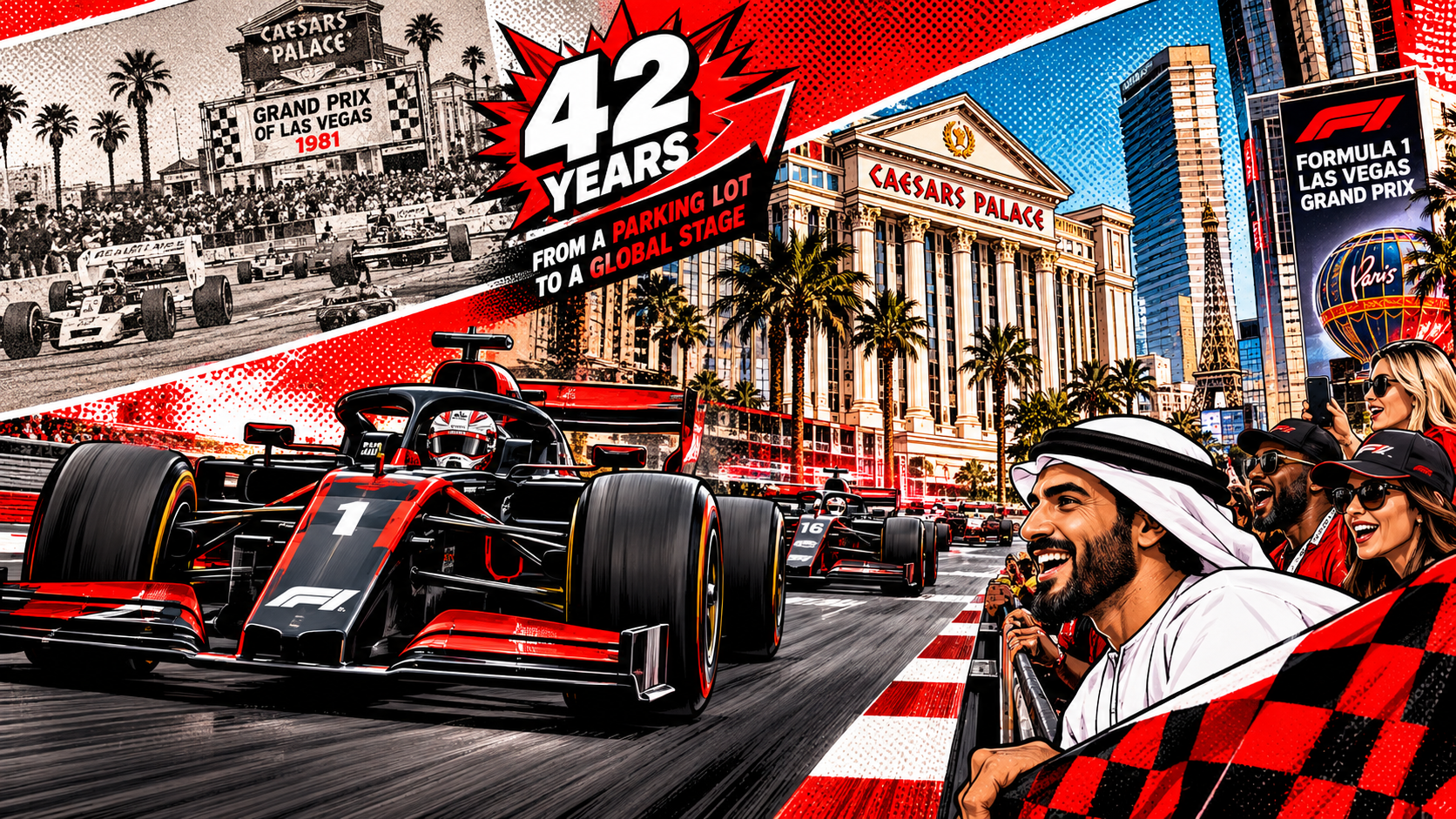
Stand on Las Vegas Boulevard during Grand Prix week, and it is almost impossible to see 1981.
That's what makes the story so good.
The barriers are taller now.
The buildings are bigger.
The money is bigger.
The audience is bigger.
The entire production is bigger.
But underneath all of it is the same wonderfully Vegas idea.
Get the world's attention.
Bring people to town.
Give them something they cannot see anywhere else.
Then make the spectacle so enormous that leaving without spending money becomes practically impossible.
Two Photographs Tell the Whole Story
Put the images beside each other.
First, 1981.
A Formula 1 car navigating a flat temporary circuit behind Caesars Palace.
Concrete.
Parking areas.
Temporary grandstands.
Desert.
A racetrack squeezed into whatever space Las Vegas could give it.
Then, 2023.
A Formula 1 car screaming down Las Vegas Boulevard at night.
Bellagio glowing.
Caesars Palace towering beside the course.
The Venetian lit up.
The Sphere glowing in the distance.
Grandstands packed into the resort corridor.
The entire Strip functioning as one enormous television set.
The first photograph says:
We found somewhere to put Formula 1.
The second says:
We put Formula 1 everywhere.
Las Vegas Was the Missing Ingredient
The Caesars Palace Grand Prix had Formula 1.
It had world champions.
It had money.
It had a famous casino.
It had international attention.
What it didn't fully have was Las Vegas.
Not the whole thing.
Not the Strip.
Not the resort corridor.
Not a citywide coalition.
Not a mature sports economy.
Not a massive American Formula 1 audience.
The modern Grand Prix finally put those pieces together.
That is why the transformation is bigger than parking lot versus boulevard.
The first race was something happening in Las Vegas.
The modern race is something happening with Las Vegas.
And sometimes happening to Las Vegas.
That last part matters.
The Spectacle Has a Cost
It would be dishonest to tell this story only from a helicopter.
From above, the Las Vegas Grand Prix looks perfect.
The lights.
The cars.
The hotels.
The Strip.
The packed grandstands.
Come down to street level, and the story gets more complicated.
There are workers trying to reach their shifts.
Businesses trying to survive construction.
Drivers sitting in detours.
Crews assembling miles of temporary infrastructure.
Restaurants hoping the visitors reach their doors.
Residents wondering whether the benefits are reaching them.
That doesn't make the Grand Prix a failure.
It makes it a Las Vegas mega-event.
Every spectacular thing this city produces has another side.
Someone has to build it.
Someone has to work it.
Someone has to move around it.
Someone gets the revenue.
Someone absorbs the disruption.
The real test of the Las Vegas Grand Prix was never whether Formula 1 could create an unforgettable weekend.
Vegas creates unforgettable weekends professionally.
The harder test is whether the event can keep getting better for the people who have to live with it after the television cameras leave.
That's the Next Race
The first challenge was getting Formula 1 back to Las Vegas.
Done.
The second was building the circuit.
Done.
The third was proving the racing could deliver.
Done.
The next challenge is harder.
Make the Grand Prix work better for Las Vegas itself.
Shorter construction windows.
Smarter transportation.
Better access for workers.
More opportunities for local businesses.
More reasons for locals to feel like the race belongs to their city too.
Because Formula 1 has already demonstrated that it can build something enormous here.
Now the opportunity is to make that enormous thing create more value beyond the circuit.
That would be the most interesting evolution of all.
The race started as a casino promotion.
It came back as a global spectacle.
Maybe its next version becomes something even bigger.
A permanent engine for the city around it.
The Parking Lot Is Gone
You cannot go back and watch Formula 1 race the old Caesars Palace circuit.
Las Vegas ate it.
That's what Las Vegas does.
The city builds over its own history with remarkable enthusiasm.
Yesterday's attraction becomes tomorrow's construction site.
A casino disappears.
A stadium appears.
A parking lot becomes something else.
Then that becomes something else.
The city rarely treats the past as sacred.
It treats it as available real estate.
But the old Grand Prix never completely disappeared.
Its central idea survived.
Las Vegas and Formula 1 belonged together.
They just needed four decades to figure out how.
One Last Look at Caesars
So go back to Caesars Palace one last time.
Not the parking lot.
The front.
Las Vegas Boulevard.
Saturday night.
The barriers are up.
The grandstands are full.
The casinos are glowing.
Somewhere inside Caesars, people are gambling.
Of course they are.
Then you hear it.
A Formula 1 car.
It appears for a moment beneath the lights.
More than 200 miles per hour.
Past the casino.
Past the crowds.
Past the place where this whole strange story started.
Then it is gone.
A few seconds later, another one arrives.
And another.
Forty-two years earlier, Formula 1 had been stuck behind Caesars Palace, racing around a temporary circuit built because the Strip was out of reach.
Now the Strip is the straightaway.
That's the joke history waited four decades to tell.
And it could only happen here.
In 1981, Las Vegas gave Formula 1 a parking lot. Forty-two years later, it gave Formula 1 the Strip, because the parking lot wasn't big enough.