Most supercars borrow a little racing glamour. A stripe here, a wing there, maybe a badge that says track edition.
The Ferrari F50 borrowed the actual engine architecture from a Formula 1 car. Then Ferrari bolted that engine into the chassis as a load bearing part, skipped the power steering, skipped ABS, and told 349 lucky humans to have fun.
This is the closest any road car in this series has come to being family. The F50 is not pretending to know Formula 1. It is related to Formula 1.
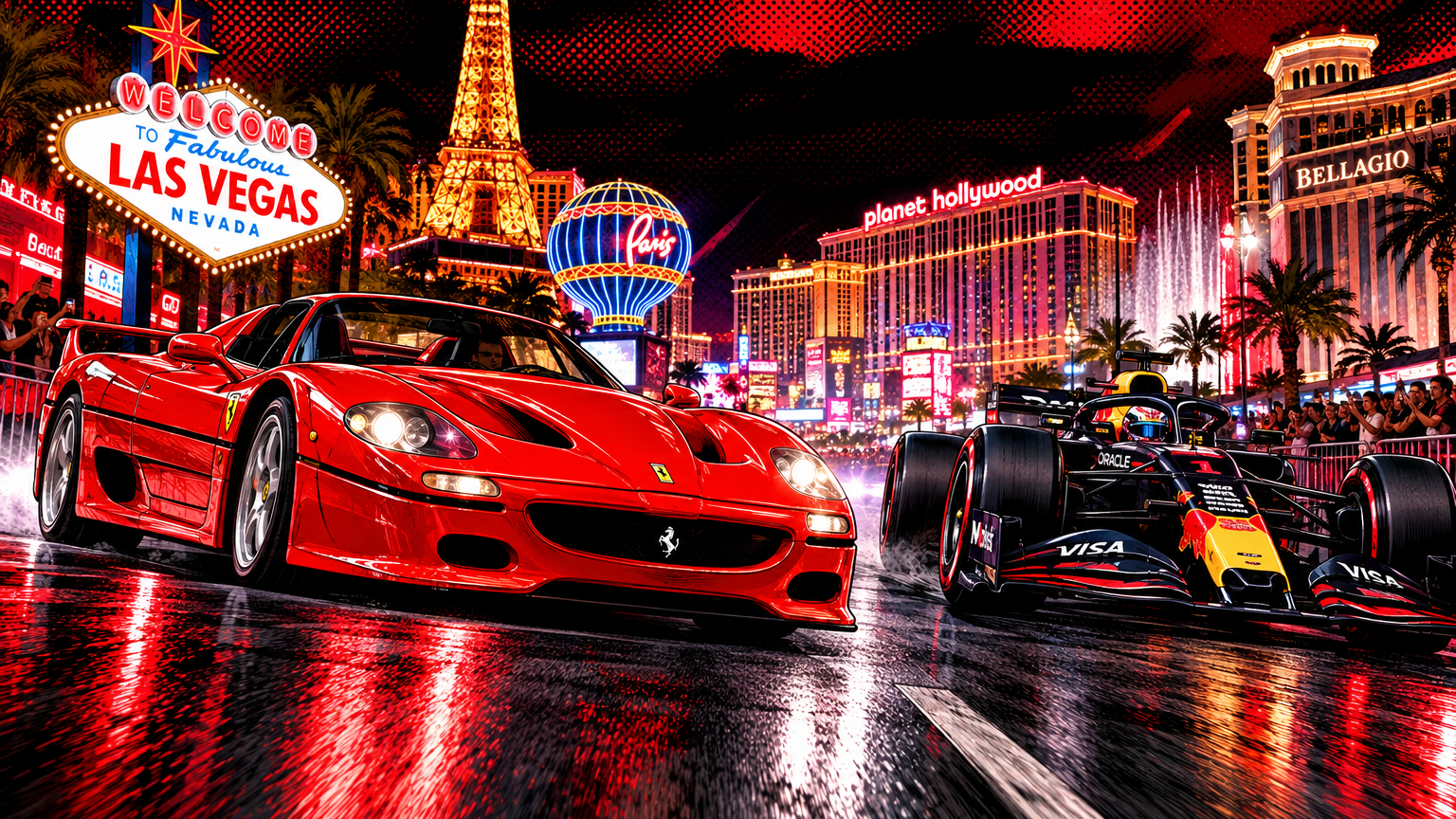
What happens if the Ferrari F50 picks a fight with a Formula 1 car?
What happens is a family argument at 8,500 rpm. The F50 brings a screaming naturally aspirated V12, a carbon fibre monocoque, and absolutely no electronic safety net.
The modern Formula 1 car brings roughly double the power, about half the weight, and thirty years of progress. Let us score it properly, on numbers that can be checked.
First, Which Ferrari F50 Are We Talking About?
The F50 name covers one road car, one famous prototype racer that never raced, and a lot of confusion. We pin ours down first.
The family, kept separate the way this series always keeps it:
- The standard F50 road car, our challenger: presented on March 9, 1995 at the Geneva Motor Show to celebrate Ferrari's fiftieth anniversary, two years early. Built from 1995 to 1997, 349 cars in total. This is the scored car.
- The 1988 style concept thinking and the Mythos: the F50 design evolved from the 1989 Ferrari Mythos concept, with cues from contemporary Formula 1 cars at the front. Context only. Not scored.
- The F50 GT: a racing derivative prototype with the V12 tuned to roughly 750 hp. It never raced in period and it is not a road car. Not scored.
- The Ferrari 333 SP: the sports racer that ran a version of this engine family in IMSA racing from 1994. A cousin, not this car. Not scored.
- The F40 and the Enzo: the turbocharged predecessor and the V12 successor in Ferrari's limited series line. Great cars, different cars. Not scored.
Now the scored car, Ferrari figures first. Ferrari's own technical specification lists a 65 degree V12 in a longitudinal rear mid layout, displacing 4,698.50 cc, with an 85 mm bore and a 69 mm stroke.
Maximum power is 382 kW, listed by Ferrari as 520 hp, at 8,500 rpm. Maximum torque is 471 Nm, about 347 lb-ft, at 6,500 rpm.
The compression ratio is 11.3 to 1. Specific output is 111 hp per litre, a serious number for a naturally aspirated road engine in 1995.
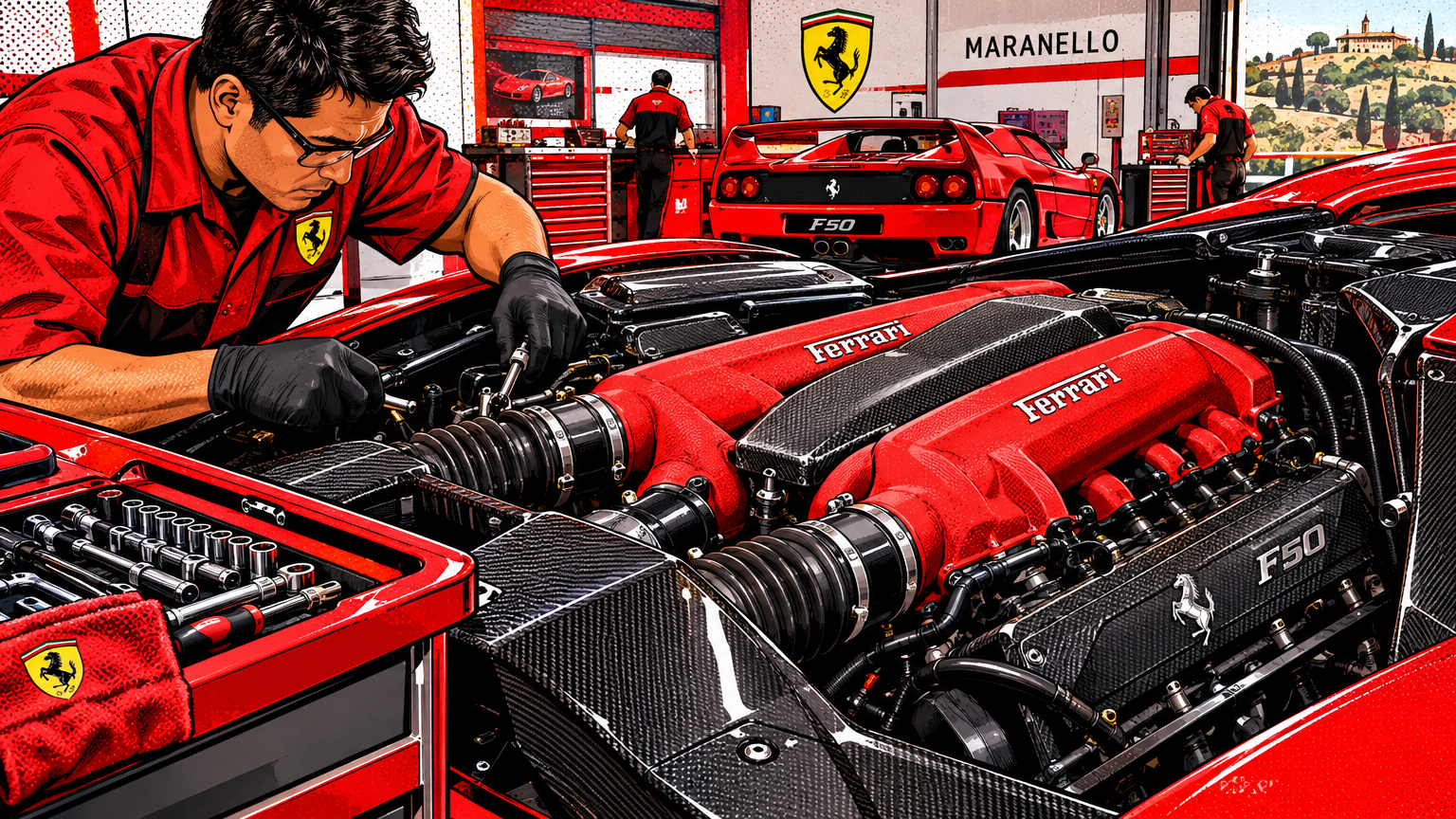
Here is the part most people miss. That V12 was derived directly from Formula 1, enlarged from the 3.5 litre engine used in Ferrari's 1990 Grand Prix car, and it carries five valves per cylinder, sixty valves in total.
Ferrari also made the engine a stressed element of the chassis. In plain English, the engine is not just sitting in the car. It is part of the structure holding the car together, exactly the way a Formula 1 car is built.
The chassis itself is a monocoque built entirely from carbon fibre. That was radical road car thinking in 1995, and the F50 was Ferrari's first limited supercar powered by a naturally aspirated V12.
The gearbox is a six speed manual with a dual plate clutch. Rear wheel drive, a proper gated shifter era layout, and no automatic mode to save you.
Ferrari lists the car at 4,480 mm long, 1,986 mm wide, and 1,120 mm tall, on a 2,580 mm wheelbase. Dry weight is 1,230 kg, about 2,712 lb, with a 105 litre fuel tank.
Tyres are 245/35 ZR 18 at the front and a very serious 335/30 ZR 18 at the rear. Pirelli now makes a dedicated Collezione tyre for the F50 in those exact sizes, launched for the F50 Legacy Tour in 2025.
Suspension uses horizontally mounted pushrod dampers, another direct lift from racing practice. The roof is a removable hardtop, so you can run it as a coupe or open it up and hear the V12 properly.
And then there is the list of things Ferrari left out. No ABS. No power assisted steering.
No traction control in the modern sense, either.
That was not cost cutting. That was the brief. Piero Ferrari's idea, as Ferrari tells it, was to build the closest thing to a Formula 1 car that a customer could drive on the road.
Ferrari performance figures: top speed 325 km/h, about 202 mph. Zero to 100 km/h in 3.87 seconds. Zero to 1,000 metres in 21.7 seconds.
Independent tests, kept separate and labelled as tests: Car and Driver's January 1997 test recorded 0 to 60 mph in 3.8 seconds, a quarter mile in 12.1 seconds at 123 mph, 0.95 g on the skidpad, and braking from 70 mph to a stop in 176 ft.
Road and Track's period test was a touch quicker to 60 mph, at 3.6 seconds, with a quarter mile in 12.1 seconds at 124.5 mph. Same car, different day, different surface. That gap is your first useful lesson in how test numbers work.
Production was capped at 349 cars. Ferrari says that number was chosen as one less than the demand from its intended market, which is the most Ferrari sentence ever written.
Meet the 2026 Formula 1 Car
The 2026 Formula 1 car is a very different kind of V based machine. Smaller engine, bigger electrical punch, and a rulebook that rewrote the car.
Its 1.6 litre turbocharged V6 hybrid pairs an internal combustion engine limited to about 400 kW with an MGU-K electric motor of up to 350 kW. Formula 1 describes the total package as more than 1,000 hp.
Minimum regulatory weight is 768 kg including the driver, about 1,693 lb. Carbon construction, rear wheel drive, active front and rear aerodynamics, and racing tyres complete the picture.
For real world speed evidence, we use measured trap speeds, not guesses. Pierre Gasly recorded 353.9 km/h, about 220 mph, in qualifying at the 2026 Chinese Grand Prix, per FIA data.
Older Las Vegas traps, labelled by year, show the ceiling in other trims. Yuki Tsunoda hit 358.3 km/h in 2025, and Alex Albon hit 368.9 km/h in 2024, the highest through the first three editions of the race.
There is no universal official Formula 1 0 to 60 mph time, and this series never invents one. We score acceleration on power to weight, traction, and the evidence we actually have.
Five things to carry into the rounds:
- Power to weight decides launches. The F50 makes about 423 hp per tonne on its dry weight. The Formula 1 car makes more than 1,300 hp per tonne.
- A top speed claim is not a trap speed. One is a best case number in top speed trim. The other is measured mid qualifying, in cornering trim, on a real circuit.
- Grip is a system. Tyres, weight, downforce, and suspension all vote. No single number wins a corner on its own.
- Brakes stop the wheels. Tyres stop the car. And heat decides whether stop number ten looks anything like stop number one.
- No driver aids means the driver is the system. In the F50, your right foot is the traction control and your leg is the brake booster.
Ferrari F50 vs. F1: The Numbers
| Category | Ferrari F50 | 2026 Formula 1 Car |
|---|---|---|
| Engine | 4,698.50 cc naturally aspirated 65 degree V12, five valves per cylinder | 1.6 litre turbocharged V6 hybrid |
| Power | 520 hp at 8,500 rpm (Ferrari) | More than 1,000 hp total (Formula 1) |
| Torque | 471 Nm at 6,500 rpm | No single combined figure published the same way |
| Gearbox | 6 speed manual, dual plate clutch | Sequential racing gearbox |
| Drive | Rear wheel drive | Rear wheel drive |
| Weight | 1,230 kg dry | 768 kg minimum, including driver |
| 0 to 100 km/h | 3.87 sec (Ferrari) | No universal official figure published |
| Top speed | 325 km/h (Ferrari figure) | 353.9 km/h measured trap, Gasly, 2026 China qualifying |
| Chassis | Carbon fibre monocoque, engine as stressed member | Carbon construction, active aero |
| Driver aids | No ABS, no power steering | Full professional racing systems and team support |
| Built | 349 cars, 1995 to 1997 | Built for one racing season at a time |
| Vegas valet factor | 10 out of 10. A valet who can drive a gated manual without stalling becomes a legend on the spot. | 0 out of 10. It cannot do valet duty, it has no passenger seat for your date, and it needs a crew to start the show. |
Read the weight line twice. The F50 was featherlight for a V12 road car in 1995, and the Formula 1 car still weighs about 462 kg less on its minimum, driver included, while making roughly double the power.
That math shapes every round that follows. The F50's hope is not in the totals. Its hope is in feel, in sound, and in being the car you can actually take home.


Round One: Acceleration
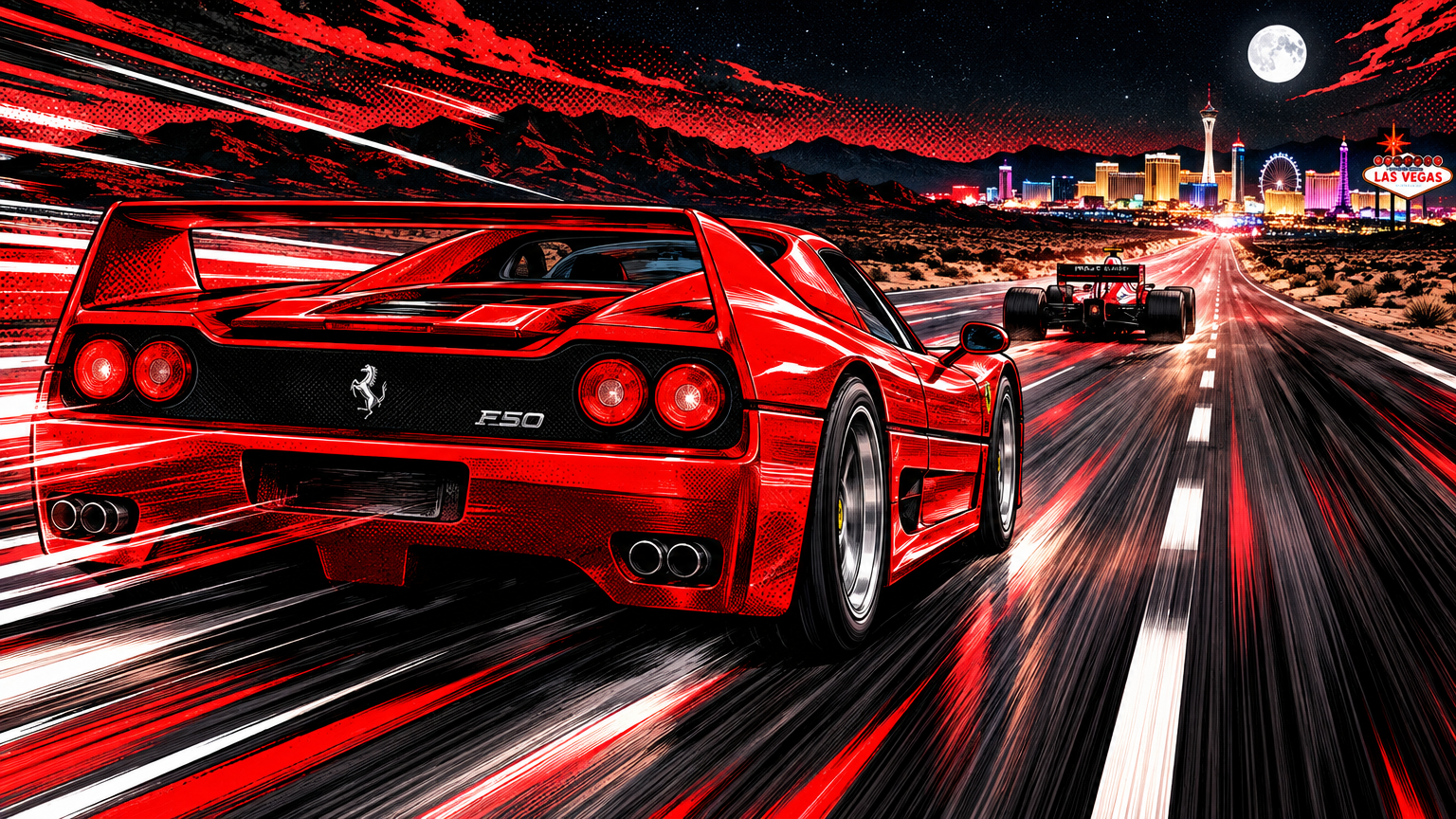
Ferrari quotes 3.87 seconds from 0 to 100 km/h for the F50. Car and Driver measured 3.8 seconds to 60 mph, and Road and Track measured 3.6.
For a manual gearbox car with no launch control and no traction control, those are heroic numbers. Every tenth in an F50 launch is earned by a human balancing clutch, throttle, and wheelspin.
The Formula 1 car plays a different sport. More than 1,000 hp, 768 kg, racing tyres warmed and ready, and a launch procedure refined by a whole team.
Power to weight tells the story without any invented stopwatch figure. About 423 hp per tonne for the Ferrari, against more than 1,300 hp per tonne for the Formula 1 car.
The F50 driver also has to change gear by hand, twice on the way to 100 km/h pace and beyond. The Formula 1 driver pulls a paddle and keeps both hands on the wheel.
Useful takeaway for your own car shopping: headline 0 to 60 times hide the driver workload. A modern automatic can repeat its best launch all day. A manual car like the F50 turns every launch into a skill test, which is either the problem or the entire point, depending on who you are.
Winner: Formula 1. The F50 launches like a superbike with doors. The Formula 1 car launches like it was fired.
Round Two: Top Speed
This round needs honesty, because the F50's number and the Formula 1 numbers are not measured the same way.
Ferrari quotes 325 km/h for the F50. That is a manufacturer top speed figure for the road car in top speed trim.
Against it, the measured Formula 1 evidence: Gasly at 353.9 km/h in 2026 qualifying trim in China. Tsunoda at 358.3 km/h in Las Vegas in 2025. Albon at 368.9 km/h in Las Vegas in 2024.
Every one of those trap speeds sits above 325 km/h. And those Formula 1 cars were not in top speed trim. They were set up to go around corners on a circuit, carrying downforce that costs straight line speed.
On the Las Vegas Strip Circuit, with its roughly 2 km straight along the Strip, the Formula 1 car would be deep into the 340s and beyond while the F50 was still climbing toward its ceiling.
Context matters, though. In 1995, 325 km/h put the F50 in the fastest club on Earth. It beat its own predecessor on top speed and did it without turbos, using revs and displacement instead.
Winner: Formula 1, on verified trap speeds alone. No claim needed, no asterisk needed. The measured numbers are already higher than the F50's quoted maximum.
Round Three: Now Add a Corner
The F50 was built to corner. Carbon tub, pushrod suspension, mid engine balance, huge rear tyres, and steering with no power assistance diluting the messages.
Car and Driver measured 0.95 g on the skidpad in 1997. That is strong grip for a road car of its era on road tyres.
Drivers who know the car talk about something a skidpad cannot measure. Because the engine is a stressed member and the tub is carbon, the whole car feels wired directly to your hands and your back.
The Formula 1 car corners with downforce the F50 simply does not have. Active aero presses it into the road, racing tyres bite at temperatures road tyres never reach, and the weight is barely more than half.
Through the 17 turns of the Las Vegas Strip Circuit, the gap would not be measured in tenths. It would be measured in the F50 driver watching the Formula 1 car disappear, then hearing it come back around.
Useful takeaway: when you read a skidpad number, ask what tyre earned it and at what temperature. Grip is not a property of the car alone. It is a property of the whole system on that day.
Winner: Formula 1. The F50 corners like a racer for the road. The Formula 1 car is the racer the road car was imitating.
Round Four: Braking
Here is where the F50's no aids brief gets very real. Its brakes are serious hardware, and there is no ABS and no servo assistance standing between your foot and the stop.
Car and Driver recorded 176 ft from 70 mph to a stop in its 1997 test. Respectable for the era, and it demanded a strong, skilled leg to repeat.
Without ABS, the driver owns the lockup problem. Brake a fraction too hard on a dusty Vegas side street and the tyre that locks is the tyre that stops steering.
The Formula 1 car brakes from far higher speeds, far later, lap after lap, with carbon brakes built for exactly that abuse and a driver trained to live at the threshold.
Heat is the hidden scorekeeper. The F50 can do a huge stop. The Formula 1 car can do huge stops as a lifestyle, fifty laps deep into a Grand Prix.
Ownership lesson, and it applies to any classic supercar: a single magazine stopping distance is a best day figure. Ask about fade, parts availability, and specialist care before you fall in love with the number.
- Check the brakes first: on any F50 era car, brake condition and correct pads matter more than the brochure figure.
- Check the tyres by date, not just tread: old rubber on a 520 hp manual car with no aids is a genuine safety issue.
- Check the specialist: carbon tub cars and stressed engine layouts need people who know them. Budget for expertise, not just parts.
- Check the roof and the history: 349 cars means provenance is everything. Paperwork is part of the car.
Winner: Formula 1. Clean sweep on the rounds, but keep reading, because the scoreboard is not the whole story.
So, Does the Ferrari F50 Win Anything?
Yes. It wins the things this series never puts on the stopwatch.
It wins sound, and it is not close. A naturally aspirated V12 at 8,500 rpm, derived from a Grand Prix engine, with the roof off, is one of the great noises in car history. The 2026 Formula 1 hybrid is brutally effective and nobody writes poems about its soundtrack.
It wins involvement. A gated manual, unassisted steering, no ABS, and a clutch that demands respect.
Modern cars make speed easy. The F50 makes speed earned, and a lot of drivers will tell you earned speed is the only kind worth remembering.
It wins honesty of purpose. Ferrari set out to build a Formula 1 car for the road and then actually did the hard parts: the engine architecture, the carbon tub, the stressed member layout, the pushrod suspension.
It wins rarity with a story. 349 cars, one less than demand, built across 1995 to 1997 for Ferrari's fiftieth anniversary. When Ferrari brought owners back together for the F50 Legacy Tour through Tuscany in 2025, thirty years after launch, the cars were still the headline.
And it wins the drive home. After the fight, the F50 takes two people, a removable roof, and a 105 litre tank onto real roads. The Formula 1 car goes back into a garage with a crew around it.
If you want more of this series, start with the previous fight, Formula 1 vs. Lamborghini Revuelto, where the challenger matched Formula 1 on headline power. Then keep the Las Vegas Grand Prix hub open for race week coverage.
What Would Happen on the Las Vegas Strip Circuit?
The Las Vegas Strip Circuit runs 6.201 km, about 3.85 miles, with 17 turns and 50 laps on Grand Prix night. Its signature is the roughly 2 km straight along the Strip, past the casinos, at night.
Picture the F50 launching onto that straight. The V12 clears its throat at 8,500 rpm, the gated shifter clacks through the gears, and the crowd hears a 1990s Grand Prix soundtrack echoing off the casino towers.
Then the numbers arrive. The Formula 1 car exits the corner before the straight carrying more speed, deploys its hybrid power, and traps well above the F50's 325 km/h ceiling.
Through the tight sections near the Sphere and down the back of the circuit, the pattern repeats. The F50 driver works beautifully and bravely. The Formula 1 car simply operates in a different performance universe.
No lap times are invented here, because none were recorded. This is an informed comparison, not a race result. But nobody who has seen both sets of numbers needs a stopwatch to call the direction of it.
What the F50 would win in Vegas is the crowd. Valet stands, casino entrances, late night runs down the Strip with the roof off. In this city, presence is a performance category, and the F50 is undefeated at presence.
The Final Call
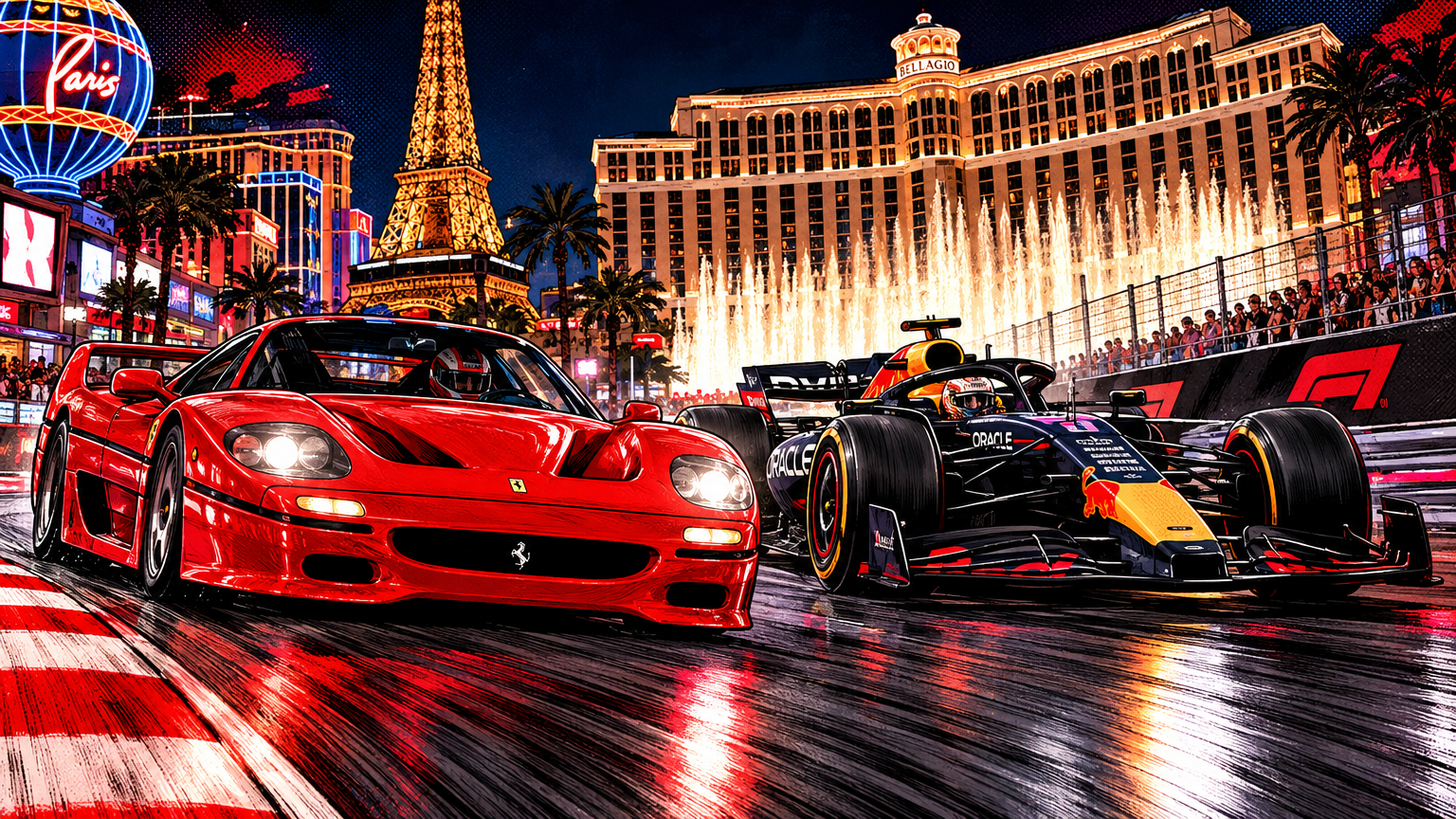
Four rounds, four wins for Formula 1. Acceleration, top speed on verified traps, cornering, and braking all go the same way, and the power to weight math said they would from the first page.
But here is the twist no other challenger in this series can claim. The F50 did not lose to a stranger. It lost to its own descendant, thirty years of its own idea, refined by hybrid power, active aero, and a rulebook full of lessons cars like the F50 taught the sport.
Every carbon tubbed, engine as structure, no nonsense performance car that followed owes this one a nod. The F50 was Ferrari asking how much Formula 1 a road car could honestly carry, and answering: almost all of it.
Formula 1 may win the fight. But the Ferrari F50 still carries a real Formula 1 heart, a manual gearbox, and no excuses, and that makes it family forever.
There are plenty more cars waiting to pick a fight with Formula 1. Next up: Formula 1 vs. Lotus Elise: the lightest car in Britain brings almost no power and almost no weight, so can clever and tiny beat huge and hybrid?