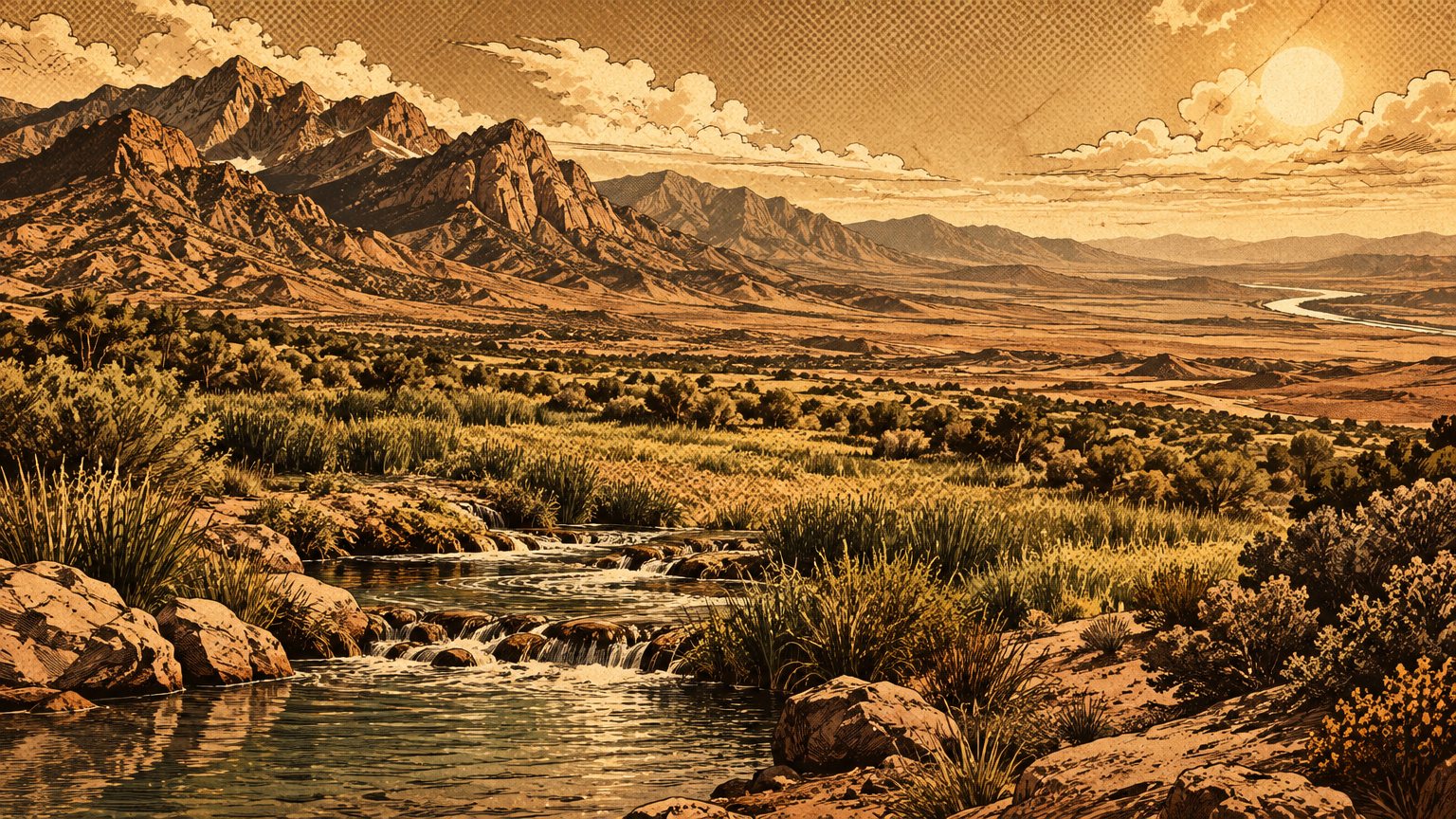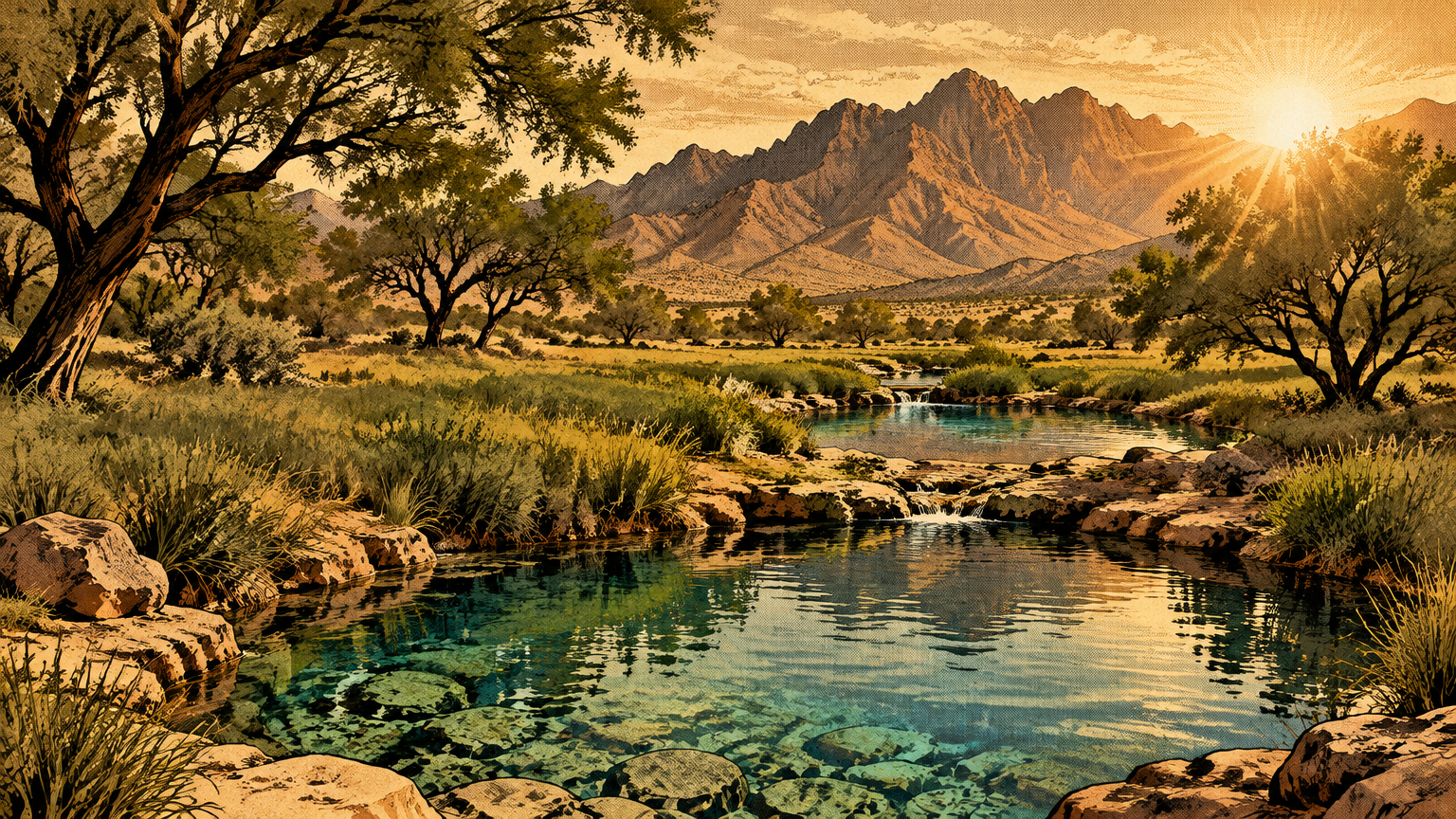
Every city wants an origin story with a dramatic first scene, and Las Vegas had one ready made for decades. In that version, Ice Age hunters stalked mammoths beside the springs more than 11,000 years ago, and a state historical marker at Tule Springs said so in plain words. There is only one problem with it.
When scientists finally tested the claim with the biggest excavation in the site's history, the evidence refused to back it up, and the state eventually took the words off the marker. What archaeology can actually tell us about the first people of this valley is less cinematic than the legend. It is also considerably more interesting.
It is a documented story of water, gardens, and seasonal journeys between the valley floor and the mountains. And it ends with a people whose descendants govern a sovereign tribal nation in this city today.
This story follows the evidence, and it respects its limits. Some of what follows is proven about as well as anything in archaeology gets proven. Elsewhere, the honest answer is that the ground has not told us, at least not yet.
The difference between those two kinds of knowledge is not a weakness in this story. It is the story.
Reading the oldest traces
Stone tools and archaeological sites
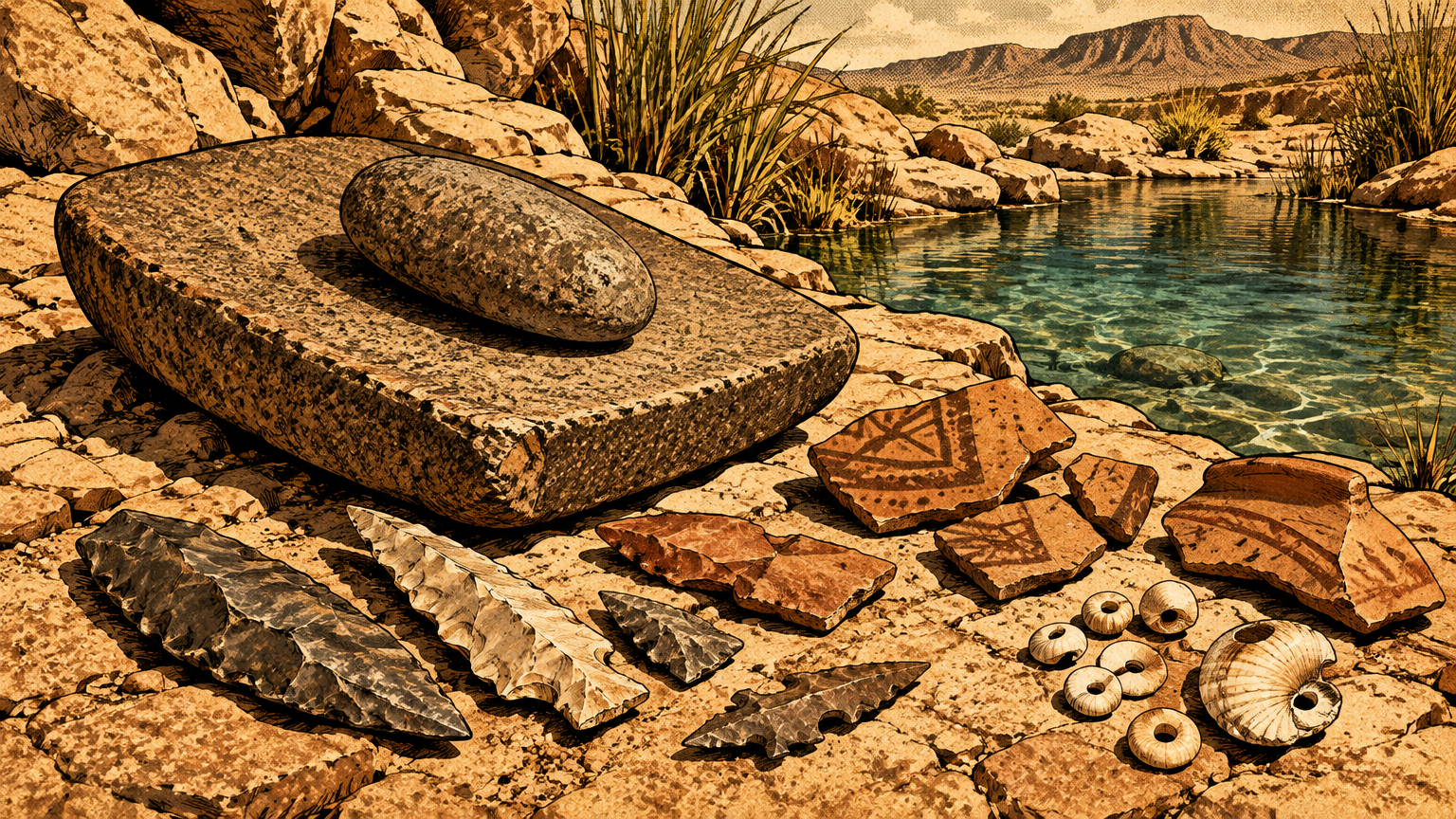
Start with what survives. Wood rots, fiber disintegrates, and food vanishes, but stone, fired clay, and shell endure.
So the earliest chapters of human history in this valley are written in the hardest materials people handled. Archaeologists working at the Las Vegas Springs have documented chipped stone, the flakes and shaped tools struck from rock, alongside ground stone worn smooth by processing food, plus ceramics, shells, and charcoal.
The Springs Preserve reports significant prehistoric artifacts found on the spring mound itself, the low rise beside the water. Down the Las Vegas Wash, the county's cultural history records the earliest traces dated to about AD 600.
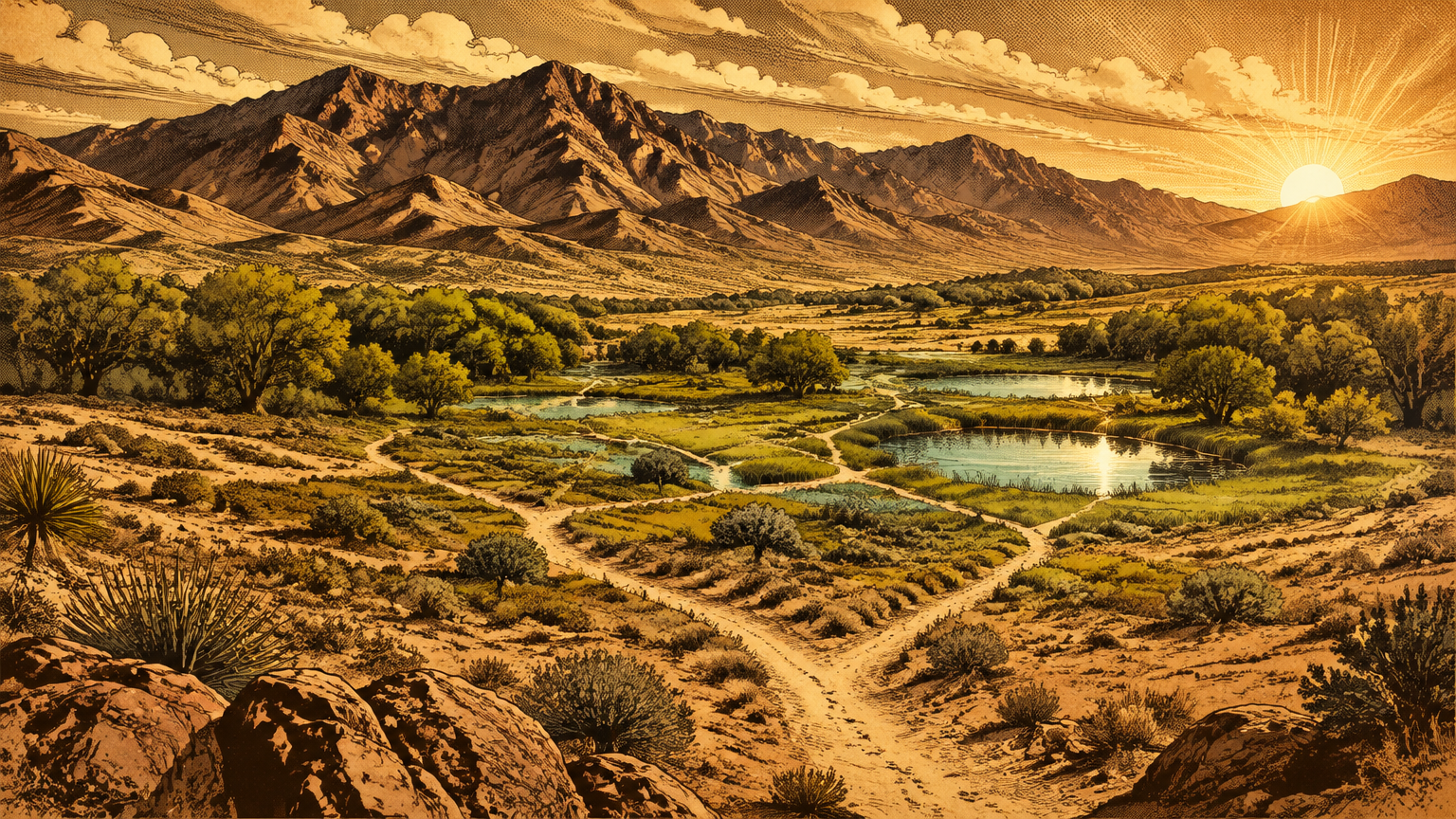
Where the evidence sits matters as much as what it is. The traces cluster where life was possible in a desert: at the springs, and along the Wash.
Clark County describes the Wash as a travel corridor, a camping and habitation locale, and a resource procurement area, all at once. The Wash also preserves the valley's filing system.
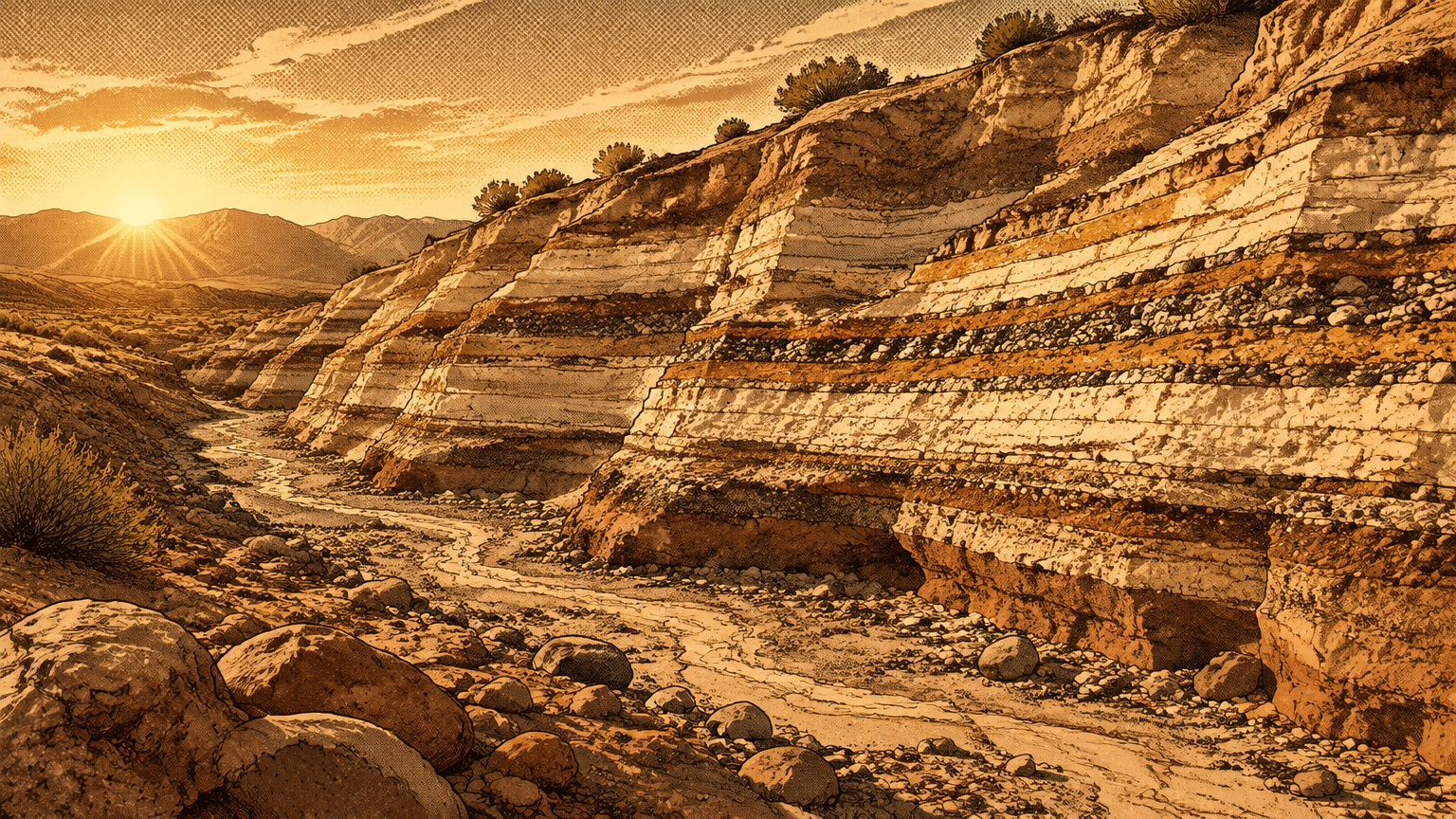
Its sediments settled in layers over time, and archaeologists read those stacked layers the way you would read pages in order, with each stratum holding the traces of the people who passed while it was the surface. A tool found in a dated layer can be placed in sequence. A tool found loose on the surface can only say that someone, at some point, stood there.
Three peoples left most of the traces in the valley, according to the county's cultural history: the Ancestral Puebloans, called the Anasazi in older writing, the Mohave, and the Southern Paiute, and their occupations overlapped in time rather than succeeding each other neatly. That overlap is worth holding onto.
The valley was never a stage where one group exited before the next entered. It was a crossroads of neighbors, and the ground keeps all of their traces mixed into the same few watered places.
Distinguishing occupation from settlement
Archaeology has to be careful with a simple question: does a trace mean people visited, or that people lived there? A scatter of stone flakes proves a stop, a tool repaired, a meal processed. It does not prove a home.
The strongest evidence of actual dwelling at the springs is a house. At what is now the Springs Preserve, archaeologists have documented and partially excavated a pithouse, a partly underground dwelling of the Ancestral Puebloan tradition, dated to about AD 700.
Its fill produced the full household kit: chipped and ground stone, ceramics, shells, and charcoal. Remote sensing surveys, using ground penetrating radar and other noninvasive techniques, suggest two more pithouses may sit nearby, still unexcavated.
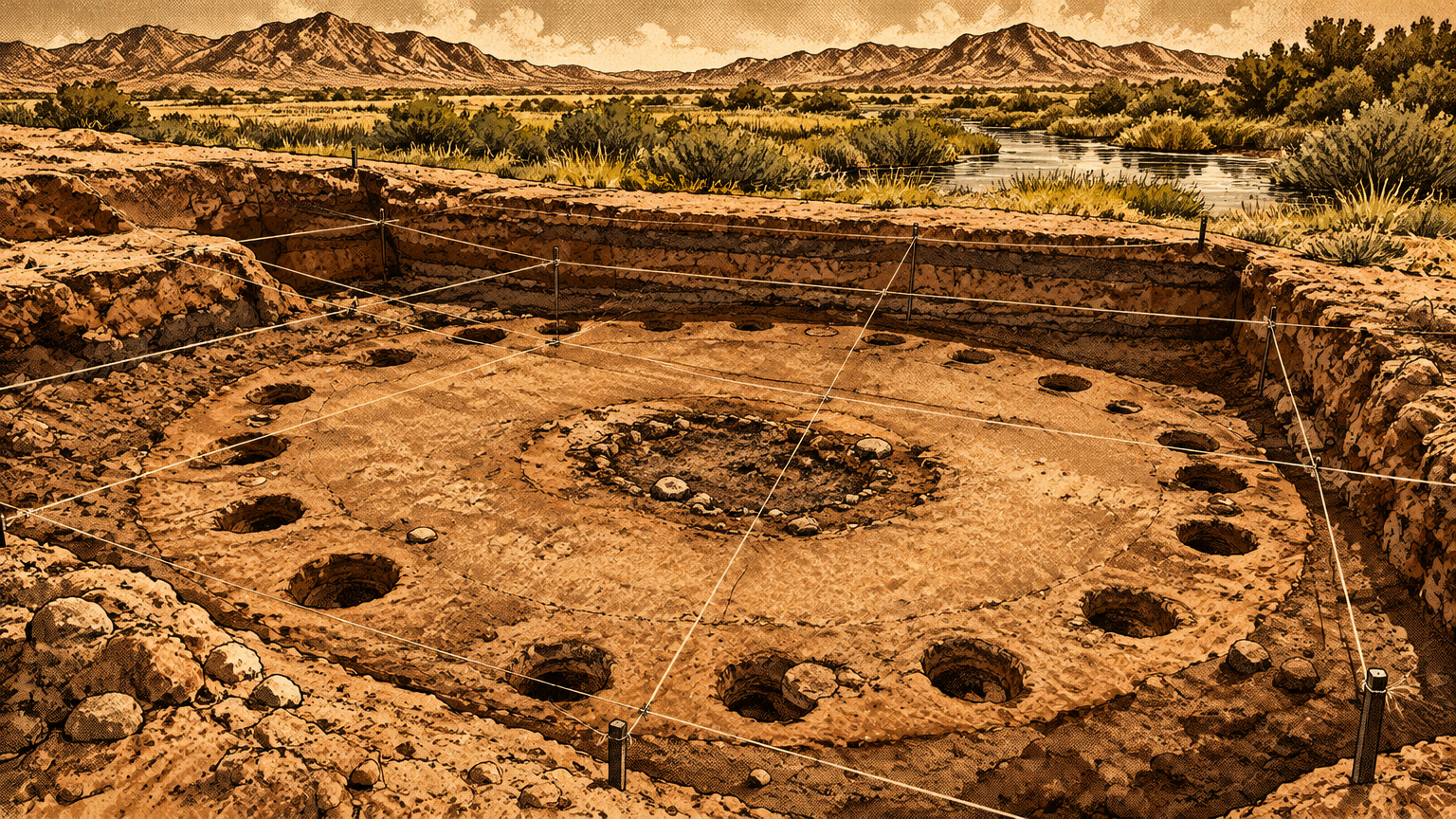
Here is the documented floor of the valley's human story, the part that rests on excavated and dated evidence. It runs roughly fourteen centuries deep: traces along the Wash from about AD 600, and a dwelling at the springs by about AD 700. Continuous Indigenous presence runs from there to the present.
That is a long, rich record. And how the valley's bigger claim fell apart is the best lesson in what archaeology can and cannot do.
In 1933, a piece of worked obsidian turned up at Tule Springs alongside charcoal and Ice Age animal remains. When Willard Libby, the inventor of radiocarbon dating, later dated that charcoal, it came back roughly 28,000 to 33,000 years old, far older than any accepted human presence in North America. The implication electrified researchers: people might have been in this valley while mammoths still drank at its springs.
In 1962 and 1963, the Tule Springs Expedition, remembered as the Big Dig, set out to prove it. It moved earth on an industrial scale (later summaries put it near 200,000 tons), while geologist C. Vance Haynes Jr. divided the sediments into dated layers.
The result was the opposite of the hoped for headline. Human made artifacts appeared only in the youngest layers of the formation, the very layers that contain no Pleistocene animal remains at all. The Geological Survey's verdict is blunt: the hypothesis that early humans coexisted with the Ice Age giants at Tule Springs was disproven.
The charcoal that started it all had mixed material from deposits of different ages, and could not have been the product of a human fire. In 2013, the Nevada State Historic Preservation Office rewrote the Tule Springs marker text and removed every reference to people in the valley 11,000 or more years ago.
The amended text honors the site instead as the first place radiocarbon dating was used systematically, with verifiable results. The valley's most famous archaeological claim is now a landmark in the history of archaeology itself.
Lives beyond the artifacts
Food, mobility and water
The artifacts go quiet on the questions that matter most to a life: what did people eat, where did they sleep in July, how far did they walk in a year? For the Southern Paiute, the Nuwuvi, whose homeland this valley was, the answers are unusually well documented.
Ethnographers recorded the pattern while it was still being lived, and archaeologists like Claude N. Warren spent careers testing it against the ground. Warren, the same archaeologist whose reconnaissance of the springs is celebrated at the Springs Preserve, described the Las Vegas Paiute pattern as a double loop.
The first loop turned on the valley floor. Families planted gardens near the springs. They irrigated them, tended them, and guarded them from animals.
Around the water, extensive mesquite groves produced beans that could be stored and, in the researchers' phrase, never failed. The second loop climbed.
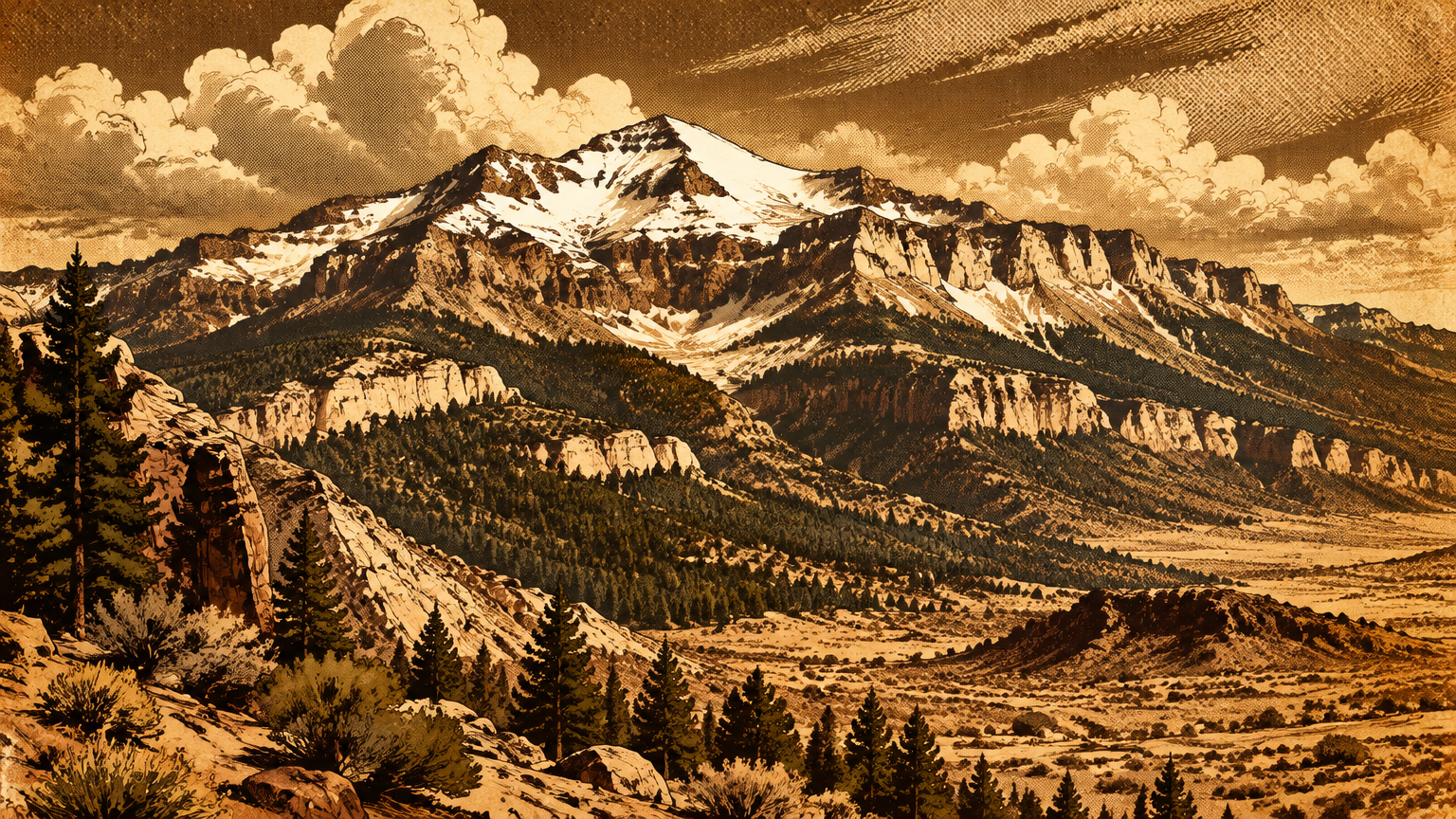
In the warmer months and into early fall, people traveled roughly twenty miles into the foothills of the Spring Mountains to harvest agave and pine nuts, returning to the same groves and the same camps year after year. Pine nuts, the Forest Service's cultural history of the Spring Mountains notes, were the essential food stored for winter. The state's own marker at the springs compresses the whole system into one sentence: the meadows were the winter homeland of the Southern Paiutes, who spent the summers in the Charleston Mountains.
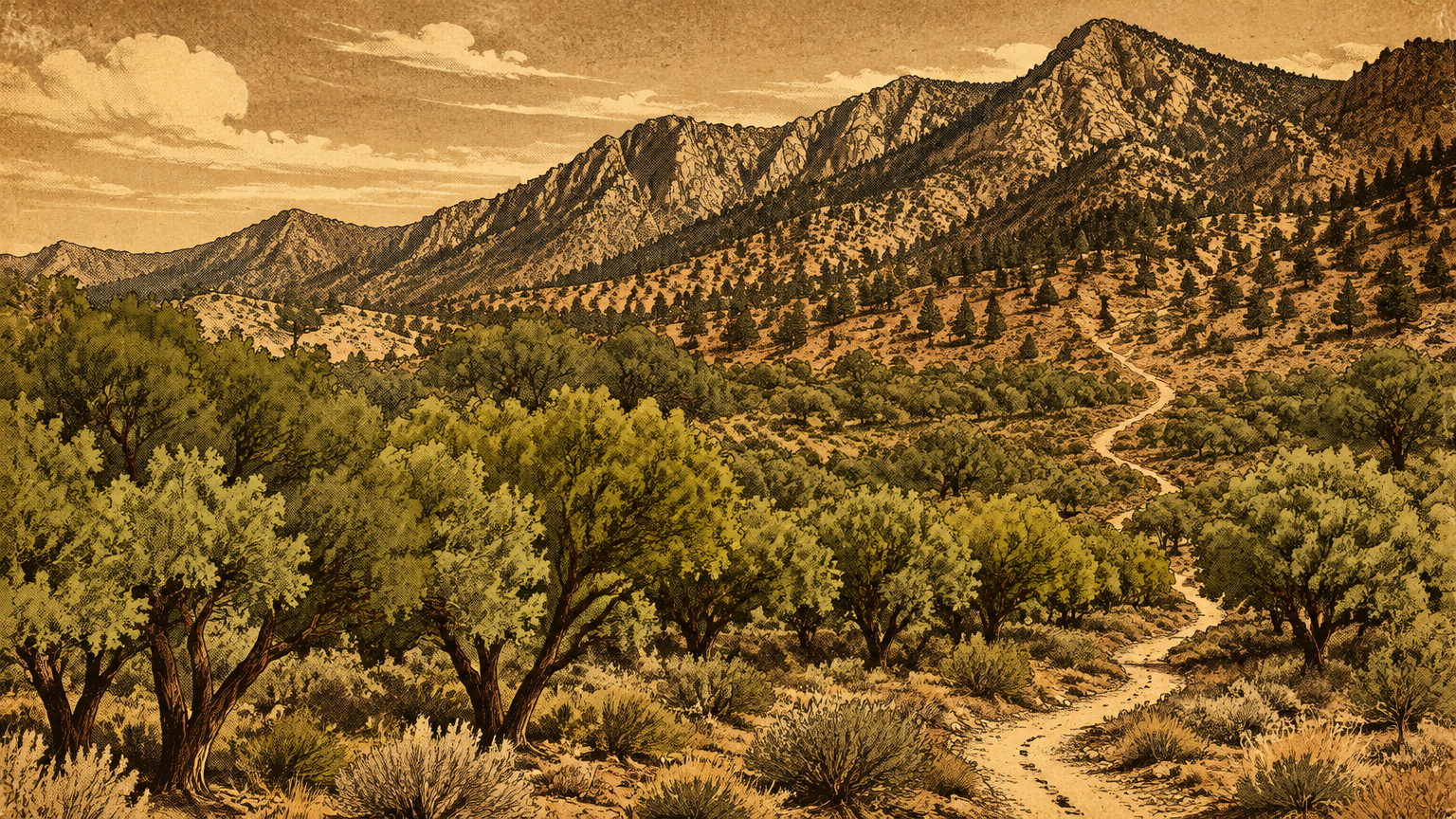
Two things about that pattern matter. First, it was not wandering. A double loop is a schedule, anchored to named places and ripening dates, with gardens on one end and pine groves on the other, and it required detailed knowledge of a large territory carried in memory.
Second, this valley made it possible. Researchers stress that the Las Vegas Valley was an unusually productive place for the Mojave Desert, with ample water, extensive mesquite forests, and mountain country within a day's walk.
Even the shells in the springs' artifact deposits hint at the wider web: shell in a desert interior arrives through carrying and exchange, and the Forest Service describes these communities' exchange networks as large. The first Las Vegas economy ran on water, beans, pine nuts, and knowing exactly when to be where.
What oral traditions add to the record
There are questions a stone tool cannot answer at all: what a place meant, who belonged to it, what was owed to it. That knowledge does not live in the ground. It lives with the people, and for the Southern Paiute it is carried in language, in teaching, and in traditions like the Salt Songs that the Las Vegas Paiute Tribe today names among the heritage it works to preserve.
The tribe's own website greets visitors with a Nuwu teaching about Nuvagantu, the sacred land, describing it as alive, a place with power that has eyes to see you and ears to hear you. Federal researchers recording the cultural background of the Spring Mountains put the related point plainly: Native groups hold that the Spring Mountains are where they were created. No excavation produces a sentence like that.
It is not archaeology's job to verify it, either. It is knowledge of a different kind, held by its own authorities.
The two kinds of knowledge meet in practice. The Springs Preserve says its archaeologists collect oral histories and combine them with historic documents and excavation data to understand how different peoples used the springs. That is an institutional admission, plain as day: the ground alone is an incomplete archive.
The seasonal round even made room for passing the stories on. The Forest Service's cultural history notes that winter, the season of stored food and stronger houses, was the time for telling stories.
This article draws only on what tribal and institutional sources have chosen to publish. The living tradition is not a quarry for other people's content, and where the published record stops, this article stops with it.


A history still alive
Tribal perspectives and stewardship
It would be easy, and wrong, to write about the first people of this valley entirely in the past tense. The Las Vegas Paiute Tribe is a federally recognized sovereign nation, known as the Tudinu and part of the greater Nuwu, the Southern Paiute people.
The tribe states that its ancestors have inhabited Southern Nevada since at least AD 1100. Its modern history runs from the original ten acre colony, established in 1911, to today's Snow Mountain Reservation of 3,850 acres northwest of the city.
An elected Tribal Council governs from 1 Paiute Drive in Las Vegas, a few miles from the springs at the center of this story. The tribe describes its cultural work in the present tense: protecting ancestral traditions, the Southern Paiute language, and the Salt Songs, and preserving what it calls 9,000 years of living connection to the land for future generations.
That continuity changes how you read everything before it in this article. The seasonal round, the gardens at the springs, the winter villages in the meadows: these are not the customs of a vanished people. They are the heritage of a nation that still exists, still governs, and still speaks for this land.
When the tribe's website calls its people guardians of sacred lands, it is not reaching for a metaphor. Stewardship of this valley did not pass from Indigenous hands to institutions. It is shared now, and the oldest claim in the room belongs to the people who were here first.
Ethics of excavation and display
Excavation is a peculiar science: its core method destroys its own evidence. A layer, once dug, can never be dug again, which is why the modern ethics of the field start with restraint.
At the Springs Preserve, archaeologists located the two suspected pithouses with radar and magnetometry rather than shovels. They read the ground without opening it, and left the sites intact for a future with better tools and better questions.
The Preserve also states its collecting policy in one unambiguous line: it is not a collecting institution, and it generally does not accept artifacts for donation. The Las Vegas Springs themselves were listed on the National Register of Historic Places in 1978, designated an archaeological site, a formal recognition that the ground is a document and should be treated like one.
The marker at Tule Springs belongs in this section too. When the evidence changed, the state changed the words, in public, on the record. That is what stewardship of the past looks like when it is done honestly: not defending a good story past its expiration date, but correcting it and saying why.
What archaeology can tell us about the first people of the Las Vegas Valley turns out to be a great deal: that they were here by AD 600, that they built homes at the springs, that they farmed, gathered, traded, and traveled a double loop between the meadows and the mountains, and that their descendants are here still. What it cannot tell us, it has also taught us to admit. In a city famous for selling certainty it does not have, that may be the most valuable exhibit of all.
The neon came later. Before it, there were gardens at the springs and pine camps in the mountains, charcoal in a pithouse floor and beans stored against the winter, and a people who read this valley the way you read a home. The evidence of their world is still in the ground under ours, and the people themselves are still here, which is more than the mammoths can say.
Next in Vegas, Back Then: Why the Las Vegas Springs Were a Desert Lifeline.