Some cars are built to win races. This one was built to enter a race that stopped existing before the car ever got to the start line.
The Ferrari 288 GTO was Maranello's homologation special for Group B, the wildest racing category of the 1980s. Ferrari built the road cars the rules demanded, and then the category was cancelled.
Every one of the 272 cars became a road car by accident. That accident also started the modern Ferrari supercar line that led straight to the F40.
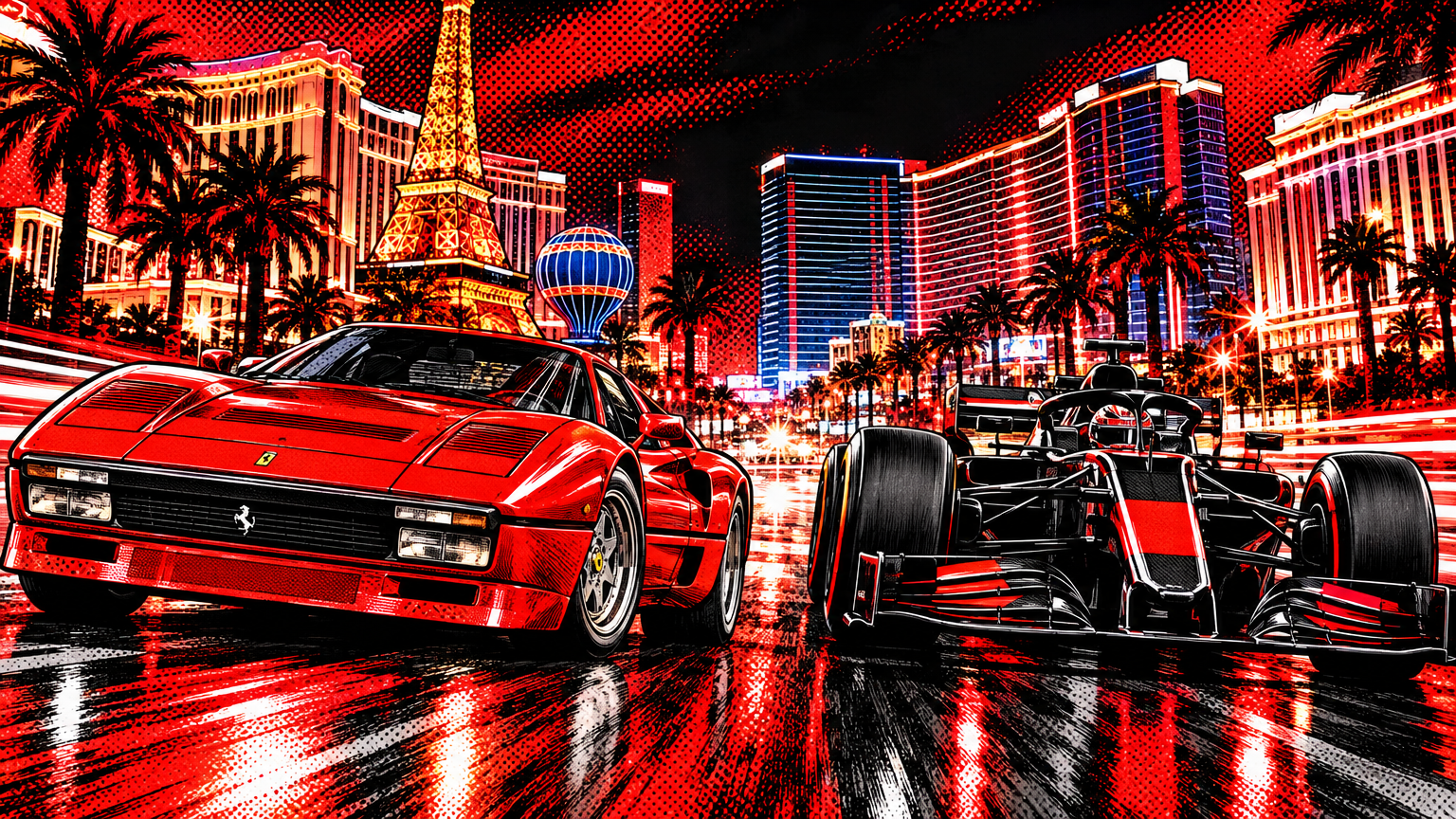
What happens if the Ferrari 288 GTO picks a fight with a Formula 1 car?
What happens is a fight between two turbocharged ideas separated by forty years. The GTO used turbos because the rulebook rewarded them, and the 2026 Formula 1 car uses a turbo hybrid system because its rulebook does the same.
Let us score it properly. Ferrari figures first, independent tests labelled as tests, and no invented numbers anywhere.
First, Which 288 GTO Are We Talking About?
We pin the standard production 288 GTO road car, unveiled at the Geneva Motor Show in March 1984 and built at Maranello from 1984 to 1987. That is the scored car.
The cars around it, kept separate:
- The standard 288 GTO, our challenger: the 400 PS twin turbo road car, 272 built. This is the scored car.
- The 288 GTO Evoluzione: the harder racing development with about 650 hp and wild bodywork, built in tiny numbers in 1986. It never raced either, and it is not scored here.
- The Ferrari 308 GTB: the donor car the GTO started from. By the end, so much had changed that calling the GTO a modified 308 is generous to the 308.
- The Ferrari F40: the successor that arrived in 1987 and inherited the GTO's twin turbo idea. It has its own place later in this series.
Start with the name, because the name is a maths lesson. The 288 means a 2.8 litre engine with 8 cylinders, and GTO stands for Gran Turismo Omologato, Italian for a grand tourer homologated for racing.
Why 2.8 litres and not a nice round 3.0? Because the Group B rules multiplied a turbo engine's size by 1.4 to compare it with naturally aspirated engines.
Do that sum on 2,855 cc and you get 3,997 cc, just under the 4.0 litre ceiling for its class. Ferrari did not pick that engine size by taste, the rulebook picked it.
That is your first usable insight from this whole article. When a race car has an oddly specific engine size, a regulation almost always wrote that number.
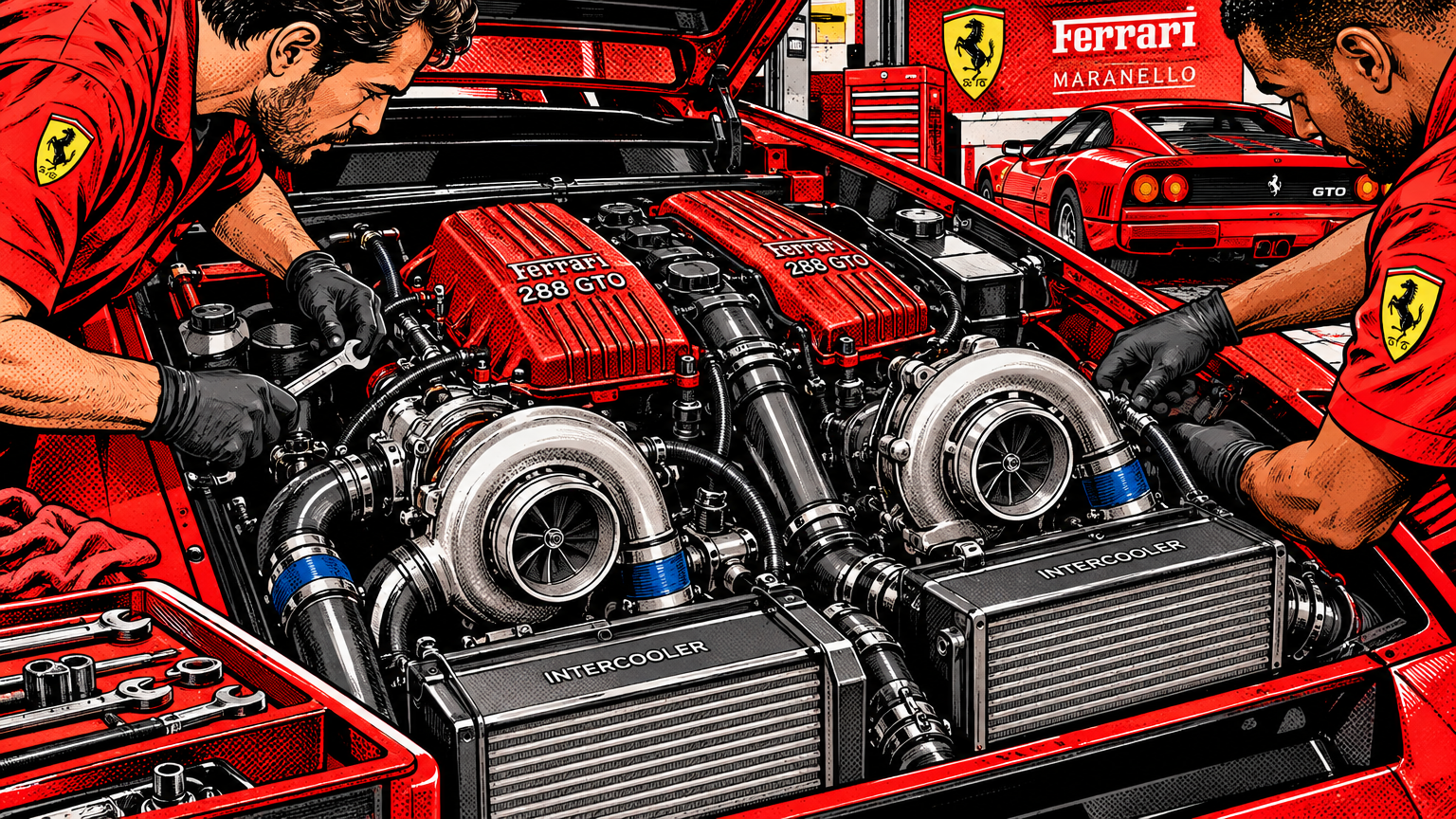
The engine is the Tipo F114B, a 2,855 cc V8 with twin IHI turbochargers, Behr air to air intercoolers, Weber-Marelli electronic injection and ignition, dry sump lubrication, and a low 7.6 to 1 compression ratio. It sits longitudinally behind the cabin, turned 90 degrees from the 308 layout to make room for the turbos and the racing gearbox plan.
Its headline figures are 400 PS, which is 395 bhp or 294 kW, at 7,000 rpm, and 496 Nm of torque, about 366 lb-ft, at 3,800 rpm. In 1984, 400 PS made this one of the most powerful road cars on Earth.
The rest of the scored specification:
- Gearbox: a five speed manual transaxle with a gated shifter, and rear wheel drive. Every 288 GTO ever built is a manual.
- Chassis: a tubular steel spaceframe, clothed in lightweight panels made from fibreglass, Kevlar, and carbon composites, with aluminium used for parts like the doors and lids.
- Weight: about 1,160 kg dry, roughly 2,557 lb. Light then, and light now.
- Size: 4,290 mm long, 1,910 mm wide, and 1,120 mm tall, on a 2,450 mm wheelbase, which is 100 mm longer than the 308's.
- Tyres: Goodyear NCT tyres, 225/55 VR16 on 8 inch front wheels and 255/50 VR16 on 10 inch rear wheels, with wider 265 rears listed for United States specification cars.
- Brakes: ventilated discs all round, with no ABS and no traction control. Your right foot is the electronics package.
- Design and engineering: styling by Leonardo Fioravanti at Pininfarina, engineering led by Nicola Materazzi, with flared arches and rear fender slashes that quote the original 250 GTO.
- Production: 272 cars, when only 200 were needed to homologate the racer. The last car is widely reported to have been gifted by Enzo Ferrari to Formula 1 champion Niki Lauda.
Now the story that makes this car matter. Group B needed 200 production cars before the racing version could compete, so Ferrari built them, and buyers snapped up every slot.
Then the category collapsed under its own speed and was cancelled in 1986. The racing GTO never turned a wheel in the series it was created for.
So the most focused Ferrari of its decade spent its life on the road instead. If you want the auction world's own summary of the car, the RM Sotheby's 288 GTO listing calls it the first in the lineage of modern Ferrari supercars, and that is hard to argue with.
One more fact for the road. Ferrari planned to sell the car in the United States, but none came through official channels when new, so American cars arrived later as imports and federalized examples.
Meet the 2026 Formula 1 Car
Now meet the other corner, which also lives by a rulebook. The 2026 Formula 1 car is a 1.6 litre turbocharged V6 hybrid, and its engine size is just as regulation written as the GTO's 2.8 litres.
The petrol engine is limited to about 400 kW, the MGU-K electric motor can add up to 350 kW, and Formula 1 describes the total package as more than 1,000 hp. Minimum weight is 768 kg including the driver, about 1,693 lb.
It is rear wheel drive, built from carbon, and it carries active aerodynamics at the front and the rear. Its tyres are racing slicks built for a Grand Prix stint.
Do the power to weight maths, because it decides almost every round in this series. The GTO makes 400 PS for 1,160 kg dry, which is about 345 PS per tonne before you add a driver and fuel.
The Formula 1 car makes more than 1,000 hp for 768 kg with the driver already counted, which is more than 1,300 hp per tonne. Call it roughly four times the GTO's figure.
If you want the full picture of the weekend this fight is staged around, start with our Las Vegas Grand Prix hub. Then come back for the scoring.
Ferrari 288 GTO vs. F1: The Numbers
| Category | Ferrari 288 GTO (1984 to 1987) | 2026 Formula 1 Car |
|---|---|---|
| Engine | 2,855 cc twin turbo V8, longitudinal | 1.6L turbo V6 hybrid |
| Power | 400 PS (395 bhp) at 7,000 rpm | More than 1,000 hp (F1 description) |
| Torque | 496 Nm (366 lb-ft) at 3,800 rpm | No single published figure |
| Gearbox | 5 speed manual, gated shifter | Sequential racing gearbox |
| Drive | Rear wheel drive | Rear wheel drive |
| Weight | About 1,160 kg dry | 768 kg minimum, about 1,693 lb, with driver |
| Power to weight | About 345 PS per tonne, dry | More than 1,300 hp per tonne |
| 0 to 60 mph | 5.0 sec, Road & Track test | No universal official figure published |
| Top speed | 189 mph claimed by Ferrari; 179 mph in the Road & Track test | 353.9 km/h trap, Gasly, 2026 Chinese GP qualifying |
| Built | 272 cars | A handful of chassis per team, per season |
| Races won | None. Its category was cancelled first | Every Grand Prix on the calendar |
| Vegas valet factor | 10 out of 10, gated shifter and all | 0, it has no valet mode and no patience |
Read the top speed line twice, because it teaches the second big lesson of this article. Ferrari claimed 189 mph, a major magazine test recorded 179 mph, and both numbers live in the car's history books.
Neither source is lying to you. They are measuring different cars, on different days, in different conditions, and that gap is exactly why this series labels every figure with its source.
Round One: Acceleration
Ferrari quoted the GTO reaching 125 mph in 15 seconds flat, which was savage pace in 1984. The independent evidence we lean on is Road & Track's period test.
That test recorded 0 to 60 mph in 5.0 seconds, 0 to 100 mph in 11.0 seconds, and a quarter mile in 14.1 seconds at 113 mph. Other period reports put 0 to 60 mph at about 4.8 seconds, and we label those as reports, not our scored figure.
Now add the character of the thing. A low compression turbo engine from 1984 does not answer the throttle like a modern car, because the turbos need a moment to wake up.
Period testers described the surge clearly: stay patient at low revs, then the boost arrives and the car lunges. That delay has a name you can use, turbo lag, and this car is a rolling lesson in it.
The Formula 1 car has the opposite personality. Electric torque from the MGU-K fills every gap instantly, the gearbox shifts without a clutch pedal, and more than 1,300 hp per tonne does the rest.
Winner, Round One: Formula 1. The GTO was a five second car when five seconds was elite, and it still loses this round by a generation of turbo development.
Round Two: Top Speed
Top speed was the GTO's headline act. Ferrari claimed 189 mph, or 304 km/h, and the car is widely credited as the fastest production car in the world at its unveiling, and the first street car to claim 300 km/h.
Keep the labels honest, though. That 189 mph is a Ferrari claim, and Road & Track's test car recorded 179 mph, or 288 km/h, on its own run.
Now the Formula 1 evidence, labelled by year the way this series always labels it. Pierre Gasly recorded 353.9 km/h, about 220 mph, in qualifying at the 2026 Chinese Grand Prix, on FIA data.
The older traps are higher still. Yuki Tsunoda hit 358.3 km/h, 222.6 mph, in 2025, and Alex Albon hit 368.9 km/h, 229.2 mph, in 2024, the highest trap figure through the first three Las Vegas editions.
Fairness note, printed every time: a speed trap is not a top speed attempt. A Formula 1 car is geared and trimmed for a circuit, so a trap speed is what it did on the day, not the most it could ever do.
That note cannot save the GTO here. Even Ferrari's own claimed 189 mph sits about 31 mph below the slowest Formula 1 trap figure above, and the tested 179 mph sits further back.
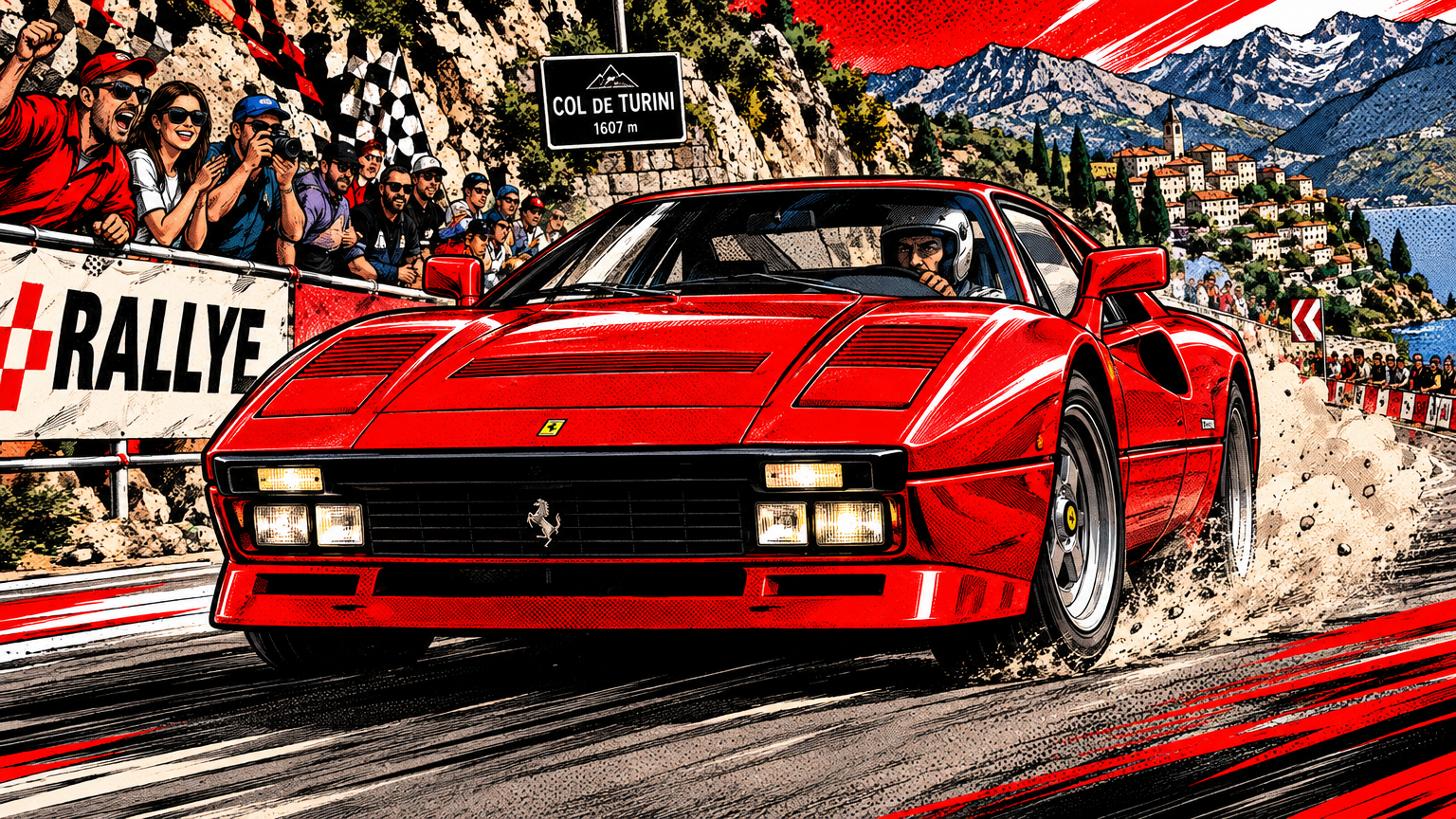
Winner, Round Two: Formula 1. The GTO owned the production car speed crown in 1984, and this round still goes the other way on both claimed and tested numbers.


Round Three: Now Add a Corner
Add a corner and the GTO's best quality shows up first. At about 1,160 kg dry with the engine in the middle, it is genuinely light, and light cars change direction without arguing about it.
Its limits are period limits, though. It corners on 16 inch tyres that look narrow next to a modern supercar's, with no downforce package worth the name and no electronic safety net of any kind.
The Formula 1 car makes downforce with its floor, its wings, and its active aero. Downforce is invisible weight: it pushes the car into the road without adding mass, so the tyres grip far beyond what the car's own weight allows.
That is the insight to take to every race you watch from now on. Ask how much downforce a car makes before you ask how much power it makes, and the cornering story usually explains itself.
The GTO driver also works harder for his speed. A gated manual, unassisted feel through the wheel, and boost that can arrive mid corner all demand respect, and that demand is exactly why owners love these cars.
Winner, Round Three: Formula 1. The GTO is light, honest, and brave, and a downforce car still corners in a different league.
Round Four: Braking
Braking is a heat problem dressed up as a stopping problem. Every stop turns speed into heat, and the car that sheds heat best can brake late, again and again.
The GTO stops with ventilated discs all round and nothing else. No ABS means a locked wheel is your mistake to fix, and period tyres set the real limit, because brakes stop the wheels but tyres stop the car.
We found no verified period braking distance from a primary or major test source that we trust enough to print, so this article prints none. A missing number is better than an invented one, every time.
The Formula 1 car brakes with carbon discs, huge cooling, and a hybrid system that slows the rear axle while harvesting energy. It hauls down from over 200 mph for slow corners, lap after lap, at forces road car drivers never feel.
Use that tyres lesson when you shop for your own car. Fresh, quality tyres will shorten your real stopping distances more than almost any brake upgrade you can bolt on.
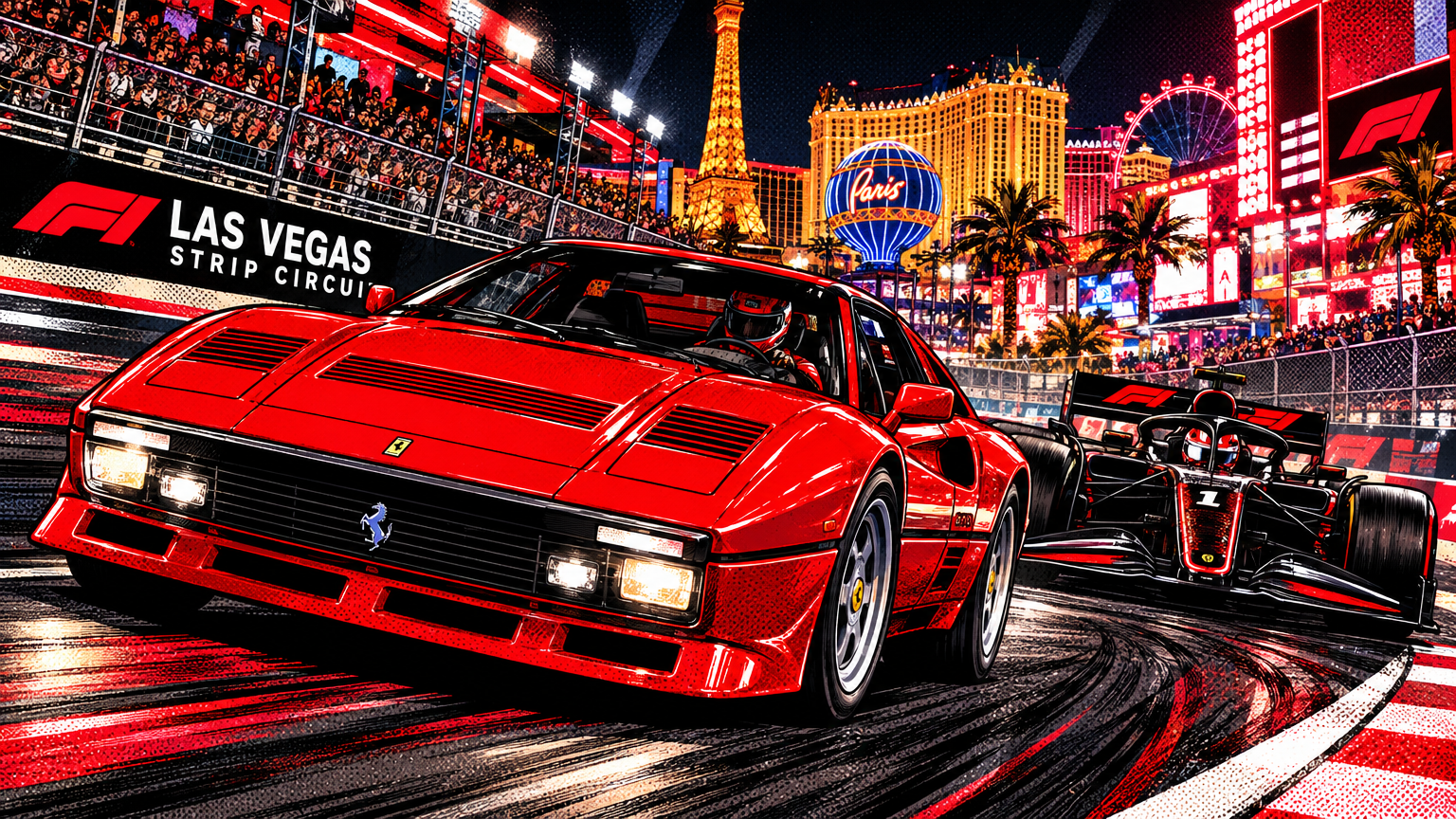
Winner, Round Four: Formula 1. The GTO's brakes were proper 1984 hardware, and 1984 was a long time ago.
So, Does the 288 GTO Win Anything?
Yes. It wins the things that made it a legend, and the list is a good one.
- It wins the origin story. This is the first car in Ferrari's modern supercar line, the car the F40, F50, Enzo, and LaFerrari all descend from in spirit.
- It wins rarity with a receipt. Just 272 cars, every one sold, and values today sit in the millions. Scarcity alone does not do that, this car has the story to back it.
- It wins the rulebook lesson. Its engine size, its production run, and its whole existence were written by Group B regulations. Read the rules and you can predict the car.
- It wins feel. A gated five speed, twin turbos with real lag, and no driver aids at all. Modern cars are faster in every way and almost none of them ask this much of you.
- It wins the room. Park a 288 GTO on the Las Vegas Strip and watch a crowd form around a car most people have only seen in posters.
It also wins a family argument inside this series. Our Formula 1 vs. Ferrari F50 piece covered the grandson of this idea, a car with a Formula 1 derived V12 and the same no nonsense attitude.
And yesterday's challenger came from the other end of racing history. If you missed it, read Formula 1 vs. Ford GT40, where a Le Mans winner with four straight titles took the same beating.
Thinking of buying a GTO, or any car that trades like one? Work through this short list before any money moves.
- Verify the chassis. With 272 real cars and decades of 308 based replicas in the world, the chassis number and its paperwork are the whole game.
- Check the federalization trail. No car came to the United States officially when new, so an American car should carry a clear import and compliance history.
- Budget for turbo age. Turbos, intercoolers, hoses, and Weber-Marelli electronics are forty year old parts now, and they need specialists, not guesses.
- Inspect the composite panels. Kevlar and fibreglass age differently from steel, and repairs done badly are hard to spot and expensive to undo.
- Buy the history file. Service records, ownership chain, and show history move the value of a car like this as much as mileage does.
What Would Happen on the Las Vegas Strip Circuit?
Bring both cars to Las Vegas and the picture gets clearer, and a little cruel. The Las Vegas Strip Circuit is 6.201 km long, about 3.85 miles, with 17 turns and 50 laps in the Grand Prix.
Its signature is the long straight along the Strip, roughly 2 km of full throttle past the casinos. That straight is where the GTO would tell its story, turbos singing at full boost in top gear.
For a few seconds, 1984 would feel very close. Then the braking zone would arrive, and with it the other sixteen turns, each one asking for downforce the GTO does not have and braking stamina its period discs cannot match.
The Formula 1 car would brake later, turn faster, and fire out with electric help, lap after lap. The GTO, to its credit, would finish the run sounding better than almost anything else in this series.
None of this is a recorded race, and we invent no lap times for either car. It is an informed comparison, built from the verified circuit facts and the verified car facts above.
The honest summary is simple. On the Strip straight, the GTO is a time machine. Everywhere else, the Formula 1 car writes the lap.
The Final Call
Score it up. Round One to Formula 1, Round Two to Formula 1, Round Three to Formula 1, and Round Four to Formula 1.
That is a clean sweep, 4 to 0. It should not feel harsh, because the GTO was never really beaten by other road cars in its day, it was beaten by time.
In 1984 it was the fastest production car Ferrari knew how to build, light, turbocharged, and aimed at the toughest racing class on Earth. The class vanished, and the car became a legend anyway, which is the harder trick.
Against a 2026 Formula 1 car, the maths is not close. Roughly four times the power per tonne, active aero, carbon brakes, and instant electric torque is not a gap, it is a different sport wearing similar clothes.
The Final Call: Formula 1 wins the fight.
Formula 1 may win the fight. But the 288 GTO still started the modern Ferrari supercar line, still carries the greatest name in the company's road car history, and still never needed a race win to earn it.
There are plenty more cars waiting to pick a fight with Formula 1. Next up: Formula 1 vs. GMC Hummer EV: a huge electric truck with a party trick called CrabWalk walks into a fight with the lightest, sharpest racing car on Earth.