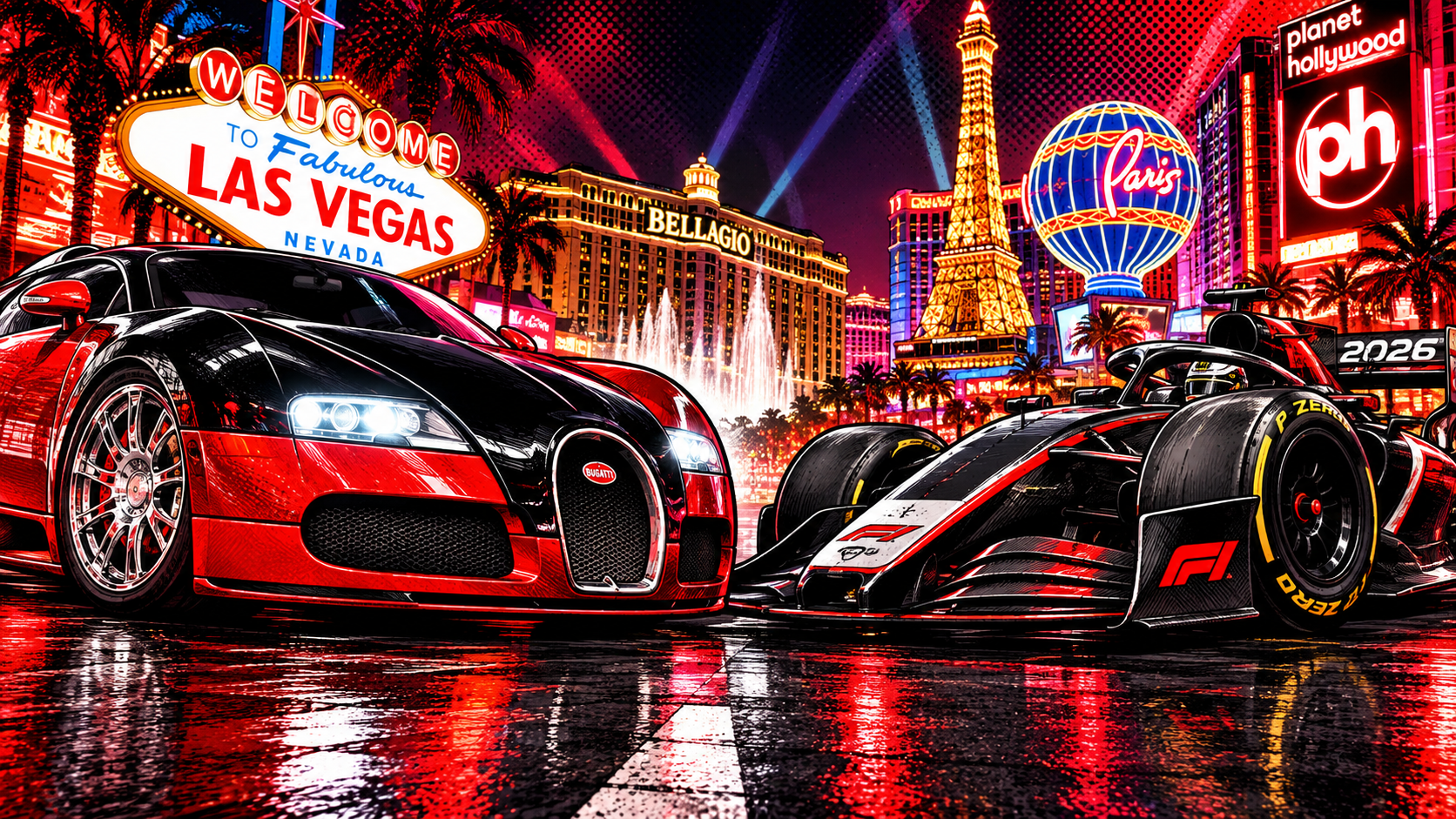
Most challengers in this series show up hoping to steal a round.
This one shows up holding a world record.
The Bugatti Veyron is the car that reset the ceiling for every production car that came after it. One thousand and one PS on the spec sheet when that number still sounded made up. Four turbochargers. Sixteen cylinders. A top speed so far past 400 km/h that Bugatti had to invent a second key just to unlock it, and Michelin had to invent a tire just to survive it.
Before the Veyron, supercars chased 200 mph like it was a summit. The Veyron cruised past that number, kept going past 250 mph, and then offered you leather seats and a polite ride home. Bugatti calls it the first hyper sports car of the modern era, and for once the marketing line is just the history book telling the truth.
What happens if the Bugatti Veyron picks a fight with a Formula 1 car?
What happens is the best top speed fight this series has had. The Saleen S7 won a round in the last fight but one on a claimed number. The Veyron does not need a claim. Its number was measured, verified, and written into the record books while a lot of today's supercar bosses were still in school.
Bring the big straight. This challenger brought one with it.
First, Which Veyron Are We Talking About?
Precision matters more with this car than with almost any other in the series, because Bugatti built the Veyron for a full decade, in two body styles, at two power levels, and the internet blends all of it into one imaginary 1,200 PS roadster that never existed as a single car.
Our challenger is the original: the Bugatti Veyron 16.4 coupé, built in Molsheim, France from 2005 to 2011. The car is named for Pierre Veyron, a Bugatti works driver who won the 1939 24 Hours of Le Mans with Jean-Pierre Wimille. Bugatti lists the full Veyron family at 450 cars in total, 300 coupés and 150 roadsters, built over ten years. The standard 16.4 coupé run is commonly counted at 252 cars, with the later Super Sport coupés making up the rest of the 300 coupé total.
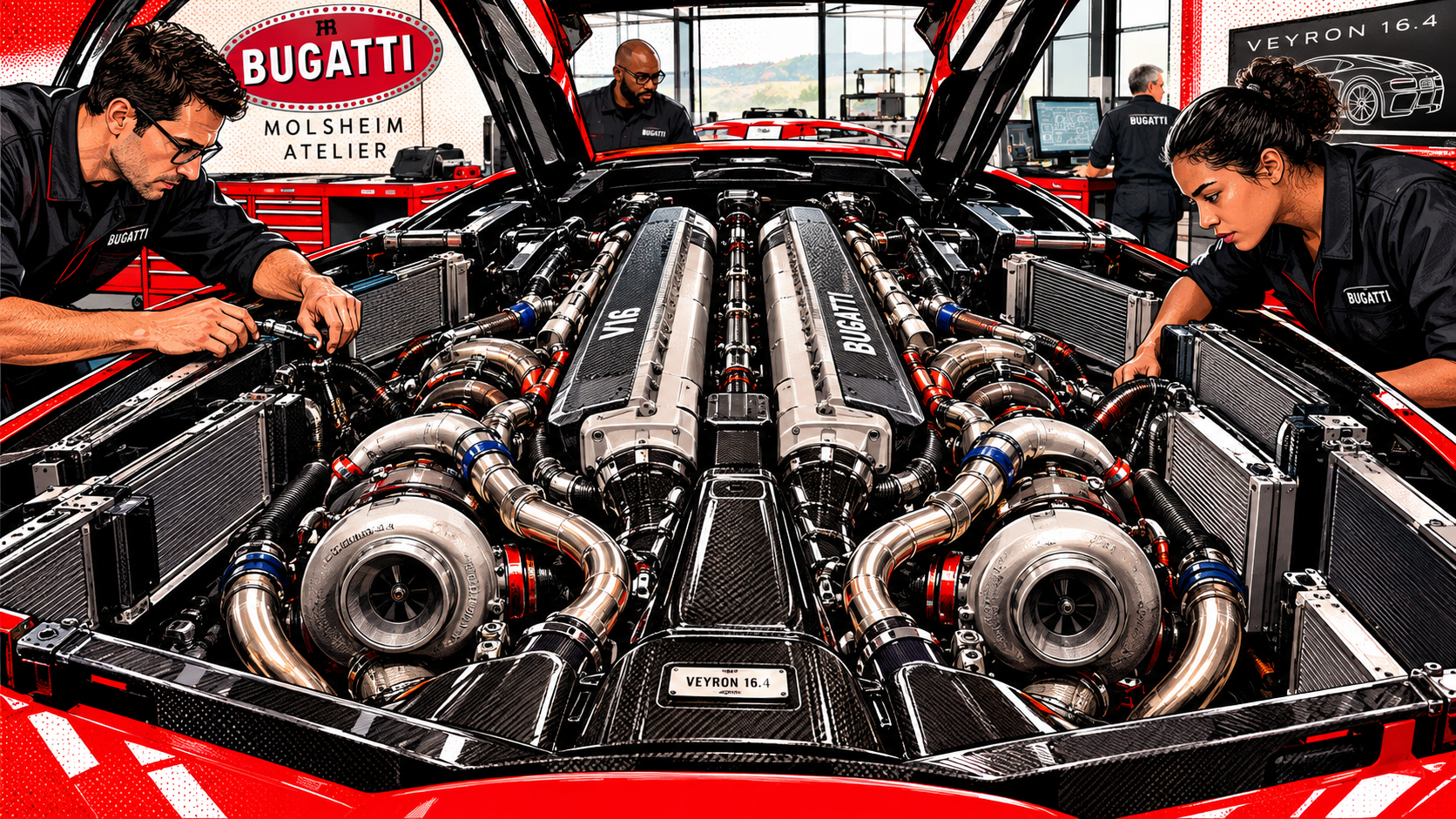
The engine is the headline, the legend, and most of the budget. It is a 7,993 cc W16, which is Bugatti shorthand for sixteen cylinders arranged in a W, fed by four turbochargers and sitting in the middle of the car. Bugatti puts the whole engine at just 710 mm long, no longer than a conventional V12, and about 490 kg. Keeping it alive takes ten radiators, a fact Bugatti states plainly on its own Veyron page, because a thousand horsepower makes roughly two thousand horsepower worth of heat and all of it has to go somewhere.
The output numbers are the ones that changed the industry. Bugatti rates the 16.4 at 1,001 PS, which is 736 kW and 987 horsepower, at 6,000 rpm, with maximum torque of 1,250 Nm, about 922 pound feet, from 2,200 to 5,500 rpm. The gearbox is a seven speed dual clutch transmission built with Ricardo, the first seven speed DSG in a production car, and it sends power to all four wheels. No manual was offered. At this level of torque, Bugatti was not being snobby. It was being practical.
Weight is the honest trade the Veyron made, so let us state it honestly. Commonly listed kerb weight is about 1,888 kg, roughly 4,162 pounds. That is luxury car mass, because this is a luxury car that happens to outrun aircraft on takeoff. Leather, sound insulation, air conditioning, and ten radiators all weigh something, and Bugatti refused to strip any of it out. The Veyron was never trying to be light. It was trying to be unstoppable and comfortable at the same time.
Now the performance figures, labeled the way this series always labels them. These are Bugatti figures for the scored car: zero to 100 km/h in 2.5 seconds, zero to 200 km/h in 7.3 seconds, zero to 300 km/h in 16.7 seconds, and a top speed of 407 km/h, about 253 mph. That top speed needs one honest footnote. In normal mode the car is limited to about 375 km/h. The full 407 km/h is unlocked in top speed mode with a separate Speed Key, after a checklist, on suitable tires and a suitable surface. It is a real, verified production car speed under those conditions, not a brochure guess.
Independent testers backed the acceleration up. Car and Driver tested a Veyron 16.4 and recorded zero to 60 mph in 2.5 seconds and a quarter mile in 10.1 seconds. Those are test results, not factory claims, and they landed within a whisker of the factory story. The launch price tells the last part of the story: about one million euros before taxes at launch in 2005, with United States prices climbing to about 1.7 million dollars by the time Car and Driver ran its 2008 test. Expensive then. A bargain compared with what clean cars trade for now, which is its own separate madness.
Two later Veyrons, kept strictly separate so nobody blends them into our car. The Veyron 16.4 Super Sport, launched in 2010, raised the same W16 to 1,200 PS and 1,500 Nm, with customer cars limited to 415 km/h. On June 26, 2010, at the Volkswagen proving grounds at Ehra-Lessien in Germany, Bugatti test driver Pierre-Henri Raphanel drove a Super Sport in both directions and Guinness confirmed an average of 431.072 km/h, about 267.9 mph, a world record for production cars at the time. The open top cars are separate again: the 1,001 PS Grand Sport and the 1,200 PS Grand Sport Vitesse, which set its own roadster record at 408.84 km/h in 2013. All wonderful. None of them is the car we are scoring. Our scores belong to the original 1,001 PS coupé, the car that started the whole hypercar era.
That is the challenger. The first production car past 1,000 PS, the first past 400 km/h, and the only car in this series so far that arrives with a verified top speed higher than anything Formula 1 has ever recorded in a speed trap.
Now it has to turn a corner.
Meet the 2026 Formula 1 Car
Across the garage sits a 2026 Formula 1 car, and for the first time in this series the power headline is a tie that is not really a tie.
The 2026 Formula 1 car runs a 1.6 liter turbocharged V6 hybrid. The combustion side is limited to about 400 kW. The electric MGU-K can deliver up to 350 kW where maximum deployment is allowed. Formula 1 describes the total package as producing more than 1,000 horsepower.
Read that against the Bugatti one more time. The Veyron made its legend out of reaching four figures of power in a road car, and it needed 8.0 liters, sixteen cylinders, and four turbochargers to do it. The Formula 1 car clears the same four figures from 1.6 liters and a hybrid system, because that is what twenty years of racing development does to a number.
Then comes the number that breaks the tie, and it is not power. It is weight. The minimum regulatory weight for a 2026 Formula 1 car is 768 kilograms, about 1,693 pounds, including the driver. The Veyron sits at about 1,888 kg before its driver gets in. The Formula 1 car makes similar power with well under half the mass to move, stop, and turn. The Veyron rewrote what a road car could weigh and still fly. Formula 1 plays a different weight game entirely.
For 2026, Formula 1 also runs active front and rear aerodynamics, low drag on the straights and high downforce in the corners, on carbon construction and racing tires built for one job only.
The Veyron is the king of the straight line, and it earned that crown honestly.
The problem is this fight has three other rounds, and the king is heavy.


Veyron vs. F1: The Numbers
| Category | Bugatti Veyron 16.4 (coupé, 2005 to 2011) | 2026 Formula 1 Car |
|---|---|---|
| Engine | 7,993 cc W16, four turbochargers, mid mounted | 1.6 liter turbocharged V6 hybrid |
| Power | 1,001 PS (987 hp, 736 kW) at 6,000 rpm, Bugatti rating | 400 kW combustion engine plus up to 350 kW MGU-K deployment; more than 1,000 hp total per Formula 1 |
| Torque | 1,250 Nm (about 922 lb-ft) at 2,200 to 5,500 rpm | No single standardized series figure |
| Weight | About 1,888 kg (about 4,162 lb), commonly listed kerb weight | 768 kg minimum regulatory weight, driver included |
| 0 to 100 km/h | 2.5 sec, Bugatti figure; Car and Driver tested 0 to 60 mph in 2.5 sec | No universal official 2026 figure |
| Quarter mile | 10.1 sec in Car and Driver testing | Not a Formula 1 measure; no official figure |
| Top speed | 407 km/h (about 253 mph), Bugatti figure, verified production car speed in top speed mode | 2026 FIA speed trap data has already exceeded 219 mph in qualifying trim |
| Drivetrain | All wheel drive, seven speed dual clutch automatic | Rear wheel drive |
| Cooling | Ten radiators | Built for a single race distance, with a pit crew watching every temperature |
| Signature tires | Michelin tires developed to withstand speeds in the region of 400 km/h | Formula 1 racing slicks |
| Aerodynamics | Retractable rear wing that doubles as an airbrake | Active front and rear aerodynamics |
| Street legal | Yes | No |
| Production | 450 Veyrons in total (300 coupés, 150 roadsters); standard 16.4 coupé commonly counted at 252 cars | One per driver, per team, per season, roughly |
| Record book | First production car past 1,000 PS and past 400 km/h | It writes a new record book every season |
| Vegas valet factor | Off the chart. Two tone paint, horseshoe grille, and a valet who will tell this story for a year | Cannot be valeted. Needs a pit crew and a laptop |
Round One: Acceleration
Give the big Bugatti its flowers first, because this launch is still silly twenty years later.
Zero to 100 km/h in 2.5 seconds is a Bugatti figure, and Car and Driver matched the spirit of it in testing with zero to 60 mph in 2.5 seconds and a 10.1 second quarter mile. The all wheel drive is a huge part of why. A rear wheel drive car with 922 pound feet of torque has a traction problem. The Veyron spreads that torque across four contact patches, hooks up, and simply leaves, with the seven speed dual clutch firing off shifts faster than a driver could work a manual even if Bugatti had offered one. Zero to 200 km/h in 7.3 seconds and zero to 300 km/h in 16.7 seconds, both Bugatti figures, tell you the launch is not even the best part. The surge just keeps coming.
The Mercedes-AMG ONE put an actual Formula 1 engine in a road car earlier in this series and still could not take this round. The Veyron is quicker to 100 km/h on paper than that car, and it does it in leather lined comfort. Respect where it is due.
Then physics clears its throat, the way it always does in Round One.
The Formula 1 car makes more than 1,000 horsepower and weighs 768 kilograms with the driver in it. The Veyron makes 987 horsepower and weighs about 1,888 kilograms before its driver sits down. That is roughly two and a half times the power per pound for the Formula 1 car, delivered through racing slicks that get pressed into the road by aerodynamic load as speed builds. There is no universal official zero to 60 figure for a 2026 Formula 1 car, and we are not inventing one. We do not need one. A 2.5 second launch is a hypercar benchmark that stood for years. It is still not a Formula 1 launch.
The Veyron is one of the quickest road cars ever built, full stop.
In this garage, quickest road car is the consolation prize.
Round One Winner: Formula 1
Round Two: Top Speed
Now the main event. Clear the straight, check the tires, and insert the second key.
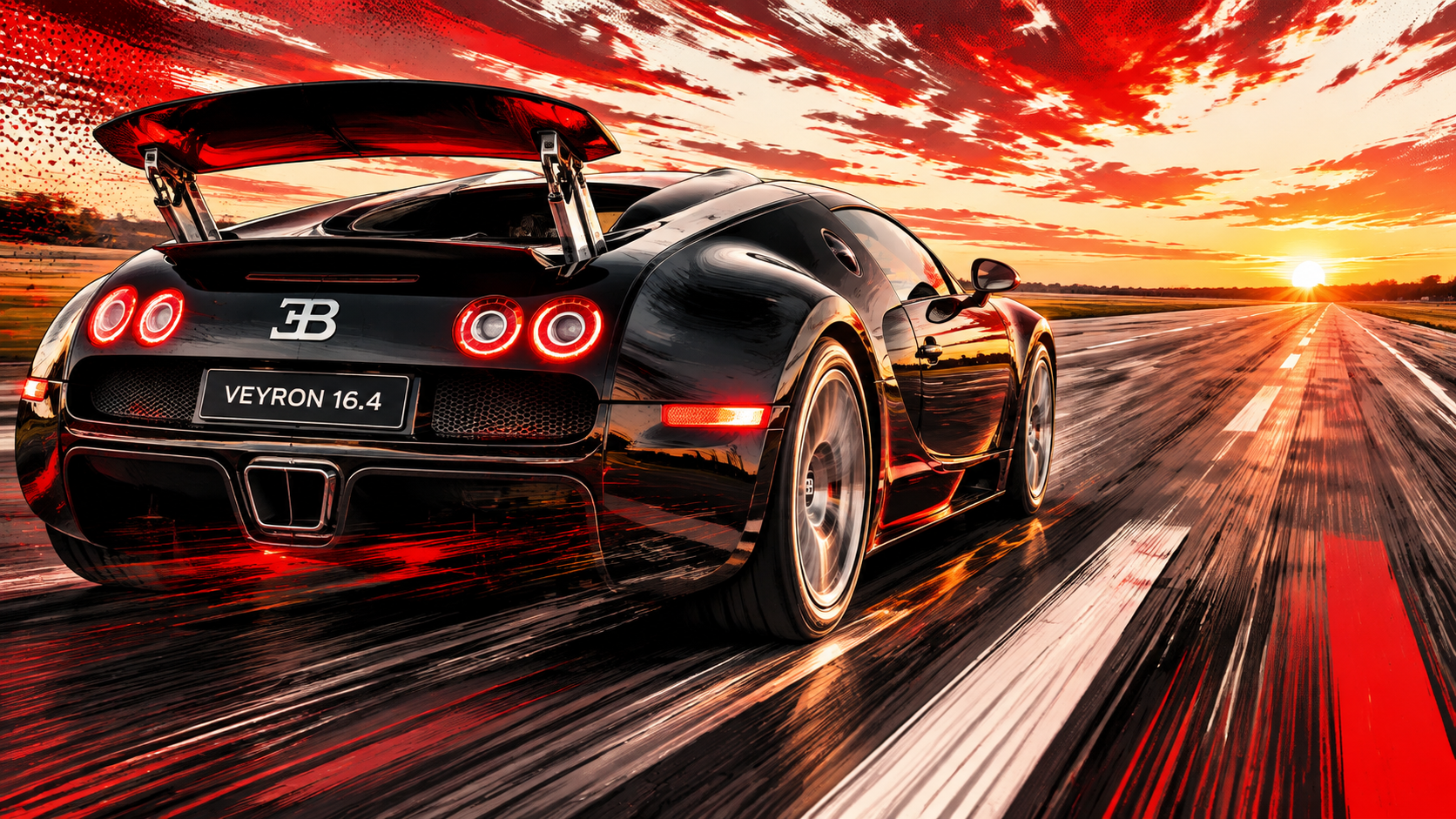
The scored car's top speed is 407 km/h, about 253 mph. That is a Bugatti figure and a verified production car speed, reached in top speed mode on a suitable surface, and it made the Veyron 16.4 the fastest production car in the world when it arrived in 2005. This is not an estimate. It is not a claim waiting for a brave owner and a long runway. It was measured, repeated, and put in the record books, and James May famously ran a Veyron to 407.16 km/h on television at the Volkswagen test track for anyone who wanted to watch it happen.
Now line up the Formula 1 car's receipts, which are also measured and also honest, just smaller. During qualifying for the 2026 Chinese Grand Prix, Pierre Gasly was recorded at 353.9 kilometers per hour, about 220 mph in the FIA speed trap. Here on the Las Vegas Strip Circuit, earlier editions were faster: in 2025, Yuki Tsunoda was recorded at 358.3 kilometers per hour, about 222.6 mph, and in 2024, Alex Albon hit 368.9 kilometers per hour, about 229.2 mph, the highest figure through the first three editions. Those years are labeled on purpose, the way this series always labels them.
Do the math out loud. The fastest Formula 1 speed trap figure in this series, from 2024, is 368.9 km/h. The Veyron's verified top speed is 407 km/h. That is a gap of about 38 km/h, roughly 24 mph, in favor of the road car. The 2026 Formula 1 figure is more than 50 km/h behind it.
Fairness matters, so here is the fairness paragraph. A Formula 1 speed trap is not a top speed attempt. Those cars run wings, gearing, and drag chosen to win on a circuit with corners, not to chase a number on a five mile straight, and trimmed purely for top speed a Formula 1 car would go faster than its trap figures. All true. But this round is scored the way the Saleen round was scored and the way every round in this series is scored: on the numbers actually on record. On claimed numbers, the Saleen took this round last week. On verified numbers, the Veyron takes it bigger, because its number is not a claim at all. It is a record.
And if anyone wants to argue the family honor, the separate Super Sport sitting in the corner holds a Guinness confirmed 431.072 km/h average from 2010. We are not scoring that car. We do not need to. The standard car already wins.
The king keeps his crown.
Round Two Winner: Bugatti Veyron
Round Three: Now Add a Corner
Here is where the bill for all that speed and leather comes due.
The Veyron case, stated fairly, is not nothing. All wheel drive gives it huge traction out of slow corners. The chassis is a carbon monocoque. Bugatti tuned the car to be stable and confidence inspiring at speeds that would terrify most drivers in most cars, and owners and testers alike praised how calm it feels going very, very fast in a straight line and through fast sweepers. This is not a dragster with a steering wheel. It is a complete car.
But complete is not the same as nimble, and the testers said that part out loud too. Car and Driver recorded about 1.00 g of skidpad grip and noted that, taxed by its heft, the Veyron is not particularly nimble in the hills. That weight figure in their test car was 4,486 pounds as tested, heavier than the commonly listed kerb figure, and either way the story is the same: there are roughly two and a half Veyron kilograms for every Formula 1 kilogram, and all of them have to change direction every time the road bends.
The Formula 1 car weighs 768 kilograms including the driver. It generates its grip with active aerodynamics pressing racing slicks into the pavement. It turns in, rotates, and fires out at cornering loads a heavy road car on road tires cannot physically follow, no matter how clever its all wheel drive is. The Veyron carries its speed like a private jet. The Formula 1 car changes direction like the jet's fighter escort.
On a mountain road, the Veyron would be the one you would choose, enjoy, and remember. On a stopwatch, in this round, there is one winner and it was never close.
Heavy is fast in a straight line. Heavy is slow everywhere else.
Round Three Winner: Formula 1
Round Four: Braking
If you only read one round for the engineering stories, read this one, because the Veyron's brakes are a masterpiece that still loses.
Bugatti built the 16.4 to stop as hard as it goes. The discs are carbon ceramic, developed to withstand surface temperatures up to 1,000 degrees, with titanium used for the disc hubs. Above 200 km/h the rear wing becomes part of the braking system: hit the brakes and the wing flips to 55 degrees in less than 0.4 seconds, working as a true airbrake. Bugatti says the airbrake alone can deliver up to 0.6 g of deceleration, and that the wheel brakes on standard tires and a proper surface generate around 1.4 g. Bugatti has also long claimed the car can brake from 400 km/h to a standstill in less than ten seconds, a claim we are labeling as a claim, and even discounted a little it describes braking power no other road car of its era could touch.
Stopping nearly two tons from 253 mph, repeatably, without fading into a prayer, is one of the great engineering achievements in the whole Veyron story. Most cars of 2005 could not stop from half that speed with this much composure.
The Formula 1 car starts every braking zone with 768 kilograms to slow, driver included. That is about 1,100 kg less mass than the Veyron carries. It adds aerodynamic load that peaks exactly when the car is fastest and braking hardest, plus carbon brakes built to deliver maximum stops lap after lap, seventeen braking events a lap for fifty laps in Las Vegas. The Veyron's airbrake is genius, and a Formula 1 car effectively has that same trick built into its entire body, all the time.
The Veyron brakes like the finest road car of its generation. Because it is.
The Formula 1 car brakes like stopping is an attack. Because in Formula 1, it is.
Round Four Winner: Formula 1
So, Does the Veyron Win Anything?
It wins a round, on verified numbers, and it wins the history argument over every other challenger in this series so far. Here is the case.
It wins top speed, outright and on the record.
A verified 407 km/h beats every FIA speed trap figure this series has used: the 2026 Gasly number, the 2025 Las Vegas number, and the 2024 Las Vegas best. The Saleen S7 took this round on a manufacturer claim. The Veyron takes it on a measured record. That is the difference between a story and a receipt, and the Veyron has the receipt.
It wins the barrier argument nobody else can enter.
First production car past 1,000 PS. First production car past 400 km/h. First car the world agreed to call a hypercar. Every hypercar since, including several still to come in this series, is living in a house the Veyron built. The Mazda RX-7 won the feel argument in the last fight. The Veyron wins the era argument in this one.
It wins speed with manners.
Two hundred fifty three mph, and you can drive it to dinner in traffic, in the rain, with the air conditioning on. Bugatti engineered the tires, the cooling, the fuel system, and the gearbox so that the fastest car in the world was also a usable car. The Formula 1 car needs a crew and a laptop to start. The Veyron needs a key. Well, two keys, if you want the full 407.
It wins the moonshot.
Ten radiators. A tire developed on aircraft test equipment. An airbrake borrowed from aviation. A second key that unlocks a speed no road car had ever reached. Volkswagen Group boss Ferdinand Piech set targets that engineers called impossible, and Bugatti hit them anyway. That stubbornness is the whole legend.
Veyron wins: the top speed round, the record book, the hypercar era, and the title of the most ambitious road car ever built.
What Would Happen on the Las Vegas Strip Circuit?
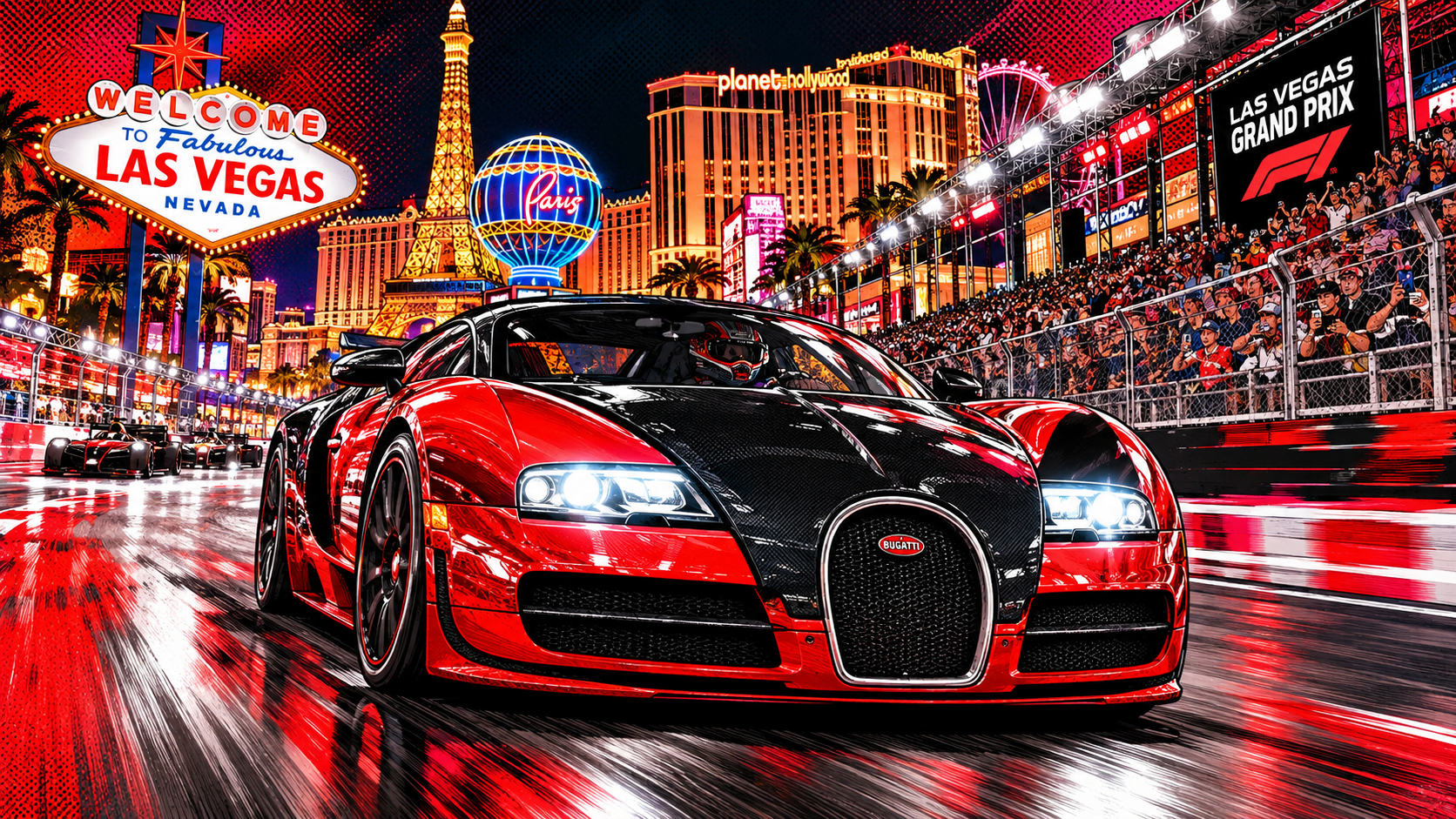
Now we bring the fight home, to the Las Vegas Strip Circuit, home of the Las Vegas Grand Prix.
The circuit runs 6.201 kilometers, about 3.85 miles, with 17 turns, and the Grand Prix lasts 50 laps. Running down the Strip there is roughly a two kilometer straight, under the neon, past the casinos.
That straight is the best two kilometers any challenger has had in this series so far. Two kilometers is long enough for the Veyron to stretch toward speeds no other road car here could reach, well past the 220 mph area where the 2026 Formula 1 cars were trapped in qualifying trim this year. For a few glorious seconds a lap, under the brightest lights in motorsport, the road car would be the fastest thing on the circuit. The crowd would feel it. A Veyron at full chat sounds like weather arriving.
Then come the other sixteen corners and the braking zones that feed them. Every one of them taxes the Veyron's weight, its road tires, and its road car brakes, and rewards the Formula 1 car's lightness, downforce, slicks, and carbon brakes. Over one lap the Formula 1 car would build a gap measured in many seconds. Over 50 laps it would be a Grand Prix car running a Grand Prix, and a Veyron running the most glamorous exhibition in the history of exhibition laps. No invented lap times here. This is an informed comparison, not a recorded race, and nobody has timed a Veyron 16.4 around this circuit for us to quote.
And here is the Vegas twist, and no car in this series fits it better.
Las Vegas is a city built on going too far on purpose. A two tone, sixteen cylinder, million euro moonshot with a second key just for top speed is not out of place on the Strip. It is the Strip, with wheels. It would lose this race. It would win every valet stand, every photo, and every argument in every bar afterward about which car actually owned the night.
The Final Call
Winner: Formula 1.
Three rounds to one, and the one is the round every car fan on Earth would have picked for this challenger.
Acceleration went to a power to weight advantage of roughly two and a half to one. Cornering and braking went to the car that weighs 768 kilograms and exists only to corner and brake. Top speed went to the Veyron, verified and undisputed, by about 24 mph over the best Formula 1 trap figure in the series. The Veyron was never going to win a Grand Prix in Las Vegas. It was built to prove that a road car could do 1,000 PS, 400 km/h, and luxury at the same time, a proof the entire industry called impossible right up until Bugatti parked it in front of them.
And that proof still stands. This is the car that arrived in 2005 at about a million euros, sold out its coupés, spawned a Super Sport that pushed the record to 431.072 km/h, and invented the hypercar category every modern flagship now lives in. The car whose name honors a Le Mans winner from 1939 and whose numbers still make engineers shake their heads twenty years later.
Formula 1 may win the fight. But the Veyron still owns the top speed crown, the record book, and the argument that impossible is just a target nobody has hit yet.
There are plenty more cars waiting to pick a fight with Formula 1.
Next up: Formula 1 vs. McLaren F1. The naturally aspirated king the Veyron dethroned comes to settle the oldest argument in the supercar world.